Painless Stochastic Gradient Descent : Interpolation, Line-Search, - - PowerPoint PPT Presentation

▶
painless stochastic gradient descent interpolation line
SMART_READER_LITE
LIVE PREVIEW

Painless Stochastic Gradient Descent : Interpolation, Line-Search, - - PowerPoint PPT Presentation

Painless Stochastic Gradient Descent : Interpolation, Line-Search, and Convergence Rates. NeurIPS 2019 Aaron Mishkin 1 21 Stochastic Gradient Descent: Workhorse of ML? Stochastic gradient descent (SGD) is today one of the main


slide-1
SLIDE 1

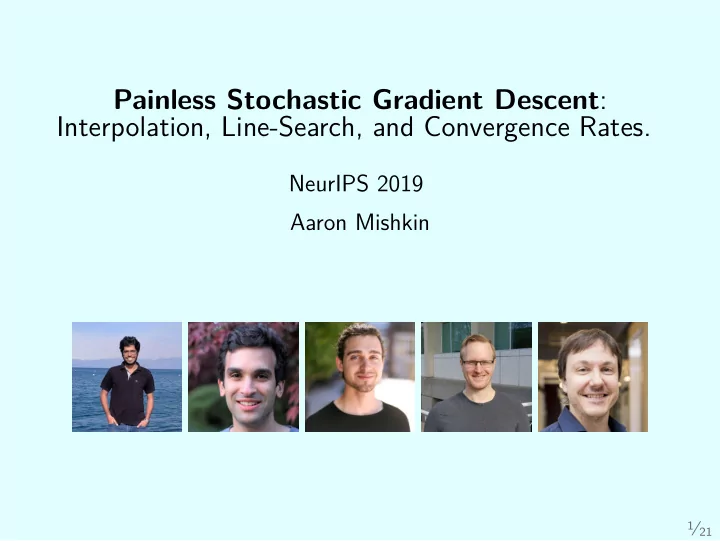
Painless Stochastic Gradient Descent: Interpolation, Line-Search, and Convergence Rates.

NeurIPS 2019 Aaron Mishkin

1

⁄

21
slide-2
SLIDE 2

Stochastic Gradient Descent: Workhorse of ML? “Stochastic gradient descent (SGD) is today one of the main workhorses for solving large-scale supervised learning and optimization problems.” —Drori and Shamir [8]

2

⁄

21

slide-3
SLIDE 3

Consensus Says… …and also Agarwal et al. [1], Assran and Rabbat [2], Assran et al. [3], Bernstein et al. [6], Damaskinos et al. [7], Gefgner and Domke [9], Gower et al. [10], Grosse and Salakhudinov [11], Hofmann et al. [12], Kawaguchi and Lu [13], Li et al. [14], Patterson and Gibson [17], Pillaud-Vivien et al. [18], Xu et al. [21], Zhang et al. [22]

3

⁄

21

slide-4
SLIDE 4

Motivation: Challenges in Optimization for ML

Stochastic gradient methods are the most popular algorithms for fjtting ML models, SGD: wk+1 = wk − ηk∇˜ f (wk). But practitioners face major challenges with

  • Speed: step-size/averaging controls convergence rate.
  • Stability: hyper-parameters must be tuned carefully.
  • Generalization: optimizers encode statistical tradeofgs.

4

⁄

21

slide-5
SLIDE 5

Better Optimization via Better Models

Idea: exploit model properties for better optimization.

5

⁄

21

slide-6
SLIDE 6

Interpolation

Loss: f (w) = 1 n

n

∑

i=1

fi(w). Interpolation is satisfjed for f if ∀w, f (w∗) ≤ f (w) = ⇒ fi(w∗) ≤ fi(w).

Separable Not Separable

6

⁄

21

slide-7
SLIDE 7

Constant Step-size SGD

Interpolation and smoothness imply a noise bound, E∥∇fi(w)∥2 ≤ ρ (f (w) − f (w∗)) .

  • SGD converges with a constant step-size [4, 19].
  • SGD is (nearly) as fast as gradient descent.
  • SGD converges to the

▶ minimum L2-norm solution for linear regression [20]. ▶ max-margin solution for logistic regression [16]. ▶ ??? for deep neural networks. Takeaway: optimization speed and (some) statistical trade-ofgs.

7

⁄

21

slide-8
SLIDE 8

Painless SGD

What about stability and hyper-parameter tuning?

Is grid-search the best we can do?

8

⁄

21

slide-9
SLIDE 9

Painless SGD: Tuning-free SGD via Line-Searches

Stochastic Armijo Condition : fi(wk+1) ≤ fi(wk)−c ηk∥∇fi(wk)∥2.

9

⁄

21

slide-10
SLIDE 10

Painless SGD: Stochastic Armijo in Theory

10

⁄

21

slide-11
SLIDE 11

Painless SGD: Stochastic Armijo in Practice

Classifjcation accuracy for ResNet-34 models trained on MNIST, CIFAR-10, and CIFAR-100.

11

⁄

21

slide-12
SLIDE 12

Painless SGD: Added Cost

Backtracking is low-cost and averages once per-iteration.

MNIST CIFAR10 CIFAR100

Experiments

0.000 0.001 0.002 0.003 0.004 0.005

Time per Iteration (s)

Iteration Costs

Tuned SGD SGD + Goldstein Adam Polyak + Armijo Coin-Betting AdaBound SGD + Armijo

mushrooms ijcnn MF: 1 MF: 10

Experiments

0.000 0.001 0.002 0.003 0.004 0.005

Time Per-Iteration (s)

Iteration Costs

Adam Polyak + Armijo Coin-Betting SGD + Armijo Nesterov + Armijo SEG + Lipschitz

12

⁄

21

slide-13
SLIDE 13

Painless SGD: Sensitivity to Assumptions

SGD with line-search is robust, but can still fail catastrophically.

100 200 300 400 Number of epochs 10

4

10

3

10

2

10

1

100 101 Distance to the optimum

Bilinear with Interpolation

100 200 300 400 Number of epochs 101 2 × 101 3 × 101 Distance to the optimum

Bilinear without Interpolation

Adam Extra-Adam SEG + Lipschitz SVRE + Restarts

13

⁄

21

slide-14
SLIDE 14

Questions.

14

⁄

21

slide-15
SLIDE 15

Bonus: Robust Acceleration for SGD

50 100 150 200 250 300 350

Iterations

10

10

10

4

Training Loss

Synthetic Matrix Fac.

Adam SGD + Armijo Nesterov + Armijo

Stochastic acceleration is possible [15, 19], but

  • it’s unstable with the backtracking Armijo line-search; and
  • the ”momentum” parameter must be fjne-tuned.

Potential Solutions:

  • more sophisticated line-search (e.g. FISTA [5]).
  • stochastic restarts for oscillations.

15

⁄

21

slide-16
SLIDE 16

References I

[1] Naman Agarwal, Brian Bullins, and Elad Hazan. Second-order stochastic optimization for machine learning in linear time. The Journal of Machine Learning Research, 18(1):4148–4187, 2017. [2] Mahmoud Assran and Michael Rabbat. On the convergence

  • f nesterov’s accelerated gradient method in stochastic
  • settings. arXiv preprint arXiv:2002.12414, 2020.

[3] Mahmoud Assran, Nicolas Loizou, Nicolas Ballas, and Michael

  • Rabbat. Stochastic gradient push for distributed deep
  • learning. arXiv preprint arXiv:1811.10792, 2018.

[4] Raef Bassily, Mikhail Belkin, and Siyuan Ma. On exponential convergence of sgd in non-convex over-parametrized learning. arXiv preprint arXiv:1811.02564, 2018.

16

⁄

21

slide-17
SLIDE 17

References II

[5] Amir Beck and Marc Teboulle. A fast iterative shrinkage-thresholding algorithm for linear inverse problems. SIAM J. Imaging Sciences, 2(1):183–202, 2009. [6] Jeremy Bernstein, Jiawei Zhao, Kamyar Azizzadenesheli, and Anima Anandkumar. signsgd with majority vote is communication effjcient and fault tolerant. arXiv preprint arXiv:1810.05291, 2018. [7] Georgios Damaskinos, El Mahdi El Mhamdi, Rachid Guerraoui, Arsany Hany Abdelmessih Guirguis, and Sébastien Louis Alexandre Rouault. Aggregathor: Byzantine machine learning via robust gradient aggregation. In The Conference

  • n Systems and Machine Learning (SysML), 2019, number

CONF, 2019.

17

⁄

21

slide-18
SLIDE 18

References III

[8] Yoel Drori and Ohad Shamir. The complexity of fjnding stationary points with stochastic gradient descent. arXiv preprint arXiv:1910.01845, 2019. [9] Tomas Gefgner and Justin Domke. A rule for gradient estimator selection, with an application to variational

  • inference. arXiv preprint arXiv:1911.01894, 2019.

[10] Robert Mansel Gower, Nicolas Loizou, Xun Qian, Alibek Sailanbayev, Egor Shulgin, and Peter Richtárik. Sgd: General analysis and improved rates. arXiv preprint arXiv:1901.09401, 2019. [11] Roger Grosse and Ruslan Salakhudinov. Scaling up natural gradient by sparsely factorizing the inverse fjsher matrix. In International Conference on Machine Learning, pages 2304–2313, 2015.

18

⁄

21

slide-19
SLIDE 19

References IV

[12] Thomas Hofmann, Aurelien Lucchi, Simon Lacoste-Julien, and Brian McWilliams. Variance reduced stochastic gradient descent with neighbors. In Advances in Neural Information Processing Systems, pages 2305–2313, 2015. [13] Kenji Kawaguchi and Haihao Lu. Ordered sgd: A new stochastic optimization framework for empirical risk minimization. [14] Liping Li, Wei Xu, Tianyi Chen, Georgios B Giannakis, and Qing Ling. Rsa: Byzantine-robust stochastic aggregation methods for distributed learning from heterogeneous datasets. In Proceedings of the AAAI Conference on Artifjcial Intelligence, volume 33, pages 1544–1551, 2019. [15] Chaoyue Liu and Mikhail Belkin. Accelerating sgd with momentum for over-parameterized learning. In ICLR, 2020.

19

⁄

21

slide-20
SLIDE 20

References V

[16] Mor Shpigel Nacson, Nathan Srebro, and Daniel Soudry. Stochastic gradient descent on separable data: Exact convergence with a fjxed learning rate. arXiv preprint arXiv:1806.01796, 2018. [17] Josh Patterson and Adam Gibson. Deep learning: A practitioner’s approach. ” O’Reilly Media, Inc.”, 2017. [18] Loucas Pillaud-Vivien, Alessandro Rudi, and Francis Bach. Statistical optimality of stochastic gradient descent on hard learning problems through multiple passes. In Advances in Neural Information Processing Systems, pages 8114–8124, 2018.

20

⁄

21

slide-21
SLIDE 21

References VI

[19] Sharan Vaswani, Francis Bach, and Mark Schmidt. Fast and faster convergence of sgd for over-parameterized models and an accelerated perceptron. In The 22nd International Conference on Artifjcial Intelligence and Statistics, pages 1195–1204, 2019. [20] Ashia C Wilson, Rebecca Roelofs, Mitchell Stern, Nati Srebro, and Benjamin Recht. The marginal value of adaptive gradient methods in machine learning. In NeurIPS, pages 4148–4158, 2017. [21] Peng Xu, Farbod Roosta-Khorasani, and Michael W Mahoney. Second-order optimization for non-convex machine learning: An empirical study. arXiv preprint arXiv:1708.07827, 2017. [22] Jian Zhang, Christopher De Sa, Ioannis Mitliagkas, and Christopher Ré. Parallel sgd: When does averaging help? arXiv preprint arXiv:1606.07365, 2016.

21

⁄

21