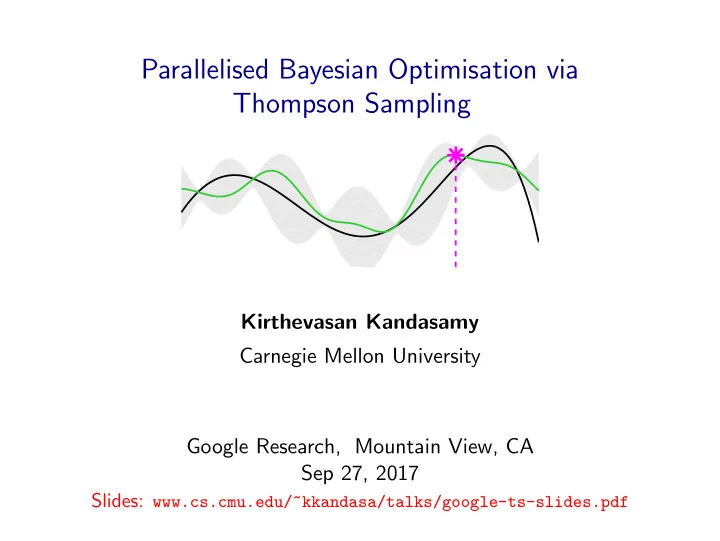
Parallelised Bayesian Optimisation via Thompson Sampling - - PowerPoint PPT Presentation
Parallelised Bayesian Optimisation via Thompson Sampling Kirthevasan Kandasamy Carnegie Mellon University Google Research, Mountain View, CA Sep 27, 2017 Slides: www.cs.cmu.edu/~kkandasa/talks/google-ts-slides.pdf www.cs.cmu.edu/ kkandasa
Slides are up on my website: www.cs.cmu.edu/∼kkandasa
Slides
Black-box Optimisation
Neural Network
hyper- parameters cross validation accuracy
- Train NN using given hyper-parameters
- Compute accuracy on validation set
1/31
Black-box Optimisation
Expensive Blackbox Function
1/31
Black-box Optimisation
Expensive Blackbox Function
Other Examples:
- ML estimation in astrophysics
- Pre-clinical drug discovery
- Optimal policy in autonomous driving
1/31
Black-box Optimisation
f : X → R is an expensive, black-box, noisy function, accessible
- nly via noisy evaluations.
x f(x)
2/31
Black-box Optimisation
f : X → R is an expensive, black-box, noisy function, accessible
- nly via noisy evaluations.
x f(x)
2/31
Black-box Optimisation
f : X → R is an expensive, black-box, noisy function, accessible
- nly via noisy evaluations.
Let x⋆ = argmaxx f (x).
x f(x) x∗
f(x∗)
2/31
Black-box Optimisation
f : X → R is an expensive, black-box, noisy function, accessible
- nly via noisy evaluations.
Let x⋆ = argmaxx f (x).
x f(x) x∗
f(x∗)
Simple Regret after n evaluations SR(n) = f (x⋆) − max
t=1,...,n f (xt).
2/31
Black-box Optimisation
f : X → R is an expensive, black-box, noisy function, accessible
- nly via noisy evaluations.
Let x⋆ = argmaxx f (x).
x f(x) x∗
f(x∗)
Cumulative Regret after n evaluations CR(n) =
n
- t=1
- f (x⋆) − f (xt)
- 2/31
Black-box Optimisation
f : X → R is an expensive, black-box, noisy function, accessible
- nly via noisy evaluations.
Let x⋆ = argmaxx f (x).
x f(x) x∗
f(x∗)
Simple Regret after n evaluations SR(n) = f (x⋆) − max
t=1,...,n f (xt).
2/31
A walk-through Bayesian Optimisation (BO) with Gaussian Processes
◮ A review of Gaussian Processes (GPs) ◮ Thompson Sampling (TS): an algorithm for BO ◮ Other methods and models for BO
3/31
Gaussian Processes (GP)
GP(µ, κ): A distribution over functions from X to R.
4/31
Gaussian Processes (GP)
GP(µ, κ): A distribution over functions from X to R. Functions with no observations
x f(x)
4/31
Gaussian Processes (GP)
GP(µ, κ): A distribution over functions from X to R. Prior GP
x f(x)
4/31
Gaussian Processes (GP)
GP(µ, κ): A distribution over functions from X to R. Observations
x f(x)
4/31
Gaussian Processes (GP)
GP(µ, κ): A distribution over functions from X to R. Posterior GP given observations
x f(x)
4/31
Gaussian Processes (GP)
GP(µ, κ): A distribution over functions from X to R. Posterior GP given observations
x f(x)
Completely characterised by mean function µ : X → R, and covariance kernel κ : X × X → R. After t observations, f (x) ∼ N( µt(x), σ2
t (x) ).
4/31
Gaussian Process (Bayesian) Optimisation
Model f ∼ GP(0, κ). Thompson Sampling (TS)
(Thompson, 1933).
x f(x)
5/31
Gaussian Process (Bayesian) Optimisation
Model f ∼ GP(0, κ). Thompson Sampling (TS)
(Thompson, 1933).
x f(x)
1) Construct posterior GP.
5/31
Gaussian Process (Bayesian) Optimisation
Model f ∼ GP(0, κ). Thompson Sampling (TS)
(Thompson, 1933).
x f(x)
1) Construct posterior GP. 2) Draw sample g from posterior.
5/31
Gaussian Process (Bayesian) Optimisation
Model f ∼ GP(0, κ). Thompson Sampling (TS)
(Thompson, 1933).
x f(x)
xt
1) Construct posterior GP. 2) Draw sample g from posterior. 3) Choose xt = argmaxx g(x).
5/31
Gaussian Process (Bayesian) Optimisation
Model f ∼ GP(0, κ). Thompson Sampling (TS)
(Thompson, 1933).
x f(x)
xt
1) Construct posterior GP. 2) Draw sample g from posterior. 3) Choose xt = argmaxx g(x). 4) Evaluate f at xt.
5/31
Thompson Sampling (TS) in GPs
(Thompson, 1933)
x f(x)
6/31
Thompson Sampling (TS) in GPs
(Thompson, 1933)
x f(x) t = 1
6/31
Thompson Sampling (TS) in GPs
(Thompson, 1933)
x f(x) t = 2
6/31
Thompson Sampling (TS) in GPs
(Thompson, 1933)
x f(x) t = 3
6/31
Thompson Sampling (TS) in GPs
(Thompson, 1933)
x f(x) t = 4
6/31
Thompson Sampling (TS) in GPs
(Thompson, 1933)
x f(x) t = 5
6/31
Thompson Sampling (TS) in GPs
(Thompson, 1933)
x f(x) t = 6
6/31
Thompson Sampling (TS) in GPs
(Thompson, 1933)
x f(x) t = 7
6/31
Thompson Sampling (TS) in GPs
(Thompson, 1933)
x f(x) t = 14
6/31
Thompson Sampling (TS) in GPs
(Thompson, 1933)
x f(x) t = 25
6/31
Some Theoretical Results for TS
Simple Regret: SR(n) = f (x⋆) − max
t=1,...,n f (xt)
7/31
Some Theoretical Results for TS
Simple Regret: SR(n) = f (x⋆) − max
t=1,...,n f (xt)
Theorem: For Thompson sampling,
(Russo & van Roy 2014, Srinivas et al. 2010)
E[SR(n)]
- Ψn log(n)
n .
ignores constants
Ψn ← Maximum Information Gain.
7/31
Some Theoretical Results for TS
Simple Regret: SR(n) = f (x⋆) − max
t=1,...,n f (xt)
Theorem: For Thompson sampling,
(Russo & van Roy 2014, Srinivas et al. 2010)
E[SR(n)]
- Ψn log(n)
n .
ignores constants
Ψn ← Maximum Information Gain. When X ⊂ Rd, SE (Gaussian) kernel: Ψn ≍ dd log(n)d. Mat´ ern kernel: Ψn ≍ n1− c
d2 . 7/31
Some Theoretical Results for TS
Simple Regret: SR(n) = f (x⋆) − max
t=1,...,n f (xt)
Theorem: For Thompson sampling,
(Russo & van Roy 2014, Srinivas et al. 2010)
E[SR(n)]
- Ψn log(n)
n .
ignores constants
Ψn ← Maximum Information Gain. When X ⊂ Rd, SE (Gaussian) kernel: Ψn ≍ dd log(n)d. Mat´ ern kernel: Ψn ≍ n1− c
d2 .
Several other results: (Agrawal et al 2012, Kaufmann et al 2012, Russo &
van Roy 2016, Chowdhury & Gopalan 2017 and more . . . )
7/31
Other methods for BO
Other criteria for selecting xt:
◮ Upper Confidence Bounds (Srinivas et al. 2010)
8/31
Other methods for BO
Other criteria for selecting xt:
◮ Upper Confidence Bounds (Srinivas et al. 2010)
x f(x) 8/31
Other methods for BO
Other criteria for selecting xt:
◮ Upper Confidence Bounds (Srinivas et al. 2010)
x f(x) 8/31
Other methods for BO
Other criteria for selecting xt:
◮ Upper Confidence Bounds (Srinivas et al. 2010)
x f(x) ϕt = µt−1 + β1/2
t
σt−1 8/31
Other methods for BO
Other criteria for selecting xt:
◮ Upper Confidence Bounds (Srinivas et al. 2010)
x f(x) ϕt = µt−1 + β1/2
t
σt−1
xt
8/31
Other methods for BO
Other criteria for selecting xt:
◮ Upper Confidence Bounds (Srinivas et al. 2010)
x f(x) ϕt = µt−1 + β1/2
t
σt−1
xt
8/31
Other methods for BO
Other criteria for selecting xt:
◮ Upper Confidence Bounds (Srinivas et al. 2010)
x f(x) ϕt = µt−1 + β1/2
t
σt−1
xt ◮ Expected improvement (Jones et al. 1998) ◮ Probability of improvement (Kushner et al. 1964) ◮ Entropy search (Hern´
andez-Lobato et al. 2014)
All deterministic methods, choose next point for evaluation by maximising a deterministic acquisition function, i.e. xt = argmaxx∈X ϕt(x).
8/31
Other methods for BO
Other criteria for selecting xt:
◮ Upper Confidence Bounds (Srinivas et al. 2010)
x f(x) ϕt = µt−1 + β1/2
t
σt−1
xt ◮ Expected improvement (Jones et al. 1998) ◮ Probability of improvement (Kushner et al. 1964) ◮ Entropy search (Hern´
andez-Lobato et al. 2014)
All deterministic methods, choose next point for evaluation by maximising a deterministic acquisition function, i.e. xt = argmaxx∈X ϕt(x). Other models for f : Neural networks (Snoek et al. 2015), Random Forests (Hutter 2009).
8/31
Big picture: scaling up black-box optimisation
9/31
Big picture: scaling up black-box optimisation
◮ Optimising in high dimensional spaces
e.g.: Tuning models with several hyper-parameters Additive models for f lead to statistically and computationally tractable algorithms.
(Kandasamy et al. ICML 2015)
9/31
Big picture: scaling up black-box optimisation
◮ Optimising in high dimensional spaces
e.g.: Tuning models with several hyper-parameters Additive models for f lead to statistically and computationally tractable algorithms.
(Kandasamy et al. ICML 2015)
◮ Multi-fidelity optimisation: what if we have cheap
approximations to f ? E.g. Train an ML model with N• data and T• iterations. But use N < N• data and T < T• iterations to approximate cross validation performance at (N•, T•).
(Kandasamy et al. NIPS 2016a&b, Kandasamy et al. ICML 2017)
9/31
Big picture: scaling up black-box optimisation
◮ Optimising in high dimensional spaces
e.g.: Tuning models with several hyper-parameters Additive models for f lead to statistically and computationally tractable algorithms.
(Kandasamy et al. ICML 2015)
◮ Multi-fidelity optimisation: what if we have cheap
approximations to f ? E.g. Train an ML model with N• data and T• iterations. But use N < N• data and T < T• iterations to approximate cross validation performance at (N•, T•).
(Kandasamy et al. NIPS 2016a&b, Kandasamy et al. ICML 2017)
Extends beyond GPs.
9/31
This work: Parallel Evaluations
(Kandasamy et al. Arxiv 2017)
Parallelisation with M workers: can evaluate f at M different points at the same time. E.g. Train M models with different hyper-parameter values in parallel at the same time. Inability to parallelise is a real bottleneck in practice!
10/31
This work: Parallel Evaluations
(Kandasamy et al. Arxiv 2017)
Parallelisation with M workers: can evaluate f at M different points at the same time. E.g. Train M models with different hyper-parameter values in parallel at the same time. Inability to parallelise is a real bottleneck in practice! Some desiderata:
◮ Statistically, achieve ×M improvement. ◮ Methodologically, be scalable for a very large number of
workers,
- Method remains computationally tractable as M increases.
- Method is conceptually simple, for robustness in practice.
10/31
Outline
(Kandasamy et al. Arxiv 2017)
- 1. Set up & definitions
- 2. Prior work & challenges
- 3. Algorithms synTS, asyTS: direct application of TS to
synchronous and asynchronous parallel settings
- 4. Experiments
- 5. Theoretical Results
- 6. Open questions/challenges
11/31
Outline
(Kandasamy et al. Arxiv 2017)
- 1. Set up & definitions
- 2. Prior work & challenges
- 3. Algorithms synTS, asyTS: direct application of TS to
synchronous and asynchronous parallel settings
- 4. Experiments
- 5. Theoretical Results
◮ synTS and asyTS perform essentially the same as seqTS in
terms of the number of evaluations.
◮ When we factor time as a resource, asyTS outperforms synTS
and seqTS.
. . . with some caveats.
- 6. Open questions/challenges
11/31
Outline
(Kandasamy et al. Arxiv 2017)
- 1. Set up & definitions
- 2. Prior work & challenges
- 3. Algorithms synTS, asyTS: direct application of TS to
synchronous and asynchronous parallel settings
- 4. Experiments
- 5. Theoretical Results
◮ synTS and asyTS perform essentially the same as seqTS in
terms of the number of evaluations.
◮ When we factor time as a resource, asyTS outperforms synTS
and seqTS.
. . . with some caveats
- 6. Open questions/challenges
11/31
Parallel Evaluations: set up
Sequential evaluations with one worker
12/31
Parallel Evaluations: set up
Sequential evaluations with one worker Parallel evaluations with M workers (Asynchronous)
12/31
Parallel Evaluations: set up
Sequential evaluations with one worker Parallel evaluations with M workers (Asynchronous) Parallel evaluations with M workers (Synchronous)
12/31
Parallel Evaluations: set up
Sequential evaluations with one worker
jth job has feedback from all previous j − 1 jobs.
Parallel evaluations with M workers (Asynchronous)
jth job missing feedback from exactly M − 1 jobs.
Parallel evaluations with M workers (Synchronous)
jth job missing feedback from ≤ M − 1 jobs.
12/31
Simple Regret in Parallel Settings
(Kandasamy et al. Arxiv 2017)
Simple regret after n evaluations, SR(n) = f (x⋆) − max
t=1,...,n f (xt).
n ← number of completed evaluations by all M workers.
13/31
Simple Regret in Parallel Settings
(Kandasamy et al. Arxiv 2017)
Simple regret after n evaluations, SR(n) = f (x⋆) − max
t=1,...,n f (xt).
n ← number of completed evaluations by all M workers. Simple regret with time as a resource, Asynchronous Synchronous SR′(T) = f (x⋆) − max
t=1,...,N f (xt).
N ← (possibly random) number of completed evaluations by all M workers within time T.
13/31
Outline
(Kandasamy et al. Arxiv 2017)
- 1. Set up & definitions
- 2. Prior work & challenges
- 3. Algorithms synTS, asyTS: direct application of TS to
synchronous and asynchronous parallel settings
- 4. Experiments
- 5. Theoretical Results
◮ synTS and asyTS perform essentially the same as seqTS in
terms of the number of evaluations.
◮ When we factor time as a resource, asyTS outperforms synTS
and seqTS.
. . . with some caveats
- 6. Open questions/challenges
13/31
Prior work in Parallel BO
(Ginsbourger et al. 2011) (Janusevkis et al. 2012) (Contal et al. 2013) (Desautels et al. 2014) (Gonzalez et al. 2015) (Shah & Ghahramani. 2015) (Wang et al. 2016) (Kathuria et al. 2016) (Wu & Frazier. 2017) (Wang et al. 2017) (Kandasamy et al. Arxiv 2017)
14/31
Prior work in Parallel BO
Asynchr-
- nicity
(Ginsbourger et al. 2011)
- (Janusevkis et al. 2012)
- (Contal et al. 2013)
(Desautels et al. 2014) (Gonzalez et al. 2015) (Shah & Ghahramani. 2015) (Wang et al. 2016)
- (Kathuria et al. 2016)
(Wu & Frazier. 2017) (Wang et al. 2017) (Kandasamy et al. Arxiv 2017)
- 14/31
Prior work in Parallel BO
Asynchr-
- nicity
Theoretical guarantees
(Ginsbourger et al. 2011)
- (Janusevkis et al. 2012)
- (Contal et al. 2013)
- (Desautels et al. 2014)
- (Gonzalez et al. 2015)
(Shah & Ghahramani. 2015) (Wang et al. 2016)
- (Kathuria et al. 2016)
- (Wu & Frazier. 2017)
(Wang et al. 2017) (Kandasamy et al. Arxiv 2017)
- 14/31
Prior work in Parallel BO
Asynchr-
- nicity
Theoretical guarantees Conceptual simplicity *
(Ginsbourger et al. 2011)
- (Janusevkis et al. 2012)
- (Contal et al. 2013)
- (Desautels et al. 2014)
- (Gonzalez et al. 2015)
(Shah & Ghahramani. 2015) (Wang et al. 2016)
- (Kathuria et al. 2016)
- (Wu & Frazier. 2017)
(Wang et al. 2017) (Kandasamy et al. Arxiv 2017)
- * straightforward extension of sequential algorithm works.
14/31
Why are deterministic algorithms not “simple”? Need to encourage diversity in parallel evaluations
Direct application of GP-UCB in the synchronous setting ...
x f(x)
15/31
Why are deterministic algorithms not “simple”? Need to encourage diversity in parallel evaluations
Direct application of GP-UCB in the synchronous setting ...
- First worker: maximise acquisition, xt1 = argmax ϕt(x).
x f(x) ϕt = µt−1 + β1/2
t
σt−1
xt1
15/31
Why are deterministic algorithms not “simple”? Need to encourage diversity in parallel evaluations
Direct application of GP-UCB in the synchronous setting ...
- First worker: maximise acquisition, xt1 = argmax ϕt(x).
- Second worker: acquisition is the same! xt1 = xt2
x f(x) ϕt = µt−1 + β1/2
t
σt−1
xt2 = xt1
15/31
Why are deterministic algorithms not “simple”? Need to encourage diversity in parallel evaluations
Direct application of GP-UCB in the synchronous setting ...
- First worker: maximise acquisition, xt1 = argmax ϕt(x).
- Second worker: acquisition is the same! xt1 = xt2
- xt1 = xt2 = · · · = xtM.
x f(x) ϕt = µt−1 + β1/2
t
σt−1
xt2 = xt1
15/31
Why are deterministic algorithms not “simple”? Need to encourage diversity in parallel evaluations
Direct application of GP-UCB in the synchronous setting ...
- First worker: maximise acquisition, xt1 = argmax ϕt(x).
- Second worker: acquisition is the same! xt1 = xt2
- xt1 = xt2 = · · · = xtM.
x f(x) ϕt = µt−1 + β1/2
t
σt−1
xt2 = xt1
Direct application of sequential algorithm does not work. Need to “encourage diversity”.
15/31
Why are deterministic algorithms not “simple”? Need to encourage diversity in parallel evaluations
◮ Add hallucinated observations. x f(x)
16/31
Why are deterministic algorithms not “simple”? Need to encourage diversity in parallel evaluations
◮ Add hallucinated observations. x f(x)
ˆ f
16/31
Why are deterministic algorithms not “simple”? Need to encourage diversity in parallel evaluations
◮ Add hallucinated observations. x f(x)
ˆ f
16/31
Why are deterministic algorithms not “simple”? Need to encourage diversity in parallel evaluations
◮ Add hallucinated observations. x f(x)
16/31
Why are deterministic algorithms not “simple”? Need to encourage diversity in parallel evaluations
◮ Add hallucinated observations. x f(x) ◮ Optimise an acquisition over X M.
16/31
Why are deterministic algorithms not “simple”? Need to encourage diversity in parallel evaluations
◮ Add hallucinated observations. x f(x) ◮ Optimise an acquisition over X M. ◮ Resort to heuristics, typically requires additional
hyper-parameters and/or computational routines.
16/31
Why are deterministic algorithms not “simple”? Need to encourage diversity in parallel evaluations
◮ Add hallucinated observations. x f(x) ◮ Optimise an acquisition over X M. ◮ Resort to heuristics, typically requires additional
hyper-parameters and/or computational routines. Take-home message: Straightforward application of sequential algorithm works for TS. Inherent randomness takes care of exploration vs. exploitation trade-off when managing M workers.
16/31
Parallel Thompson Sampling
(Kandasamy et al. Arxiv 2017)
Asynchronous: asyTS At any given time,
- 1. (x′, y′) ← Wait for
a worker to finish.
- 2. Compute posterior GP.
- 3. Draw a sample g ∼ GP.
- 4. Re-deploy worker at
argmax g.
17/31
Parallel Thompson Sampling
(Kandasamy et al. Arxiv 2017)
Asynchronous: asyTS At any given time,
- 1. (x′, y′) ← Wait for
a worker to finish.
- 2. Compute posterior GP.
- 3. Draw a sample g ∼ GP.
- 4. Re-deploy worker at
argmax g. Synchronous: synTS At any given time,
- 1. {(x′
m, y′ m)}M m=1 ← Wait for
all workers to finish.
- 2. Compute posterior GP.
- 3. Draw M samples
gm ∼ GP, ∀m.
- 4. Re-deploy worker m at
argmax gm, ∀m.
17/31
Parallel Thompson Sampling
(Kandasamy et al. Arxiv 2017)
Asynchronous: asyTS At any given time,
- 1. (x′, y′) ← Wait for
a worker to finish.
- 2. Compute posterior GP.
- 3. Draw a sample g ∼ GP.
- 4. Re-deploy worker at
argmax g. Synchronous: synTS At any given time,
- 1. {(x′
m, y′ m)}M m=1 ← Wait for
all workers to finish.
- 2. Compute posterior GP.
- 3. Draw M samples
gm ∼ GP, ∀m.
- 4. Re-deploy worker m at
argmax gm, ∀m. Variants in prior work:
(Osband et al. 2016, Israelsen et al. 2016, Hernandez-Lobato et al. 2017)
17/31
Outline
(Kandasamy et al. Arxiv 2017)
- 1. Set up & definitions
- 2. Prior work & challenges
- 3. Algorithms synTS, asyTS: direct application of TS to
synchronous and asynchronous parallel settings
- 4. Experiments
- 5. Theoretical Results
◮ synTS and asyTS perform essentially the same as seqTS in
terms of the number of evaluations.
◮ When we factor time as a resource, asyTS outperforms synTS
and seqTS.
. . . with some caveats
- 6. Open questions/challenges
18/31
Experiment: Park1-4D M = 10
Comparison in terms of number of evaluations
10 0
asyTS seqTS
20 40 60 80 100 120
synTS
19/31
Experiment: Branin-2D M = 4
Evaluation time sampled from a uniform distribution
10 20 30 40 10 -2 10 -1
20/31
Experiment: Branin-2D M = 4
Evaluation time sampled from a uniform distribution
10 20 30 40 10 -2 10 -1
20/31
Experiment: Branin-2D M = 4
Evaluation time sampled from a uniform distribution
synRAND synHUCB synUCBPE synTS asyRAND asyUCB asyHUCB asyEI asyHTS asyTS
10 20 30 40 10 -2 10 -1
20/31
Experiment: Hartmann-6D M = 12
Evaluation time sampled from a half-normal distribution
synRAND synHUCB synUCBPE synTS asyRAND asyUCB asyHUCB asyEI asyHTS asyTS
5 10 15 20 25 30 10 -1 10 0
21/31
Experiment: Hartmann-18D M = 25
Evaluation time sampled from an exponential distribution
synRAND synHUCB synUCBPE synTS asyRAND asyUCB asyHUCB asyEI asyHTS asyTS
5 10 15 20 25 30 2.5 3 3.5 4 4.5 5 5.5 6 6.5
22/31
Experiment: Currin-Exponential-14D M = 35
Evaluation time sampled from a Pareto-3 distribution
synRAND synHUCB synUCBPE synTS asyRAND asyUCB asyHUCB asyEI asyHTS asyTS
5 10 15 20 10 15 20 25
23/31
Experiment: Model Selection in Cifar10 M = 4
Tune # filters in in range (32, 256) for each layer in a 6 layer CNN. Time taken for an evaluation: 4 - 16 minutes.
1000 2000 3000 4000 5000 6000 7000 0.68 0.69 0.7 0.71 0.72
synTS asyRAND
asyHUCB
asyTS asyEI synHUCB
24/31
Outline
(Kandasamy et al. Arxiv 2017)
- 1. Set up & definitions
- 2. Prior work & challenges
- 3. Algorithms synTS, asyTS: direct application of TS to
synchronous and asynchronous parallel settings
- 4. Experiments
- 5. Theoretical Results
◮ synTS and asyTS perform essentially the same as seqTS in
terms of the number of evaluations.
◮ When we factor time as a resource, asyTS outperforms synTS
and seqTS.
. . . with some caveats.
- 6. Open questions/challenges
24/31
Bounds for SR(n), synTS
seqTS
(Russo & van Roy 2014)
E[SR(n)]
- Ψn log(n)
n Ψn ← Maximum information gain.
25/31
Bounds for SR(n), synTS
seqTS
(Russo & van Roy 2014)
E[SR(n)]
- Ψn log(n)
n Ψn ← Maximum information gain. Theorem: synTS
(Kandasamy et al. Arxiv 2017)
E[SR(n)] M
- log(M)
n +
- Ψn+M log(n+M)
n Leading constant is also the same.
25/31
Bounds for SR(n), asyTS
seqTS
(Russo & van Roy 2014)
E[SR(n)]
- Ψn log(n)
n
26/31
Bounds for SR(n), asyTS
seqTS
(Russo & van Roy 2014)
E[SR(n)]
- Ψn log(n)
n Theorem: asyTS
(Kandasamy et al. Arxiv 2017)
E[SR(n)]
- ξMΨn log(n)
n ξM = supDn,n≥1 maxA⊂X,|A|≤M eI(f ;A|Dn).
26/31
Bounds for SR(n), asyTS
seqTS
(Russo & van Roy 2014)
E[SR(n)]
- Ψn log(n)
n Theorem: asyTS
(Kandasamy et al. Arxiv 2017)
E[SR(n)]
- ξMΨn log(n)
n ξM = supDn,n≥1 maxA⊂X,|A|≤M eI(f ;A|Dn). Theorem: There exists an asynchronously parallelisable initiali- sation scheme requiring O(Mpolylog(M)) evaluations to f such that ξM ≤ C.
(Krause et al. 2008, Desautels et al. 2012)
26/31
Bounds for SR(n), asyTS
seqTS
(Russo & van Roy 2014)
E[SR(n)]
- Ψn log(n)
n Theorem: asyTS, arbitrary X
(Kandasamy et al. Arxiv 2017)
E[SR(n)] Mpolylog(M) n +
- CΨn log(n)
n ξM = supDn,n≥1 maxA⊂X,|A|≤M eI(f ;A|Dn). Theorem: There exists an asynchronously parallelisable initiali- sation scheme requiring O(Mpolylog(M)) evaluations to f such that ξM ≤ C.
(Krause et al. 2008, Desautels et al. 2012)
26/31
Bounds for SR(n), asyTS
seqTS
(Russo & van Roy 2014)
E[SR(n)]
- Ψn log(n)
n Theorem: asyTS, arbitrary X
(Kandasamy et al. Arxiv 2017)
E[SR(n)] Mpolylog(M) n +
- CΨn log(n)
n ξM = supDn,n≥1 maxA⊂X,|A|≤M eI(f ;A|Dn). Theorem: There exists an asynchronously parallelisable initiali- sation scheme requiring O(Mpolylog(M)) evaluations to f such that ξM ≤ C.
(Krause et al. 2008, Desautels et al. 2012)
* We do not believe this is necessary.
26/31
Bounds for asyTS without the initialisation scheme
Theorem: synTS, arbitrary X
(Kandasamy et al. Arxiv 2017)
E[SR(n)] M
- log(M)
n +
- Ψn+M log(n + M)
n
27/31
Bounds for asyTS without the initialisation scheme
Theorem: synTS, arbitrary X
(Kandasamy et al. Arxiv 2017)
E[SR(n)] M
- log(M)
n +
- Ψn+M log(n + M)
n Theorem: asyTS, X ⊂ Rd
(Ongoing work)
E[SR(n)] . . . +
- M log(n)
n1/O(d)
27/31
Theoretical Results for SR′(T)
Model evaluation time as an independent random variable
◮ Uniform
unif(a, b) bounded
◮ Half-normal
HN(τ 2) sub-Gaussian
◮ Exponential
exp(λ) sub-exponential
28/31
Theoretical Results for SR′(T)
Model evaluation time as an independent random variable
◮ Uniform
unif(a, b) bounded
◮ Half-normal
HN(τ 2) sub-Gaussian
◮ Exponential
exp(λ) sub-exponential Theorem (Informal): If evaluation times are the same, synTS≈ asyTS. Otherwise, bounds for asyTS are better than synTS. More the variability in evaluation times, the bigger the difference.
Theoretical Results for SR′(T)
Model evaluation time as an independent random variable
◮ Uniform
unif(a, b) bounded
◮ Half-normal
HN(τ 2) sub-Gaussian
◮ Exponential
exp(λ) sub-exponential Theorem (Informal): If evaluation times are the same, synTS≈ asyTS. Otherwise, bounds for asyTS are better than synTS. More the variability in evaluation times, the bigger the difference.
- Uniform: constant factor
- Half-normal:
- log(M) factor
- Exponential: log(M) factor
28/31
Outline
(Kandasamy et al. Arxiv 2017)
- 1. Set up & definitions
- 2. Prior work & challenges
- 3. Algorithms synTS, asyTS: direct application of TS to
synchronous and asynchronous parallel settings
- 4. Experiments
- 5. Theoretical Results
◮ synTS and asyTS perform essentially the same as seqTS in
terms of the number of evaluations.
◮ When we factor time as a resource, asyTS outperforms synTS
and seqTS.
. . . with some caveats
- 6. Open questions/challenges
28/31
Open Challenges for Parallelised TS
- 1. Bounds for asynchronous TS without initialisation.
- 2. Other models for evaluation times.
- e.g. evaluation time depends on x ∈ X.
29/31
Open Challenges for Parallelised TS
- 1. Bounds for asynchronous TS without initialisation.
- 2. Other models for evaluation times.
- e.g. evaluation time depends on x ∈ X.
- 3. In the asynchronous setting,
◮ Should you wait for another job to finish without immediately
re-deploying?
◮ Do you kill an on-going job depending on the result of a
completed job?
29/31
Open Challenges for Parallelised TS
- 4. Optimising the sample when X = [0, 1]d,
x f(x)
xt
xt = argmax
x∈X
g(x), where g ∼ Posterior GP
◮ Global optimisation of a non-convex function!
.. a common challenge in most BO methods.
30/31
Open Challenges for Parallelised TS
- 4. Optimising the sample when X = [0, 1]d,
x f(x)
xt
xt = argmax
x∈X
g(x), where g ∼ Posterior GP
◮ Global optimisation of a non-convex function!
.. a common challenge in most BO methods. But additionally for TS,
◮ As g is not deterministic, draw samples from a fixed set of
points and pick the maximum.
◮ Or if using an adaptive method, scales O((N + S)3) where
N ← # of evaluations to f , S ← # of evaluations to g.
30/31
Summary
◮ synTS, asyTS: direct application of TS to synchronous and
asynchronous parallel settings.
31/31
Summary
◮ synTS, asyTS: direct application of TS to synchronous and
asynchronous parallel settings.
◮ Take-aways: Theory
- Both perform essentially the same as seqTS in terms of the
number of evaluations.
- When we factor time as a resource, asyTS performs best.
31/31
Summary
◮ synTS, asyTS: direct application of TS to synchronous and
asynchronous parallel settings.
◮ Take-aways: Theory
- Both perform essentially the same as seqTS in terms of the
number of evaluations.
- When we factor time as a resource, asyTS performs best.
◮ Take-aways: Practice
- Conceptually simple and scales better with the number of
workers than other methods.
31/31
Akshay Jeff Barnab´ as Krishnamurthy Schneider P´
- czos