
SLIDE 1
Parnasimautik
Nunavik: Past, Present and Future Our Communities
1
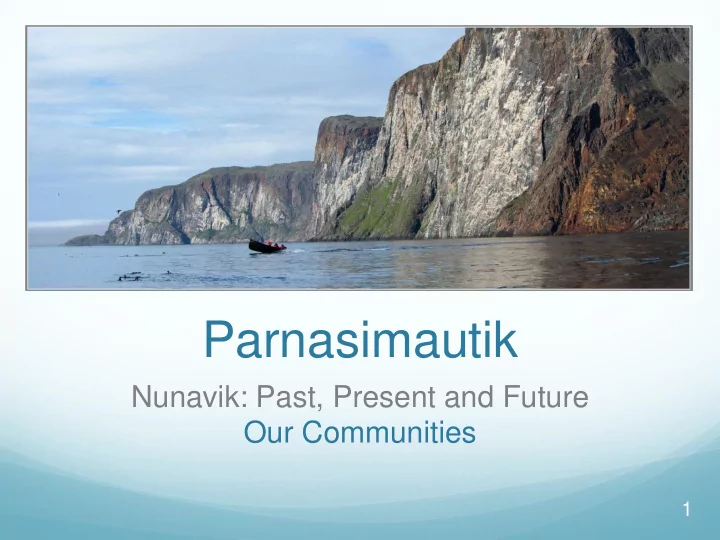
Parnasimautik Nunavik: Past, Present and Future Our Communities 1 - - PowerPoint PPT Presentation
Parnasimautik Nunavik: Past, Present and Future Our Communities 1 Elders, Women and Youth (Sector 5) Service improvements are needed for elders, and elders must also be enabled to make meaningful contributions to their communities.
1
2
needed for elders, and elders must also be enabled to make meaningful contributions to their communities.
families, women are concerned with issues such as health, healing, culture and language, as well as community and industrial development.
nutrition and involve investments in programs.
3
The KSB promotes Inuit culture, language and identity in its curriculum and pedagogical materials. Inuit students must have access to the same services and pathways as those in the south.
4
educational program development and training is needed.
Education training program for Inuit teachers must be more accessible in order to speed up certification.
made available in Nunavik.
5
Major advances in the delivery of healthcare in the region since 1975 have improved the general well-being of residents.
6
it difficult to deliver healthcare in line with Inuit values.
difficult.
the well-being of our communities depends on solutions to the region’s social problems.
construction has failed to meet increasing demand. Overcrowding is a serious problem.
negatively on the health of Nunavimmiut and can foster contagious diseases.
municipal taxes and the high cost of living are obstacles to homeownership. 7
8
not re-established a sense of well-being, safety and social peace in the communities.
the crime it contributes to continue to increase because
coordinated resources.
9
with behaviour that leads to crime and other social issues.
correctional services.
10
gradually been transferred to local decision-makers.
local infrastructure and programs since 1975, community development continues to lag behind most other regions
11
preoccupation for residents.
the transportation, energy, mining and telecommunications sectors.
what we eat comes from elsewhere in the world, contributing to food security.
store-brought food is more expensive. 12
threaten habitats.
relevant food are immense.
Nunavik is two to three times higher than in other parts of Québec.
students drop out of classes before completing high school.
training facilities are a barrier to employment, and contribute to poverty.
Nunavimmiut for existing employment opportunities in the region and help them to retain these jobs. 13
Our Communities
Better adapted health, education and training, housing, justice, correctional, community development, and biofood services, as well as employment, can help to improve the quality of life of Nunavimmiut, and contribute to resolving some of the more important challenges facing the communities, such as increasing crime, school dropout, and various health issues. How will we develop our potentials to improve services and infrastructure for Nunavimmiut, and what contribution to community services and infrastructure will be made by those exploiting the region’s mineral and energy potentials. 14
15