Part 3 Surgical Phase 26/11/2015 LIMU Dr. Rafik M. Alkowafi 109 - - PDF document

part 3 surgical phase
SMART_READER_LITE
LIVE PREVIEW

Part 3 Surgical Phase 26/11/2015 LIMU Dr. Rafik M. Alkowafi 109 - - PDF document

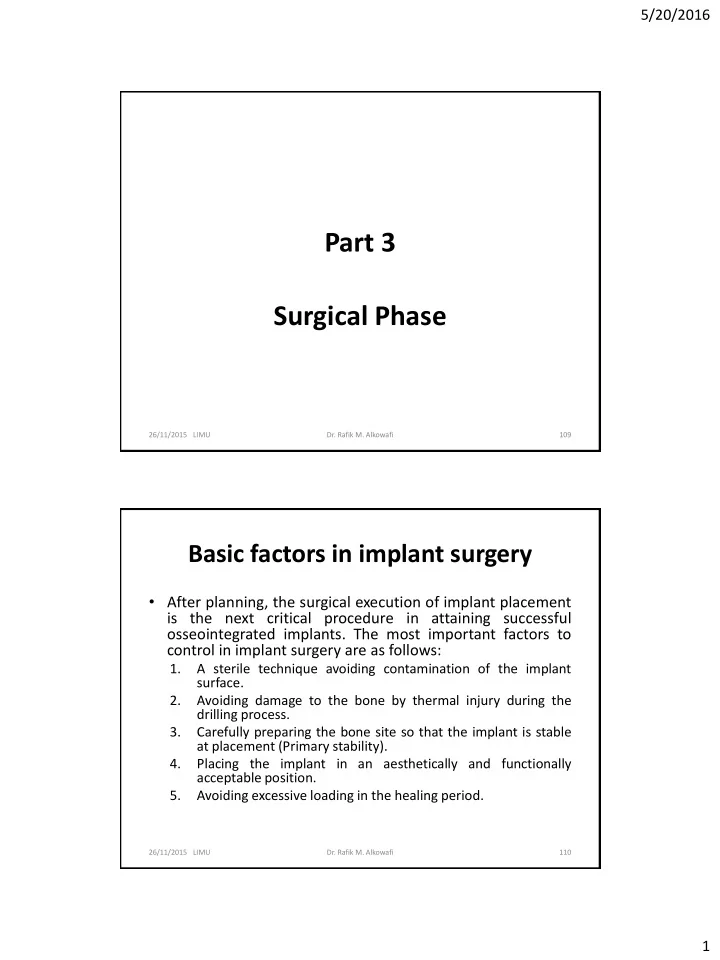
5/20/2016 Part 3 Surgical Phase 26/11/2015 LIMU Dr. Rafik M. Alkowafi 109 Basic factors in implant surgery After planning, the surgical execution of implant placement is the next critical procedure in attaining successful


slide-1
SLIDE 1

5/20/2016 1

Part 3 Surgical Phase

26/11/2015 LIMU

  • Dr. Rafik M. Alkowafi

109

Basic factors in implant surgery

  • After planning, the surgical execution of implant placement

is the next critical procedure in attaining successful

  • sseointegrated implants. The most important factors to

control in implant surgery are as follows:

1. A sterile technique avoiding contamination of the implant surface. 2. Avoiding damage to the bone by thermal injury during the drilling process. 3. Carefully preparing the bone site so that the implant is stable at placement (Primary stability). 4. Placing the implant in an aesthetically and functionally acceptable position. 5. Avoiding excessive loading in the healing period.

26/11/2015 LIMU

  • Dr. Rafik M. Alkowafi

110

slide-2
SLIDE 2

5/20/2016 2

Basic factors in implant surgery

  • Poor control of these factors can lead to failure of
  • sseointegration,

which may be manifested subsequently as:

1. Infection at the implant site. 2. Implant mobility or the implant may be rotated when attempting to detach or attach a component. 3. Pain from inflammation in the bone surrounding the implant. 4. A radiolucent space surrounding the implant, which is consistent with fibrous encapsulation.

26/11/2015 LIMU

  • Dr. Rafik M. Alkowafi

111

Basic factors in implant surgery

  • Avoiding damage to the bone by thermal

injury during the drilling process. This is avoided by:

  • 1. careful cooling of the bone and drills with

copious sterile saline (internal or/and external).

  • 2. Use of sharp drills.
  • 3. Control of the cutting speed.
  • 4. Periodic withdrawal of the drill to allow bone

cuttings to be cleared from the drill flutes.

26/11/2015 LIMU

  • Dr. Rafik M. Alkowafi

112

slide-3
SLIDE 3

5/20/2016 3

Basic factors in implant surgery

  • Ensuring good initial stability (Primary stability) of the
  • implant. This can be judged by:

1. Simple clinical evaluation (dependent

  • n
  • perator

experience). 2. Torque insertion forces—these can be set on the drilling unit and are usually between 10 and 50 Ncm. Some units record the torque and provide a print out. 3. Periotest values—the mobility can be measured with an electronic instrument that was originally designed to measure tooth mobility. 4. Resonance frequency analysis—this device measures the stiffness of the implant within the bone through electronic vibration and recording.

26/11/2015 LIMU

  • Dr. Rafik M. Alkowafi

113

Basic factors in implant surgery

  • Initial stability of the implant depends on the

following:

1. Length of the implant. 2. Diameter of the implant. 3. Design of the implant. 4. Surface configuration of the implant. 5. Thickness of the bone cortex and how many cortices the implant engages. 6. Density of the medullary bone trabeculation. 7. Dimensions of the preparation site compared with that of the implant.

26/11/2015 LIMU

  • Dr. Rafik M. Alkowafi

114

slide-4
SLIDE 4

5/20/2016 4

Basic factors in implant surgery

  • Preoperative care, anaesthesia and analgesia:

1. Antiseptic rinsing of the oral cavity. Chlorhexidine gluconate (2% or 1.2% proprietary rinses for 1 minute) is recommended. 2. Administration of analgesics. Oral analgesics (ibuprofen 200 mg or 400 mg or paracetamol 1 g) are usually

  • sufficient. Control of pain is more effective if analgesics

are given prior to surgery . 3. Administration of antibiotics (e.g., multiple implants where bone is exposed for long periods or grafting is carried out), the clinician could use a standard protocol (e.g., amoxicillin 0.5 to 1 g preoperatively followed by a 5-day course).

26/11/2015 LIMU

  • Dr. Rafik M. Alkowafi

115

Basic factors in implant surgery

  • Basic postoperative care:

1. Patients should be prescribed appropriate analgesics, antibiotics if indicated, and a chlorhexidine mouthrinse. 2. They should be advised to use ice packs to reduce swelling and bruising. 3. Pain should not be severe. Pain should not arise from the bone because this would indicate poor technique and damage possibly leading to failure. 4. Surgery close to the inferior dental nerve may result in transient altered sensation and the patient should be made aware of this possibility. 5. In many cases patients are advised not to wear their removable dentures for one to two weeks to avoid pressure on the wound and implants.

26/11/2015 LIMU

  • Dr. Rafik M. Alkowafi

116

slide-5
SLIDE 5

5/20/2016 5

Surgical techniques (Basic)

  • Surgical Armamentarium

1. Anesthesia: syringes and cartridges

  • f

anesthetic 2. Retractors: for cheeks, tongue, and soft tissue 3. Incision: scalpels and blades 4. Exodontia: peritomes, elevators, and forceps 5. Bone modification: rongeurs, burs, bone files, chisels, and mallet 6. Osteotomy development: implant drills, motors, handpieces, and osteotomes 7. Soft tissue manipulation: scissors and tissue forceps 8. Suturing: sutures, needle holders, scissors, and tissue forceps 9. Irrigation: syringes and solution 10. Suction: Suction tips 11. Miscellaneous: bowls, mouth props, gauze, tile clips

26/11/2015 LIMU

  • Dr. Rafik M. Alkowafi

117

Surgical preparation

  • Preparation for implant surgery requires a thorough

review of the patient’s chart including:

– Medical and dental histories,

  • peratory

notes, radiographs, anticipated implant sizes and locations, surgical guides, surgical sequencing and strategy, possible complications.

  • Once the patient has been draped in a sterile fashion

and the surgical team has been gloved and gowned, the patient is anesthetized.

  • In many cases, the implants can be placed using local

anesthetic block or infiltration techniques. However, in more complex and lengthy procedures, some type of sedation or general anesthesia may be preferred

26/11/2015 LIMU

  • Dr. Rafik M. Alkowafi

118

slide-6
SLIDE 6

5/20/2016 6

Implant site exposure

  • Exposure
  • f

the implant site can be accomplished in several ways, including:

  • 1. Flapless surgery.
  • 2. Tissue elevation (flap) that may include.

26/11/2015 LIMU

  • Dr. Rafik M. Alkowafi

119

Implant site exposure

  • 1. Flapless surgery:
  • Indicated when there is adequate keratinized tissue over an ideal ridge form.
  • flapless surgery, the implant and the healing or provisional restoration are

placed in a single stage.

  • Advantages:

1. Minimal incision and less trauma 2. Patient comfort 3. Less bone resorption 4. Allows for immediate loading 5. Improved esthetics 6. Decreased surgical time 7. Patient perception of “minimally invasive surgery

  • Disadvantages:

1. Lack of surgical visibility especially near vital structures. 2. Greater learning curve. 3. Limited irrigation to osteotomy. 4. Limited hard/soft tissue manipulation.

26/11/2015 LIMU

  • Dr. Rafik M. Alkowafi

120

slide-7
SLIDE 7

5/20/2016 7

Flapless surgery

26/11/2015 LIMU

  • Dr. Rafik M. Alkowafi

121

Flapless surgery. A, Preoperative view. B, Tissue is excised in the exact diameter of the implant to be placed using a tissue punch. C, Tissue removed. D, Implant placement

Implant site exposure

  • 2. Tissue elevation (flap):

– The flap should be designed to allow convenient retraction

  • f soft tissue for unimpeded access for implant placement.

This is usually necessary when better access and visualization of the underlying bone is necessary and when additional procedures such as bone or soft tissue grafting are done at the time of implant placement. – Types: a. Sulcular incision. b. Mid-crestal incision c. Vertical-releasing incisions ( two sided or 3 sided flap).

26/11/2015 LIMU

  • Dr. Rafik M. Alkowafi

122

slide-8
SLIDE 8

5/20/2016 8

Implant site exposure

26/11/2015 LIMU

  • Dr. Rafik M. Alkowafi

123

A and B, Papilla-sparing, mid-crestal incision, conservative release. C, Incision with more generous anterior releasing incision. D, Mesial- and distal-releasing incision providing more generous exposure

Implant site exposure

  • Mid-crestal incision: The incision should be made

through the keratinized tissue, In areas with a narrow zone of keratinized tissue,

  • If sulcular incisions are necessary, great care is taken to

follow the contour of the sulcus so as not to damage the soft tissue architecture.

  • Vertical-releasing incision: Using a sharp #15 blade, a

curvilinear, papilla sparring incision should be made to reduce or eliminate incision scarring.

  • It must be ensured that the vertical-releasing incision is

extended apically enough to allow complete release of the flap.

26/11/2015 LIMU

  • Dr. Rafik M. Alkowafi

124

slide-9
SLIDE 9

5/20/2016 9

Implant placement

1. Flap reflection. 2. Flap retraction, When the buccal flap has been reflected completely, a retractor can be positioned against the bone inside the flap. This allows good visualization of the

  • perative site while protecting the integrity of the flap.

3. Preparing the osteotomy, The surgeon must confirm that the handpiece and motor are functioning properly: the speed setting on the motor should be checked; it must be confirmed that the drill is spinning in the forward mode. The torque is about 15 Ncm and the speed should be set at 800 to 1200 revolutions per minute (rpm) for the precision and pilot drills. All drills, including osteotomy drills, should be copiously irrigated, internally, externally,

  • r both, when preparing the bone.

26/11/2015 LIMU

  • Dr. Rafik M. Alkowafi

125

Implant placement

26/11/2015 LIMU

  • Dr. Rafik M. Alkowafi

126

A and B, Initial marking or preparation of the implant site with a round

  • bur. C and D, Use of a 2-mm twist drill to establish depth and align the

implant.

slide-10
SLIDE 10

5/20/2016 10

26/11/2015 LIMU

  • Dr. Rafik M. Alkowafi

127

Implant placement

  • Anatomic

Structures to be avoided during implant

  • steotomy:

– Maxilla

1. Maxillary sinus (floor and anterior wall) 2. Nasal cavity (floor and lateral wall) 3. Incisive foramen 4. Canine fossa

– Mandible

1. Mandibular canal 2. Anterior loop of the mandibular canal 3. Anterior extension of the mandibular canal 4. Mental foramen 5. Submandibular fossa 6. Lingual inclination of the alveolar ridge

26/11/2015 LIMU

  • Dr. Rafik M. Alkowafi

128

slide-11
SLIDE 11

5/20/2016 11

Implant placement

  • Controling variables in implant placement:
  • 1. Mesiodistal positioning
  • 2. Buccolingual positioning
  • 3. Angulation of the long axis of the implant
  • 4. Vertical positioning of the implant head
  • Drilling is done with the precision drill at full speed to a depth of 1

to 2 mm short of the depth of the intended implant (e.g., 8 mm deep for a 10-mm implant).

  • The area is irrigated and the 2-mm pilot drill positioned in the exact

same location after verifying the correct angulation. Once position and angulation are confirmed, the 2-mm pilot drill is run at full speed to the intended depth of the implant (e.g., 10 mm deep for a 10-mm implant).

26/11/2015 LIMU

  • Dr. Rafik M. Alkowafi

129

Implant placement

  • The area is rinsed, and

the guide pin that is

  • placed. Use of the guide

pin allows the surgeon to evaluate the position, spacing, and angulation

  • f

the developing

  • steotomy. It also helps

evaluate where the pin lines up against the

  • pposing dentition.
  • X-ray ma be necessary for

conformation.

26/11/2015 LIMU

  • Dr. Rafik M. Alkowafi

130

slide-12
SLIDE 12

5/20/2016 12

Implant placement

  • The tip of the narrowest twist drill is placed into the

pilot hole, and the correct position and angulation of the drill are verified. Once confirmed, the drill is run at full speed in a gentle pumping motion.

  • It may be necessary to remove the drill and clean the

accumulated bone off the drill.

  • The drill is again run at full speed and taken to the final

depth of the intended implant.

  • The site is sequentially prepared in this manner.
  • The osteotomy is rinsed, and the appropriate guide pin

is placed to re-evaluate position and alignment.

26/11/2015 LIMU

  • Dr. Rafik M. Alkowafi

131

Implant placement

  • The tip of final twist drill is placed into the opening of

the osteotomy, and then its position and angulation are

  • verified. The drill then finalizes the osteotomy.
  • The osteotomy is inspected with a thin instrument for

possible bone perforation (e.g., sinus communication

  • r buccal wall perforation).
  • 4. Implant placement: Immediately after completing the
  • steotomy, the torque of the motor is changed to 30-

35 newton centimeters (Ncm) and the speed to for the insertion of the implant to 30 rpm.

26/11/2015 LIMU

  • Dr. Rafik M. Alkowafi

132

slide-13
SLIDE 13

5/20/2016 13

Implant placement

26/11/2015 LIMU

  • Dr. Rafik M. Alkowafi

133

Implant placement

  • Using the hand torque wrench, the surgeon continues to seat the

implant, using the torque lever of the wrench to quantify the amount of torque present.

  • The seating of the implant is finalized by verifying that the platform

is even with the mesial and distal heights of bone and that any

  • rientation marker is pointed in the correct position.
  • The area is irrigated thoroughly. It should be determined if there

will be a single-stage or two-stage healing period. This is determined by the torque value measured on the surgical motor or the hand torque wrench. An implant with a torque value of 35 Ncm

  • r greater is considered to have good primary stability, and single-

stage healing is possible. If so, an appropriate-sized healing abutment is placed.

  • If a two-stage process is required, then an appropriate-sized cover

screw is screwed with hex drive after that the flap is sutured back.

26/11/2015 LIMU

  • Dr. Rafik M. Alkowafi

134

slide-14
SLIDE 14

5/20/2016 14

Implant placement

26/11/2015 LIMU

  • Dr. Rafik M. Alkowafi

135

Implant placement

26/11/2015 LIMU

  • Dr. Rafik M. Alkowafi

136

slide-15
SLIDE 15

5/20/2016 15

Implant placement

  • In case of one stage process, the healing abutment is

screwed into the implant and tightened with finger pressure.

  • the healing abutment should protrude 1 to 2 mm through

the tissue. 5. Suturing: The flap is sutured using some type of resorbable suture (chromic gut or Vicryl 4/0).

  • The anterior papilla is secured first.
  • The vertical release is then sutured, followed by the mesial

and distal sides of the abutment by simple interrupted sutures.

  • If nonresorbable sutured used, suture removal should be

done after one week.

26/11/2015 LIMU

  • Dr. Rafik M. Alkowafi

137

Implant placement

A, Initial preparation of the implant site with a round bur. B, Use of a 2-mm twist drill to establish depth and align the implant. C, Guide pin is placed in the osteotomy site to confirm position and angulation. D, Pilot drill is used to increase the diameter of the coronal aspect of the osteotomy site. E, Final drill is used to finish preparation of the

  • steotomy site.

F, Countersink drill is used to widen the entrance

  • f the recipient site

G, Implant is inserted into the prepared

  • steotomy site with a handpiece or

handheld driver. H, Cover screw is placed and soft tissues are closed and sutured

26/11/2015 LIMU

  • Dr. Rafik M. Alkowafi

138

slide-16
SLIDE 16

5/20/2016 16

Implant placement

26/11/2015 LIMU

  • Dr. Rafik M. Alkowafi

139

Implant Uncovering

  • Uncovering: The healing time is necessary to achieve
  • sseointegration varies from site to site and from

patient to patient. Insertion torque values, quality of bone, bone grafts, patient health, location number of implants, and soft tissue health all have an impact on healing time.

  • Typical healing times are 3 to 6 months. In single-stage

surgery, no surgical uncovering is necessary. The implant stays exposed via the healing abutment after surgery and throughout the healing phase. After an appropriate integration time, restoration of the implant can proceed.

26/11/2015 LIMU

  • Dr. Rafik M. Alkowafi

140

slide-17
SLIDE 17

5/20/2016 17

Implant Uncovering

  • In a two-stage system, the implant must be

surgically uncovered and a healing abutment

  • placed. The goals of surgical uncovering are to

attach the healing abutment to the implant, preserve keratinized tissue, and modify the form or thickness of tissue.

  • A soft tissue healing period after uncovering

must be allowed before restoration of the implant can take place, typically 2 to 4 weeks.

26/11/2015 LIMU

  • Dr. Rafik M. Alkowafi

141

Implant Uncovering

  • The simplest method of surgical uncovering is the “tissue

punch” This method of uncovering utilizes a soft tissue punch equal to or slightly larger than the diameter of the implant placed.

  • The implant is palpated through the tissue to determine its

location.

  • The tissue punch is placed directly over the implant

circumference and twisted through the soft tissue

  • thickness. The punch is then removed, along with a

precisely determined piece of tissue that was lying directly above the implant, easily exposing the implant cover screw.

  • The cover screw is then removed and appropriate-shaped

healing abutment is placed.

26/11/2015 LIMU

  • Dr. Rafik M. Alkowafi

142

slide-18
SLIDE 18

5/20/2016 18

Implant Uncovering

  • Disadvantages “tissue punch” technique:
  • 1. Sacrifice of a portion of the keratinized tissue.
  • 2. Inability to visualize the bone surrounding the

implant.

  • 3. Inability to directly visualize the precise

abutment–implant interface.

26/11/2015 LIMU

  • Dr. Rafik M. Alkowafi

143

Implant Uncovering

(Tissue punch)

26/11/2015 LIMU

  • Dr. Rafik M. Alkowafi

144

slide-19
SLIDE 19

5/20/2016 19

Implant Uncovering

(healing abutment)

26/11/2015 LIMU

  • Dr. Rafik M. Alkowafi

145

Implant Uncovering

  • If the implants cannot be accurately located, if the clinician

needs to visualize underlying bone, or if a slight keratinized tissue transfer is indicated, then a crestal incision with the creation of a slight soft tissue flap is required to uncover the implants.

  • The soft tissue flap can be contoured with a scalpel,

scissors, or a punch to conform to the shape of the healing abutment

  • Advantages to this technique:

1. Easy access. 2. Minimal invasiveness. 3. Ability to directly visualize the bone surrounding the implant. 4. Precisely fit the healing abutment to the implant platform.

26/11/2015 LIMU

  • Dr. Rafik M. Alkowafi

146

slide-20
SLIDE 20

5/20/2016 20

Implant Uncovering

  • The disadvantage to reflecting a flap during

uncovering is the possibility of bone loss due to stripping the periosteum from bone during the uncovering.

  • Advanced

techniques for cases with an inadequate zone of attached tissue include tissue transfer procedures, tissue grafting, and split thickness apically repositioned flaps.

26/11/2015 LIMU

  • Dr. Rafik M. Alkowafi

147

Implant Uncovering

26/11/2015 LIMU

  • Dr. Rafik M. Alkowafi

148

A, Prior to uncovering B, After small flap elevation, tissue is recontoured and sutured to maintain adequate keratinized tissue around implant.

slide-21
SLIDE 21

5/20/2016 21

Part 4 Immediate and early replacement implants

26/11/2015 LIMU

  • Dr. Rafik M. Alkowafi

149

Immediate and early replacement implants

  • Immediate and early implant placement protocols can offer highly

predictable results, which in clinical trials have been shown to be comparable to traditional protocols. Immediate and early loading protocols may present higher risk of failure, especially in the hands

  • f less experienced clinicians.
  • TIMING OF EXTRACTIONS AND IMPLANT PLACEMENT

1. Immediately following extraction during the same surgical procedure (immediate implant placement). 2. Following a delay of a few weeks (early implant placement); this is normally two to six weeks to allow resolution

  • f

infection/inflammation or some soft tissue coverage. 3. Following a delay of three to six months (delayed implant placement) to allow some bone healing.

26/11/2015 LIMU

  • Dr. Rafik M. Alkowafi

150

slide-22
SLIDE 22

5/20/2016 22

Immediate and early replacement implants

26/11/2015 LIMU

  • Dr. Rafik M. Alkowafi

151

Immediate and early replacement implants

  • Tooth extraction:
  • It is essential to carry out the tooth/root extraction atraumatically to

preserve as much of the socket as possible and to prevent the following: 1. Fracture of the socket walls. 2. Loss of the labial or palatal plates of bone. 3. Excessive trauma to the socket wall that could lead to necrosis of bone or a localized osteitis.

  • In most cases, it is recommended to use gradual and careful loosening and

elevation of the roots with specifically designed periotomes and luxators

  • Periotomes allow gradual dilatation of the coronal part of the socket and

severance/rupture of the periodontal ligament fibers.

  • The periotome should be worked circumferentially around the root with

rocking force, working gradually deeper until the tooth is displaced with little force.

26/11/2015 LIMU

  • Dr. Rafik M. Alkowafi

152

slide-23
SLIDE 23

5/20/2016 23

Periotomes

26/11/2015 LIMU

  • Dr. Rafik M. Alkowafi

153

Immediate and early replacement implants

  • It is not possible to exert an elevatory force with the periotome, it is solely

a severance/ dilation instrument.

  • A combination of alternate apical instrumentation with the periotome
  • followed by coronal action of an appropriate elevator can expand the

socket very efficiently.

  • Once an appropriate level of dilatation has been achieved, final delivery

with appropriate forceps can be done.

  • Careful forceps extraction without prior use of dilators is also permissible,

particularly if small rotational movements are used and leverage against the labial and palatal plates of bone can be avoided. This is, however, largely restricted to roots that have a circular cross-sectional profile

  • Following successful removal of the tooth, any inflammatory/ granulation

tissue should be curetted from the socket and any inflamed periodontal pocket tissue excised

26/11/2015 LIMU

  • Dr. Rafik M. Alkowafi

154

slide-24
SLIDE 24

5/20/2016 24

Immediate and early replacement implants

  • Implant placement:
  • It is important to prepare the site for insertion of an implant that

achieves high primary stability. The insertion torque should be at least 10 Ncm for an implant where restoration is delayed, but should be at least 30 Ncm for immediate and early loading/restoration protocols.

  • In immediate placement, the socket will have been gently

curetted to remove any residual soft tissue.

  • The surgical preparation (with drills matched to the system being

utilized) more or less follows the angulation of the socket, provided the tooth was in a satisfactory position However, in some cases involving the maxillary anterior teeth, the bone on the palatal aspect of the socket is the best to provide a good site preparation to secure implant stability.

26/11/2015 LIMU

  • Dr. Rafik M. Alkowafi

155

Immediate and early replacement implants

The most suitable bone to secure stability of the implant is on the palatal aspect of the socket, especially where the labial plate is very thin or has been lost. However, the implant will be palatally placed and aesthetics may be compromised An Astra Tech ST implant has an apical threaded portion that can be used to engage bone apical to the socket and provide good stability. The conical microthreaded collar is wider at the top (4.5 or 5 mm) and reduces the dead space

26/11/2015 LIMU

  • Dr. Rafik M. Alkowafi

156

slide-25
SLIDE 25

5/20/2016 25

Immediate and early replacement implants

  • In most cases it is essential to prepare the site apical to

the natural socket to ensure implant stability and predictable osseointegration into mature bone.

  • In situations where there is little or no bone available

apical to the socket, a wider diameter implant has to be selected or the procedure delayed to allow adequate bone healing of the socket.

  • The level of the implant head is usually placed just

within the socket or slightly apical, according to the aesthetic requirements.

  • A more apically placed implant head often reduces the

size of gap between implant surface and socket wall.

26/11/2015 LIMU

  • Dr. Rafik M. Alkowafi

157

Immediate and early replacement implants

  • Implant selection:
  • Ideally the implant should be slightly bigger than the root it is replacing to ensure

a good fit in the prepared site within the socket and hence a high degree of primary stability.

  • The apical threaded portion gives good initial stability, especially if it can be

extended into bone apical to the socket. This latter feature is the main way of achieving good stability with parallel sided, screw-threaded implants.

  • Ideally there should be 4 to 5 mm of sound bone apical to the socket to prepare

and engage with the implant. There is often a gap between the coronal part of the socket and the implant surface, normally on the buccal aspect. The size of the gap is critical.

  • A gap of 1 mm up to 2 mm should fill with bone and osseointegration should
  • ccur. Where the gap is larger this may be grafted, preferably using autogenous

bone collected from the site preparation or an adjacent area of suitable donor

  • bone. In addition it is often possible to reduce the size of the gap by compressing

the walls of the socket by finger pressure or gentle fracturing of the thin coronal walls of the socket with a suitable instrument.

  • Implants designed with a wider coronal portion should help to minimize the gap.

26/11/2015 LIMU

  • Dr. Rafik M. Alkowafi

158

slide-26
SLIDE 26

5/20/2016 26

Immediate and early replacement implants

26/11/2015 LIMU

  • Dr. Rafik M. Alkowafi

159

Immediate and early replacement implants

26/11/2015 LIMU

  • Dr. Rafik M. Alkowafi

160

slide-27
SLIDE 27

5/20/2016 27

Immediate and early replacement implants

26/11/2015 LIMU

  • Dr. Rafik M. Alkowafi

161

Immediate and early replacement implants

26/11/2015 LIMU

  • Dr. Rafik M. Alkowafi

162

slide-28
SLIDE 28

5/20/2016 28

Immediate and early replacement implants

  • Immediate and early restoration/ loading:
  • Following immediate and early implant placement protocols, there has

been further developments in immediate restoration and loading, protocols that also apply to implants that have been placed at healed sites.

  • It should be reemphasized that successful osseointegration does require a

period of healing during which movement is avoided. Very small degrees

  • f movement, micromovement less than 100 μm, may be compatible with

successful osseointegration.

  • Immediate loading/restoration is where the prostheses is fitted within
  • ne week of implant placement. This often depends on the logistics of

how rapidly the prosthesis can be fabricated, which in many cases is on the same day as implant placement.

26/11/2015 LIMU

  • Dr. Rafik M. Alkowafi

163

Immediate and early replacement implants

  • Early loading has been defined between one week and two
  • months. Following placement of the implant, the early healing

events result in some bone resorption that may reduce the primary stability of the implant at two to three weeks postsurgery.

  • This would therefore be the most critical period where the implant

is vulnerable to loading. Bone deposition at four to six weeks should improve the implant stability (secondary stability), and this

  • sseointegration can occur rapidly with implant surfaces.
  • Rgardless of the definition an implant that is restored/loaded within

the first three to four weeks may be more vulnerable to loading, and this is especially the case with implants that have been placed into extraction sockets.

  • Single tooth implants can be restored with a provisional prosthesis

with no occlusal contacts. The patient is strongly advised to minimize functional forces through the prosthesis

26/11/2015 LIMU

  • Dr. Rafik M. Alkowafi

164

slide-29
SLIDE 29

5/20/2016 29

Immediate and early replacement implants

26/11/2015 LIMU

  • Dr. Rafik M. Alkowafi

165

Part 5 Grafting procedures for implant placement

26/11/2015 LIMU

  • Dr. Rafik M. Alkowafi

166

slide-30
SLIDE 30

5/20/2016 30

Grafting procedures for implant placement

  • Requirement for successful implant placement is to have enough

bone volume of sufficient density to enable an implant of the appropriate size to be placed in a desirable position and

  • rientation. Many of the grafting procedures
  • There are also many situations where the soft tissue in the area of

proposed implant placement is deficient. The soft tissues play a vital role in maintaining the long-term health of the peri-implant environment, and also contribute greatly to the resulting aesthetics, particularly in the anterior region.

  • Aims of grafts are:

1. Enable implant placement. 2. Enhance aesthetics and improve soft tissues. 3. Change the preexisting jaw relationship.

26/11/2015 LIMU

  • Dr. Rafik M. Alkowafi

167

Grafting procedures for implant placement

  • Bone graf materials:
  • Osseoconduction Osteoconduction occurs when the bone graft material serves as

a scaffold for new bone growth. Osteoblasts from the margin of the defect that is being grafted utilize the bone graft material as a framework upon which to spread and generate new bone. In the very least, a bone graft material should be

  • steoconductive.
  • Osseoinduction Osteoinduction involves the stimulation of osteoprogenitor cells

to differentiate into osteoblasts that then begin new bone formation. The most widely studied type of osteoinductive cell mediators are bone morphogenetic proteins (BMPs).

  • Osteopromotion: Osteopromotion involves the enhancement of osteoinduction

without the possession of osteoinductive properties. For example, enamel matrix derivative has been shown to enhance the osteoinductive effect of demineralized freeze dried bone allograft (DFDBA), but will not stimulate de novo bone growth alone.

  • Osteogenesis: Osteogenesis occurs when vital osteoblasts originating from the

bone graft material contribute to new bone growth along with bone growth generated via the other two mechanisms.

26/11/2015 LIMU

  • Dr. Rafik M. Alkowafi

168

slide-31
SLIDE 31

5/20/2016 31

Grafting procedures for implant placement

  • The ideal characteristics of a bone graft material have

been described (Hammerle, 1999) as follows:

1. Sterile 2. Nontoxic 3. Nonimmunogenic 4. Osteoconductive or osteoinductive 5. Favorable clinical handling 6. Resorption and replacement by host bone 7. Synthetic 8. Available in sufficient quantities 9. Low in cost

26/11/2015 LIMU

  • Dr. Rafik M. Alkowafi

169

Grafting procedures for implant placement

  • Types of bone graft materials:

1. Autogenous bone grafts.

  • involves utilizing bone obtained

from the same individual receiving the graft.

  • Its main advantages

1. Availability 2. Sterility 3. Biocompatability 4. Osseoinductive potential 5. Osseoconductive potential 6. Osteogenisis potential 7. Ease of use

  • The main disadvantages:

1. Limited volumes available particularly intraorally 2. Access to good donor sites 3. Postoperative pain and

  • ther
  • perative

sequelae (second site of operation) 4. Potential damage to adjacent structures

26/11/2015 LIMU

  • Dr. Rafik M. Alkowafi

170

slide-32
SLIDE 32

5/20/2016 32

Grafting procedures for implant placement

  • 2. Allogenic Grafts
  • is derived from humans; the difference is that allograft is harvested from an

individual other than the one receiving the graft (cadavers).

  • Types:

1. Fresh or fresh-frozen bone 2. Freeze-dried bone allograft (FDBA) 3. Demineralized freeze-dried bone allograft (DFDBA)

  • All of which are thought to be a good source of bone morphogenetic protein.

It is harvested from donors with well-documented medical histories and tested for all the common infective antigens and is considered to be a safe source of grafting material.

  • They are osseoconductive, providing a framework for new bone growth.
  • The ability of DFDBA to induce new bone formation (i.e., osteoinductive) has

been the subject of a great amount of research with conflicting results.

  • Despite the rigorous testing of the donors, there remains the possibility of

some cross-infection from the graft.

26/11/2015 LIMU

  • Dr. Rafik M. Alkowafi

171

Grafting procedures for implant placement

26/11/2015 LIMU

  • Dr. Rafik M. Alkowafi

172

slide-33
SLIDE 33

5/20/2016 33

Grafting procedures for implant placement

  • 3. Xenografts
  • Xenograft bone substitute has its origin from a species other than

human, such as bovine bone (or recently porcine bone) which can be freeze dried or demineralized and deproteinized.

  • Bio-Oss (Deproteinized Bovine Bone Mineral) probably the mostly widely used

and documented xenograft material.

  • As a purely mineral graft it is osseoconductive and is thought to undergo some

resorption.

  • When used in a particulate form it is mixed with the patient’s blood and

packed into the defect. Some authors have described improved results when combining this with a membrane to protect the blood clot.

  • As deproteinized bovine bone is available in large quantities, it has been used

in sinus lift procedures instead of autografting. The particles may also be used as a filler to increase the volume of autogenous graft material.

26/11/2015 LIMU

  • Dr. Rafik M. Alkowafi

173

Grafting procedures for implant placement

26/11/2015 LIMU

  • Dr. Rafik M. Alkowafi

174

slide-34
SLIDE 34

5/20/2016 34

Grafting procedures for implant placement

  • 4. Alloplastic graft materials:
  • Synthetically produced materials have the advantage of

having no risk of cross- infection but may still give rise to an antigenic response. Their physical properties can be manipulated to a great degree and they may also be used in combination with bone-promoting molecules to enhance their effectiveness. They act as a framework for bone formation

  • n

their surface and are therefore

  • sseoconductive, They include the following

1. Hydroxyapatite 2. Calcium phosphate 3. Tricalcium phosphate (TCP) 4. Bioactive glasses

26/11/2015 LIMU

  • Dr. Rafik M. Alkowafi

175

Grafting procedures for implant placement

  • Guided bone regeneration (GBR):
  • GBR membranes were originally developed to promote new tissue growth

(GTR) within a protected volumetric defect for periodontal attachment regeneration.

  • In implant dentistry, membranes are largely used in combination with

particulate or block grafts to protect the graft material. The main aim is to allow ingress of osteoprogenitor cells and promote bone formation within the defect.

  • The original membranes were expanded PTFE. This is an occlusive

membrane that prevents ingress of soft tissue cells into the regeneration

  • site. It is a nonresorbable material and requires removal at second-stage

surgery.

  • The need for membrane removal and therefore a second surgical

procedure led to the development of resorbable membranes made of synthetic polymers such as polylactate and polyglycolic acid, as well as collagen membranes.

  • Resorbable materials should be functional for between three and six

months after insertion.

26/11/2015 LIMU

  • Dr. Rafik M. Alkowafi

176

slide-35
SLIDE 35

5/20/2016 35

Grafting procedures for implant placement

26/11/2015 LIMU

  • Dr. Rafik M. Alkowafi

177

  • Horizontal bone

augmentation with expanded polytetrafluoroethylene (ePTFE) barrier membrane. Bone graft consists of a mixture of autogenous particles harvested from the alveolar ridge and Bio-Oss

Grafting procedures for implant placement

30 December 2015 LIMU

  • Dr. Rafik Al Kowafi

178

  • Autograft can be obtained from:

1. Mandible

a) Symphyseal region b) Coronoid process c) Ramus d) Lingual cortex

2. Calvarial (Skull) 3. Iliac crest 4. Tibial 5. Rib: usually 5th to 8th

slide-36
SLIDE 36

5/20/2016 36

Grafting procedures for implant placement

30 December 2015 LIMU

  • Dr. Rafik Al Kowafi

179

Grafting procedures for implant placement

30 December 2015 LIMU

  • Dr. Rafik Al Kowafi

180

slide-37
SLIDE 37

5/20/2016 37

Grafting procedures for implant placement

  • Autograft from Symphyseal region:
  • Once the mucoperiosteal flap has been raised via a sulcular

incision to give wide exposure of the mandible, the graft can be outlined leaving at least 5-8 mm of clear bone below the apices of the incisor teeth. No more than 4 mm in depth to avoid compromising tooth vitality.

  • For harvesting blocks of bone, the surgeon has a number of

choices:

1. Fissure burs 2. Oscillating saws 3. Rotating discs 4. Piezo surgery 5. Trephines

26/11/2015 LIMU

  • Dr. Rafik M. Alkowafi

181

Straight handpieces for the use of diamond discs for bone grafting

26/11/2015 LIMU

  • Dr. Rafik M. Alkowafi

182

slide-38
SLIDE 38

5/20/2016 38

Trephine donor sites from the lower retromolar area

26/11/2015 LIMU

  • Dr. Rafik M. Alkowafi

183

harvesting of a block of bone from the buccal aspect of the mandible to augment an upper central incisor site

26/11/2015 LIMU

  • Dr. Rafik M. Alkowafi

184

slide-39
SLIDE 39

5/20/2016 39

Grafting procedures for implant placement

  • Advantages of autogenous bone:
  • 1. It provides osteogenic cells for phase I bone

formation. 2. No immunologic response occurs.

  • Disadvantages:
  • 1. This procedure necessitates another site of
  • peration for harvesting the graft.
  • 2. Donor site complications e.g. pain, infection,

fracture, loss of function.

30 December 2015 LIMU

  • Dr. Rafik Al Kowafi

185

Bone Morphogenetic Proteins

  • Bone Morphogenetic Proteins (BMP) are a family of protein

factors that have been isolated and applied to reconstruction of the maxillofacial skeleton.

  • These proteins have the ability to enhance bone graft
  • healing. The BMP is placed on carriers, usually absorbable

collagen sponges, to facilitate placement in the graft site.

  • BMP can be positioned around implants within the

extraction sites aiding in osseointegration.

  • The obvious advantages include eliminating the need for

donor site surgery and improved bone formation at the site

  • f augmentation.
  • The

primary disadvantages include significant postoperative edema and the cost of the BMP.

26/11/2015 LIMU

  • Dr. Rafik M. Alkowafi

186

slide-40
SLIDE 40

5/20/2016 40

A bone trap used for harvesting bone chips and

  • sseous coagulum during bone preparation

with rotary instruments

26/11/2015 LIMU

  • Dr. Rafik M. Alkowafi

187