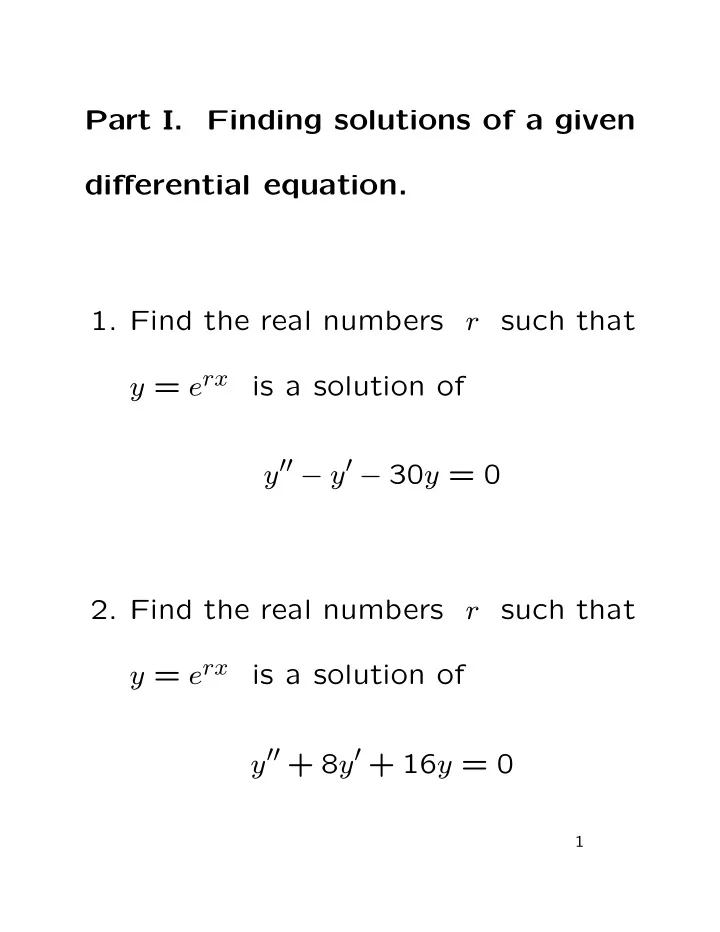
SLIDE 1 Part I. Finding solutions of a given differential equation.
- 1. Find the real numbers r
such that y = erx is a solution of y′′ − y′ − 30y = 0
- 2. Find the real numbers r
such that y = erx is a solution of y′′ + 8y′ + 16y = 0
1
SLIDE 2
- 3. Find the real numbers r
such that y = erx is a solution of y′′ − 2y′ + 10y = 0
- 4. Find the real numbers r
such that y = xr is a solution of x2y′′ − 5xy′ + 8y = 0
- 5. Find the real numbers r
such that y = xr is a solution of y′′ − 5 x y′ + 9 x2y = 0
SLIDE 3 Part II. Find the differential equa- tion for an n-parameter family of curves. Examples:
- 1. y2 = Cx3 − 2.
- 2. y = C1 x3 + C2
x .
- 3. y = C1 e−2x + C2 xe−2x.
SLIDE 4
- 4. y3 = C(x − 2)2 + 4
- 5. y = C1 e3x cos 4x + C2 e3x sin 4x.
- 6. y = C1 e−2x + C2 e5x.
- 7. y = C1 + C2e4x + 2x
- 8. y3 = Cx2 − 3x
SLIDE 5
SLIDE 6
SLIDE 7
SLIDE 8 Part III. Identify each of the follow- ing first order differential equations.
- 1. x(1 + y2) + y(1 + x2)y′ = 0.
- 2. xdy − 2y
x dx = x3e−xdx
- 3. (xy + y)y′ = x − xy.
- 4. xy2dy
dx = x3ey/x − x2y
x + x4y1/3.
SLIDE 9
- 6. (3x2 + 1)y′ − 2xy = 6x.
- 7. x2y′ = x2 + 3xy + y2
- 8. x(1 − y) + y(1 + x2)dy
dx = 0.
SLIDE 10 Part IV. First order linear equa- tions; find general solution, solve an initial-value problem.
- 1. Find the general solution of
x2 dy − 2xy dx = x4 cos 2x dx
- 2. Find the general solution of
(1 + x2) y′ + 1 + 2x y = 0
SLIDE 11
SLIDE 12
- 3. Find the general solution of
xy′ − y = 2x ln x
- 4. Find the solution of the initial-value
problem xy′ + 3y = ex x , y(1) = 2
y = y(x) is the solution of the initial-value problem y′ + 3y = 2 − 3e−x, y(0) = 2,
SLIDE 13
then lim
x→∞ y(x) =
SLIDE 14 Part V. Separable equations; find general solution, solve an initial-value problem. Examples:
- 1. Find the general solution of
y′ = xex+y
- 2. Find the general solution of
yy′ = xy2 − x − y2 + 1
SLIDE 15
- 3. Find the general solution of
ln x dy dx = y x
- 4. Find the solution of the initial-value
problem y′ = x2y − y y + 1 , y(3) = 1
SLIDE 16 Part VI. Bernoulli equations; find general solution. Examples:
- 1. Find the general solution of
y′ + xy = xy3
- 2. Find the general solution of
y′ = 4y + 2ex√y
SLIDE 17
SLIDE 18
- 3. Find the general solution of
xy′ + y = y2 ln x
SLIDE 19 Part VII. Homogeneous equations; find general solution. Examples:
- 1. Find the general solution of
y′ = y2 xy + y2
- 2. Find the general solution of
xy y′ = x2ey/x + y2
SLIDE 20
- 3. Find the general solution of
y′ = y +
x
SLIDE 21 Part VIII. Applications Examples:
- 1. Given the family of curves
y = Ce2x + 1 Find the family of orthogonal tra- jectories.
- 2. Given the family of curves
y2 = C(x + 2)3 − 2
SLIDE 22
SLIDE 23
SLIDE 24 Find the family of orthogonal tra- jectories.
- 3. Given the family of curves
y3 = Cx2 + 2 Find the family of orthogonal tra- jectories.
- 4. A 200 gallon tank, initially full of
water, develops a leak at the bot-
- tom. Given that 20% of the water
SLIDE 25
leaks out in the first 4 minutes, find the amount of water left in the tank t minutes after the leak develops if: (i) The water drains off a rate pro- portional to the amount of water present. (ii) The water drains off a rate pro- portional to the product of the time elapsed and the amount of water present.
SLIDE 26 (iii) The water drains off a rate pro- portional to the square root of the amount of water present.
- 5. A certain radioactive material is de-
caying at a rate proportional to the amount present. If a sample of 100 grams of the material was present initially and after 2 hours the sam- ple lost 20% of its mass, find:
SLIDE 27
SLIDE 28 (a) An expression for the mass of the material remaining at any time t. (b) The mass of the material after 4 hours. (c) The half-life of the material.
- 6. A biologist observes that a certain
bacterial colony triples every 4 hours and after 12 hours occupies 1 square
SLIDE 29
- centimeter. Assume that the colony
- beys the population growth law.
(a) How much area did the colony
- ccupy when first observed?
(b) What is the doubling time for the colony?
- 7. A thermometer is taken from a room
where the temperature is 72o F to the outside where the temperature
SLIDE 30
is 32o F . After 1/2 minute, the thermometer reads 50o F . Assume Newton’s Law of Cooling. (a) What will the thermometer read after it has been outside for 1 minute? (b) How many minutes does the ther- mometer have to be outside for it to read 35o F ?
SLIDE 31
- 8. An advertising company designs a
campaign to introduce a new prod- uct to a metropolitan area of pop- ulation M. Let P = P (t) de- note the number of people who be- come aware of the product by time t. Suppose that P increases at a rate proportional to the number
- f people still unaware of the prod-
- uct. The company determines that
no one was aware of the product at the beginning of the campaign and
SLIDE 32 that 30% of the people were aware
- f the product after 10 days of ad-
vertising. (a) Give the mathematical model (dif- ferential equation and initiation condition). (b) Determine the solution of the initial- value problem in (a). (c) Determine the value of the pro- portionality constant.
SLIDE 33 (d) How long does it take for 90% of the population to become aware
- f the product?
- 9. A disease is infecting a troop of 100
monkeys living in a remote preserve. Let M(t) be the number of sick monkeys t days after the outbreak. Suppose that the disease is spread- ing at a rate proportional to the product of the time elapsed and the
SLIDE 34
number of monkeys which have the disease. Suppose, also, that 20 monkeys had the disease initially, and that 30 monkeys were sick after 2 weeks. (a) Give the mathematical model (dif- ferential equation and initiation condition). (b) Determine the solution of the initial- value problem in (a).
SLIDE 35 (c) Determine the value of the pro- portionality constant. (d) How long does it take for 90% of the population to become aware
SLIDE 36 Part IX. Second order linear equa- tions; general theory. Examples: 1.
- y1(x) = e2x, y2(x) = e−2x
is a fun- damental set of solutions of a linear homogeneous differential equation. What is the equation? 2.
is a funda- mental set of solutions of a linear
SLIDE 37 homogeneous differential equation. What is the equation?
- 3. Given the differential equation
x2y′′ − 2x y′ − 10 y = 0 (a) Find two values of r such that y = xr is a solution of the equa- tion. (b) Determine a fundamental set of solutions and give the general so-
SLIDE 38 lution of the equation. (c) Find the solution of the equa- tion satisfying the initial condi- tions y(1) = 6, y′(1) = 2.
- 4. Given the differential equation
y′′ −
6
x
12
x2
(a) Find two values of r such that y = xr is a solution of the equa- tion.
SLIDE 39
(b) Determine a fundamental set of solutions and give the general so- lution of the equation. (c) Find the solution of the equa- tion satisfying the initial condi- tions y(1) = 2, y′(1) = −1. (d) Find the solution of the equa- tion satisfying the initial condi- tions y(2) = y′(2) = 0.
SLIDE 40 Part X. Homogeneous equations with constant coefficients. Examples:
- 1. Find the general solution of
y′′ + 10y′ + 25 y = 0
- 2. Find the general solution of
y′′ − 8 y′ + 15 y = 0
SLIDE 41
- 3. Find the general solution of
y′′ + 4y′ + 20y = 0
- 4. Find the solution of the initial-value
problem: y′′−2y′+2y = 0; y(0) = −1, y′(0) = −1
- 5. Find the solution of the initial-value
problem: y′′+4y′+4y = 0; y(−1) = 2, y′(−1) = 1
SLIDE 42
- 6. Find the general solution of
y′′ − 2α y′ + α2y = 0, α a constant.
- 7. Find the general solution of
y′′ − 2α y′ + (α2 + β2)y = 0, α, β constants.
y = 2e3x − 5e−4x is a solution of a second order linear
SLIDE 43 differential equation with constant
- coefficients. What is the equation?
- 9. The function
y = 7e−3x cos 2x is a solution of a second order linear differential equation with constant
- coefficients. What is the equation?
- 10. Find a second order linear homo-
geneous differential equation with constant coefficients that has y = e−4x as a solution.
SLIDE 44
y = 6xe4x is a solu- tion of a second order linear differ- ential equation with constant coef-
- ficients. What is the equation?