SLIDE 1
ECO 305 — FALL 2003 — October 23
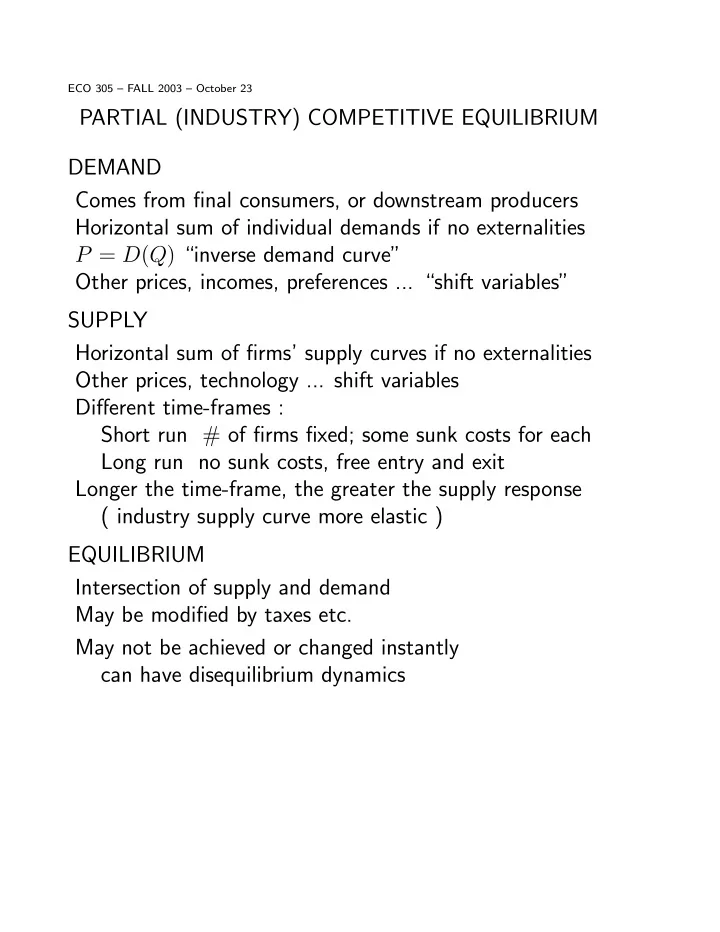
PARTIAL (INDUSTRY) COMPETITIVE EQUILIBRIUM DEMAND Comes from final consumers, or downstream producers Horizontal sum of individual demands if no externalities P = D(Q) “inverse demand curve” Other prices, incomes, preferences ... “shift variables” SUPPLY Horizontal sum of firms’ supply curves if no externalities Other prices, technology ... shift variables Different time-frames : Short run # of firms fixed; some sunk costs for each Long run no sunk costs, free entry and exit Longer the time-frame, the greater the supply response ( industry supply curve more elastic ) EQUILIBRIUM Intersection of supply and demand May be modified by taxes etc. May not be achieved or changed instantly can have disequilibrium dynamics
SLIDE 2
COMPARATIVE STATICS Change in some exogenous variable Shift of one curve, causes movement along the other Compare new equilibrium with old EXAMPLE — TAX INCIDENCE ECO 102 PICTURE Pd = price paid by consumers Ps = price received by firms t = tax per unit of the good With “normal” D and S Pd rises by less than t Ps falls by less than t Q decreases
SLIDE 3
CALCULUS METHOD Pd = D(Q), Ps = S(Q), Pd − Ps = t Everything is a function of t. Differentiate: dPd dt = D0(Q) dQ dt , dPs dt = S0(Q)|dQ dt , and dPd dt − dPs dt = 1 Substitute and solve (eqns. linear in derivatives) dQ dt = 1 D0(Q) − S0(Q) dPd dt = D0(Q) D0(Q) − S0(Q), dPs dt = S0(Q) D0(Q) − S0(Q) In “normal” case D0(Q) < 0, S0(Q) > 0, and dQ dt < 0, 0 < dPd dt < 1, −1 < dPs dt < 0 Enables more precise quantitative calculations CS and PS
SLIDE 4
CONSUMER SURPLUS Utility: U(x, y) = y + F(x) Budget: p x + y = M FONC: p = F 0(x) SOSC: F 00(x) < 0 When quantity q consumed, F(q) = F(0) +
Z q
0 F 0(x) dx
Spending E = p q = q F 0(q) CS(q) = [F(q) − F(0)] − E PRODUCER SURPLUS Cost: C(x) Profit: Π(x) = p x − C(x) FONC: p = C0(x) SOSC: C00(x) > 0 When quantity q produced, C(q) = FC +
Z q
0 C0(x) dx
Revenue R = p q PS(q) = R − [C(q) − FC] F(q) − C(q) = CS(q) + PS(q) + FC − F(0) Social optimum: F 0(q∗) = C0(q∗) = p∗ Achieved in competitive equilibrium