Particles approximation for Vlasov equation with singular interaction - - PowerPoint PPT Presentation

particles approximation for vlasov equation with singular
SMART_READER_LITE
LIVE PREVIEW

Particles approximation for Vlasov equation with singular interaction - - PowerPoint PPT Presentation

Particles approximation for Vlasov equation with singular interaction M. Hauray, in collaboration with P.-E. Jabin. Universit e dAix-Marseille Oberwolfach Worshop, December 2013 M. Hauray (UAM) Particles systems towards Vlasov


slide-1
SLIDE 1

Particles approximation for Vlasov equation with singular interaction

  • M. Hauray, in collaboration with P.-E. Jabin.

Universit´ e d’Aix-Marseille

Oberwolfach Worshop, December 2013

  • M. Hauray (UAM)

Particles systems towards Vlasov Oberwolfach, Dec. 2013 1 / 27

slide-2
SLIDE 2

Outline

1

Introduction of the problem

2

A toy model: the 1D Vlasov-Poisson system.

3

The convergence of particles systems in 3D

4

Some ingredients of the proof.

5

The related problem of stability

  • M. Hauray (UAM)

Particles systems towards Vlasov Oberwolfach, Dec. 2013 2 / 27

slide-3
SLIDE 3

Outline

1

Introduction of the problem

2

A toy model: the 1D Vlasov-Poisson system.

3

The convergence of particles systems in 3D

4

Some ingredients of the proof.

5

The related problem of stability

  • M. Hauray (UAM)

Particles systems towards Vlasov Oberwolfach, Dec. 2013 2 / 27

slide-4
SLIDE 4

Outline

1

Introduction of the problem

2

A toy model: the 1D Vlasov-Poisson system.

3

The convergence of particles systems in 3D

4

Some ingredients of the proof.

5

The related problem of stability

  • M. Hauray (UAM)

Particles systems towards Vlasov Oberwolfach, Dec. 2013 2 / 27

slide-5
SLIDE 5

Outline

1

Introduction of the problem

2

A toy model: the 1D Vlasov-Poisson system.

3

The convergence of particles systems in 3D

4

Some ingredients of the proof.

5

The related problem of stability

  • M. Hauray (UAM)

Particles systems towards Vlasov Oberwolfach, Dec. 2013 2 / 27

slide-6
SLIDE 6

Outline

1

Introduction of the problem

2

A toy model: the 1D Vlasov-Poisson system.

3

The convergence of particles systems in 3D

4

Some ingredients of the proof.

5

The related problem of stability

  • M. Hauray (UAM)

Particles systems towards Vlasov Oberwolfach, Dec. 2013 2 / 27

slide-7
SLIDE 7

Introduction of the problem

Particle systems with singular forces.

N particles with masses (or charges) ai/N, positions Xi et speed Vi in R2d [Zi = (Xi, Vi)] interacting through force F ∀i ≤ N,

  • ˙

Xi = Vi ˙ Vi = 1

N

  • j=i ajF(Xi − Xj) +

0 dBi. Singular forces : Satisfying for some 0 < α < d − 1, F ∈ C 1

b (Rd\{0}) and :

F(x) ∼

x→0

x |x|α+1 precisely |F(x)| ≤

C |x|α ,

|∇F| ≤

C |x|α+1

(Sα-condition) About the resolution Repulsive case : OK (No collisions). Attractive case : For α = d − 1 ⇒ N-body problem. True collisions are rare, but does non non-collisions singularities are? (Xia) and (Saary) α < 1 : OK by DiPerna-Lions theory. For N large, particles systems should converge towards...

  • M. Hauray (UAM)

Particles systems towards Vlasov Oberwolfach, Dec. 2013 3 / 27

slide-8
SLIDE 8

Introduction of the problem

Particle systems with singular forces.

N particles with masses (or charges) ai/N, positions Xi et speed Vi in R2d [Zi = (Xi, Vi)] interacting through force F ∀i ≤ N,

  • ˙

Xi = Vi ˙ Vi = 1

N

  • j=i ajF(Xi − Xj) +

0 dBi. Singular forces : Satisfying for some 0 < α < d − 1, F ∈ C 1

b (Rd\{0}) and :

F(x) ∼

x→0

x |x|α+1 precisely |F(x)| ≤

C |x|α ,

|∇F| ≤

C |x|α+1

(Sα-condition) About the resolution Repulsive case : OK (No collisions). Attractive case : For α = d − 1 ⇒ N-body problem. True collisions are rare, but does non non-collisions singularities are? (Xia) and (Saary) α < 1 : OK by DiPerna-Lions theory. For N large, particles systems should converge towards...

  • M. Hauray (UAM)

Particles systems towards Vlasov Oberwolfach, Dec. 2013 3 / 27

slide-9
SLIDE 9

Introduction of the problem

Particle systems with singular forces.

N particles with masses (or charges) ai/N, positions Xi et speed Vi in R2d [Zi = (Xi, Vi)] interacting through force F ∀i ≤ N,

  • ˙

Xi = Vi ˙ Vi = 1

N

  • j=i ajF(Xi − Xj) +

0 dBi. Singular forces : Satisfying for some 0 < α < d − 1, F ∈ C 1

b (Rd\{0}) and :

F(x) ∼

x→0

x |x|α+1 precisely |F(x)| ≤

C |x|α ,

|∇F| ≤

C |x|α+1

(Sα-condition) About the resolution Repulsive case : OK (No collisions). Attractive case : For α = d − 1 ⇒ N-body problem. True collisions are rare, but does non non-collisions singularities are? (Xia) and (Saary) α < 1 : OK by DiPerna-Lions theory. For N large, particles systems should converge towards...

  • M. Hauray (UAM)

Particles systems towards Vlasov Oberwolfach, Dec. 2013 3 / 27

slide-10
SLIDE 10

Introduction of the problem

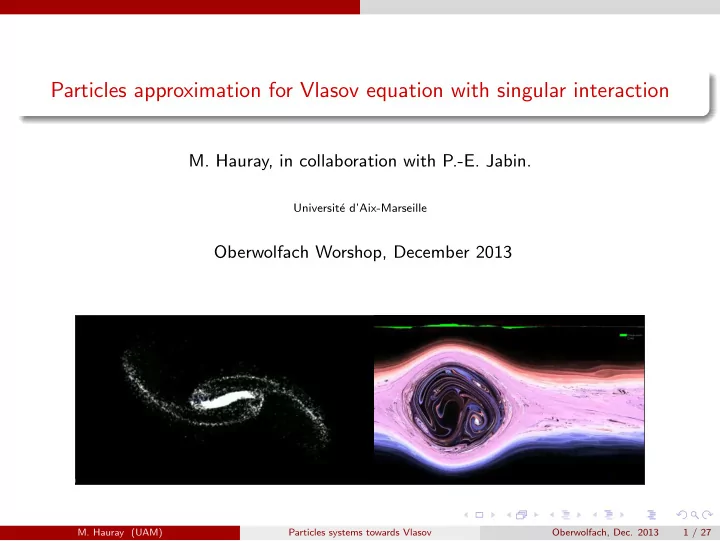
An example : Antennae galaxies.

  • M. Hauray (UAM)

Particles systems towards Vlasov Oberwolfach, Dec. 2013 4 / 27

slide-11
SLIDE 11

Introduction of the problem

The Vlasov-“Poisson” equation

f (t, x, v) is the density of particles and satisfies :    ∂tf + v · ∇xf + E(t, x) · ∇vf = 0 E(t, x) =

  • Ω F(x − y)ρ(t, y) dy,

ρ(t, x) =

  • f (t, x, v) dv

(1) + initial condition: f (0, x, v) = f 0(x, v). Two particular cases : F(x) = ±c

x |x|d ⇒ E = −∇V , ∆V = ±ρ,

−: gravitationnal case , +: Coulombian one. About the Resolution Compact school : Pfaffelm¨

  • ser (’92), Sch¨

affer(’93), H¨

  • rst (’96).

Moment school : Lions-Perthame (’91), Jabin-Illner-Perthame (’99), Pallard (’11). α < 1 : much simpler. In the following, f (t) is a compactly supported and strong solution of (1).

  • M. Hauray (UAM)

Particles systems towards Vlasov Oberwolfach, Dec. 2013 5 / 27

slide-12
SLIDE 12

Introduction of the problem

The Vlasov-“Poisson” equation

f (t, x, v) is the density of particles and satisfies :    ∂tf + v · ∇xf + E(t, x) · ∇vf = 0 E(t, x) =

  • Ω F(x − y)ρ(t, y) dy,

ρ(t, x) =

  • f (t, x, v) dv

(1) + initial condition: f (0, x, v) = f 0(x, v). Two particular cases : F(x) = ±c

x |x|d ⇒ E = −∇V , ∆V = ±ρ,

−: gravitationnal case , +: Coulombian one. About the Resolution Compact school : Pfaffelm¨

  • ser (’92), Sch¨

affer(’93), H¨

  • rst (’96).

Moment school : Lions-Perthame (’91), Jabin-Illner-Perthame (’99), Pallard (’11). α < 1 : much simpler. In the following, f (t) is a compactly supported and strong solution of (1).

  • M. Hauray (UAM)

Particles systems towards Vlasov Oberwolfach, Dec. 2013 5 / 27

slide-13
SLIDE 13

Introduction of the problem

The Vlasov-“Poisson” equation

f (t, x, v) is the density of particles and satisfies :    ∂tf + v · ∇xf + E(t, x) · ∇vf = 0 E(t, x) =

  • Ω F(x − y)ρ(t, y) dy,

ρ(t, x) =

  • f (t, x, v) dv

(1) + initial condition: f (0, x, v) = f 0(x, v). Two particular cases : F(x) = ±c

x |x|d ⇒ E = −∇V , ∆V = ±ρ,

−: gravitationnal case , +: Coulombian one. About the Resolution Compact school : Pfaffelm¨

  • ser (’92), Sch¨

affer(’93), H¨

  • rst (’96).

Moment school : Lions-Perthame (’91), Jabin-Illner-Perthame (’99), Pallard (’11). α < 1 : much simpler. In the following, f (t) is a compactly supported and strong solution of (1).

  • M. Hauray (UAM)

Particles systems towards Vlasov Oberwolfach, Dec. 2013 5 / 27

slide-14
SLIDE 14

Introduction of the problem

The Vlasov-“Poisson” equation

f (t, x, v) is the density of particles and satisfies :    ∂tf + v · ∇xf + E(t, x) · ∇vf = 0 E(t, x) =

  • Ω F(x − y)ρ(t, y) dy,

ρ(t, x) =

  • f (t, x, v) dv

(1) + initial condition: f (0, x, v) = f 0(x, v). Two particular cases : F(x) = ±c

x |x|d ⇒ E = −∇V , ∆V = ±ρ,

−: gravitationnal case , +: Coulombian one. About the Resolution Compact school : Pfaffelm¨

  • ser (’92), Sch¨

affer(’93), H¨

  • rst (’96).

Moment school : Lions-Perthame (’91), Jabin-Illner-Perthame (’99), Pallard (’11). α < 1 : much simpler. In the following, f (t) is a compactly supported and strong solution of (1).

  • M. Hauray (UAM)

Particles systems towards Vlasov Oberwolfach, Dec. 2013 5 / 27

slide-15
SLIDE 15

Introduction of the problem

The case of regular interaction forces.

Important remark : Under the assumption F(0) = 0, The empirical distribution µN

Z (t) = 1

N

N

  • i=1

aiδZi (t)

  • f the particle system is a solution of the Vlasov eq. (1).

⇒ For smooth F, a theory of measure solutions of the Vlasov eq. is possible Stability of meas. sol ⇒ Convergence of part. systems Theorem (Braun & Hepp ’77, Neunzert & Wick ’79, Dobrushin) Two measures solution µ and ν of the Vlasov eq. satisfy W1(µ(t), ν(t)) ≤ e(1+2 ∇F∞)tW1(µ0, ν0) Also CLT available using linearisation of VP, ... W1 is the order one Monge-Kantorovitch-Wasserstein distance.

  • M. Hauray (UAM)

Particles systems towards Vlasov Oberwolfach, Dec. 2013 6 / 27

slide-16
SLIDE 16

Introduction of the problem

The case of regular interaction forces.

Important remark : Under the assumption F(0) = 0, The empirical distribution µN

Z (t) = 1

N

N

  • i=1

aiδZi (t)

  • f the particle system is a solution of the Vlasov eq. (1).

⇒ For smooth F, a theory of measure solutions of the Vlasov eq. is possible Stability of meas. sol ⇒ Convergence of part. systems Theorem (Braun & Hepp ’77, Neunzert & Wick ’79, Dobrushin) Two measures solution µ and ν of the Vlasov eq. satisfy W1(µ(t), ν(t)) ≤ e(1+2 ∇F∞)tW1(µ0, ν0) Also CLT available using linearisation of VP, ... W1 is the order one Monge-Kantorovitch-Wasserstein distance.

  • M. Hauray (UAM)

Particles systems towards Vlasov Oberwolfach, Dec. 2013 6 / 27

slide-17
SLIDE 17

Introduction of the problem

The case of regular interaction forces.

Important remark : Under the assumption F(0) = 0, The empirical distribution µN

Z (t) = 1

N

N

  • i=1

aiδZi (t)

  • f the particle system is a solution of the Vlasov eq. (1).

⇒ For smooth F, a theory of measure solutions of the Vlasov eq. is possible Stability of meas. sol ⇒ Convergence of part. systems Theorem (Braun & Hepp ’77, Neunzert & Wick ’79, Dobrushin) Two measures solution µ and ν of the Vlasov eq. satisfy W1(µ(t), ν(t)) ≤ e(1+2 ∇F∞)tW1(µ0, ν0) Also CLT available using linearisation of VP, ... W1 is the order one Monge-Kantorovitch-Wasserstein distance.

  • M. Hauray (UAM)

Particles systems towards Vlasov Oberwolfach, Dec. 2013 6 / 27

slide-18
SLIDE 18

Introduction of the problem

The quantic equivalent is “better” understood.

Convergence of Hartree-Fock towards Schordinger-Poisson already obtained by (Bardos, Golse, ... ’90), Erd¨

  • s-Yau, Nier (’12), Pickl.

Formalism more complex, but the non exact localization of particles may act like a cut-off.

  • M. Hauray (UAM)

Particles systems towards Vlasov Oberwolfach, Dec. 2013 7 / 27

slide-19
SLIDE 19

Introduction of the problem

Numerical approximation with soften forces : PIC methods

Particle-in-Cell methods : introduce virtual ”large” particles to solve the VP equation. The Poisson or gravitational force is cut off at a length ε(N) : Fε(x) =

x (|x|+ε)d .

Two possibilities for the computation of the field : PM : Compute it at the nodes of a mesh with the appropriate solver (plasma). PP : Use only binary interaction (astrophysics). Problem : PP requires normally N2 operations, except if you use a tree code (cost reduced to N ln N). Theorem (Cottet-Raviart ’91, Victory & all ’89) Assume that f is a smooth solution of the VP equation, with initial data f 0. The Z N

i (0) at the node of a mesh of size β ≈ N1/2d, and ai = f 0(Z N i (0)).

ε ≈ βr for some r < 1. Then, if the ¯ Z N

i (t) are transported by the flow of the VP eq. (¯

Z N

i (0) = Z N i (0))

Z N(t) − ¯ Z N(t)p ≤ CN−s, for some s > 0. s depends on the regularity of f , and the cut-off used.

  • M. Hauray (UAM)

Particles systems towards Vlasov Oberwolfach, Dec. 2013 8 / 27

slide-20
SLIDE 20

Introduction of the problem

Numerical approximation with soften forces : PIC methods

Particle-in-Cell methods : introduce virtual ”large” particles to solve the VP equation. The Poisson or gravitational force is cut off at a length ε(N) : Fε(x) =

x (|x|+ε)d .

Two possibilities for the computation of the field : PM : Compute it at the nodes of a mesh with the appropriate solver (plasma). PP : Use only binary interaction (astrophysics). Problem : PP requires normally N2 operations, except if you use a tree code (cost reduced to N ln N). Theorem (Cottet-Raviart ’91, Victory & all ’89) Assume that f is a smooth solution of the VP equation, with initial data f 0. The Z N

i (0) at the node of a mesh of size β ≈ N1/2d, and ai = f 0(Z N i (0)).

ε ≈ βr for some r < 1. Then, if the ¯ Z N

i (t) are transported by the flow of the VP eq. (¯

Z N

i (0) = Z N i (0))

Z N(t) − ¯ Z N(t)p ≤ CN−s, for some s > 0. s depends on the regularity of f , and the cut-off used.

  • M. Hauray (UAM)

Particles systems towards Vlasov Oberwolfach, Dec. 2013 8 / 27

slide-21
SLIDE 21

Introduction of the problem

Numerical approximation with soften forces : PIC methods

Particle-in-Cell methods : introduce virtual ”large” particles to solve the VP equation. The Poisson or gravitational force is cut off at a length ε(N) : Fε(x) =

x (|x|+ε)d .

Two possibilities for the computation of the field : PM : Compute it at the nodes of a mesh with the appropriate solver (plasma). PP : Use only binary interaction (astrophysics). Problem : PP requires normally N2 operations, except if you use a tree code (cost reduced to N ln N). Theorem (Cottet-Raviart ’91, Victory & all ’89) Assume that f is a smooth solution of the VP equation, with initial data f 0. The Z N

i (0) at the node of a mesh of size β ≈ N1/2d, and ai = f 0(Z N i (0)).

ε ≈ βr for some r < 1. Then, if the ¯ Z N

i (t) are transported by the flow of the VP eq. (¯

Z N

i (0) = Z N i (0))

Z N(t) − ¯ Z N(t)p ≤ CN−s, for some s > 0. s depends on the regularity of f , and the cut-off used.

  • M. Hauray (UAM)

Particles systems towards Vlasov Oberwolfach, Dec. 2013 8 / 27

slide-22
SLIDE 22

A toy model: the 1D Vlasov-Poisson system.

The mean-field limit for VP1D.

In 1D, the interaction is not very singular: F(x) = sign(x). ⇒ the problem is simpler. In fact there is a weak-strong stability principle for the 1D VP equation Theorem (H. 2013) Assume that: f is a solution to VP1D with bounded density ρ, µ is a weak measure solution. Then, for some c > 0 and all t ≥ 0 W1(f (t), µ(t) ≤ ec

t

0 ρ(s)∞ dsW1(f 0, µ0).

But µ = µN is allowed. It implies Theorem (Mean-field limit, Trocheris ’86) If µ0

N ⇀ f 0, then for any time t ≥ 0

µN(t) ⇀ f (t).

  • M. Hauray (UAM)

Particles systems towards Vlasov Oberwolfach, Dec. 2013 9 / 27

slide-23
SLIDE 23

A toy model: the 1D Vlasov-Poisson system.

The mean-field limit for VP1D.

In 1D, the interaction is not very singular: F(x) = sign(x). ⇒ the problem is simpler. In fact there is a weak-strong stability principle for the 1D VP equation Theorem (H. 2013) Assume that: f is a solution to VP1D with bounded density ρ, µ is a weak measure solution. Then, for some c > 0 and all t ≥ 0 W1(f (t), µ(t) ≤ ec

t

0 ρ(s)∞ dsW1(f 0, µ0).

But µ = µN is allowed. It implies Theorem (Mean-field limit, Trocheris ’86) If µ0

N ⇀ f 0, then for any time t ≥ 0

µN(t) ⇀ f (t).

  • M. Hauray (UAM)

Particles systems towards Vlasov Oberwolfach, Dec. 2013 9 / 27

slide-24
SLIDE 24

A toy model: the 1D Vlasov-Poisson system.

The propagation of molecular chaos.

The notion goes back to L. Boltzmann and its famous ”Stosszahl Ansatz”. Formalized by Sniztmann Definition (Chaotic sequences of particle distribution.) A sequence of symmetric probabilities (F N) of P(R2dN) is f -chaotic if (equivalent conditions)

1

µN ⇀ f in law in P(R2d),

2

For all k the sequence of k marginals F N

k ⇀ f ⊗k,

3

F N

2 ⇀ f ⊗2.

It is also possible to quantify that notion of convergence: (Mischler & Mouhot) or (H. & Mischler). W1(F N

2 , f ⊗2) ≤ 1

N W1(F N, f ⊗N) ≤ C

  • W1(F N

2 , f ⊗2)

α.

  • M. Hauray (UAM)

Particles systems towards Vlasov Oberwolfach, Dec. 2013 10 / 27

slide-25
SLIDE 25

A toy model: the 1D Vlasov-Poisson system.

The propagation of molecular chaos for VP1D.

Just take the expectation of the mean-field result. Theorem (Prop of chaos for VP1D) If f is a solution to VP1D with bounded density: Then, for some c > 0 and all t ≥ 0 E

  • W1(f (t), µ(t)
  • ≤ ec

t

0 ρ(s)∞ dsE

  • W1(f 0, µ0)
  • .

Obtain also large deviation upper bound in the same way. Results are also obtained on the trajectories.

  • M. Hauray (UAM)

Particles systems towards Vlasov Oberwolfach, Dec. 2013 11 / 27

slide-26
SLIDE 26

A toy model: the 1D Vlasov-Poisson system.

A more usual viewpoint: The Vlasov Hierarchy.

The Liouville Equation for the time marginals of the N ”indistinguishable” particles ∂tF N +

2

  • i=1

vi · ∇xi F N + 1 N

  • i=j

∇V (xi − xj) · ∇vi F N = 0, satisfies in the limit N → +∞ the Vlasov Hierarchy ∂tF1 + v1 · ∇x1F1 +

  • ∇V (x1 − x2) · ∇v1F2(v1, v2) dv2 = 0,

. . . ∂tFi +

  • j=1i

vj · ∇xj F1 +

i

  • j=1
  • ∇V (xj − xi+1) · ∇v1Fi+1(v1, . . . , vi+1) dvi+1 = 0,

The propagation of molecular chaos roughly says that F k = f ⊗k, which is necessary to get a non-linear one particle model form the linear Hierarchy.

  • M. Hauray (UAM)

Particles systems towards Vlasov Oberwolfach, Dec. 2013 12 / 27

slide-27
SLIDE 27

A toy model: the 1D Vlasov-Poisson system.

A more usual viewpoint: The Vlasov Hierarchy.

The Liouville Equation for the time marginals of the N ”indistinguishable” particles ∂tF N +

2

  • i=1

vi · ∇xi F N + 1 N

  • i=j

∇V (xi − xj) · ∇vi F N = 0, satisfies in the limit N → +∞ the Vlasov Hierarchy ∂tF1 + v1 · ∇x1F1 +

  • ∇V (x1 − x2) · ∇v1F2(v1, v2) dv2 = 0,

. . . ∂tFi +

  • j=1i

vj · ∇xj F1 +

i

  • j=1
  • ∇V (xj − xi+1) · ∇v1Fi+1(v1, . . . , vi+1) dvi+1 = 0,

The propagation of molecular chaos roughly says that F k = f ⊗k, which is necessary to get a non-linear one particle model form the linear Hierarchy.

  • M. Hauray (UAM)

Particles systems towards Vlasov Oberwolfach, Dec. 2013 12 / 27

slide-28
SLIDE 28

A toy model: the 1D Vlasov-Poisson system.

A more usual viewpoint: The Vlasov Hierarchy.

The Liouville Equation for the time marginals of the N ”indistinguishable” particles ∂tF N +

2

  • i=1

vi · ∇xi F N + 1 N

  • i=j

∇V (xi − xj) · ∇vi F N = 0, satisfies in the limit N → +∞ the Vlasov Hierarchy ∂tF1 + v1 · ∇x1F1 +

  • ∇V (x1 − x2) · ∇v1F2(v1, v2) dv2 = 0,

. . . ∂tFi +

  • j=1i

vj · ∇xj F1 +

i

  • j=1
  • ∇V (xj − xi+1) · ∇v1Fi+1(v1, . . . , vi+1) dvi+1 = 0,

The propagation of molecular chaos roughly says that F k = f ⊗k, which is necessary to get a non-linear one particle model form the linear Hierarchy.

  • M. Hauray (UAM)

Particles systems towards Vlasov Oberwolfach, Dec. 2013 12 / 27

slide-29
SLIDE 29

A toy model: the 1D Vlasov-Poisson system.

A strong result: Propagation of entropic chaos.

Definition (Entropy chaotic sequences.) A sequence of symmetric probabilities (F N) of P(R2dN) is f -chaotic if it is f -chaotic, 1 N H(F N) → H(f ). A stronger notion: ⇒ strong convergence of the marginals lim

N→+∞

  • F N

k − f ⊗k

  • 1 = 0

Theorem (Prop. of entropic chaos.) The propagation of entropic chaos holds for the VP1D equation. It is a “simple” consequence of the preservation of entropy in VP1D and Liouville equation. What about Fisher chaos?

  • M. Hauray (UAM)

Particles systems towards Vlasov Oberwolfach, Dec. 2013 13 / 27

slide-30
SLIDE 30

A toy model: the 1D Vlasov-Poisson system.

A strong result: Propagation of entropic chaos.

Definition (Entropy chaotic sequences.) A sequence of symmetric probabilities (F N) of P(R2dN) is f -chaotic if it is f -chaotic, 1 N H(F N) → H(f ). A stronger notion: ⇒ strong convergence of the marginals lim

N→+∞

  • F N

k − f ⊗k

  • 1 = 0

Theorem (Prop. of entropic chaos.) The propagation of entropic chaos holds for the VP1D equation. It is a “simple” consequence of the preservation of entropy in VP1D and Liouville equation. What about Fisher chaos?

  • M. Hauray (UAM)

Particles systems towards Vlasov Oberwolfach, Dec. 2013 13 / 27

slide-31
SLIDE 31

The convergence of particles systems in 3D

The “‘mean-field” convergence result (compact support).

In the sequel, we set ai = 1 for all i (all the particles have the same mass). Theorem (H., Jabin ’11) Assume that F satisfies a Sα-condition with α < d − 1, and that f is a strong bounded sol. of VP’, and γ ∈ (0, 1). For each N, choose the initial positions (Zi) such that (i) sup

z∈R2d N−1µ

  • B(z, N− γ

2d )

  • ≤ C

(ii) inf

i=j |Xi(0) − Xj(0)| ≥ C N− γ(1+r)

2d

, for some r < d−1

α+1. Then for some κ > 0

W1(µN

z (t), f (t)) ≤ eκt

W1(µN

z (0), f0) + 2 N− γ

2d

  • The r may be chosen larger than 1 only for d > 3. It implies the next result.
  • M. Hauray (UAM)

Particles systems towards Vlasov Oberwolfach, Dec. 2013 14 / 27

slide-32
SLIDE 32

The convergence of particles systems in 3D

Chaos propagation for singular interactions.

In the sequel, we set ai = 1 for all i (all the particles have the same mass). Theorem (H., Jabin ’11) Assume that F satisfies a Sα-condition with α < 1 if d ≥ 3, α < 1 2 if d = 2 For each N, choose the initial positions Zi independently according to the continuous and compact profile f 0. Then propagation of chaos holds and precisely for γ < 1 (but close enough) there exists κ (almost as before) and β > 0 (but small) s.t. P

  • W1(µN

z (t), f (t)) ≥ eκt

N

γ 2d

  • ≤ C

Nβ Roughly : For independent initial conditions with profile f 0, we have with large probability W1(µN

z (0), f 0) ≤ ε := N− 1

2d

which propagates in time W1(µN

z (t), f (t)) ≤ eκtε.

  • M. Hauray (UAM)

Particles systems towards Vlasov Oberwolfach, Dec. 2013 15 / 27

slide-33
SLIDE 33

The convergence of particles systems in 3D

The first scale : Average distance between particles.

Precisely : Average distance between a particle and its closest neighbour in phase space.

Heuristic : Pick all Zi uniformly in [0, 1]2d. Average distance of order N− 1

2d .

Precise results : Proposition (Peyre ’07,Boissard ’11) For N independant r.v. Zi with law f compact and d ≥ 2, there exists a constant L0 such that P

  • W1(µN

z , f ) ≥

L N

1 2d

  • ≤ e−Nα(L−L0)

α= d−1

2d

Remark : W1(µN

z , f ) ≥ c f ∞ N− 1

2d

Theorem (Gao ’03) If νN = µN ∗

χBε |Bε| with ε = N− γ

2d , then

lim sup

N→+∞

1 N1−γ ln P (νN∞ ≥ 2f ∞) ≤ cf ∞,

with c=|B1|(2 ln 2−1)

  • M. Hauray (UAM)

Particles systems towards Vlasov Oberwolfach, Dec. 2013 16 / 27

slide-34
SLIDE 34

The convergence of particles systems in 3D

The first scale : Average distance between particles.

Precisely : Average distance between a particle and its closest neighbour in phase space.

Heuristic : Pick all Zi uniformly in [0, 1]2d. Average distance of order N− 1

2d .

Precise results : Proposition (Peyre ’07,Boissard ’11) For N independant r.v. Zi with law f compact and d ≥ 2, there exists a constant L0 such that P

  • W1(µN

z , f ) ≥

L N

1 2d

  • ≤ e−Nα(L−L0)

α= d−1

2d

Remark : W1(µN

z , f ) ≥ c f ∞ N− 1

2d

Theorem (Gao ’03) If νN = µN ∗

χBε |Bε| with ε = N− γ

2d , then

lim sup

N→+∞

1 N1−γ ln P (νN∞ ≥ 2f ∞) ≤ cf ∞,

with c=|B1|(2 ln 2−1)

  • M. Hauray (UAM)

Particles systems towards Vlasov Oberwolfach, Dec. 2013 16 / 27

slide-35
SLIDE 35

The convergence of particles systems in 3D

The first scale : Average distance between particles.

Precisely : Average distance between a particle and its closest neighbour in phase space.

Heuristic : Pick all Zi uniformly in [0, 1]2d. Average distance of order N− 1

2d .

Precise results : Proposition (Peyre ’07,Boissard ’11) For N independant r.v. Zi with law f compact and d ≥ 2, there exists a constant L0 such that P

  • W1(µN

z , f ) ≥

L N

1 2d

  • ≤ e−Nα(L−L0)

α= d−1

2d

Remark : W1(µN

z , f ) ≥ c f ∞ N− 1

2d

Theorem (Gao ’03) If νN = µN ∗

χBε |Bε| with ε = N− γ

2d , then

lim sup

N→+∞

1 N1−γ ln P (νN∞ ≥ 2f ∞) ≤ cf ∞,

with c=|B1|(2 ln 2−1)

  • M. Hauray (UAM)

Particles systems towards Vlasov Oberwolfach, Dec. 2013 16 / 27

slide-36
SLIDE 36

The convergence of particles systems in 3D

An unphysical scale : the minimal inter-particle distance.

dN

z := min i=j (|Zi − Zj|)

Heuristic : Pick all Zi uniformly in [0, 1]2d. Minimal distance of order N− 1

d .

Precise results : Proposition (H. ’07) For Zi uniformly distributed with profile f bounded, then P

  • dN

z ≥

l N1/d

  • ≥ e−c2d f 0∞ld .

Important : It is a very weak deviation result. (Ineq. in bad sense). In fact, P

  • dN

z ≤

l N1/d

  • ≤ 1 − e−c2d f 0∞l−d ≤ c2df 0∞ld.

It is normal : no large deviation for minimum (or maximum).

  • M. Hauray (UAM)

Particles systems towards Vlasov Oberwolfach, Dec. 2013 17 / 27

slide-37
SLIDE 37

The convergence of particles systems in 3D

An unphysical scale : the minimal inter-particle distance.

dN

z := min i=j (|Zi − Zj|)

Heuristic : Pick all Zi uniformly in [0, 1]2d. Minimal distance of order N− 1

d .

Precise results : Proposition (H. ’07) For Zi uniformly distributed with profile f bounded, then P

  • dN

z ≥

l N1/d

  • ≥ e−c2d f 0∞ld .

Important : It is a very weak deviation result. (Ineq. in bad sense). In fact, P

  • dN

z ≤

l N1/d

  • ≤ 1 − e−c2d f 0∞l−d ≤ c2df 0∞ld.

It is normal : no large deviation for minimum (or maximum).

  • M. Hauray (UAM)

Particles systems towards Vlasov Oberwolfach, Dec. 2013 17 / 27

slide-38
SLIDE 38

Some ingredients of the proof.

Sketch of the proof (for d = 3).

Dirac Blobs Smooth µN

z (0)

W∞(0)

Npart

  • νN

z (0)

¯ W1(0)

  • VP
  • f (0)

VP

  • µN

z (t) W1(t) ≤W∞+ ¯

W1

  • W∞(t) νN

z (t)

¯ W1(t)

f (t)

1

(Probabilistic) Eliminate bad initial conditions.

2

(Deterministic) Estimate the distance ¯ W1(t) := W1(νN

z (t), f (t)).

3

(Deterministic) Estimate W∞(t) := W∞(µN

z (t), νN z (t)).

  • M. Hauray (UAM)

Particles systems towards Vlasov Oberwolfach, Dec. 2013 18 / 27

slide-39
SLIDE 39

Some ingredients of the proof.

Sketch of the proof (for d = 3).

Dirac Blobs Smooth µN

z (0)

W∞(0)

Npart

  • νN

z (0)

¯ W1(0)

  • VP
  • f (0)

VP

  • µN

z (t) W1(t) ≤W∞+ ¯

W1

  • W∞(t) νN

z (t)

¯ W1(t)

f (t)

1

(Probabilistic) Eliminate bad initial conditions.

2

(Deterministic) Estimate the distance ¯ W1(t) := W1(νN

z (t), f (t)).

3

(Deterministic) Estimate W∞(t) := W∞(µN

z (t), νN z (t)).

  • M. Hauray (UAM)

Particles systems towards Vlasov Oberwolfach, Dec. 2013 18 / 27

slide-40
SLIDE 40

Some ingredients of the proof.

Step 1 and 2

Step 1 : Choose r and γ such that 1 < r < 2 1 + α, 2 1 + r < γ < 1. Define our reference scale ε = N− γ

2d . Then with large probability we have,

  • νN

z (0)∞ ≤ 2f (0)∞,

  • dN

z ≥ ε1+r,

  • ¯

W1(0) ≤ Cε. Step 2 : Prove propagation of the compact support : Supp f (t), νN

z (t) ⊂ [−R(t), , R(t)]6.

Then bound ρ(t)∞ ≤ 2f (0)∞R(t)d. Use the following proposition Proposition (Loeper ’06) For two solutions of Vlasov-“Poisson” with an Sα-condition, α < d − 1 W1(f (t), g(t)) ≤ eκtW1(f (0), g(0)),

where κ=C supt∈[0,T](ρf (t)∞+ρg (t)∞)

  • M. Hauray (UAM)

Particles systems towards Vlasov Oberwolfach, Dec. 2013 19 / 27

slide-41
SLIDE 41

Some ingredients of the proof.

Step 1 and 2

Step 1 : Choose r and γ such that 1 < r < 2 1 + α, 2 1 + r < γ < 1. Define our reference scale ε = N− γ

2d . Then with large probability we have,

  • νN

z (0)∞ ≤ 2f (0)∞,

  • dN

z ≥ ε1+r,

  • ¯

W1(0) ≤ Cε. Step 2 : Prove propagation of the compact support : Supp f (t), νN

z (t) ⊂ [−R(t), , R(t)]6.

Then bound ρ(t)∞ ≤ 2f (0)∞R(t)d. Use the following proposition Proposition (Loeper ’06) For two solutions of Vlasov-“Poisson” with an Sα-condition, α < d − 1 W1(f (t), g(t)) ≤ eκtW1(f (0), g(0)),

where κ=C supt∈[0,T](ρf (t)∞+ρg (t)∞)

  • M. Hauray (UAM)

Particles systems towards Vlasov Oberwolfach, Dec. 2013 19 / 27

slide-42
SLIDE 42

Some ingredients of the proof.

Step 3

Choose the simplest coupling between µN

z (0) and νN z (t).

Integrate the evolution on a small interval of tim [t − εr′, t], ( r ′ > r). Compare the two mean fields with a partition of phase space

Figure : The partition of phase space.

and obtain the estimates...

  • M. Hauray (UAM)

Particles systems towards Vlasov Oberwolfach, Dec. 2013 20 / 27

slide-43
SLIDE 43

Some ingredients of the proof.

The estimates of step 3.

˜ W∞(t) − ˜ W∞(t − εr′) εr′ ≤ C2

  • ˜

W∞(t)

At

+ ελ1 ˜ W d

∞(t)

  • Bt

+ ελ2 ˜ W 2d

∞ (t) ˜

d−α

N

(t)

  • Ct
  • ,

|∇NE|∞(t) ≤ C2

  • 1 + ελ3 ˜

W d

∞(t) + ελ4 ˜

W 2d

∞ (t) ˜

d−α

N

(t))

  • ˜

dN(t) + εr′−r ≥ [˜ dN(t − τ) + εr′−r]e−τ(1+|∇NE|∞(t)). Where λi > 0, and the minimum is λ3 = d − 1 − (1 + α)r ′. ε sufficiently small ⇒ the system is almost linear ⇒ No Explosion.

  • M. Hauray (UAM)

Particles systems towards Vlasov Oberwolfach, Dec. 2013 21 / 27

slide-44
SLIDE 44

Some ingredients of the proof.

More singular but with cut-off.

We may use cuted-off forces Sα

m

|F(x)| ≤

C (|x|+εm)α ,

|∇F| ≤

C (|x|+εm)α+1

and get a similar result for α ≥ 1. Theorem (H., Jabin ’11) Assume that F satisfies a Sα

m-condition with

m < min d − 2 α − 1, 2d − 1 α

  • For each N initial independant positions with Zi law f 0 (continuous and compact). Then

propagation of chaos holds and precisely for γ < 1 (but close enough) there exists κ (almost as before) and β > 0 (but small) s.t. 1 Nβ ln P

  • W1(µN

z (t), f (t)) ≥ eκt

N

γ 2d

  • ≤ −C < 0.
  • M. Hauray (UAM)

Particles systems towards Vlasov Oberwolfach, Dec. 2013 22 / 27

slide-45
SLIDE 45

Some ingredients of the proof.

More singular but with cut-off.

We may use cuted-off forces Sα

m

|F(x)| ≤

C (|x|+εm)α ,

|∇F| ≤

C (|x|+εm)α+1

and get a similar result for α ≥ 1. Theorem (H., Jabin ’11) Assume that F satisfies a Sα

m-condition with

m < min d − 2 α − 1, 2d − 1 α

  • For each N initial independant positions with Zi law f 0 (continuous and compact). Then

propagation of chaos holds and precisely for γ < 1 (but close enough) there exists κ (almost as before) and β > 0 (but small) s.t. 1 Nβ ln P

  • W1(µN

z (t), f (t)) ≥ eκt

N

γ 2d

  • ≤ −C < 0.
  • M. Hauray (UAM)

Particles systems towards Vlasov Oberwolfach, Dec. 2013 22 / 27

slide-46
SLIDE 46

Some ingredients of the proof.

Perspectives : Towards more singular interaction.

An interesting question : Can we get some estimate on the second marginal F N

2 of the

N particles Law? → A difficult question since everything is correlated. Near a gaussian equilibrium, good stability properties can be shown even for singular forces (1 < α < 2). Work with P.-E. Jabin and J. Barr´ e, ’10. → Large use of good marginals properties in the only setting we know it (Since Messer & Spohn) .

  • M. Hauray (UAM)

Particles systems towards Vlasov Oberwolfach, Dec. 2013 23 / 27

slide-47
SLIDE 47

Some ingredients of the proof.

Perspectives : Towards more singular interaction.

An interesting question : Can we get some estimate on the second marginal F N

2 of the

N particles Law? → A difficult question since everything is correlated. Near a gaussian equilibrium, good stability properties can be shown even for singular forces (1 < α < 2). Work with P.-E. Jabin and J. Barr´ e, ’10. → Large use of good marginals properties in the only setting we know it (Since Messer & Spohn) .

  • M. Hauray (UAM)

Particles systems towards Vlasov Oberwolfach, Dec. 2013 23 / 27

slide-48
SLIDE 48

The related problem of stability

Stability of Vlasov Equilibrium.

Vlasov equation admits many equilibrium : Gravitationnal case : spherical galaxies. ⇒ They are non-linearly stable (M´ ehats, Lemou, Raphael ’10-11). Plasma in a periodic domain : Stationary profiles (f (x, v) = g(v)). ⇒ If decreasing they are non-lineraly stable (Marchioro & Pulvirenti, Batt & Rein ’93). ⇒ Penrose criteria : some double-humped profile are non-linearly unstable (Guo-Strauss ’95)

  • M. Hauray (UAM)

Particles systems towards Vlasov Oberwolfach, Dec. 2013 24 / 27

slide-49
SLIDE 49

The related problem of stability

Stability of N particles system around Vlasov equilibrium.

For the Hamiltonian Mean Field (HMF) model : x ∈ R/πZ and F = −∇V with V (x) = 1 − cos x 2

Figure : The stability law for QSS (from Yamaguchi, Barr´ e, Bouchet, Dauxois & Ruffo ’03 )

  • M. Hauray (UAM)

Particles systems towards Vlasov Oberwolfach, Dec. 2013 25 / 27

slide-50
SLIDE 50

The related problem of stability

Stability of N particles system : rigourous results.

Going back to the convergence result in the regular interaction case, we get W (µN(t), geq) ≤ e∇F∞tW (µN(t), geq) ≈ e∇F∞t N1/2d The N system stay close to feq at least till T = ln N. This has been improved Theorem (Caglioti & Rousset ’07-08) Assume that geq(|v|) is a smooth decreasing equilibrium, and the force is repulsive ( ˆ V ≤ 0). Then, in dimension N for almost all initial configuration, we have µN(t) − geqLipN ≤ C √ N (1 + Mt)2 for all t ≤ CN1/8.

  • M. Hauray (UAM)

Particles systems towards Vlasov Oberwolfach, Dec. 2013 26 / 27