PATIENT PROTECTION & AFFORDABLE CARE ACT 1 4/16/2015 - - PDF document

patient protection affordable care act 1 4 16 2015
SMART_READER_LITE
LIVE PREVIEW

PATIENT PROTECTION & AFFORDABLE CARE ACT 1 4/16/2015 - - PDF document

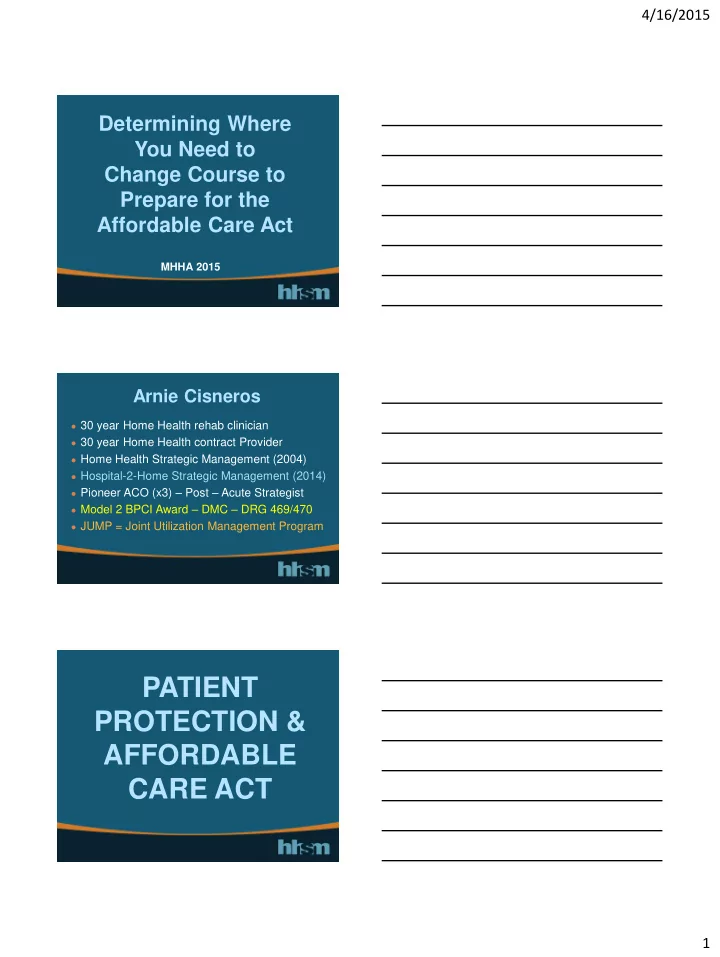
4/16/2015 Determining Where You Need to Change Course to Prepare for the Affordable Care Act MHHA 2015 Arnie Cisneros 30 year Home Health rehab clinician 30 year Home Health contract Provider Home Health Strategic Management (2004)


slide-1
SLIDE 1

4/16/2015 1

Determining Where You Need to Change Course to Prepare for the Affordable Care Act

MHHA 2015

Arnie Cisneros

  • 30 year Home Health rehab clinician
  • 30 year Home Health contract Provider
  • Home Health Strategic Management (2004)
  • Hospital-2-Home Strategic Management (2014)
  • Pioneer ACO (x3) – Post – Acute Strategist
  • Model 2 BPCI Award – DMC – DRG 469/470
  • JUMP = Joint Utilization Management Program

PATIENT PROTECTION & AFFORDABLE CARE ACT

slide-2
SLIDE 2

4/16/2015 2

ACCOUNTABLE CARE ORGANIZATIONS

Accountable Care Organizations

An ACO is a healthcare organization characterized by a payment and care delivery model that seeks to tie provider reimbursements to quality metrics and reductions in the total cost of care for an assigned population of patients.

CARE TRANSITIONS MANAGEMENT

slide-3
SLIDE 3

4/16/2015 3 Care Transitions Management

Care Transition refers to the movement patients make between health care settings as their condition and care needs change during the course of a chronic or acute illness; each shift from care providers and settings is defined as a care transition.

  • Post-Acute Bundling – 30 day episodic
  • Acute Discharges - Reinvention
  • Readmission focus – Episodic Result
  • Find Savings/Efficiencies
  • Redefine Acute Care – Care vs Provider
  • IT Use – connectivity thru episode
  • Traditional Versus Episodic

EPISODIC CARE DELIVERY

slide-4
SLIDE 4

4/16/2015 4 Episodic Care Delivery

The re-engineering of the acute

episode derived from acuity-based expectations of patient care requirements, devoid of Provider preference, and driven by the least restrictive/costly care environment.

SILO EFECT ON THE CARE CONTINUUM

The Silo Effect

The Silo effect refers to the lack

  • f communication and support often

found in acute care episodes. Provider types focus primarily on their own goals, often ignoring the needs of others.

slide-5
SLIDE 5

4/16/2015 5

  • Intake Accuracy
  • Inadequate SOC Response times – 24 hours?
  • SOC/OASIS Accuracy
  • 60 Day Certification (versus Post-Acute)
  • Clinical Efficiency/Productivity
  • Lack of Safety-Based Frequencies?
  • Disconnected Rehab Services
  • Lack of In-episode Control

Silo Effect Concerns

EPISODIC CARE DELIVERY

Episodic Care Delivery

The re-engineering of the acute

episode derived from acuity-based expectations of patient care requirements, devoid of Provider preference, and driven by the least restrictive/costly care environment.

slide-6
SLIDE 6

4/16/2015 6

POST-ACUTE BUNDLING

ACO INTEGRATION FOR POST-ACUTE CARE

ACO Integration for Post- Acute

Post-Acute Providers seeking to participate in the ACO era must integrate ACO programming goals to counteract the legacy of silo-based care present in the PPS Care Continuum. Clinical accuracy, staff control, and care insight required for value concerns are paramount.

slide-7
SLIDE 7

4/16/2015 7

Joint Utilization Management Program

Detroit Medical Center/HHSM

JUMP

  • Traditional Payer – Medicare at Risk
  • BPCI Model 2 Program – DMC at Risk
  • An Informed Patient – Provider - Clinicians
  • BPCI Clinical Pathway Compliance
  • BPCI Clinical Documentation
  • Lack of UR In-episode Control – Directability
  • Evidence – Based, Best Practice Care

Episodic Bundling Concerns

Episodic Bundling Clinical Parameters

  • Traditional 469/470 Utilization – SNF (21 days) – HH (9-14 vis)
  • 2014 SNF LOS/Utilization Target – 8-11 Days @ High RUG
  • 2014 HH LOS/Utilization Target – 7- 10 Days @ 6/7 rehab visits
  • Clinical Program Focus - ROM, Pain, Safety, Transfers, Mobility
  • DC Planning – Mimic Acute Care – Care Completion Approach
  • Problems/Concerns/Modifications – Authorize with Payer (JUMP)
slide-8
SLIDE 8

4/16/2015 8

J.U.M.P. 2015 February Utilization

Weekly JUMP Volume T

  • tal

Cases RIM IN (IRF) IRF OON SNF IN SNF OON HHC Referrals IN HHC Referrals OON OP Therapy Services IN OP Therapy Services OON

20 2 7 4 12 2 8 2 Utilization Target 5% </= 25% >/= 70% 75% IN Target 100% 75% 75% 75% Total % Utilization 10% 55% 70% 50% % IN Referrals 100% 64% 86% 80% % OON Referrals 0% 36% 10% 20%

J.U.M.P. Partner 2014 SNF Utilization

PAC Provider Q1 Q2 Q3 Q4 Target JUMP 1 12 6 15 11 JUMP 2 14 13 10 11* 11 JUMP 3 15 13 17 11 JUMP 4 21 18 13 14 11 JUMP 5 17* 9* 12 11 11 JUMP 6 21 10 2* 11 JUMP 7 19 15 11* 11 11 PAC Provider Q1 Q2 Q3 Q4 Target JUMP 1 12 10* 5 6 7 JUMP 2 7 8 7 8 7 JUMP 3 11 11 10 9 7 JUMP 4 9 5* 5 7 JUMP 5 7 6 7 6 7 JUMP 6 15 14 12 10 7 JUMP 7 5* 12 12 9 7 JUMP 8 8 15 12 6 7 JUMP 9 18* 8 7 7

J.U.M.P. Partner 2014 HHC Utilization

slide-9
SLIDE 9

4/16/2015 9

UTILIZATION REVIEW IN HOME HEALTH

Utilization Review in Home Health

The development and delivery of Home

Health services created from a Utilization Review, PPS - compliant perspective. Patient centered, case managed care; modified in an

  • ngoing manner for patient response to
  • treatment. UR-Managed HH produces levels
  • f clinical/fiscal outcomes not regularly seen

in homecare as it creates the episodic programs of the future.

UR in Home Health Philosophy

  • Assure Combined Clinical/Fiscal PPS Programs
  • Manage PPS Home Health model Intrinsics
  • UR Admission Profile/Global Programming
  • Control Nursing Volumes – Therapy Volumes
  • Manage your clinicians & patients - in episode
  • Abandon Clinician-Managed Care Beliefs
  • Create a “Discharge for Outcomes” culture
  • OASIS Accuracy / Utilization Review Control
slide-10
SLIDE 10

4/16/2015 10

UR ACA Opportunities in Home Health Care Programs

UR in Home Health Targets

  • Intake Management
  • OASIS Accuracy / Utilization Review Control
  • OASIS UR Real – Time Global Programming
  • UR Nursing/Rehab – Safety-Based POC
  • Provider – Managed Scheduling/Productivity
  • IT Management for Clinical Control - DC
  • Changing legacy of clinician – centered care

Weighted UR Home Health Episode

slide-11
SLIDE 11

4/16/2015 11

UR in Home Health Outcomes

  • Case Mix Weight – HHRG Optimization
  • Visit Mgmnt Nursing/Therapy – Value Specific
  • OASIS Accuracy – UR Collaboration
  • In – Episode Care Management – Efficiency
  • Results: Improved Clinical/Fiscal Outcomes
  • Decreased Re-Admissions
  • Optimal Earnings – UR/Schedule/Productivity

2015 Case-Mix Weight/HHRG UR Results

Agency 1 CMW (%) Agency 1 HHRG (%) Agency 2 CMW (%) Agency 2 HHRG Agency 3 CMW (%) Agency 3 HHRG (%) Month 1 1.40 (38%) $3771 (50%) 1.16 (31%) $2999 (36%) 1.26 (42%) $3318 (42%) Month 2 1.23 (22%) $3352 (33%) 1.18 (33%) $3040 (38%) Month 3 1.18 (16%) $3182 (27%) 1.22 (37%) $3136 (42%) Month 4 1.197 (18%) $3232 (29%) Month 5 1.35 (33%) $3650 (45%) Month 6 1.46 (45%) $3853 (53%) Month 7 1.44 (43%) $3855 (53%) Month 8 1.34 (32%) $3572 (42%) Month 9 1.34 (32%) $3570 (42%)

Home Health 2015 UR Demo Case

slide-12
SLIDE 12

4/16/2015 12

  • Patient – 90 y/o Pneumonia/Weakness - w Cgvr
  • Post-Acute hosp admission – Troubling SOB (2)
  • OASIS score assist – SOB, Meds, Inc, Functional
  • PLOF = Independent -- Now Unsafe Ambulation (3)
  • M1860 score compromises dressing, toileting, etc.
  • Concerns re falls, re-admit, frequent flyer profile
  • Nursing POC orders – 2 x 4
  • Initial PT frequency – 1 x 1, 2 x 2 – safety – NO

Home Health 2015 UR Demo Case

  • Concerns – inadequate OASIS objective scoring
  • Inadequate “C” & “F” scores creates $120 change
  • Excessive Nursing visits originally proposed ($$)
  • Lack of Safety-Based rehab frequency (3 x wk)
  • Incomplete PPS HH programming re OT ADL
  • Optimal rehab orders – PT (1 x 1, 3 x 4) OT (2x2)
  • Resultant change in Case – Mix --- (+ 30%)
  • Case Mix Example #1 – (0.9 – 1.29) 2015 terms

Home Health 2015 UR Demo Case

Closing

thoughts on Home Health for the ACA era

slide-13
SLIDE 13

4/16/2015 13

Closing Thoughts for the ACA era

  • Home Health is the DESIRED Post-Acute site
  • Cost levels favorable, fluid, In-home delivery
  • HH Concerns limit ACA potential for value
  • Delayed SOC, SOC integrity, POC concerns
  • 60/day legacy, Inefficient delivery (MV), Cgvr
  • Clinician-led programs, Lacks UR & Innovation
  • Failure to internalize & manage PPS model

Closing Thoughts for the ACA era

  • Previous HH era ends - changes Everything!!
  • Marketing, Referrals, LOS, Clinical Skill
  • 30-day care orbits, Re-admission risk, DC focus
  • Schedules, Productivity, Daily Reporting, UR
  • Cuts/Rebasing continue – Bundling Kickoff 1/18
  • Culture Change Is Hard – Can’t do it ourselves?
  • UR Programs = Better Care, Better Outcomes

CAN YOU MANAGE TO IMPROVE YOUR CARE? MANAGE

slide-14
SLIDE 14

4/16/2015 14

1-877-449-HHSM

Home Health Strategic Management

www.homehealthstrategicmanagement.com