
SLIDE 1
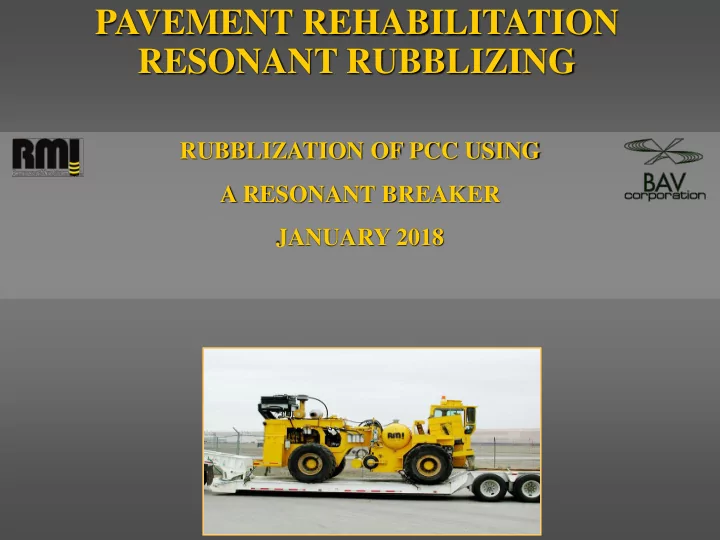
RUBBLIZATION OF PCC USING A RESONANT BREAKER JANUARY 2018
PAVEMENT REHABILITATION RESONANT RUBBLIZING RUBBLIZATION OF PCC - - PowerPoint PPT Presentation
PAVEMENT REHABILITATION RESONANT RUBBLIZING RUBBLIZATION OF PCC USING A RESONANT BREAKER JANUARY 2018 INTRODUCTION RMI Worldwide RMI has been in business since 1984 RMI Construction Services: RMI is headquartered in Tulsa,
RUBBLIZATION OF PCC USING A RESONANT BREAKER JANUARY 2018
BAV Corporation performs subcontractor services for RMI in CIS and Europe:
– Highway and Street surface rehabilitation – Airport runway reconstruction – Commercial Parking lot and Warehouse floor reconstruction
vehicle manufacturer and inventor of the Resonant Beam Technology
Oklahoma with satellite offices in:
– Kansas City, Missouri – Minneapolis Minnesota – Shanghai, China – Moscow, Russia
specialized subcontractor with expertise in:
– Concrete rubblization – Concrete demolition – Concrete breaking – Break and Seat, Crack and Seat, Breaking for Removal – RMI has successful completed concrete and rubblizing projects throughout North America, China, Eastern Europe and Chili
No Projects Rubblization Projects
Concrete «Snips» from traffic
Close
HMA
Cooling Open Warming up
«Reflecting crack
The Process of Fracturing Pavement of Portland Cement Concrete into Angular “Puzzle-like” Pieces for Direct Overlay
Over 20 Studies from Multiple States support that rubblizing provides: ✓Long life for surfaces – 22+ years ✓smooth driving conditions ✓Rubblization eliminates reflective cracking and dramatically reduces surface defects
Alabama Michigan
High Amplitude Damage to Base / Utilities Low Amplitude No Violation of Base / Utilities
“Rubblizing” doesn’t affect the base integrity due to the low amplitude
A
A
Warning
Environmentally Friendly Construction
5 1 4 3 2
PSI
Number of Years
Quality of the Road
5 1 4 3 2
PSI
Number of Years
Quality of the Road
Rubblizing
New HMA layer
≈ 35˚to 40˚
Angular Fracture Pattern for Greater Modulus
Structural Failure Reflective Cracking 100 Probability of Failure
Low PCC Modulus High Small Nominal Fragment Size Large
Target Zone
Pedestal / Shoe Resonant Beam Weight Flotation Tires Motor Computer Controls
New computer system was installed in 2008
Frequency 44 Hz Amplitude 13-19 mm (3/4”)
Vibration Technology Weight
Vibration Technology Weight
Frequency 44 Hz Amplitude 13-19 mm (3/4”)
Frequency 44 Hz Amplitude 13-19 mm (3/4”)
Vibration Technology Weight
6,000 m2
Major Steps
AAPTP
use and deterioration.
required to insure that the cause of the failure
the Subgrade or Sub-Base Problems, Pavement is a Candidate for Rubblization.
Problems, Rubblization will Not Eliminate the Issue.
should be Installed or Repaired Prior to Rubblizing the Pavement.
can be Used Depending on the Site.
10 cm open-graded 5 cm dense-graded # 57 Stone
3 % Slope Outlet
Filter Fabric
Shoulder Area Rubblized PCC Base Course Subgrade
Permeable Zone Relief Cut @ 9-12 m.
The Modulus of the Rubblized Concrete depends on the Thickness, Subbase and
Rubblized Concrete is 2.5 Times Stronger than any Granular Material. E1 E3 > E2 E4 > E3
Where E3 = f(E2) Where E2 = f(E1)
E2 > E1
Subbase Subgrade
Drainage System
Overlay Currently in Place
Test Pit Confirm Specification and Debonding
Cement Stabilized Base
Wright Patterson Airport, USA
Rubblize and Overlay
Unbonded Concrete Overlay Remove & Replace Concrete
Item Extension Item Extension Item Extension Edge Drain, Rubblization 4” Unmodified HMA @ 145 lb/ft 4” Modified HMA @ 145 lb/ft 10% Patching existing PCC 2” HMA Bond Breaker, 8” Concrete Overlay Remove 11” PCC, Place 11” PCC Total
100%
Total
155%
Total
165%
reflective cracks
concrete slabs into angular interlocked pieces
structure (PCC pavement) into a flexible structure
damage the base. NO displacement into the base!
the base. Integrity of the base is compromised!
– Reduces project complexity – Reduces project cost – Creates angular fracture pattern for greater modulus – Creates pieces sand size to 12.5 cm – 17.78 cm at the top to 20cm> towards the bottom – Microprocessor Impact Adjustment, Consistency in Particle Size
April 30, 2007