SLIDE 1
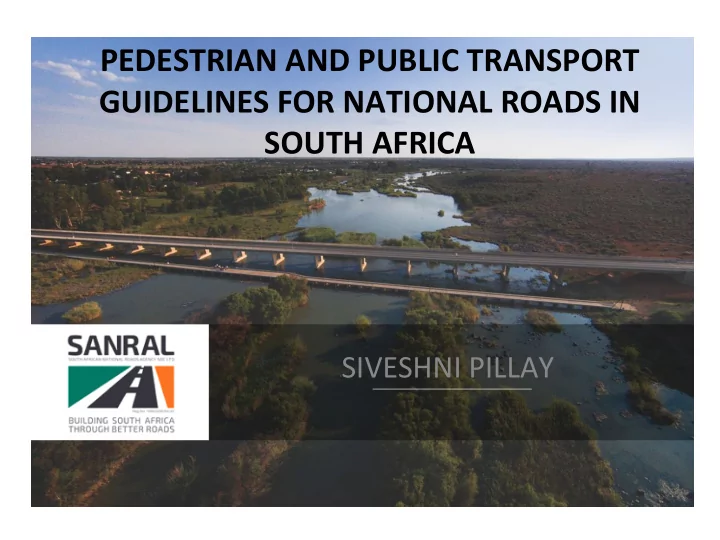
PEDESTRIAN AND PUBLIC TRANSPORT GUIDELINES FOR NATIONAL ROADS IN SOUTH AFRICA
SIVESHNI PILLAY
SLIDE 2 SANRAL AND THE ECONOMY
- Historically, SANRAL managed mainly high mobility
corridors including freeways.
- SANRAL has since taken over additional routes from
the provinces, with substantial public transport and pedestrian activities and facilities.
SLIDE 3 BACKGROUND
LEGACY ISSUES
Poor Access Management Poor Pedestrian Management (Alongside and crossing the road) Poor Spatial planning (pedestrian generators close to the freeway) Many schools (3403) within 2km
SLIDE 4 Pedestrians crossing freeways at grade Public transport activities such as dropping off and picking up passengers alongside national roads Public transport modal transfer areas Informal trading at such locations Pedestrian activities inside the road reserve (pedestrians walking next to the road/inside shoulders) Increased pressure to accommodate these public transport and pedestrian facilities
Background cont.
SANRAL CHALLENGES
SLIDE 5
CURRENT CHALLENGES
Many of these inherited with routes taken over i.e Moloto Road, R71, R61
SLIDE 6
CURRENT CHALLENGES
N11– 10km from Middelburg
SLIDE 7
CURRENT SOLUTIONS
N2 George
SLIDE 8
CURRENT SOLUTIONS
N2 North of Durban towards King Shaka International Airport
SLIDE 9 LEGISLATIVE OVERVIEW
- Contrary to popular opinion, there is a way to legally
have pedestrians on freeways with the use of proper road signage
- DOT – Roads Policy
- Critical factor – to implement in the correct
environment and with proper control
SLIDE 10 THE RIGHT APPROACH ???
APPROACH 1 APPROACH 2
Accept reality and manage it
- Balance between freeway mobility,
public transport and pedestrian accommodation
- Ensure safety of both pedestrians an
road users
SLIDE 11 MINDSHIFT – THINK DIFFERENTLY
How do we accommodate public transport and pedestrians responsibly? How do we improve integrated planning (SPLUMA)? Is SANRAL getting involved in public transport
SLIDE 12 HORSES FOR COURSES
- Facility on Moloto Road will
be different from the N1 Eastern Bypass
environment (irrespective of road class) will be different from an urbanised area
- Allows in design principles
for phased development of an integrated roadway/ public transport/ pedestrian facilities
SLIDE 13 OBJECTIVES OF THE GUIDELINES
- To develop an understanding of the problem
- To understand the legal framework for managing
pedestrians and public transport activities
- To provide a uniform approach for all SANRAL regions
- To provide guidance to designers and decision
makers through a system approach
SLIDE 14 UNIVERSAL ACCESS
not about universal access.
design is considered and designed in all our solutions and implemented as far as practicably possible
SLIDE 15 FURTHER ADDITIONS
– NRTA allows the MEC to determine conditions and circumstances for organized scholar patrol – Outlines implementation and links to the procedures
- Operational Aspects for Public Transport Facilities
– Agreements and approvals for the management and maintenance of the facility, enforcement
- Public Transport Shelter Guidelines
SLIDE 16 GUIDELINES FOR BUS SHELTERS
- Provides guidelines for bus stops
and bus shelters placement and design
- Not design standards
- Outlines design principles and
accessibility
- Advantages / Disadvantages of
recommended materials
SLIDE 17 List of Typical Drawings
- Class 1 – Urban and rural
- Class 2 – divided and Undivided
- Class 3 and 4
- Roundabouts
- Interchanges – Urban and Rural
SLIDE 18
ON ROAD FACILITIES – CLASS 1 RURAL
SLIDE 19
ON ROAD FACILITIES – CLASS 1 RURAL
SLIDE 20
ON ROAD FACILITIES – CLASS 1 URBAN
SLIDE 21
INTERSECTIONS – CLASS 1 URBAN
SLIDE 22 ON ROAD FACILITIES
It is proposed that these facilities in order to operate for its intended purpose that SANRAL, jointly with the local authority, undertake :
- Operations and maintenance
- Provide resources
- Keep it clear from informal trading and
- Provide security
3D Flythrough Simulation
SLIDE 23
ON ROAD FACILITIES – CLASS 2 DIVIDED
SLIDE 24
ON ROAD FACILITIES – CLASS 2 UNDIVIDED
SLIDE 25
INTERSECTIONS – CLASS 2 URBAN
SLIDE 26
ROUNDABOUTS – CLASS 2
SLIDE 27
INTERCHANGES – CLASS 1 URBAN
SLIDE 28
INTERCHANGES – CLASS 1 URBAN
SLIDE 29
INTERCHANGES – CLASS 1 URBAN
SLIDE 30
INTERCHANGE – CLASS 1 URBAN
SLIDE 31 PEDESTRIANS ALONGSIDE THE ROADWAY
Should walkways be allowed inside the road reserve
- Yes
- How are they separated?
- Safe distance away from traffic?
SLIDE 32 PEDESTRIAN ACCOMODATION
– More free flow a facility, the higher the conflict between pedestrians and vehicles:
- Slipways
- Circles
- Single point interchanges
- Diverging diamond
- Freeway in general
SLIDE 33 PEDESTRIAN ACCOMODATION cont…
- Pedestrians need to be separated preferably
physically with barriers to ensure safety and control
- Pedestrians feel insecure in enclosed environments
- Need to find the necessary mitigation
SLIDE 34 PEDESTRIAN MOVEMENT
STORMVOEL ROAD
AT DIAMOND INTERCHANGES
SLIDE 35
PEDESTRIAN MOVEMENT
AT DIVERGING DIAMOND
SLIDE 36
PEDESTRIAN AND PUBLIC TRANSPORT CONFLICTS
N2 Plettenberg Bay
SLIDE 37
PEDESTRIAN AND PUBLIC TRANSPORT CONFLICTS
Solution: Pedestrian Bridge and Drop off and collection Zone
SLIDE 38
PEDESTRIAN AND PUBLIC TRANSPORT CONFLICTS
Completed Solution
SLIDE 39 CONCLUDING REMARKS
- Pedestrians and public transport comprises more
than 60% of person movement
- SANRAL cannot ignore it, we must have clear
guidelines and thresholds to accommodate it
- Legally
- Good balance between mobility and safety
SLIDE 40 CONCLUDING REMARKS
- Mindshift
- Instead off wishing it away rather accept the
responsibility to properly incorporate and accommodate it.
- SANRAL is getting into the public transport facility
- perations space
SLIDE 41 CONCLUDING REMARKS
- In principle acceptance in SANRAL
- Pilot phase to test the practicalities and workability of
the proposed solutions
- Encourage consultants to consider the solutions
proposed in these guidelines
SLIDE 42