Pediatric Airway VS: RR 70, O 2 94%, T39 -nasal flaring, grunting, - - PDF document

pediatric airway
SMART_READER_LITE
LIVE PREVIEW

Pediatric Airway VS: RR 70, O 2 94%, T39 -nasal flaring, grunting, - - PDF document

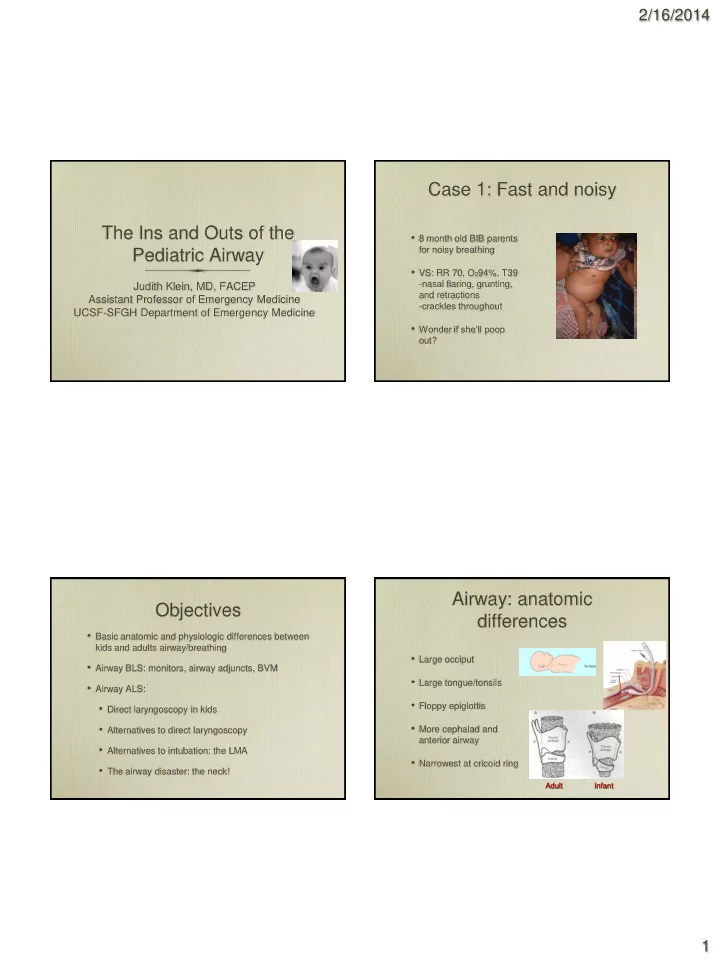
2/16/2014 Case 1: Fast and noisy The Ins and Outs of the 8 month old BIB parents for noisy breathing Pediatric Airway VS: RR 70, O 2 94%, T39 -nasal flaring, grunting, Judith Klein, MD, FACEP and retractions Assistant Professor of


slide-1
SLIDE 1

2/16/2014 1

The Ins and Outs of the Pediatric Airway

Judith Klein, MD, FACEP Assistant Professor of Emergency Medicine UCSF-SFGH Department of Emergency Medicine

Case 1: Fast and noisy

  • 8 month old BIB parents

for noisy breathing

  • VS: RR 70, O294%, T39
  • nasal flaring, grunting,

and retractions

  • crackles throughout
  • Wonder if she’ll poop
  • ut?

Objectives

  • Basic anatomic and physiologic differences between

kids and adults airway/breathing

  • Airway BLS: monitors, airway adjuncts, BVM
  • Airway ALS:
  • Direct laryngoscopy in kids
  • Alternatives to direct laryngoscopy
  • Alternatives to intubation: the LMA
  • The airway disaster: the neck!

Airway: anatomic differences

  • Large occiput
  • Large tongue/tonsils
  • Floppy epiglottis
  • More cephalad and

anterior airway

  • Narrowest at cricoid ring

Adult Infant

slide-2
SLIDE 2

2/16/2014 2

Anatomic differences

  • Secretions easily block

airway

  • Increased aspiration risk
  • Flexible thoracic cage:

retractions/paradoxical breathing

  • Immature respiratory

muscles: tire easily

  • Obligate nasal breathers <6

months

Conditions that can cause airway problems

  • Genetic/congenital:
  • trisomy 21, Pierre-Robin
  • Infection
  • croup, epiglottitis, abscess
  • Rheumatologic
  • JRA
  • Burns/trauma

A/B Physiologic differences

  • High metabolic rate high

O2 consumption

  • MV=RR x TV
  • TV limited by thorax size
  • MV more RR dependent
  • RR with respiratory

compromise or with increased metabolic demand

Physiologic differences

  • Limited respiratory

reserve

  • Apnea time to 90% O2

sat after pre-

  • xygenation:
  • 6 minutes

adult/adolescent

  • 90 seconds if <6

months*

*Patel, et al. Can J Anesth 1994.

slide-3
SLIDE 3

2/16/2014 3

Case 2: Let’s use the propofol

  • 2 year old with distal

radius fracture

  • Propofol for reduction
  • O2 sat to 92%, sonorous

respirations

  • What now?

Airway BLS

  • Monitors:
  • Basic: pulse ox, HR, BP
  • ETco2 key to early

detection of hypoventilation

  • (Re-)Positioning:
  • large occiput
  • roll under shoulders
  • Suction:
  • secretions/blood easily
  • bstruct airway
  • nasal sxn in infants

Airway BLS

  • Jaw thrust-->airways adjunct:
  • NP: nares to tragus
  • OP: mouth to angle of jaw
  • BVM:
  • bridge of nose to cleft of chin
  • 2 person technique
  • lift face to mask: don’t push

mask onto face

Case 3: Code 3 call-14 mo old asthma

  • Paramedic ringdown: 14 mo
  • ld severe asthma, declining

RR and HR: Doc, should we tube him?

  • OOH success with intubation:

*< 3 yrs old: 56%! *3-8 yrs: 61%!

  • No difference in survival or

neuro outcome ETT or BVM

  • 2010 ALS: BVM preferred
  • ver intubation if transport

time short

*Gausche, et al. JAMA 2000.

slide-4
SLIDE 4

2/16/2014 4

He’s circling the toilet bowl..

  • In ED, pt sleepy, RR

14, O2 90%, minimal air movement

  • Asthma meds?
  • Silastic therapy?
  • Working on the IV...

Airway ALS: RSI or TED? (Tie Em

Down)

(?
  • RSI!: even in neonate (2x

greater success, fewer complications)

  • Paralytic choice?
  • Succinylcholine: black box due

to K, arrhythmias, card arrest

vs

  • Rocuronium: longer acting but

reversal agent soon (Sugammadex-acts in 1-2 min)*

  • IO time

*Puhringer, Anesthesiology 2008.

Airway ALS: RSI

  • Atropine?
  • bradycardia risk
  • < 1 year old or if use

succinylcholine

  • Cricoid pressure?
  • reduce gastric air/aspiration

but also distort airway

  • 2010 ALS: “safety and value

not clear” so let up if needed

  • NC O2 during intubation?:
  • kid data scant but why not?

Airway ALS: The tube

  • Narrowest portion of

airway below cricoid ring

  • Who needs a cuff?
  • Uncuffed under 6

years unless air leak control critical:

slide-5
SLIDE 5

2/16/2014 5

What if he didn’t look so bad...

  • Non-invasive ventilation?
  • CPAP or PPV
  • Face mask, nasal

mask* or helmet*

  • Improve gas exchange

and decrease work of breathing

Non-invasive ventilation

  • Indications: >1 yr,

hypoxic, not in resp failure

  • pneumonia, bronchiolitis,

asthma

  • Contraindications: AMS,

vomiting, impaired gag, advanced resp failure, HD instability

  • Limited studies: Try it

early

Case 4: Is he 5 or 15?

  • 5 yo morbidly obese

fever/SOB x 2 days

  • VS: RR 40, O2 88% on

NRB, HR 150 PE: tripoding, BS with crackles both bases, no wheeze

  • What next?

Direct laryngoscopy? Maybe not...

  • Alternatives to the ETT
  • LMA Classic
  • LMA Proseal
  • LMA Supreme
  • LMA Fastrach: intubating(>10yrs)
  • Combitube (>4 feet tall)
  • Alternatives to direct laryngoscopy
  • Lighted stylet (e.g. Trachlight)
slide-6
SLIDE 6

2/16/2014 6

LMA: Love My Airway

  • Classic:
  • basic model, reusable -

90% 1st pass/99% overall (lower in infants)

  • complication rate <10%

(infants )

  • Proseal: 2nd generation
  • reusable, gastric port, bite

block

  • better seal than Classic
  • slightly lower 1st pass success

LMA

  • LMA Supreme:
  • single use
  • curved like fastrach for

easy insertion

  • gastric port
  • LMA Fastrach
  • intubating
  • >30kg only

Direct laryngoscopy: so retro!

  • Stylets: slip tube over
  • Lighted stylet (e.g. Trachlight,

Tube Stat):

  • good with secretions but not

edema/masses

  • look for light mid neck
  • Optical stylet (e.g Shikani,

Levitan):

  • shapeable with fiberoptic

scope - secretions are the enemy

  • use w/ or w/o laryngoscope

Airway video games

  • Glidescope, Airtraq, Storz
  • See around the corner: No need

for direct line of sight to see glottis/place tube

  • Great for c-spine patients
  • Secretions/blood are a killer
  • Tendency to focus on monitor
  • ral trauma
slide-7
SLIDE 7

2/16/2014 7

Do video games work better?

  • 200 kids 3 mo-17 yrs direct

laryngoscopy vs. Glidescope

  • Improved view but
  • 97 vs 90% 1st pass

success

  • Took longer (24 vs 36

sec)

Kim, et al, Br J Anesth 2008

Can’t intubate/Can’t ventilate!!

  • 8 month old with

respiratory distress

  • Respiratory arrest!
  • BVM: unable to ventilate
  • Reposition/suction/oral

airway still unable to ventilate

  • What next???

Airway disaster plan

  • BVM
  • Laryngoscopy
  • LMA
  • GO TO THE NECK

When is it time to go to the neck?

  • Can’t intubate/can’t ventilate
  • All attempts at oxygenation are failing
  • Child not waking up soon
  • Vitals deteriorating due to hypoxia
slide-8
SLIDE 8

2/16/2014 8

Big guys vs. little guys

  • Cricothyroid membrane:
  • 13 x 12 mm (adult) vs
  • 2.5 x 3 mm (neonate)!!
  • Landmarks tough
  • >8 years: surgical or

percutaneous approach

  • <8 years: needle/catheter
  • nly

Needle cricothyroidotomy

  • Extend neck with roll, adipose

towards mandible, quick prep

  • Any tracheal site below

thyroid cartilage

  • 14G angiocath on 10cc

syringe (or Ventilation Catheter <VBM, Germany>)

  • Insert until free flow air then

advance catheter

Trans-tracheal ventilation

  • Jet ventilation
  • Pseudo-jet ventilation:
  • Cook tubing connects to

angiocath and 15 l/min O2

  • Macgyver: cut sideholes

into oxygen tubing

  • Bag ventilation: -

3.0 ETT adapter - 8.0 ETT adapter inserted in 3cc syringe barrel

  • Allow time for passive

exhalation-2:1 ratio

Pediatric airway pitfalls

  • Failure to monitor properly and understand

airway BLS

  • Failure to anticipate difficult airway and have

range of equipment available

  • Failure to practice alternative techniques
  • Prolonged attempts trauma/bleeding in airway
  • Spending too long placing IV go to IO
  • Failure to move to the neck when all else fails
slide-9
SLIDE 9

2/16/2014 9