Performance Specifications for the ATLAS TileCAL Front End - - PDF document

performance specifications for the atlas tilecal front
SMART_READER_LITE
LIVE PREVIEW

Performance Specifications for the ATLAS TileCAL Front End - - PDF document

Performance Specifications for the ATLAS TileCAL Front End Electronics sLHC Upgrade Environment The TileCAL Group Mar. 24, 2009 Version 2.0 1. Smallest Signal to Measure The smallest signal of interest from the detector, expressed in terms


slide-1
SLIDE 1

Performance Specifications for the ATLAS TileCAL Front End Electronics sLHC Upgrade Environment

The TileCAL Group

  • Mar. 24, 2009

Version 2.0

  • 1. Smallest Signal to Measure

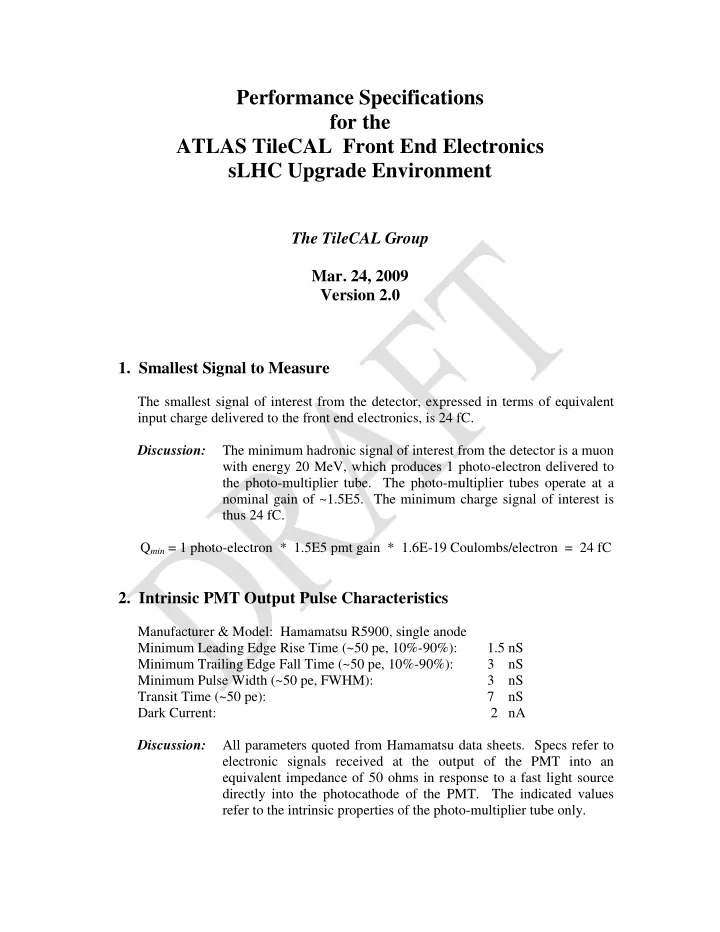
The smallest signal of interest from the detector, expressed in terms of equivalent input charge delivered to the front end electronics, is 24 fC. Discussion: The minimum hadronic signal of interest from the detector is a muon with energy 20 MeV, which produces 1 photo-electron delivered to the photo-multiplier tube. The photo-multiplier tubes operate at a nominal gain of ~1.5E5. The minimum charge signal of interest is thus 24 fC. Qmin = 1 photo-electron * 1.5E5 pmt gain * 1.6E-19 Coulombs/electron = 24 fC

  • 2. Intrinsic PMT Output Pulse Characteristics

Manufacturer & Model: Hamamatsu R5900, single anode Minimum Leading Edge Rise Time (~50 pe, 10%-90%): 1.5 nS Minimum Trailing Edge Fall Time (~50 pe, 10%-90%): 3 nS Minimum Pulse Width (~50 pe, FWHM): 3 nS Transit Time (~50 pe): 7 nS Dark Current: 2 nA Discussion: All parameters quoted from Hamamatsu data sheets. Specs refer to electronic signals received at the output of the PMT into an equivalent impedance of 50 ohms in response to a fast light source directly into the photocathode of the PMT. The indicated values refer to the intrinsic properties of the photo-multiplier tube only.

slide-2
SLIDE 2

ATLAS TileCAL Front End Electronics Specification p. 2

  • 3. PMT Output Pulse Characteristics – Detector Response
  • A. Laser Response

Minimum Leading Edge Rise Time (~50 pe, 10%-90%) 3 nS Minimum Trailing Edge Fall Time (~50 pe, 10%-90%) 8 nS Minimum Pulse Width (~50 pe, FWHM) 8 nS

  • B. Response to Muons

Minimum Leading Edge Rise Time (~50 pe, 10%-90%) 3 nS Minimum Trailing Edge Fall Time (~50 pe, 10%-90%) 20 nS Minimum Pulse Width (~50 pe, FWHM) 9 nS

  • C. Response to Pions

Minimum Leading Edge Rise Time (~50 pe, 10%-90%) 2-5 nS Minimum Trailing Edge Fall Time (~50 pe, 10%-90%) 40 nS Minimum Pulse Width (~50 pe, FWHM) 15-25 nS Discussion: All parameters measured. Specs refer to electronic signals received at the output of the PMT into an equivalent impedance of 50 ohms in response to particle interactions in the detector. The response characteristics are dominated by properties of the wavelength- shifting fibers.

  • 4. Electronic Noise

The intrinsic noise of the electronics, as measured through the digitization path, expressed in terms of equivalent input charge, shall not be greater than 12 fC RMS at pedestal. Discussion: Specification refers to intrinsic electronics noise only, with 10 pF of source capacitance included. General goal is for the pedestal noise to be no greater than one half of the minimum signal of interest.

slide-3
SLIDE 3

ATLAS TileCAL Front End Electronics Specification p. 3

  • 5. Single-Shot Measurement Resolution of Signal

The single-shot resolution of the electronics, measured through the digitization path, expressed in terms of equivalent input charge, shall be (12 fC @ nominal PMT gain) or (5% of signal), whichever is greater. Discussion: Specification refers to intrinsic electronics noise only, with 10 pF of source capacitance included. General goal is for the minimum resolution to be one half of the minimum signal of interest, taking into account all contributions from the electronics including thermal noise, shot noise, etc. Statistical quantization noise is excluded from this spec, and is addressed later.

  • 6. Largest Signal of Interest

The largest signal delivered to the electronics from the detector, expressed in terms

  • f equivalent input charge, is 800 pC.

Discussion: The maximum hadronic signal of interest from the detector is a hadronic jet with energy 650 GeV. From the earlier specification of the minimum signal of interest, a 20 MeV muon delivers 24 fC of charge to the electronics. The maximum signal of interest expressed in terms of equivalent charge referred to the muon signal on a linear scale is thus 800 pC. Qmax = 650 GeV * ( 24 fC / 20 MeV ) = 780 pC ~ 800 pC

  • 7. Dynamic Range

The dynamic range of the electronics is 65,000:1, or approximately 16 bits. Multiple ranges are acceptable, provided that they have a minimum of 5 bits of

  • verlap, referenced to the next smallest scale.

Discussion: The minimum charge signal of interest is 12 fC, defined by the measurement resolution. The maximum charge signal of interest is 800 pC. The ratio is thus 66,666, or ~16 bits.

  • 8. Differential Nonlinearity of the Electronics

The differential nonlinearity of the ADC shall be less than 1 ADC count.

slide-4
SLIDE 4

ATLAS TileCAL Front End Electronics Specification p. 4

  • 9. Intrinsic Integral Nonlinearity of the Electronics

No digitization code may have an intrinsic error greater than 1% of reading, or the equivalent of two least counts of resolution whichever is greater, due to integral

  • nonlinearity. The net integral nonlinearity may be improved at the system level

through calibration techniques.

  • 10. Digitization Speed

The reference clock provided to the front-end electronics shall be 40 MHz. The intrinsic digitization throughput shall be at least 40 MHz. The ADC may be

  • pipelined. If pipelining is used, the pipeline length must be no greater than 5 clock

periods at 40 MHz. Discussion: The intrinsic digitization throughput corresponds to the intrinsic beam interaction rate of the LHC. The requirement for the pipeline depth is due to the latency requirements of the front end for the Level 1 Trigger.

  • 11. Timing

The electronics shall provide a means for measuring the time of arrival of the signal from the photo-multiplier to an accuracy of 1 nS. Discussion: It is desirable for the electronics to be capable of identifying cosmic rays through timing information.

  • 12. Data Output

The front-end electronics shall produce (at least) one word of output data every 25 nSec (40 MHz.) If multiple ranges are used, it is a system-level decision on how to process the data readout from multiple ranges. Discussion: The intrinsic digitization throughput corresponds to the intrinsic beam interaction rate of the LHC.

slide-5
SLIDE 5

ATLAS TileCAL Front End Electronics Specification p. 5

  • 13. Single Channel Recovery Time for Digitization

The front end electronics must return to baseline and have less than 5% residual after 200 nSec from a previous input pulse. Discussion: Signals should not be corrupted by a preceding pulse by more than the intrinsic accuracy of the electronics.

  • 14. Channel-to-Channel Accuracy

Intrinsic channel gains must match to better than 5% due to electronics. Overall gain accuracy after calibration should be of order ~1% Discussion: Gives acceptable accuracy to meet physics goals.

  • 15. Double Pulse Timing Resolution

Must be able to resolve in time two pulses of the same amplitude spaced 200 nS apart. Discussion: Provides adequate resolution for the highest average hit rate per channel in the detector. Spec corresponds to eight beam crossing clocks.

  • 16. Stability of Digitized Pedestals Over Time

The average pedestal value must be stable to +/- 3 least ADC counts over a 24 hour period at constant temperature. Discussion: The electronics must be capable of operating over a 24 hour period without need for pedestal adjustment or threshold adjustment.

  • 17. Stability of Digitized Pedestals Over Temperature

Pedestals must not change by more than 5 least counts of the ADC over a 5 degree Celsius change in temperature. Discussion: Temperature of the detector halls is expected to be stable to 5 degrees C, and the pedestals should not change so as to compromise the accuracy of charge reconstruction.

slide-6
SLIDE 6

ATLAS TileCAL Front End Electronics Specification p. 6

  • 18. Gain Stability Over Temperature

Channel gains must not change more than 2% over a 5 degree Celsius change in temperature. Discussion: Temperature of the detector halls is expected to be stable to 5 degrees C, and the gain should not change so as to compromise the accuracy requirements.

  • 18. Gain Stability Over Temperature

Channel gains must not change more than 2% over a 5 degree Celsius change in temperature. Discussion: Temperature of the detector halls is expected to be stable to 5 degrees C, and the gain should not change so as to compromise the accuracy requirements.

  • 19. Power Supply Rejection

The performance of the front end electronics must be insensitive to changes in the power supply voltages supplied to the electronics to better than 70 db. Discussion: The spec defines the power supply rejection ratio (PSSR), as -70db,

  • r 1 part in 3162, i.e. a change in the power supply voltage of 1.000

mV should produce a change in the output voltage of the electronics prior to digitization of 0.3162 V or less.

  • 20. Charge Injection

A means shall be provided for performing charge injection, directly into the input of the preamplifier. The front-end shall have an on-board DAC with at least 16 bits of dynamic range on a single linear scale. The least count of the DAC expressed in equivalent charge must correspond to a least-count of the digitizer. Discussion: Charge injection is needed to monitor gain and proper operation of front-end electronics. It will also be used to provide calibration between different ADC ranges.

slide-7
SLIDE 7

ATLAS TileCAL Front End Electronics Specification p. 7

  • 21. Accuracy of Charge Injection

The absolute accuracy of the gain of the charge injection is 1%. System uniformity shall be of order 0.5%. Repeatability at the channel level shall be of order 0.1% at constant temperature. Discussion: Provides primary method of calibrating electronics uniformity across the system. Provides adequate accuracy to diagnose bad channels, and aids in diagnosing bad phototubes.

  • 22. Channel-to-Channel Matching of Charge Injection

Channel-to-channel matching of the charge injection across the system is 1%. Discussion: Provides adequate accuracy to diagnose bad channels, and aids in diagnosing bad phototubes.

  • 23. Source Monitoring – Slow Integrator

A means shall be provided for measuring the average current received from the photo-multiplier tube. The circuit must be DC-coupled to the anode of the PMT. The gain must be programmable over a 50:1 range, with a transimpedance gain between 2E6 and 100E6. The circuit shall have a 12-bit ADC. Discussion: This circuit is needed for the measurement of the Cesium source.

  • 24. DC Current Measurement Parameters

A typical source signal is 50 nA. The required resolution is 0.5 nA/ADC count. The time constant for averaging the signal shall be 10 mSec. Discussion: The required resolution is 1% of the typical signal. The maximum rate of the source is 3E5 disintegrations per second. The time constant is adequate for the velocity of movement of the source.

slide-8
SLIDE 8

ATLAS TileCAL Front End Electronics Specification p. 8

  • 25. Power Budget

The power consumed by the front end electronics in the drawers shall be no greater than 1.0 Watts per channel. This figure refers only to the drawer electronics, and does not include the power consumed by the back end electronics. It also does not include the efficiency of the finger power supplies. Discussion: Provides adequate safety margin for the cooling capacity in the drawers.