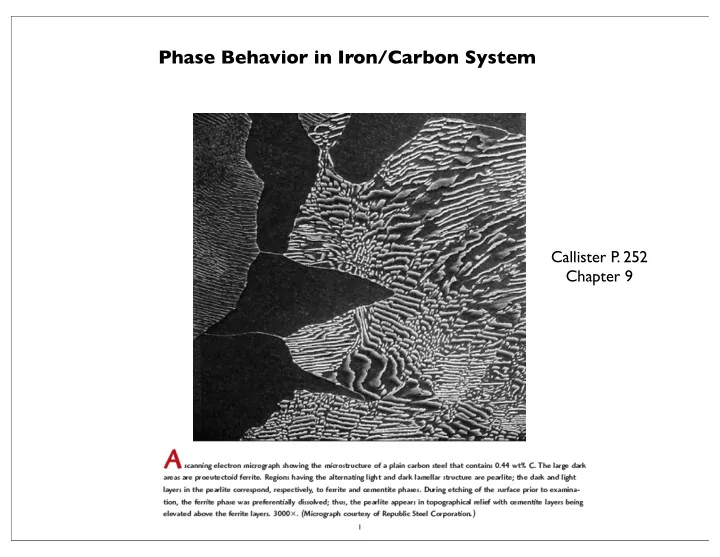
Phase Behavior in Iron/Carbon System Callister P. 252 Chapter 9 1 - - PowerPoint PPT Presentation

phase behavior in iron carbon system
SMART_READER_LITE
LIVE PREVIEW

Phase Behavior in Iron/Carbon System Callister P. 252 Chapter 9 1 - - PowerPoint PPT Presentation

Phase Behavior in Iron/Carbon System Callister P. 252 Chapter 9 1 Iron Age 1500 to 1000 BC Iron Ore is extremely common and was used as a fluxing agent in copper smelting from malachite (Copper carbonate) Making an iron rich slag. Melting


slide-1
SLIDE 1

1

Phase Behavior in Iron/Carbon System

Callister P. 252 Chapter 9

slide-2
SLIDE 2

2

Iron Age 1500 to 1000 BC Iron Ore is extremely common and was used as a fluxing agent in copper smelting from malachite (Copper carbonate) Making an iron rich slag. Melting point is 1538°C

slide-3
SLIDE 3

3

Copper Slag contains some reduced iron as sponge iron. Hammering compacts the sponge producing wrought iron. Iron Ore was used as a fluxing agent in copper smelting from malachite (Copper carbonate) Making an iron rich porous slag, sponge iron. Bronze is harder than pure iron Iron is also subject to corrosion So pure iron is not an advancement

  • ver Bronze
slide-4
SLIDE 4

4

Hittites (Turkey) repeatedly heated bloom in charcoal furnaces at 1200°C Followed by working with a hammer CO lead to the diffusion of C into the iron at the surface Case Hardened Steel Even a fraction of a percent of carbon can have a dramatic effect on hardness Hittites needed to beat bronze in terms of hardness so their weapons could pierce bronze shields Quenching also hardened steel (Martensite) (followed by tempering (heating))

slide-5
SLIDE 5

5

FCC Martensite (non equilibrium BCT phase from quench of γ) BCC Orthorhombic Iron/Carbon Phase Diagram Iron shows a eutectic with Carbon allowing for a lower melting alloy Body Centered T etragonal

slide-6
SLIDE 6

6

slide-7
SLIDE 7

7

slide-8
SLIDE 8

8

Carbon content can be reduced by reaction with oxygen and stirring

slide-9
SLIDE 9

9

slide-10
SLIDE 10

10

Eutectoid Steel Pearlite

slide-11
SLIDE 11

11

Time-Temperature-Transformation Diagram

slide-12
SLIDE 12

12

Time-Temperature-Transformation Diagram Just below 727°C Thermodynamics drive is low so time is long

slide-13
SLIDE 13

13

Time-Temperature-Transformation Diagram Well below 727°C Diffusion is slow so time is long

slide-14
SLIDE 14

14

Time-Temperature-Transformation Diagram At very deep quenches Diffusionless Transformation Occurs: Martinsitic Transformation

slide-15
SLIDE 15

15

Hypoeutectoid Steel

slide-16
SLIDE 16

16

Hypoeutectoid Steel

slide-17
SLIDE 17

17

Hypoeutectoid Steel

slide-18
SLIDE 18

18

Hypoeutectoid Steel

slide-19
SLIDE 19

19

slide-20
SLIDE 20

20

Hypereutectoid Steel

slide-21
SLIDE 21

21

slide-22
SLIDE 22

22

Kinetics of Phase Growth

slide-23
SLIDE 23

23

slide-24
SLIDE 24

24

Heat Treatment of Steel

Spheroidizing: Spheroidite forms when carbon steel is heated to approximately 700 °C for over 30 hours. Spheroidite can form at lower temperatures but the time needed drastically increases, as this is a diffusion-controlled process. The result is a structure of rods or spheres of cementite within primary structure (ferrite or pearlite, depending on which side of the eutectoid you are on). The purpose is to soften higher carbon steels and allow more formability. This is the softest and most ductile form of steel. Process annealing: A process used to relieve stress in a cold-worked carbon steel with less than 0.3 wt% C. The steel is usually heated up to 550–650 °C for 1 hour, but sometimes temperatures as high as 700 °C. Quench and tempering: This is the most common heat treatment encountered, because the final properties can be precisely determined by the temperature and time of the tempering. Tempering involves reheating quenched steel to a temperature below the eutectoid temperature then cooling. The elevated temperature allows very small amounts of spheroidite to form, which restores ductility, but reduces hardness. Actual temperatures and times are carefully chosen for each composition.

slide-25
SLIDE 25

25

Martensite Austinite => Martensite Transformation FCC => BCT

slide-26
SLIDE 26

26

slide-27
SLIDE 27

27

slide-28
SLIDE 28

28

slide-29
SLIDE 29

29

slide-30
SLIDE 30

30

slide-31
SLIDE 31

31

slide-32
SLIDE 32

32

slide-33
SLIDE 33

33

slide-34
SLIDE 34

34

slide-35
SLIDE 35

35

slide-36
SLIDE 36

36

slide-37
SLIDE 37

37

slide-38
SLIDE 38

38

slide-39
SLIDE 39

39

slide-40
SLIDE 40

40

slide-41
SLIDE 41

41

slide-42
SLIDE 42

42

slide-43
SLIDE 43

43

slide-44
SLIDE 44

44