Phenotypic ic Ratio io and The Chi-Square Test en.wikipedia.org - - PowerPoint PPT Presentation

phenotypic ic ratio io and the chi square test
SMART_READER_LITE
LIVE PREVIEW

Phenotypic ic Ratio io and The Chi-Square Test en.wikipedia.org - - PowerPoint PPT Presentation

Lab # 3: : Mendelian In Inheritance in in Corn: Phenotypic ic Ratio io and The Chi-Square Test en.wikipedia.org In Previous Labs.. 1. The Principle of Segregation and the Principle of Independent Assortment. 2. Gene Interactions:

slide-1
SLIDE 1

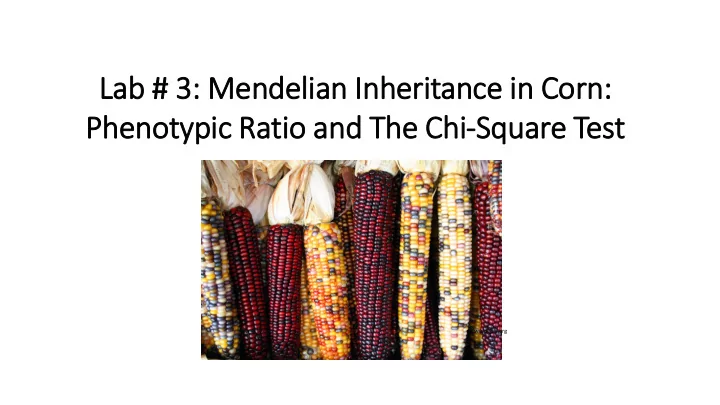
Lab # 3: : Mendelian In Inheritance in in Corn: Phenotypic ic Ratio io and The Chi-Square Test

en.wikipedia.org

slide-2
SLIDE 2
  • 1. To explore how Mendel’s principles can explain transmission
  • f characters from one generation to the next.
  • 2. To understand and perform the Chi-square statistical test to

evaluate hypotheses about mechanisms of inheritance.

Today’s Objectives

  • 1. The Principle of Segregation and the Principle of Independent

Assortment.

  • 2. Gene Interactions: recessive epistasis, dominant epistasis,

complementary gene action

In Previous Labs..

slide-3
SLIDE 3

Kernel (F2)

Corn: Genes and Phenotypes

RRSuSu rrsusu

slide-4
SLIDE 4

Cl and R Pr and R C and R

Phenotypic ratio?

Corn: Genes and Phenotypes

slide-5
SLIDE 5

Grain Phenotype Expected Ratio Expected Number Observed Number Purple & Smooth 9/16 9/16 * 381 = 214.31 216 Purple & Shrunken 3/16 3/16 * 381 = 71.43 79 Yellow & Smooth 3/16 3/16 * 381 = 71.43 65 Yellow & Shrunken 1/16 1/16 * 381 = 23.81 21 Total Number: 381

A B C D

Can we consider observed and expected values to be the same?

Observed and Expected Values

slide-6
SLIDE 6
  • The chi square test is designed to test the statistical significance of

an experimental outcome.

  • We use the Chi-square test to compare observed data with the

data we would expect to obtain according to our hypothesis (=Mendelian ratios).

  • Null hypothesis – observed values are not different from the

expected values

  • Alternative hypothesis – observed values are different from

expected values

The Chi-Square Test

slide-7
SLIDE 7

Grain Phenotype Expected Ratio Expected Number Observed Number Purple & Smooth 9/16 9/16 * 381 = 214.31 216 Purple & Shrunken 3/16 3/16 * 381 = 71.43 79 Yellow & Smooth 3/16 3/16 * 381 = 71.43 65 Yellow & Shrunken 1/16 1/16 * 381 = 23.81 21 Total Number: 381

c2 = (216-214.31)2 / 214.31 + (79-71.43)2 / 71.43 + (65-71.43)2 / 71.43 + (21-23.81)2 / 23.81 = 0.97

c2 = (observed – expected)2 number expected

A B C D

S

The Chi-Square Test

slide-8
SLIDE 8

c2 values df

c2 = 0.97

Chi-Square Table of Critical Values

slide-9
SLIDE 9

Tue Mon Thu Sat Sun Fri Wed

df = # observations which are free to vary

df = n-1

n = # of classes (e.g., phenotypes) df = 4 - 1 = 3 Total # of hats (n) = 7 # of hats which are free to vary = 6 # of hats which are not free to vary (must wear them) = 1

Degrees of Freedom

slide-10
SLIDE 10

c2 values df

c2 = 0.97 df = 3

0.97

Chi-Square Table of Critical Values

slide-11
SLIDE 11
  • 1. Purple color in corn kernels:
  • dominant
  • recessive
  • 2. Starchy kernels:
  • dominant
  • recessive
  • 3. Which hypothesis do we test using the Chi-square test?
  • null hypothesis
  • alternative hypothesis

Concluding Questions