Philippines Philippines JAIME M. FORTES, JR. Deputy Commissioner - - PowerPoint PPT Presentation

philippines philippines
SMART_READER_LITE
LIVE PREVIEW

Philippines Philippines JAIME M. FORTES, JR. Deputy Commissioner - - PowerPoint PPT Presentation

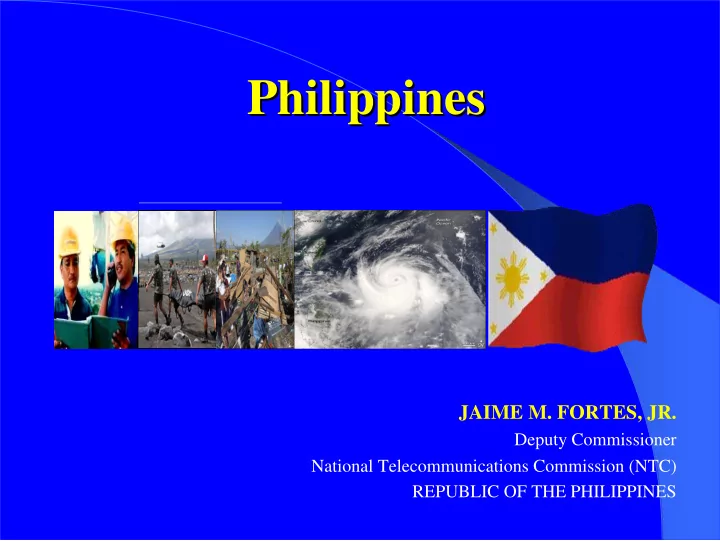
Philippines Philippines JAIME M. FORTES, JR. Deputy Commissioner National Telecommunications Commission (NTC) REPUBLIC OF THE PHILIPPINES An archipelago of over 7,000 islands that seats on the pacific rim of fire and is described as

slide-1
SLIDE 1

JAIME M. FORTES, JR.

Deputy Commissioner National Telecommunications Commission (NTC) REPUBLIC OF THE PHILIPPINES

Philippines Philippines

slide-2
SLIDE 2

An archipelago of over 7,000 islands that seats on the “pacific rim of fire” and is described as Asia’s “typhoon mat” as the seas around it spawn destructive typhoons and monsoon. It has a population of approximately 80 million. The Philippines has about 6.6 million installed telephones lines, about 50%

  • f which are subscribed.

And there are about 35 million mobile telephone subscribers.

slide-3
SLIDE 3

DISASTER THREATS IN DISASTER THREATS IN THE PHILIPPINES THE PHILIPPINES

slide-4
SLIDE 4

SEVERE WEATHER SEVERE WEATHER

slide-5
SLIDE 5

An average of 20 tropical cyclones hit the Philippines every year, each one categorized according to its strength or intensity. Once a weather disturbance enters the Philippines’ area of responsibility, the government, through its various agencies forewarns the general public. A Public Storm Signal warning tells the people what they should expect and carries with it an advisory for them to take the necessary precautions.

slide-6
SLIDE 6

PUBLIC STORM SIGNAL NO. 1:

A tropical cyclone will affect the locality. winds of 30-60 kph may be expected in at least 36 hours. very light or no damage at all may be sustained by the

exposed community.

Classes suspended in the elementary level.

PUBLIC STORM SIGNAL NO. 2:

A moderate tropical cyclone will affect the locality. winds of greater than 60 kph to 100 may be expected in

at least 24 hours.

Large nipa and cogon houses maybe partially or totally

unroofed.

Classes suspended at the high school level.

slide-7
SLIDE 7

PUBLIC STORM SIGNAL NO. 3:

A strong tropical cyclone will affect the locality. Winds of greater than 100 kph to 185 kph may be

expected in at least 18 hours.

There maybe widespread disruption of electrical

power and communication services.

In general, moderate to heavy damage may be

expected in both the agricultural and industrial sectors.

Sea and coastal waters will be dangerous to all sea

crafts.

Classes suspended at the all levels.

slide-8
SLIDE 8

PUBLIC STORM SIGNAL NO.4:

A very intense typhoon will affect the locality Very strong winds of more than 185 kph may be

expected in at least 12 hours.

Electric power distribution and communication service

may be disrupted.

Damage to affected communities can be very heavy.

slide-9
SLIDE 9

FLOODING FLOODING

As a result of heavy rains, flooding occurs, some of which are severe. Again, the government, through its various agencies issue warnings to the general public.

slide-10
SLIDE 10

BEFORE THE FLOOD

Find out the frequency of occurrence of floods in your

locality.

All family members must know the flood warning system in

your community.

Keep informed of daily weather condition. Inquire on designated evacuation areas for families and

livestock.

Keep a stock of food which requires little cooking and

refrigeration; electric power may be interrupted.

Keep a transistor radio, flashlight with spare batteries,

emergency cooking equipment, candles, matches and first aid kit handy in case of emergency.

PRECAUTIONARY MEASURES:

slide-11
SLIDE 11

AFTER THE FLOOD

Re-enter dwellings with caution using flashlights, not

lanterns or torches. There may be flammable materials inside.

Be alert of fire hazards like broken wires. Do not eat food or drink water until they have been checked

for floodwater contamination.

DURING THE FLOOD

Avoids areas subject to sudden flooding. Do not attempt to cross rivers of flowing streams where

water is above the knee.

Beware of water-covered roads and bridges. Do not go swimming or boating in swollen rivers.

slide-12
SLIDE 12
slide-13
SLIDE 13
slide-14
SLIDE 14
slide-15
SLIDE 15
slide-16
SLIDE 16
slide-17
SLIDE 17
slide-18
SLIDE 18
slide-19
SLIDE 19
slide-20
SLIDE 20

LANDSLIDES LANDSLIDES

Because of massive deforestation and/or due to the buildup of volcanic ash and debris during volcanic eruptions/activities, landslides and mudflows occur during heavy rains, wreaking havoc and much despair to the lowlands.

slide-21
SLIDE 21
slide-22
SLIDE 22
slide-23
SLIDE 23
slide-24
SLIDE 24
slide-25
SLIDE 25

TSUNAMIS TSUNAMIS

Is a series of traveling ocean waves of long length and period usually caused by a seismic disturbances in the ocean floor or confines, which upon reaching the shore, losses speed but increases in height. Depending upon the residual force upon arrival, such waves may rush in shore and cause devastation to human settlements and infrastructures along the shoreline. On August 16, 1976, the Moro Gulf earthquake produced tsunamis which devastated the southwest coast

  • n Mindanao and left more than 3,000 people dead, with

at least 1,000 people missing. More than 8,000 people were injured and approximately 12,000 families were rendered homeless by 5 meter(s) high waves.

slide-26
SLIDE 26

NATIONAL AUTHORITIES NATIONAL AUTHORITIES INVOLVED IN DISASTER INVOLVED IN DISASTER MANAGEMENT MANAGEMENT

slide-27
SLIDE 27

THE NATIONAL DISASTER COORDINATNG COUNCIL (NDCC)

The highest government body responsible for advising the President of the status of disaster preparedness programs and disaster relief and rehabilitation efforts at the national level.

NDCC FUNTIONS:

At the National level, the NDCC serves as the President’s adviser on disaster preparedness programs, disaster operations and rehabilitation efforts undertaken by the government and the private sector. It acts as the top coordinator of all disaster management and the highest allocator of resources in the country to support the efforts

  • f the lower DCC level. In the discharge of its functions, the

NDCC utilizes the facilities and services of the Office of Civil Defense as its operating arm.

slide-28
SLIDE 28

TASK OF NDCC CHAIRMAN AND MEMBER TASK OF NDCC CHAIRMAN AND MEMBER-

  • AGENCIES

AGENCIES

  • A. Secretary of National Defense- Convenes the council as often as

necessary and calls on all other departments/ bureaus/agencies, other instrumentalities of the government and the private sector for assistance when the need arises.

B. Administrator, Office of Civil Defense- Coordinates the activities,

functions of the various agencies and instrumentalities of the Government, private institutions and civic organizations to implement the policies and programs of the NDCC.

  • C. Secretary of Interior and Local Government- Oversees the
  • rganization of the DCCs, the establishment of Disaster Operation Centers of

all local governments, the training of DCC members and coordination with OCD, DSWD, PNRC and other appropriate agencies.

  • D. Secretary of Social Welfare and Development- Extends relief

assistance and social services to the victims as necessary.

E. Secretary of Health- provides health services during emergencies as

necessary, and organizes reaction team and hospitals, clinics and sanitary and

  • ther health institution.
slide-29
SLIDE 29

F. Director- General NEDA- responsible for the determination and analysis

  • f the effect of disasters and calamities on the socio-economy plans and

programs of the country, and for the development of damage assessment schemes.

  • G. Secretary of Labor and Employment- provides emergency

employment opportunities to disaster victims, implements the industrial civil defense programs and measures and organizes and trains Disaster Control Groups in all factories and industrial complexes.

  • H. Secretary of Education, Culture and Sports- Provides assistance in

the public education and campaign regarding Disaster preparedness,prevention and mitigation, makes available school buildings as evacuation centers and

  • rganizes and trains disaster control groups and the reaction teams in all

schools and institutions of learning.

I. Secretary of Trade and Industry- Maintains normal level of prices of

commodities during emergencies, and organizes disaster control groups and reaction teams in large buildings used for commercial and recreational purposes.

slide-30
SLIDE 30

J. Secretary of Agriculture- Undertakes surveys in disaster areas to

determine the extent of damage of agricultural crops, livestock and fisheries and renders technical assistance to disaster victims whose crops or livestock have been destroyed.

  • K. Secretary of Environment and Natural Resources- Responsible

for reforestation and control of areas which tend to cause flooding, landslides, mudflow and ground subsidence, provides seeds, seedlings and saplings and technical assistance regarding mines, forests and lands, formulates rules and regulations for the control and reaction of pollution.

L. Secretary of Finance- Issues rules and regulations with the relevant

agencies concerned for the funding by local governments of the requirements for organizing, equipping, and training of their respective disaster coordinating councils and reaction teams.

  • M. Secretary of Public Works and Highways- Restores destroyed

public structures such as flood control, waterworks, roads, bridges and other vertical and horizontal facilities/infrastructures and provides heavy and light equipment for relief, rescue operations and reaction teams.

  • N. Secretary of Tourism- Organizes and trains disaster control groups and

reaction teams in hotels, pension houses, restaurants and other tourist-oriented facilities.

slide-31
SLIDE 31
  • O. Secretary of Transportation and Communications- Restores

destroyed communications (in coordination with the National Telecommunications Commission) and transportation facilities such as railroads and vertical structures, and organizes emergency communications and transport services from the national down to the barangay level and undertakes the restoration of destroyed communication and transportation facilities such as railroads and vertical structures in collaboration with the public utilities.

P. Director, Philippine Information Agency- Provides public

information service through dissemination of disaster mitigation measures.

  • Q. Secretary-General, Philippine National Red Cross- Conducts

disaster leadership training courses, assists in the training of DCCs at all levels and assists in providing emergency relief assistance to disaster victims.

  • R. Chief of Staff,Armed Forces of the Philippines-Responsible for

the provision of security in disaster areas and assistance in the reconstruction

  • f roads, bridges and other structures and transportation facilities for rapid

movement or relief supplies and personnel and for the evacuation of disaster victims.

slide-32
SLIDE 32

THE ROLES OF THE MAJOR SERVICES THE ROLES OF THE MAJOR SERVICES IN DISASTER MANAGEMENT IN DISASTER MANAGEMENT

  • Philippine Army

In coordination with the department of Public Works and Highways, the Engineering Brigades of the Philippine Army provide vital support in the restoration of destroyed public works, such as flood control, waterworks, roads, bridges, power facilities and other public structures and utilities.

slide-33
SLIDE 33
  • Philippine Air Force

In coordination with the Department of Transportation and Communications Air Transportation Office, the Philippine Air Force 1. Undertakes aerial search and rescue

  • perations, 2. Supervises immediate repair of damaged

airport, runways, and facilities 3. Attends to inter- agency contingency planning and execution of plans for air crashes

  • utside airport facilities, 4. Prepares daily outlooks in

coordination with the Philippine Atmospheric and Geophysical and Astronomical Services Administration.

  • Philippine Navy

In cooperation with the Philippine Coast Guard, the Philippine Navy conducts and monitors rescue and emergency operations. It also assists in transporting relief goods and personnel via sea lanes.

slide-34
SLIDE 34
slide-35
SLIDE 35

THE NATIONAL CALAMITY AND THE NATIONAL CALAMITY AND DISASTER PREPAREDNESS PLAN DISASTER PREPAREDNESS PLAN

OBJECTIVES:

The primary objective of this plan is to ensure the effective and efficient implementation of civil protection programs thru an integrated, multi- sectoral and community-based approach and strategies for the protection and preservation of life, property and environment.

slide-36
SLIDE 36

STRATEGY AND INITIATIVES STRATEGY AND INITIATIVES TOWARDS DISASTER TOWARDS DISASTER MANAGEMENT MANAGEMENT

slide-37
SLIDE 37

Philippine Disaster Management Framework Philippine Disaster Management Framework

  • A. MITIGATION

Refers to measures/programs aimed to minimize the impact of a natural or a man-made hazard upon the nation or a small community in terms of casualties and damages. It also refers to measures designed to prevent a natural phenomenon from causing or resulting to disasters or other related emergency situations. MEASURES Insurance- property, personal accident, fire,

earthquake, etc.

Regulations- safety regulations, land use, zoning, the

implementation of Building and fire Codes, etc.

slide-38
SLIDE 38
  • B. PREPAREDNESS

Refers to pre- disaster actions and measures being undertaken to avert or minimize loss of lives and properties such as, but not limited to, community organizing, training, planning, equipping, stockpiling, hazard mapping and public information and education initiatives.

Plan- contingency plan, fire and earthquake plans, etc. Information- public information, rapid dissemination of

information thru mass media, population awareness, etc.

Resources- available response units, capabilities, equipment,

manpower, location, contact nos. & persons, etc.

Education and training- training of local chief executives, LGU

deputized coordinators, auxiliaries, volunteers, organic personnel, etc.

slide-39
SLIDE 39
  • C. RESPONSE

Refers to any concerned effort by one or more agencies, public

  • r private, to provide emergency assistance or relief to persons who

are victims of disasters or calamities, and the restoration of essential public activities and facilities. It includes alert- receipt and rapid dissemination of warnings to threatened communities/ populations; notification – immediate notification of response units; and consequence management.

  • D. REHABILITATION

Refers to the process by which the affected communities/areas

  • r damaged public infrastructures are restored to their normal
  • perational level or their actual condition prior to the occurrence of

the disaster or calamity. It also includes the release of emergency funding assistance from national and local calamity funds and various government sources.

slide-40
SLIDE 40

AREAS OF CONCERN FOR LEGISLATION AREAS OF CONCERN FOR LEGISLATION

Institutionalization of a public safety and

emergency management office in all Provinces and Cities.

Provision of calamity insurance coverage for

crops, fisheries and livestock including public infrastructure.

Land use and zoning plan for all Provinces, Cities

and Municipalities. Integration of disaster mitigation and preparedness in the development plan of all Provinces, Cities and Municipalities.

Use of local calamity fund for pre- disaster

activities.

slide-41
SLIDE 41

CHALLENGES AND AREAS OF CHALLENGES AND AREAS OF ASSISTANCE NEEDED IN ASSISTANCE NEEDED IN DISASTER MANAGEMENT DISASTER MANAGEMENT

slide-42
SLIDE 42
  • Limited capacity of various government Search

Limited capacity of various government Search and Rescue (SAR) teams nationwide to respond to and Rescue (SAR) teams nationwide to respond to emergency situations like water SAR, aerial SAR, emergency situations like water SAR, aerial SAR, land land-

  • based SAR, collapsed structure SAR, urban

based SAR, collapsed structure SAR, urban SAR, fire SAR, etc. SAR, fire SAR, etc.

  • Lack of or absence of a permanent Emergency

Lack of or absence of a permanent Emergency Medical Service (EMS) practitioner in the Medical Service (EMS) practitioner in the provincial, city and municipal levels. provincial, city and municipal levels.

  • Inadequate equipment of EMS teams nationwide

Inadequate equipment of EMS teams nationwide like properly like properly-

  • equipped ambulances with life

equipped ambulances with life-

  • saving devices, emergency communications

saving devices, emergency communications equipment that can be utilized in severely equipment that can be utilized in severely damaged areas that have been rendered without damaged areas that have been rendered without any form of communications whatsoever. any form of communications whatsoever.

AREAS OF CONCERN FOR AREAS OF CONCERN FOR CONSEQUENCE MANAGEMENT CONSEQUENCE MANAGEMENT

slide-43
SLIDE 43

One of the challenges of civil military coordination in the Philippines is the frequent turnover of personnel in the AFP and in its AFP disaster Response Task Force and disaster coordinating contents. This poses tremendous adverse implications on effective coordination for response. In order to address the limitations brought by frequent turnover of personnel in the AFP, it would be helpful if civilian institutions, particularly the national agencies, develop a pool of civil-military coordinators who can facilitate smooth interfacing of both civilian and military personnel during response and rehabilitation operations.

slide-44
SLIDE 44

THANK YOU