
SLIDE 1
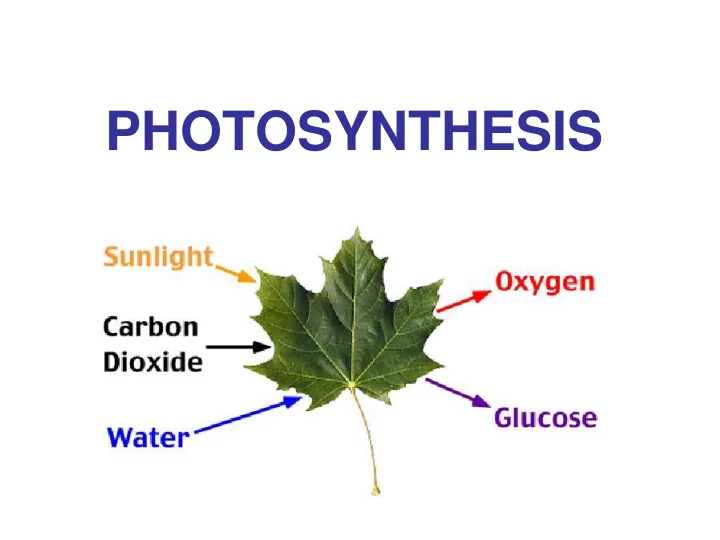
PHOTOSYNTHESIS Fundamental biological processes for making and - - PowerPoint PPT Presentation
PHOTOSYNTHESIS Fundamental biological processes for making and using energy Photosynthesis : process by which plants convert radiant energy to chemical energy Respiration : process by which glucose molecules are broken down and stored energy
Photosynthesis: process by which plants convert radiant energy to chemical energy Respiration: process by which glucose molecules are broken down and stored energy is released
Photosynthesis - autotrophs make glucose Respiration – organisms break down glucose
Autotrophs
molecules from inorganic substances (photosynthesis)
light energy to make food (plants, algae, cyanobacteria)
to drive food making reactions (bacteria, fungi)
Heterotrophs
from other organisms (heterotrophs or autotrophs)
Chloroplast- double membrane organelle Thylakoid discs (photosystem: 200-300 thylakoids)
accessory pigments
structurally and functionally Grana (stacks of thylakoid discs) location of light reactions Stroma (protein rich solution, outside grana) location of Calvin Cycle Mesophyll: location of chloroplasts Stomata: pores in leaf CO2 enters/ O2 exits Chlorophyll: pigiment in thylakoids
6 CO2 + 6 H2O + light energy → C6H12O6 + 6 O2
process whereby autotrophs (plants) take in light energy and convert it to chemical energy (sugar) Redox Reactions water is split → e- transferred with H+ to CO2 → sugar biochemical pathway- series of linked redox reactions where product of
Endergonic- absorbs solar energy Exergonic- releases energy for organism
Evidence that chloroplasts split water molecules enabled researchers to track atoms through photosynthesis (C.B. van Niel)
Reactants: Products: 6 CO2
12 H2O C6H12O6 6 H2O
6 O2
6 CO2
Photosynthesis = Light Reactions + Calvin Cycle “photo” “synthesis” energy building sugar building reactions reactions
Comes from radiation (energy that travels in waves) from the sun photon- particles which have energy wavelength- crest to crest of wave sunlight- mixture of all visible wavelengths white light- all wavelengths reflected equally so looks white visible spectrum- all colors of white light
Pigment: substance that absorbs light
bond energy
Absorption spectrum graph plotting pigment light absorption vs wavelength representation of how well particular pigment absorbs different wavelengths of white light
chlorophyll a (blue green)
chlorophyll b (yellow green)
carotenoids (orange, yellow)
anthocyanin (red, purple, blue): antioxidants
Action spectrum plots rate of photosynthesis of different wavelengths,
i.e. CO2 consumption , O2 release
(different than absorption spectrum) Englemann’s experiment: Used alga and bacteria Measured O2 output Result: violet-blue and red wavelengths caused most photosynthesis
(particles which carry fixed amount of energy)
electrons and excites them to jump to next level * *Move from ground state to excited state**
light or heat
Photosystem: reaction center (proteins that hold special pair of chlorophyll a molecules) + light harvesting complexes (cloro. a & b, carotenoids bound to proteins)
Primary electron acceptor: accepts electrons and becomes reduced (electrons move to higher energy level) Photosystem I: chlorophyll a absorbs at 700 nm- far red (p700) Photosystem II: chlorophyll a absorbs at 680 nm- red (p680)
1. light reactions (needs light)
4 basic steps
chlorophyll
released (O2 production)
and released into stroma
to make ATP and NADPH (energy carrier molecule)
3 basic steps
NADPH
to start cycle over again
animation
STEPS OF LIGHT REACTION
light and excites electrons
electrons are forced to higher energy level (reaction center) ***purpose of photosystem II is to generate ATP and supply electrons to photosystem I ***
chlorophyll a molecule (oxidation reaction)
3. primary electron acceptor sends electrons into ETC
make ATP
released into atmosphere
Photosystem II
interior of grana (lumen)
(proton gradient) of H+ ions
membranes (ATPsynthase) LINEAR ELECTRON FLOW NON-CYCLICAL PHOTOPHOYPHORYLATION animation
4. at end of ETC, electrons are passed to photosystem I thru the (cytochrome complex = plastiquinone Pq (e- carrier) and plastocyanin Pc (protein)
to excite electrons in chloro. A
electron transport chain in photosystem I to a different primary electron acceptor ferradoxin Fd (protein) facilitates movement of e-
to generate NADPH
(reduces it to NADPH)
stroma LINEAR ELECTRON FLOW NON-CYCLICAL PHOTOPHOYPHORYLATION
animation
Non cyclic
Cyclic
End products of light reactions
needed to power dark reactions
by product released into atmosphere
Respiration and photosynthesis use chemiosmosis to generate ATP
ETCs pump protons (H+) across membrane from areas of low concentration to high concentration Protons then diffuse back across membrane thru ATPsynthase to make ATP
H+ reserviors for each organelle mitochondria- matrix chloroplast – lumen
Mitochondria:high energy e- come from organic molecules Chloroplasts: high energy e- come from water
Proton motive force (H+ gradient) generated by: (1) H+ from water (2) H+ pumped across by cytochrome (3) Removal of H+ from stroma when NADP+ is reduced
animation
after light rxns
CO2 in atmosphere)
calvin cycle animation
atmosphere and binds with RuBP ribulose biphosphate (5 C sugar)
( RuBP carboxylase)
sugar
net: 6 PGA
2. Reduction (PGA to G3P) 2 steps
from ATP
from NADPH and breaks phosphate bond
(glyceraldehydre 3 phosphate)
6 ATP and 6 NADPH needed to produce 1 net G3P/PGAL
3. Regeneration of RuBP from G3P
RuBP
(cyclical – continues over and over again)
3 ATP needed to regenerate RuBP
End product of Calvin Cycle Glucose *6 turns of cycle needed to make 1 molecule of glucose* Calvin Cycle uses: 3 CO2, 9 ATP, 6 NADPH animation 1 C6H12O6 molecule = 6 CO2, 18 ATP, 12 NADPH
plants evolved a more efficient type of photosynthesis to cope
photorespiration video
Evolutionary Advantages
(because of 3 C PGA that is initially formed)
cycle
closed
pumps CO2 to bundle sheath
advantage in hot sunny areas
2. CAM Pathway
compounds, stored in mesophyll cells
light reactions supply ATP, NADPH; CO2 released from organic acids for Calvin cycle
advantage in arid areas
C fixation and Calvin Cycle together C fixation and Calvin Cycle in different CELLS C fixation and Calvin Cycle at different TIMES
Environmental Variables
intensity because pigments can only absorb so much light
Plant Variables