
SLIDE 1
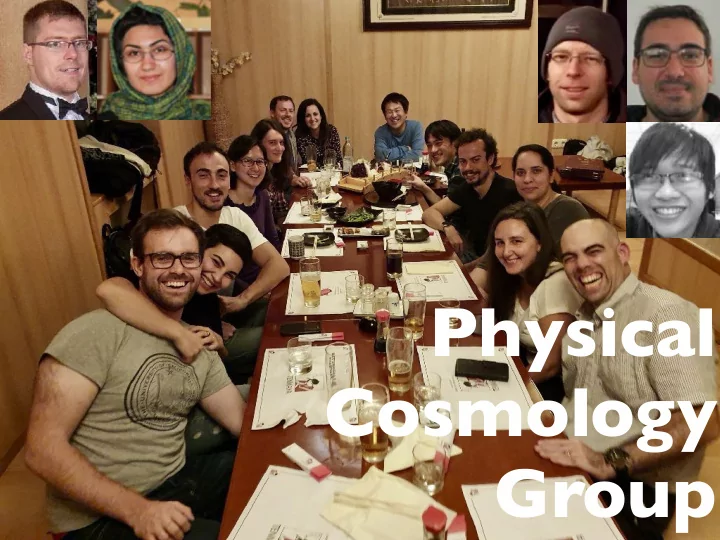
Physical Cosmology Group 14 members from 9 male, 5 female 11 - - PowerPoint PPT Presentation
Physical Cosmology Group 14 members from 9 male, 5 female 11 countries Alex Barreira (PD) Eiichiro Komatsu Linda Blot (PD) Giovanni Cabass (PD) Fabian Schmidt (W2) Elisa Ferreira (PD) Chris Byrohl (PhD) Kaloian
14 members from 11 countries
9 male, 5 female
14 members from 11 countries
9 male, 5 female
Brazil (1), Bulgaria (1), France (0.5), Germany (3), Iran (2), Israel (1), Italy (1.5), Japan (1), Portugal (1), UK (1), Vietnam (1)
Since the 2016 Fachbeirat:
Xun Shi (2012–2018) Physics of Galaxy Clusters
Associate Professor, Yunnan University
Shun Saito (2016–2018) Large-scale Structure
Assistant Professor, Missouri Univ. of S&T
Marcello Musso (2015–2018) Large-scale Structure
Faculty Member, ICTP , Rwanda
Important Note:
Fabian Schmidt’s ERC group
achievements
Four Big Questions in Cosmology
[What is the physics of inflation?]
cosmic acceleration? [What is the nature of dark energy?]
matter?
We use both theory and
data to make progress
Four Big Questions in Cosmology
[What is the physics of inflation?]
cosmic acceleration? [What is the nature of dark energy?]
matter?
We use both theory and
data to make progress
Basic Routine
Brilliant New Ideas Data
Measure/Test Feedback
Research Style
1.Come up with new ideas (new tests; new
methods; new observables), which will help make progress on the four questions
2.Write papers 3.Apply these ideas to extract new information
from data; or collect new data if necessary
4.Write papers 5.Go back to #1
Idea Data
A Typical Thesis Structure
Idea Data
Main Tools
(CMB)
ation
distribution of matter, galaxies, galaxy clusters, and strong lensing
dark energy and mass of neutrinos
CCAT-prime LiteBIRD PFS HETDEX
Main Research Activities
Universe
formation
formation
Theory Simulation Data Analysis
2017 2018 2019 2020 2021 2022 2023 2024 2025 2026 2027 2028 LiteBIRD [2028–] CCAT-prime [2021–]
CMB: Early Universe Probe
HETDEX [2017–2023] PFS [2022–]
LSS: Late Universe Probe
Data available to our group
Three recommendations from the 2016 Fachbeirat
Three recommendations from the 2016 Fachbeirat
May 21, 2019: LiteBIRD has been selected by JAXA. The launch date is 2028
Three recommendations from the 2016 Fachbeirat
May 21, 2019: LiteBIRD has been selected by JAXA. The launch date is 2028 MPA joined the CCAT-prime telescope project in Chile (first light 2021). This will be the first CMB S-4 class observatory
Frank Bertoldi’s slide from the Florence meeting
CCAT-prime Collaboration
Simons Observatory (USA)
in collaboration
South Pole?
Simons Observatory (USA)
in collaboration
South Pole?
This could be “CMB-S4”
Together with our European colleagues, we are shaping European contributions to CMB S-4. I am one of the German representatives [another is Joe Mohr at LMU]
Three recommendations from the 2016 Fachbeirat
Challenging the paradigm
Primordial gravitational waves from vacuum fluctuations in the early Universe
Frequency of gravitational waves [Hz] Present-day energy density spectrum of primordial gravitational waves
Are GWs from vacuum fluctuation in spacetime, or from sources?
⇤hij = −16πGπij
Are GWs from vacuum fluctuation in spacetime, or from sources?
⇤hij = −16πGπij
fluctuations at linear order (possible at non-linear level)
Aniket Agrawal Kaloian Lozanov Azadeh Maleknejad Leila Mirzagholi
Particle Production by gauge field [like the Schwinger Effect, but by SU(2)]
New Paradigm
circular polarisation
fields
“Chiral” GW
⇤hij = −16πGπij
Thorne, Fujita, Hazumi, Katayama, EK & Shiraishi, PRD, 97, 043506 (2018) LISA BBO Planck LiteBIRD
Frequency of gravitational waves [Hz] Present-day energy density spectrum of primordial gravitational waves
Large bispectrum in GW from SU(2) fields
detected GW comes from the vacuum or sources
BRRR
h
(k, k, k) P 2
h(k)
≈ 25 ΩA
[Maldacena (2003); Maldacena & Pimentel (2011)] Agrawal, Fujita & EK, PRD, 97, 103526 (2018); JCAP , 06, 027 (2019)
Experimental Strategy Commonly Assumed So Far
sure that it is from the CMB (i.e., Planck spectrum)
invariant spectrum?
in spacetime
New Experimental Strategy: New Standard!
sure that it is from the CMB (i.e., Planck spectrum)
fluctuation in spacetime
Particle Production! Rich Phenomenology
By A. Maleknejad
Hubble Constant
Sherry Suyu
Two innovations from our group
Science, 365, 1134 (2019)
Inh Jee’s master (Texas) and PhD work (MPA)
Innovation (1): Angular Diameter Distances
It has become the standard practice of the field
H0LiCOW Collaboration
Innovation (2): “Inverse Distance Ladder”
supernovae using strong lenses => Robust inference
Jee et al., Science (2019)
Inh Jee
Innovation (2): “Inverse Distance Ladder”
supernovae using strong lenses => Robust inference
Jee et al., Science (2019) H0LiCOW Collaboration
Sunyaev-Zeldovich Effect
Is there a tension in the amplitude of matter density fluctuations?
E2E Test of Cosmology
background
test of the evolution of the fluctuations
condition given by the CMB, can we reproduce late-time
Normalisation for the linear power spectrum of matter density fluctuations at present
Primordial amplitude constrained by the CMB Present-day amplitude constrained by late-time
The Biggest Enemy: Mass Bias
B=Mtrue/Mestimated
(People more often use 1–b = 1/B)
Planck SZ Cluster Count, N(z)
Planck CMB prediction with B=1.25 Planck CMB+SZ best fit with B=1.67
Planck Collaboration XX, arXiv:1303.5080v2
Galaxy Cluster Counts [SZ]
If the galaxy cluster mass can be calibrated accurately
Planck Collaboration 2015
Galaxy Cluster Counts [SZ]
This plot is for B=Mtrue/Mest=1.28
Planck Collaboration 2015
B=1.45±0.15 B=1.28±0.15 B=0.99±0.19
B=Mtrue/Mestimated
Planck Collaboration 2015
Full-sky Thermal Pressure Map
North Galactic Pole South Galactic Pole Planck Collaboration
My favourite approach: No number counts, but we model the map
State-of-the-art Model and Analysis
We have established the definitive model and analysis methods for analysing the power spectra and cross-power spectra of SZ and galaxy surveys
Ryu Makiya
Full-sky Thermal Pressure Map
North Galactic Pole South Galactic Pole Planck Collaboration
No redshift information from SZ alone => Cross-correlation!!
2MASS Redshift Survey
Huchra et al. (2012)
2MASS Redshift Survey
Huchra et al. (2012)
Cross-correlation extracts SZ signals at z<0.1
First measurement of the 2MASS-SZ cross-power
Makiya, Ando & EK (2018)
52
Makiya, Ando & EK (2018)
But, what do we learn from this? We need auto power spectra. We need 3x2pt!
First measurement of the 2MASS-SZ cross-power
2MRS Auto Power
Ando, Benoit-Lévy & EK (2018)
(GRAPPA, U. Amsterdam)
SZ Auto Power
We need to include non- Gaussian error bars [connected trispectrum]
used Gaussian covariance ignoring the non-Gaussian term
nuisance parameters
Bolliet, Comis, EK, Macias-Pérez (2018) with non-Gaussian error without
(U. Manchester)
Planck Collaboration (2016)
Foregrounds = Nuisance Parameters
Key Quantity: Mass Bias
this quantity
with the Planck CMB cosmology?
with weak lensing data without any reference to CMB?
galaxy clusters?
˜ M500c = M500c,true/B
<latexit sha1_base64="jG4q3CLuBbOdwxz2VYtq2xgJvfo=">ACD3icbZC7SgNBFIZn4y3G26qlzWAQLSTuiqIWQoiNjRDBmEASwuzkJBkye2HmrBCWfQbX8XGQsXW1s63cXIRNPrDwMd/zuHM+b1ICo2O82lZmbn5heyi7ml5ZXVNXt941aHseJQ4aEMVc1jGqQIoICJdQiBcz3JFS9/sWwXr0DpUY3OAgqbPuoHoCM7QWC17t4FCtoFetZJjx+EpPf/G/aShfIoqhjQ9KLXsvFNwRqJ/wZ1AnkxUbtkfjXbIYx8C5JpXedCJsJUyi4hDTXiDVEjPdZF+oGA+aDbiajg1K6Y5w27YTKvADpyP05kTBf64HvmU6fYU9P14bmf7V6jJ3TZiKCKEYI+HhRJ5YUQzpMh7aFAo5yYIBxJcxfKe8xTiaDHMmBHf65L9QOSycFdzro3yxNEkjS7bINtkjLjkhRXJyqRCOLknj+SZvFgP1pP1ar2NWzPWZGaT/JL1/gUgTpr4</latexit><latexit sha1_base64="jG4q3CLuBbOdwxz2VYtq2xgJvfo=">ACD3icbZC7SgNBFIZn4y3G26qlzWAQLSTuiqIWQoiNjRDBmEASwuzkJBkye2HmrBCWfQbX8XGQsXW1s63cXIRNPrDwMd/zuHM+b1ICo2O82lZmbn5heyi7ml5ZXVNXt941aHseJQ4aEMVc1jGqQIoICJdQiBcz3JFS9/sWwXr0DpUY3OAgqbPuoHoCM7QWC17t4FCtoFetZJjx+EpPf/G/aShfIoqhjQ9KLXsvFNwRqJ/wZ1AnkxUbtkfjXbIYx8C5JpXedCJsJUyi4hDTXiDVEjPdZF+oGA+aDbiajg1K6Y5w27YTKvADpyP05kTBf64HvmU6fYU9P14bmf7V6jJ3TZiKCKEYI+HhRJ5YUQzpMh7aFAo5yYIBxJcxfKe8xTiaDHMmBHf65L9QOSycFdzro3yxNEkjS7bINtkjLjkhRXJyqRCOLknj+SZvFgP1pP1ar2NWzPWZGaT/JL1/gUgTpr4</latexit><latexit sha1_base64="jG4q3CLuBbOdwxz2VYtq2xgJvfo=">ACD3icbZC7SgNBFIZn4y3G26qlzWAQLSTuiqIWQoiNjRDBmEASwuzkJBkye2HmrBCWfQbX8XGQsXW1s63cXIRNPrDwMd/zuHM+b1ICo2O82lZmbn5heyi7ml5ZXVNXt941aHseJQ4aEMVc1jGqQIoICJdQiBcz3JFS9/sWwXr0DpUY3OAgqbPuoHoCM7QWC17t4FCtoFetZJjx+EpPf/G/aShfIoqhjQ9KLXsvFNwRqJ/wZ1AnkxUbtkfjXbIYx8C5JpXedCJsJUyi4hDTXiDVEjPdZF+oGA+aDbiajg1K6Y5w27YTKvADpyP05kTBf64HvmU6fYU9P14bmf7V6jJ3TZiKCKEYI+HhRJ5YUQzpMh7aFAo5yYIBxJcxfKe8xTiaDHMmBHf65L9QOSycFdzro3yxNEkjS7bINtkjLjkhRXJyqRCOLknj+SZvFgP1pP1ar2NWzPWZGaT/JL1/gUgTpr4</latexit><latexit sha1_base64="jG4q3CLuBbOdwxz2VYtq2xgJvfo=">ACD3icbZC7SgNBFIZn4y3G26qlzWAQLSTuiqIWQoiNjRDBmEASwuzkJBkye2HmrBCWfQbX8XGQsXW1s63cXIRNPrDwMd/zuHM+b1ICo2O82lZmbn5heyi7ml5ZXVNXt941aHseJQ4aEMVc1jGqQIoICJdQiBcz3JFS9/sWwXr0DpUY3OAgqbPuoHoCM7QWC17t4FCtoFetZJjx+EpPf/G/aShfIoqhjQ9KLXsvFNwRqJ/wZ1AnkxUbtkfjXbIYx8C5JpXedCJsJUyi4hDTXiDVEjPdZF+oGA+aDbiajg1K6Y5w27YTKvADpyP05kTBf64HvmU6fYU9P14bmf7V6jJ3TZiKCKEYI+HhRJ5YUQzpMh7aFAo5yYIBxJcxfKe8xTiaDHMmBHf65L9QOSycFdzro3yxNEkjS7bINtkjLjkhRXJyqRCOLknj+SZvFgP1pP1ar2NWzPWZGaT/JL1/gUgTpr4</latexit> 0.56 0.64 0.72 0.80 0.88
σ8
0.8 1.0 1.2 1.4 1.6 1.8 2.0 2.2 2.4
Mass bias B
tSZ+Shear (σ8 < 0.90) tSZ+CMB
One figure summary
Mass bias needed to reconcile SZ and CMB
Makiya et al. (2018) Bolliet et al. (2018)
Range of mass bias from astrophysics
Shi et al. (2014,2015,2016)
0.56 0.64 0.72 0.80 0.88
σ8
0.8 1.0 1.2 1.4 1.6 1.8 2.0 2.2 2.4
Mass bias B
tSZ+Shear (σ8 < 0.90) tSZ+CMB
One figure summary
Mass bias needed to reconcile SZ and shear. No CMB!
Makiya et al. (2019) Conclusion: Non-CMB data agree with astrophysical expectation! Another indication of a tension between CMB and low-z data?
Hobby-Eberly Telescope Dark Energy Experiment
Location McDonald Observatory (West Texas) Primary Mirror Size 10 m Location Subaru Telescope (Hawaii) Primary Mirror Size 8.2 m Wavelength Coverage 350–550 nm (Δλ=6.2Å) Wavelength Coverage Blue: 380–650 nm (Δλ=2.1Å) Red(LR): 630–970 nm (Δλ=2.7Å) Red(HR): 710–885 nm (Δλ=1.6Å) NIR: 940–1260 nm (Δλ=2.4Å) Redshift (Lyα) z=1.9–3.5 Redshift ([OII]) z=0.02–0.74 z=0.69–1.60 z=0.90–1.37 z=1.52–2.38
PFS
Spectrograph Type Integral Field Unit (IFU) # of fibers 34,944 Spectrograph Type Robotic Multi Object Fiber-fed # of fibers 2,394 + 96 Field of View 0.1 deg2 (22’ diam.) Field of View 1.25 deg2 (1.38 deg diam.) Fiber Diameter 1.5 arcsec Fiber Diameter 1.2 arcsec Survey Type Blind Survey Type Traditional Survey Volume 8.2 (Gpc/h)3 Survey Volume 2.8 (Gpc/h)3
~20 Mpc in one go!
Hobby-Eberly Telescope Dark Energy Experiment PFS
Texas-led $42M experiment Japan-led $85M instrument
Three major science programs:
But, we can do:
Main Objective: Spectroscopic follow-up of targets detected by the imaging survey of Hyper Suprime Cam Main Objective: Cosmology CPPC
NEPG
Prime Focus Instrument (2 tons!) Fibers Detectors / Cryogenic system
Hobby-Eberly Telescope with VIRUS
One VIRUS Detector Unit cameras
HETDEX Started!
*VIRUS = Visible Integral-field Replicable Unit Spectrograph
VIRUS = World’s Largest IFS
as they are built (at the rate of 3 units per month)
HETDEX Collaboration
14
A typical hetdex field
Reconstructed image of the 21k fibers. Filled squares are active IFUs,
remaining. In this frame, we would use about 15 of the stars for astrometry and throughput measures.
Karl Gebhardt
26k
Example of full field on M3. Green boxes are the IFU locations.
Karl Gebhardt
65~1 arcmin, completely filled by fibers (after 3 dither)
HETDEX main extension
HETDEX Foot-print (in RA-DEC coordinates)
One exposure is 20 minutes
300 deg2 150 deg2 Volume = 2.8 (Gpc/h)3 Total: 450 deg2
66
Example calibration check, using 2 white dwarfs from SDSS (virus in red, SDSS in black)
Karl Gebhardt
24
Examples from one field
Karl Gebhardt
Analysis well underway
One of the “Red” Spectrograph Modules being tested at LAM
One of the “Red” Spectrograph Modules being tested at LAM
shipped from LAM to Subaru!
Major contributions from MPA scientists to shaping PFS’s cosmology program
Aoife Boyle Ryu Makiya Fabian Schmidt
Vision: Summary
significant contributions to:
[LiteBIRD, CCAT
during inflation!
2017 2018 2019 2020 2021 2022 2023 2024 2025 2026 2027 2028 LiteBIRD [2028–] CCAT-prime [2021–]
CMB: Early Universe Probe
HETDEX [2017–2023] PFS [2022–]
LSS: Late Universe Probe
Coming Decade