- R. J. Wilkes
Email: ph116@u.washington.edu
Physics 116
Lecture 10
Review: oscillations and waves
Oct 14, 2011
If we have time to spare:
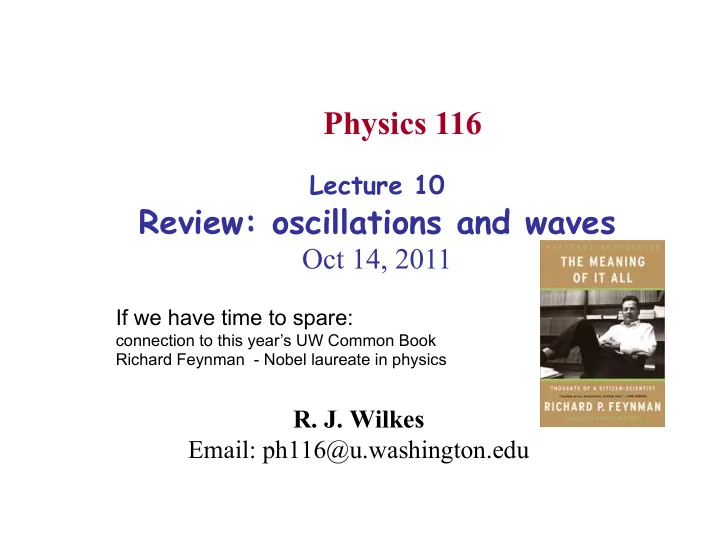
connection to this year’s UW Common Book Richard Feynman - Nobel laureate in physics
Physics 116 Lecture 10 Review: oscillations and waves Oct 14, 2011 - - PowerPoint PPT Presentation
Physics 116 Lecture 10 Review: oscillations and waves Oct 14, 2011 If we have time to spare: connection to this years UW Common Book Richard Feynman - Nobel laureate in physics R. J. Wilkes Email: ph116@u.washington.edu Announcements
connection to this year’s UW Common Book Richard Feynman - Nobel laureate in physics
* laptop, netbook, iPad, or equivalent NOT ALLOWED: NO wifi !
students) - Latecomers can sit at tables in front or back
questions
– you will get a copy of formula page as part of the exam paper
3
Today
The story so far – all the stuff you have learned about in 116:
10/14/11
4
NY Times, 10/14/11: …students exchanged exam horror stories… “I know a girl who saw the physics paper and she fainted,” said Nikita Sachdeva, her eyes widening.
Don’t faint! Our exam will not be so scary.
harmonic motion with an amplitude of 1.27 cm and a frequency of 2.55 Hz. (a) What is the maximum speed of the needle? (b) What is the maximum acceleration of the needle? v(t) = A sin t
a(t) = A 2 cos t
2 = 326cm / s2
Note: I’ve fixed typos in these slides, so compare to your class notes. (and many thanks to students who found some I’d missed!)
t = 0 s the mass has zero speed and is at x = 8.30 cm. What is its speed at t = 2.50 s? A) 10.9 cm/s B) 3.06 cm/s C) 3.32 cm/s D) 1.80 cm/s E) 0 cm/s Answer: B
is doubled, by what factor does the maximum acceleration of the
A) 2 B) 4 C) 1 D) 1/2 E) 1/4
a(t) = A 2 cos t
SHM = 2 fSHM a(t) SHM
2
fSHM
2
f 2 f a 4a
Answer: B
undergoing simple harmonic oscillations with a frequency of 1.95 Hz and an amplitude of 7.50 cm. What is the speed of the mass when it is 3.00 cm from its equilibrium position? A) 0.0368 m/s B) 0.551 m/s C) 0.421 m/s D) 0.842 m/s E) 0.919 m/s Answer: D
period T on Earth, what will its period be on the Moon? A) B) C) T/6 D) 6T E) T/3 Answer: A
the slowest and weakest, shear (S) waves, which are transverse waves and carry most
The speed of P waves is approximately 7 km/s, and that of S waves is about 4 km/s. People do not generally feel the P waves, but animals seem to be sensitive to them. If a person reports that her dog started barking 20 seconds "before the earthquake," then approximately how far was the origin of the earthquake? A) 100 km B) 200 km C) 300 km D) 400 km E) 500 km
Answer: B
x = c t
tP = cS cP tS
cS cP 1
4km / s 7km / s 1
20sec = tS 0.43
x = cStS = 4km / s
A) twice as intense as the sound of 20 decibels. B) four times as intense as the sound of 20 decibels. C) 10 times as intense as the sound of 20 decibels. D) 100 times as intense as the sound of 20 decibels. E) 1000 times as intense as the sound of 20 decibels. dB]
[ ] = 10log10
I I0
40dB = 10log10 I40dB I0
I20dB I0
1
40 10
I40dB I0
1 20
10
I20dB I0
I20dB = 104 102 = 102 Answer: D
there A) are displacement nodes at each end. B) are displacement antinodes at each end. C) is a displacement node at the open end and a displacement antinode at the closed end. D) is a displacement node at the closed end and a displacement antinode at the open end. Answer: D
constant speed, sounding its horn, and you hear a frequency of 76 Hz. After the car goes by, you hear a frequency of 65 Hz. What is the speed
A) 26 m/s B) 27 m/s C) 28 m/s D) 29 m/s E) 30 m/s Answer: B
f ' = f 1 1 uSRC / c
76Hz = f 1 1 uSRC / c
65Hz = f 1 1+ uSRC / c
f = 76Hz 1 uSRC / c
( ) = 65Hz 1+ uSRC / c ( )
76Hz 76Hz
( ) uSRC / 343m / s ( ) = 65Hz + 65Hz ( ) uSRC / 343m / s ( )
76Hz 65Hz
( )343m / s = 76Hz + 65Hz ( )uSRC
76Hz 65Hz
( )
76Hz + 65Hz
( )
343m / s = uSRC = 26.8m / s
approaching him at a speed of 35.0 m/s. The wave is reflected by the car and interferes with the emitted sound producing beats. What is the frequency of the beats? The speed
A) 5000 Hz B) 4500 Hz C) 8490 Hz D) 9000 Hz E) 4250 Hz
Answer: D
f ' = f 1+ uOBS c
f ' = 39.6kHz 1+ 35m / s 343m / s
f ' = 39.6kHz 1.102
( ) = 43.6kHz
f '' = f ' 1 1 uOBS c
f '' = 43.6kHz 1 1 35m / s 343m / s
f '' = 43.6kHz 1.114
( ) = 48.6kHz
fBEAT = f f '' = 39.6kHz 48.6kHz = 9kHz
Reflected wave will have f ‘ = frequency observed by car. So f ’ = frequency for stationary source and moving observer. but f’ in car’s reference frame is heard as f’’ in stationary frame, where f’’ = frequency for stationary observer and moving source (car acts as moving source of f’)
See you Monday! Please take alternate seats for the exam (empty seat between students) Latecomers can sit at tables in front or back
connection to this year’s UW Common Book Richard Feynman - Nobel laureate in physics, famous 1964 lecture series at Cornell U. - more samples will be played later http://www.youtube.com/watch?v=1SrHzSGn-I8&feature=related http://www.washington.edu/news/articles/much-more-than-physics- remembering-common-book-author-richard-feynman