
SLIDE 1
- R. J. Wilkes
Email: ph116@u.washington.edu
Physics 116
Lecture 13
EM spectrum and speed of light
Oct 20, 2011
10/20/11 1
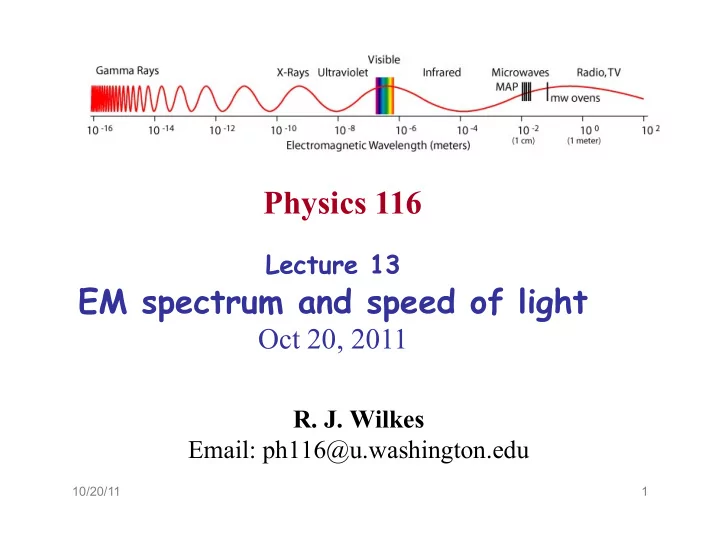
Physics 116 Lecture 13 EM spectrum and speed of light Oct 20, 2011 - - PowerPoint PPT Presentation
Physics 116 Lecture 13 EM spectrum and speed of light Oct 20, 2011 R. J. Wilkes Email: ph116@u.washington.edu 10/20/11 1 Announcements JW will be away until 10/31 Guest lecturer today: Prof. Victor Polinger Clicker
10/20/11 1
10/20/11 2
3
10/20/11
4
10/20/11 4
5
Name Typical wavelength AM radio band 100 m FM radio / TV / CB bands 1 m Microwaves 1mm Infrared (IR) radiation 1 micron (10-6 m) Visible light 0.5 micron Ultra-violet (UV) radiation 0.1 micron X-rays 10-8 m (atom size) Gamma rays (energy > 0.1 MeV)
10/20/11
6
7
8
9
– Voice/music/picture signals (~ 1kHz) slightly vary carrier – AM means amplitude variation carries information content – FM means frequency is tweaked to model information content » Digital transmissions use pulse modulation (either AM or FM)
(microvolt) signals on its antenna $ Filters out carrier wave $ Amplifies audio/video signal $ Sends reconstituted signals to loudspeaker, earphone, or screen
10
Cavity resonator from microwave oven
11
12
– Navy uses Extremely Low Frequency (ELF) to communicate with submarines: wave with # ~ 100km penetrates (a bit) into ocean
– Modulation frequency must be << carrier frequency (many cycles/bit) – “Bandwidth”: carrier frequency is spread by modulation frequency » At 100 MHz, can only use <1 MHz modulation » At 2.5 GHz may have many MHz of modulation (many calls) » ELF: only a few bits - tell sub to surface and phone home!
So E and B are proportional
10/20/11 13
So the yellow line at 587 nm emitted by helium atoms in the star will be
Ex Ey By Bx
% % 10/20/11 14
15