Physics 116 Lecture 8 Interference Halfway between are Oct 11, - - PowerPoint PPT Presentation

physics 116 lecture 8 interference
SMART_READER_LITE
LIVE PREVIEW

Physics 116 Lecture 8 Interference Halfway between are Oct 11, - - PowerPoint PPT Presentation

lines of reinforcement, where peaks overlap ( constructive interference) Physics 116 Lecture 8 Interference Halfway between are Oct 11, 2011 lines of destructive interference R. J. Wilkes Email: ph116@u.washington.edu 10/11/11 1


slide-1
SLIDE 1
  • R. J. Wilkes

Email: ph116@u.washington.edu

Physics 116

Lecture 8

Interference

Oct 11, 2011

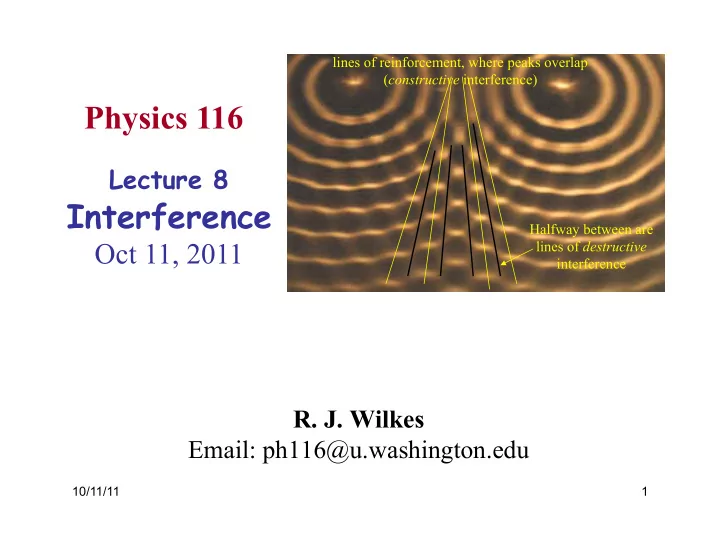
Halfway between are lines of destructive interference lines of reinforcement, where peaks overlap (constructive interference)

10/11/11 1

slide-2
SLIDE 2
  • Exam 1 is Monday, 10/17
  • All multiple choice, similar to HW problems
  • YOU must bring a standard mark-sense (bubble) sheet
  • Closed book/notes, formula page provided
  • You provide: bubble sheet, pencils, calculator, brain
  • Covers material in Ch.13 and 14 (through Thursday’s class)
  • Damped/driven oscillators will NOT be on test
  • Friday’s class: review, and example questions
  • TA Kyle Armour’s regular office hour on Thursdays: time changed

to 10:30-11:30 (in B442).

  • Kyle will hold a special office hour 11:30-12:30 on Monday 10/17 in

room B442.

Announcements

10/11/11 2

slide-3
SLIDE 3

3

Today

Lecture Schedule

(up to exam 1)

10/11/11

slide-4
SLIDE 4

4

If sound source and observer are in relative motion, observed frequency will differ from source’s frequency

  • Sound waves require a material medium to propagate
  • Recall: Galilean relativity

– If two coordinate systems differ only by a constant v, not by an acceleration, we can simply add velocity vectors to get apparent v in either – Standard example: rowboat in a river that is flowing with speed v

  • rower has speed u relative to water,
  • water has speed v relative to earth,
  • so rower’s speed relative to earth is u + v

u is + if same direction as river (rowing downstream), negative if opposite (upstream)

  • Coordinate system of medium (air, water, etc) is “special” for sound waves

– Sound waves have speed c, and f and ! are related by

  • For an observer moving relative to medium with speed u, apparent

propagation speed c’ will be different:

– Wavelength cannot change – it’s a constant length in the medium, and same length in moving coordinate system (motion does not change lengths) – Observed frequency has to change, to match apparent speed and fixed wavelength:

(sign depends on relative direction of u )

Doppler effect:

10/11/11 4
slide-5
SLIDE 5

5

Doppler effect:

  • So if observer is moving (speed u) relative to source at rest in medium,

then apparent frequency f’ is:

  • However, if source is moving (speed u) relative to observer at rest in

medium, then

– Frequency remains constant (same time interval between wavefront emissions) – But source now chases its own waves (or runs away from them): wavelength in the medium is shorter or longer

  • Wave speed = c
  • Time between successive peaks = T
  • Distance between peaks = cT – uT = wavelength
  • Frequency of wave in medium (and for observer):

Notice the central role of the medium in both cases

+ sign if u is toward source, Minus sign if away from source minus sign if toward observer, + sign if away from observer. Notice: different f for observers

  • n opposite sides of the source!

10/11/11 5

slide-6
SLIDE 6

6

Doppler effect:

  • General case

– For either source or observer (or both) moving relative to medium, c = speed of sound in medium u = speed of source/observer in the medium (both are unsigned = always taken as positive) Use upper sign if source and observer move toward each other, lower sign if source and observer move away from each other

f ' = f 1± uOBS c

  • 1 uSRC

c

  • +
slide-7
SLIDE 7

7

Examples

  • Car moving with u=18 m/s sounds horn with f=550 Hz, in still air at 20C.

What f’ is heard by observer on sidewalk? Moving source, observer at rest in air: Car toots again while at stop sign. What f’ is heard by bicyclist with u=7.2 m/s toward the car?

Moving observer, source at rest in air:

Road-raging driver toots horn yet again, when car is again moving with u=18 m/s. Now what f’ is heard by bicyclist? Source and observer both in motion relative to air, approaching each other

slide-8
SLIDE 8
  • Pop Quiz 2
  • Mr. A is on a train moving toward me at 100 m/s
  • I am at rest on the ground next to the track
  • Mr. A aims a horn at me and toots it

His horn toots at 256 Hz. The frequency that I hear is:

  • A. Higher than 256 Hz
  • B. 256 Hz (same frequency as he observes, on the train)
  • C. Lower than 256 Hz
  • D. (it is impossible to predict what the observer would find)
slide-9
SLIDE 9

Interference

  • Important properties of waves:

– They can add to each other (superposition ), because of which… – They can interfere with each other

  • Superpose 2 waves (colliding water waves, merging sound

waves, etc) have same ! and their amplitudes add

– If one is going down while the other is going up, result = 0 !

+ = At each point along the waves, they add up to zero: We say they are “out of phase”

Note: doesn’t matter if the horizontal axis is time or space… OR: if they add to each other, they are “in phase”: result = wave with 2X amplitude

slide-10
SLIDE 10

Interference patterns

  • Imagine two kids paddling their hands in a pond in unison
  • Waves (ripples) propagate outward, and overlap
  • There will be lines of reinforcement, and lines of cancellation

(constructive and destructive interference)

– We’ll come back to this soon, when we talk about optics…

Halfway between are lines of destructive interference lines of reinforcement, where peaks overlap (constructive interference)

slide-11
SLIDE 11

11

Interference = defining property of waves

  • If you see interference effects, you are looking at waves !

Case study: Isaac Newton thought light was a stream of particles Newton’s “Opticks” (1687) explained all observations at the time Thomas Young (120 years later) observed interference effects with light Only waves could do that… Wave theory of light replaced Newton’s particle theory

  • Interference depends on phase relationship of overlapping waves
  • Phase relationship depends on distance from source

Recall: Phase at distance D from source = 2! (D/") but sin/cos repeat every cycle, so all that matters is where we are relative to start of latest cycle: fraction of a cycle Phase at distance D from source = 2! [ fractional part of (D/") ] Example: fractional part of 5.678 is 0.678

slide-12
SLIDE 12

12

Phase relationships

Example: source of sound has "=1.5m Point A is 2.5 m away, B is 5.5 m away, C is 7 m away Phase values are

D / " (distance, in units of wavelengths)

A B C A, B, C are all 2/3 along a cycle, so sound waves have the same phase at all these points at all times

Snapshot at some instant of time… D (distance, in meters)

3 6 9

slide-13
SLIDE 13

13

Example: 2 sound sources with same f

Solid line: R = one wavelength, dashed R= wavelength

A B C

Point A: sources 1 and 2 are in phase, so we get constructive interference Points B and C: 1 and 2 are “180 deg out of phase”, so destructive interference

1 2

slide-14
SLIDE 14

Examples

  • R and L channel loudspeakers, spaced 3m apart, are in phase: both

speaker cones move forward or backward in sync together Observer 4m away, parallel to L speaker hears constructive interference. What f sound is being played? Any integer multiple of this f will also produce constructive interference at the observer’s location

3m 4m 5m

10/11/11 14

slide-15
SLIDE 15

Self-interference: “standing waves”

  • If I wiggle the rope at just the right f

– Waves reflected from the end interfere constructively with new waves I am making – Result: looks as if some points stand still: standing waves

  • Example of resonance: rope length L = multiple of "/2

Point A moves with big amplitude Point B has amplitude ~0

  • Same thing happens in musical instruments

– Structure favors waves which have L = multiple of "/2

  • Guitar, violin strings: both ends must be nodes

– Organ pipes, wind instruments: one end must be node, other antinode

Anti-node Node

Nodes = stationary points; anti-nodes=maxima