
SLIDE 1
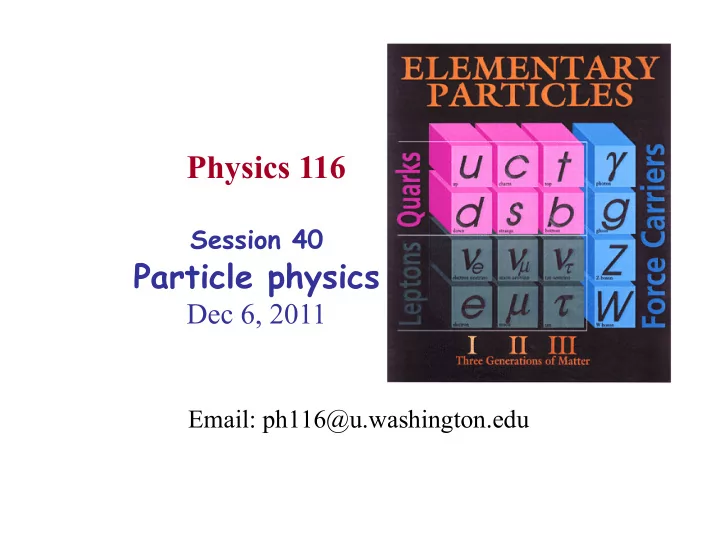
Physics 116 Session 40 Particle physics Dec 6, 2011 Email: - - PowerPoint PPT Presentation
Physics 116 Session 40 Particle physics Dec 6, 2011 Email: ph116@u.washington.edu Announcements Final exam: Monday 12/12, 2:30-4:20 pm Same length/format as previous exams (but you can have 2 hrs) Kyle Armour is away this
TODAY: YOUR CHANCE FOR REVENGE – COURSE EVALUATION Pick up now: bubble sheet, yellow sheet and pencil but wait to fill out until I leave the room (or, if you must leave early, leave forms with a neighbor to turn in) Leave completed forms in box at front of room, at end of class. News items worth reading: Today’s NY Times, see
SCOTT AARONSON (contemporary atomic physics)
3
Today
4
– Mass smaller that 1.4 Sun’s mass: as nuclear fuel burns out, becomes a “brown dwarf” (blob of frozen gas) – Mass between 1.4 and about 3 Msun : supernova explosion
massive sudden explosion: supernova
“compact object”, typically radiates lots of energy (“pulsar”) – Mass greater than about 3 Msun: collapses too quickly for the supernova stage, into a “black hole”
escape: black hole
* Density >1017 kg/m3 = Earth crushed to size of Manhattan
“Not on exam”
Today’s NY Times
Artists’ conception of Black Hole with M=1010 Msun What is required to make gravitational escape velocity = speed of light? Recall from PHYS 114: vESC =
2GM EARTH REARTH c = 2GM BH R
BH
R
BH = 2GM BH
c2 ? We used classical physics, but GR
calculation gives the same result Schwarzschild radius: “horizon” of BH of mass M “event horizon” = radius such that nothing can escape (all light cones bend into the BH; “future” of any object there lies entirely inside the BH Most BHs have spin – stars spiral into them
the same scale
“Not on exam”
6
are produced when atoms are smashed (over 200 identified)
– "elementary" because thought to be fundamental in 1950s
– Truly no known substructure (as of today!)
(Greek: hadros = strong)
– protons, neutrons; plus pions, kaons, lambda particles...etc – now known to be made of fundamental particles: quarks
(Greek: leptos = weak)
– responsible for radioactive decays – electrons, plus muons, taus and associated neutrinos
yesterday
7
counterpart
Electron Antielectron (Positron) Proton Antiproton Neutron Antineutron
Antiparticles have opposite electric charge (and other properties) but are otherwise identical
– It’s just as easy to make antimatter as matter
– But: if particle and antiparticle meet – annihilation! – How come we live in a universe where there is almost no antimatter? (luckily - or we might not survive long…) What caused the Big Bang to create much more matter than antimatter?
8
Basic ingredients of matter are the fundamental particles: quarks and leptons
6 quarks 6 leptons
+ their antiparticles
(Symmetry!)
These types of particles are called 'fermions'
(from http://www.fnal.gov)
Fundamental forces are mediated by photons, gluons, Z’s and W’s These types of particles are called 'bosons'
(after Enrico Fermi) (after Satrendyanath Bose)
9
(Neutrinos are invisibly tiny on this scale)
10
– LIGO experiment in Hanford, WA will try!
LIGO Hanford Observatory http://www.ligo-wa.caltech.edu/
exchanged particle
– Gravity and electromagnetic forces extend infinitely far (though weaken with increased distance) – Strong and weak nuclear forces are remote from everyday experience: only come into play at distances like nuclear size
11
– up/down, charm/strange, top/bottom
entire 'zoo' of particles cataloged since the 1950s
– 6 quarks, 6 anti-quarks, grouped in twos and threes
– Many dozens of combinations, but only 1 or 2 stable – Charges always come out as multiples of e charge! – Model explained newly discovered particles too!
– Up, charm, top quarks have +2/3 charge – Down, strange, bottom quarks have –1/3 charge – 2u + 1d (uud) proton, with +1 charge
– 2d + 1u (ddu) neutron, with 0 charge
12
CERN, Switzerland
Geneva airport CERN proton accelerator and p/anti-p collider rings (LHC = Large hadron collider)
See http://public.web.cern.ch/
13
Size of humans! UW members: Profs. Henry Lubatti, Anna Goussiou, and Gordon Watts and their students
14
15
generations of particle accelerators
Hot results expected from LHC next week…
16
Actual data (as of early November If p+anti-p make a Higgs, we expect to see a bump in the probability vs total energy
bump below has become much bigger (>3) with more data.
= std. deviations