Physics 2D Lecture Slides Lecture 9 : Jan 19th 2005 Vivek Sharma - - PDF document

physics 2d lecture slides lecture 9 jan 19th 2005
SMART_READER_LITE
LIVE PREVIEW

Physics 2D Lecture Slides Lecture 9 : Jan 19th 2005 Vivek Sharma - - PDF document

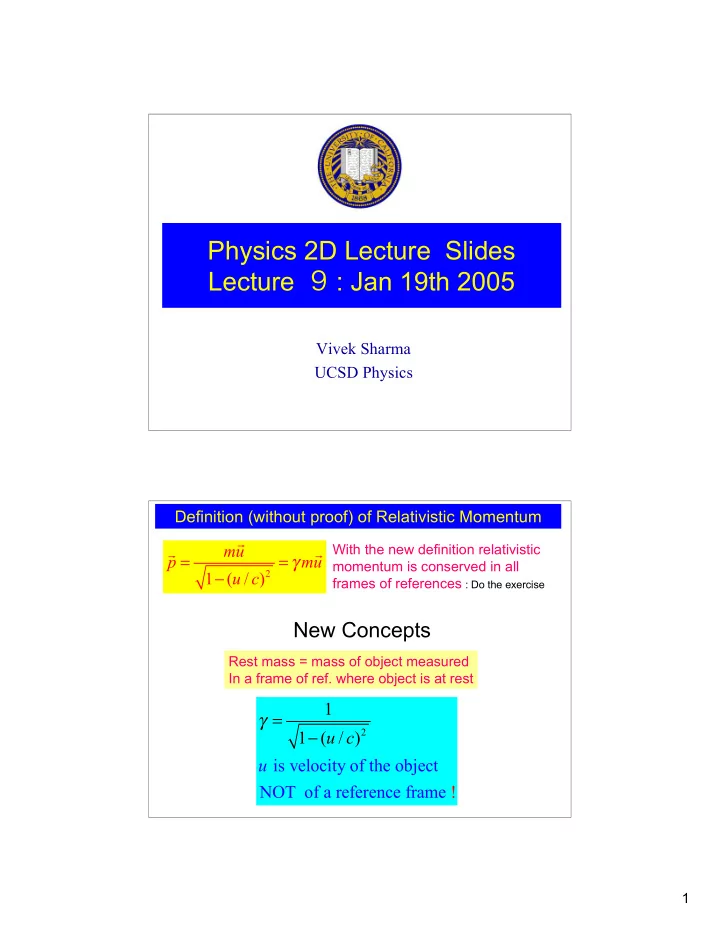
Physics 2D Lecture Slides Lecture 9 : Jan 19th 2005 Vivek Sharma UCSD Physics Definition (without proof) of Relativistic Momentum mu With the new definition relativistic = = p mu momentum is conserved in all 2 1 (


slide-1
SLIDE 1

1

Physics 2D Lecture Slides Lecture 9 : Jan 19th 2005

Vivek Sharma UCSD Physics Definition (without proof) of Relativistic Momentum

2

1 ( / ) mu p mu u c

  • =

=

  • With the new definition relativistic

momentum is conserved in all frames of references : Do the exercise

New Concepts

Rest mass = mass of object measured In a frame of ref. where object is at rest

2

is velocity of the object NOT of a referen 1 1 ( / ) ! ce frame u u c =

slide-2
SLIDE 2

2

Relativistic Force & Acceleration Relativistic Force And Acceleration

2

1 ( / ) mu p mu u c

  • =

=

  • (

) ( ) ( )

3/2 2 2 2 2 2 2 3/2 2 3/2 2 2 2

1 ( / ) : Relativistic For 1 2 ce ( )( ) 1 ( / ) Since A 2 1 ( / ) 1 ( ccel / ) 1 ( e ) a / r d du d use dt dt du m mu u du F c dt u c u c mc mu mu du F du dt dp d mu F dt dt u c m F u c dt c u c =

  • =

+

  • +
  • =
  • =

=

  • =
  • 3/2

2

tion a = Note: As / 1, a 0 !!!! It [rate of change of v s harder to accelerate when you get closer to s elocity , F ] peed of l a = 1 ( / ) m ight du u c dt u c

  • Reason why you cant

quite get up to the speed

  • f light no matter how

hard you try!

PEP-II accelerator schematic and tunnel view PEP-II accelerator schematic and tunnel view

Linear Particle Accelerator : 50 GigaVolts Accelating Potential 3/2 2

eE a= 1 ( / ) m u c

slide-3
SLIDE 3

3 Relativistic Work Done & Change in Energy

x1 , u=0 X2 , u=u

2 2 1 1

3/ 2 2 2 2 2 3/ 2 2 2

substitute in . . , 1 1 , W (change in var x u) 1

x x x x u

dp W F dx dx dt du m mu dp dt p dt u u c c du m dt W u t c ud = = =

  • =
  • =
  • Relativistic Work Done & Change in Energy

x1 , u=0 X2 , u=u

2 2 3/2 1/2 2 2 2 2 2 2 2 2 2 2

Work done is change in energy (KE in this case) 1 1 K =

  • r Total

E= Energy

u

mudu mc W mc u u c c m mc m K m mc c c c c m

  • =

=

  • =
  • =

+

slide-4
SLIDE 4

4 But Professor… Why Can’s ANYTHING go faster than light ?

K = mc2 1 u2 c2

  • 1/2 mc2 K + mc2

( )

2 =

mc2 1 u2 c2

  • 1/2
  • 2

1 u2 c2

  • = m2c4 K + mc2
  • 2

u = c 1 ( K mc2 +1)2 (Parabolic in u Vs K mc2 ) As u c , Kinetic Energy K Need to do infinite amount of work on the particle to rev it up to the speed of light! Non-relativistic case: K = 1 2 mu2 u = 2K m

Relativistic Kinetic Energy Vs Velocity

slide-5
SLIDE 5

5 A Digression: How to Handle Large/Small Numbers

  • Example: consider very energetic particle with very large Energy E
  • Lets Say γ = 3x10¹¹, Now calculate u from 
  • Try this on your el-cheapo calculator, you will get u/c =1, u=c due

to limited precision.

  • In fact u ≅c but not exactly!, try to get this analytically

2 2 2 2

1 E mc K K mc mc mc

  • +

= = = +

1/2 2

1 1 u c

  • =
  • 2

24 2

1 1 (1 )(1 ) 1 u Since = 1, 1 2 c 1 2 1 1 1 5 10 , 2 0.999 999 999 999 999 999 999 995c !! Such particles are routinely produced in violent cosmic collisions u c u

  • =

=

  • +
  • +

=

  • =

= =

  • =

In Quizzes, you are Expected to perform Such simple approximations

When Electron Goes Fast it Gets “Fat”

2

E mc

  • =

v As 1, c Apparent Mass approaches

  • New Concept

Rest Mass = particle mass when its at rest

2 2

E = Total Energy mc K mc

  • =

+

slide-6
SLIDE 6

6

Relativistic Kinetic Energy & Newtonian Physics

1 2 2 2 2 2 n 2 2 2

nx n(n-1) (1+x) = (1+ x +small Relativistic KE K = 1 When , 1- 1 ...smaller ter Remember Binomial Theorem for x << er terms) 1! 2! 1; 2 ms s mc u u c c mc u c

  • <
  • <

+ +

  • +
  • 2

2 2 2 2

1

  • [1

] (classical form reco 1 2 vered) 2 m u K mc c c u m

  • +
  • =

2 2 2

For a partic Total Energy of a le at rest, u = 0 Part Total Energy E= icle m c E mc KE mc

  • =

= +

  • Q: Solar Energy reaches earth at rate of 1.4kW per square

meter of surface perpendicular to the direction of the

  • sun. by how much does the mass of sun decrease per

second owing to energy loss? The mean radius of the Earth’s orbit is 1.5 x 10¹¹m.

  • Surface area of a sphere of radius r is A = 4πr2
  • Total Power radiated by Sun = power received by a sphere whose

radius is equal to earth’s orbit radius

E=mc2 ⇒ Sunshine Won’t Be Forever !

r

slide-7
SLIDE 7

7

E= mc2 ⇒ Sunshine Won’t Be Forever !

r

3 2 11 2 26 26 2 26 2

(1.4 10 / )(4 )(1.5 10 4 E 4.0 10 mass decreases ) 4.0 10 So Sun loses E = 4.0 10 J of rest energy per second I by m = ts

incident incident

sun lost sun lost Earth Earth earth sun earth sun

P P P A r W A A P c m W

  • =
  • =
  • =
  • =

=

8 30 9 2

So how long with the Sun last ? One day the sun will be gone and J 4.4 10 per se the solar sy If the Sun's Mass = stem will not be a c!! (3.0 1 hosp 2.0 1 itable place for l f i ) e k kg g =

  • Total Power radiated by Sun

= power received by a sphere with radius equal to earth-sun orbit radius( r in figure)

Relationship between P and E E = mc2 E2 = 2m2c4 p = mu p2c2 = 2m2u2c2 E2 p2c2 = 2m2c4 2m2u2c2 = 2m2c2(c2 u2) = m2c2 1 u2 c2 (c2 u2) = m2c4 c2 u2 (c2 u2) = m2c4 E2 = p2c2 + (mc2)2 ........important relation For particles with zero rest mass like photon (EM waves) E= pc or p = E c (light has momentum!) Relativistic Invariance : E2 p2c2 = m2c4 : In all Ref Frames Rest Mass is a "finger print" of the particle

slide-8
SLIDE 8

8

Mass Can “Morph” into Energy & Vice Verca

  • In Newtonian mechanics: mass and energy separate

concepts

  • In relativistic physics : Mass and Energy are the same

thing !

  • New word/concept : MassEnergy , just like SpaceTime
  • It is the mass-energy that is always conserved in every

reaction : Before & After a reaction has happened

  • Like squeezing a balloon : Squeeze here, it grows

elsewhere

– If you “squeeze” mass, it becomes (kinetic) energy & vice verca !

  • CONVERSION FACTOR = C2
  • This exchange rate never changes !

Mass is Energy, Energy is Mass : Mass-Energy Conservation

befor 2 e 2 2 2 2 after 2 2 2 2 2 2 2 2 2 2

2 2 1 Kinetic energy has been transformed int

  • mass increase

E E 2 2 1

  • 1

1 2 mc mc Mc K mc M M m u u m M m u c mc c c u c c c

  • =

= = = >

  • =

+ =

  • Examine Kinetic energy Before and After Inelastic Collision: Conserved?

S 1 2 Before v v 2 1 After V=0 K = mu2 K=0 Mass-Energy Conservation: sum of mass-energy of a system of particles before interaction must equal sum of mass-energy after interaction

transforme Kinetic energy is not lost, its into more mass in final d state
slide-9
SLIDE 9

9

Creation and Annihilation of Particles

γ

µ+ µ-

+

Sequence of events in a matter-antimatter collision: e e µ µ

  • +
  • +

+

  • Relativistic Kinematics of Subatomic Particles

Reconstructing Decay of a π Meson π+

At rest

ν

Pν , Εν

µ+

Pµ , , Εµ

2

is invisible, has m 0; leaves a trace in a B The decay of a stationary happens quickly, mass=106 MeV/c , field What was mass of the fleeting KE = Energy Conservati 4.6 MeV

  • n:

E ? E E

  • µ
  • µ
  • µ

µ +

+ + + +

  • =
  • +

2 2 2 2 2 2 2 2 2 2

Momentum Conservation : m ( ) ( ) c m c p c p c m c m c p c p c p p

µ

  • µ

µ

  • µ

µ µ

  • =

+ = + + = +

slide-10
SLIDE 10

10

Relativistic Kinematics of Subatomic Particles

π+

ν

µ+

At rest

Pν , Εν

Pµ , , Εµ

Energy Conservation: E = Eµ + E mc2 = (mµc2)2 + pµ

2c2 + pc

Momentum Conservation : pµ = p mc2 = (mµc2)2 + pµ

2c2 + pµc

also pµ

2c2 = Eµ 2 (mµc2)2 = (Kµ + mµc2)2 (mµc2)2

=Kµ

2 + 2Kµmµc2

Substituting for pµ

2c2

mc2 = mµ

2c4 + Kµ 2 + 2Kµmµc2 +

2 + 2Kµmµc2

Put in all the known #s mc2 = 111MeV + 31MeV = 141MeV m = 141MeV / c2

Detecting Baby Universes : Need a “Camera”

slide-11
SLIDE 11

11

Two Faced Particle : Beauty With Strangeness (Bs) Sometimes Matter Sometimes Antimatter My Discovery (1993): Beauty With Strangeness

slide-12
SLIDE 12

12

Conservation of Mass-Energy: Nuclear Fission

2 2 2 2 3 1 2 1 2 3 2 2 2 1 2 3 2 2 2

1 1 1 M c M c M c Mc u u u c c M M c M M = +

  • >

+ +

  • +
  • M

M1 M2

M3

+ +

Nuclear Fission < 1 < 1 < 1

Loss of mass shows up as kinetic energy of final state particles Disintegration energy per fission Q=(M – (M1+M2+M3))c2 =ΔMc2

90 9 236 92 143

  • 27

55 1

  • 28

2

U 931.49 Me + +3 n ( ) m=0.177537u=2 Cs 1 AMU= 1.6605402 10 energy release/fission =peanuts .9471 10 165.4 MeV= b V R kg kg

  • =
  • =
  • What makes it explosive is 1 mole of Uranium = 6.023 x 10²³ Nuclei !!

Nuclear Fission Schematic : “Tickling” a Nucleus

Absorption of Neutron Excited U Oscillation Deforms Nucleus Unstable Nucleus

slide-13
SLIDE 13

13

Sustaining Chain Reaction: 1st three Fissions

To control reaction => define factor K

Supercritical K >> 1 in a Nuclear Bomb Critical K = 1 in a Nuclear Reactor Average # of Neutrons/Fission = 2.5 Neutron emitted in fission of one U Needs to be captured by another

Schematic of a Pressurized-Water Reactor

Water in contact with reactor core serves as a moderator and heat transfer

  • Medium. Heat produced in fission drives turbine
slide-14
SLIDE 14

14

Lowering Fuel Core in a Nuclear Reactor

First Nuclearr reactor :Pennsylvania 1957 Pressure Vessel contains : 14 Tons of Natural Uranium + 165 lb of enriched Uranium Power plant rated at 90MW, Retired (82) Pressure vessel packed with Concrete now sits in Nuclear Waste Facility in Hanford, Washington

Nuclear Fusion : What Powers the Sun

Mass of a Nucleus < mass of its component protons+Neutrons Nuclei are stable, bound by an attractive "Strong For Think of Nuclei as molecul ce"

Opposite of Fission

Binding Energy: Work/Energy required to pull a bound system (M) apart leaving its components (m) free of the attractive es and proton/neutron as atoms force and at rest: mak i ng it

2 2 4 1 1 n 2 i i 2 2 =1

23.9 MeV Deut Mc +BE erium H + Deuteriu = m c Heli H um + Released En = He + = = Think of energy released m i erg u y n F

  • 26

38

sion as

  • f Chemistry

Sun's Power Output = 4 10 Watts 10 Fusion/Second Dissociation en !!!! er gy

slide-15
SLIDE 15

15

Nuclear Fusion: Wishing For The Star

  • Fusion is eminently desirable because

– More Energy/Nucleon

  • (3.52 MeV in fusion Vs 1 MeV in fission)
  • 2H + 3H  4He + n + 17.6 MeV

– Relatively abundant fuel supply, No danger like nuclear reactor going supercritical

  • Unfortunately technology not commercially available

– What’s inside nuclei => protons and Neutrons – Need Large KE to overcome Coulomb repulsion between nuclei

  • About 1 MeV needed to bring nuclei close enough together for Strong

Nuclear Attraction  fusion

  • Need to

– heat particle to high temp such that thermal energy E= kT ≈ 10keV  tunneling thru coulomb barrier – Implies heating to T ≈ 108 K ( like in stars) – Confine Plasma (± ions) long enough for fusion » In stars, enormous gravitational field confines plasma

Inertial Fusion Reactor : Schematic

Pellet of frozen-solid Deuterium & tritium bombarded from all sides with intense pulsed laser beam with energy ≈106 Joules lasting 10-8 S Momentum imparted by laser beam compresses pellet by 1/10000 of normal density and heats it to temp T ≈ 108 K for 10-10 S Burst of fusion energy transported away by liquid Li

slide-16
SLIDE 16

16

World’s Most Powerful Laser : NOVA @ LLNL

Generates 1.0 x 10¹⁴ watts (100 terawatts)

Size of football field, 3 stories tall 10 laser beams converge onto H pellet (0.5mm diam) Fusion reaction is visible as a starlight lasting 10-10 S Releasing 1013 neutrons

ITER: The Next Big Step in Nuclear Fusion

Visit www.iter.org for Details of this mega Science & Engineering Project This may be future of cheap, clean Nuclear Energy for Earthlings