Picture of Tvlle in wet season Frogs love this Rick loves disease - - PDF document
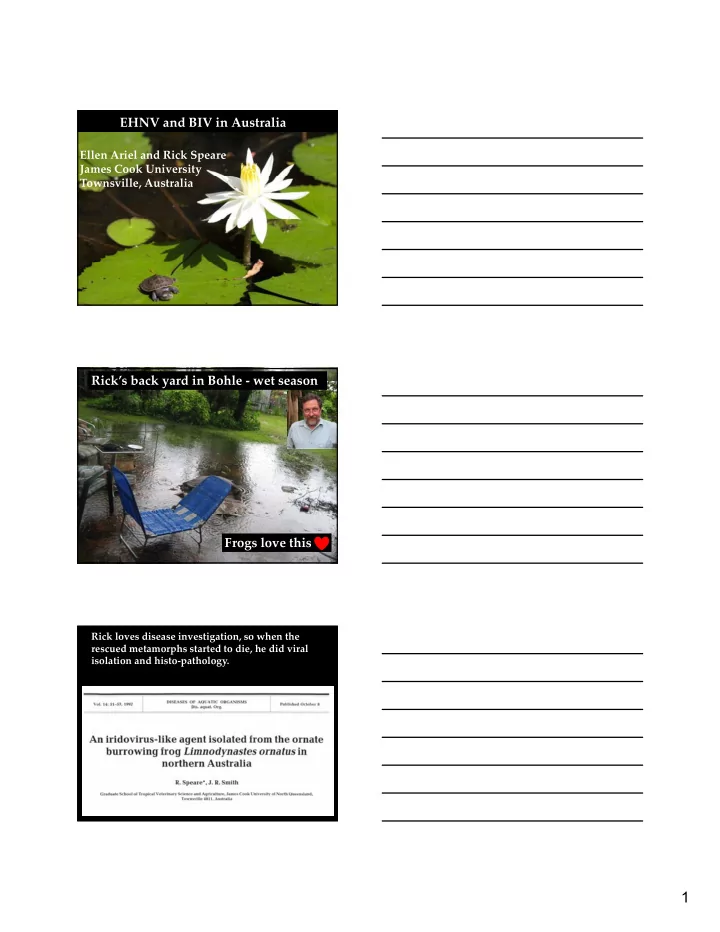
EHNV and BIV in Australia Ellen Ariel and Rick Speare James Cook University Townsville, Australia Ricks back yard in Bohle wet season Picture of Tvlle in wet season Frogs love this Rick loves disease investigation, so when the Bohle
2
Ellen Ariel Associate Professor Virology
Veterinary and Biomedical Sciences Human Viral Diseases Aquatic Epidemiology
Community Reference Lab for Fish Diseases
Denmark PhD Aquatic Pathobiology ‐ ranavirus
EHNV and BIV in Australia
EHNV 1987 BIV 2012 BIV 1989
Epizootic Haematopoietic Necrosis virus Bohle iridovirus
Python 1998
OIE (World Animal Health Organisation) has listed EHNV as a notifiable disease in fish and ranavirus in amphibians
3
OIE (World Animal Health Organisation) reference laboratory for EHNV and ranavirus is based in Australia
Dr Nick Moody Australian Animal Health Laboratory Geelong Victoria 3220 AUSTRALIA Email: nick.moody@csiro.au Dr Richard Whittington University of Sydney Faculty of Veterinary Science Camden NSW 2570 AUSTRALIA Email: richardw@camden.usyd.edu.au
Challenge trials
Leigh Owens Jeremy Langdon 1989
EHNV trials 11 teleosts EHNV trials 12 freshwater fish spp
Joy Becker 2013
BIV trials Student projects: fish, crustaceans amphibians and reptiles Moody 1994 Barramundi Cullen 1995 Frogs Ariel 1997 Tilapia Ariel 2015 Crocodiles, snakes and turtles
Challenge trials EHNV
In addition to redfin perch (Perca fluviatilis) and rainbow trout (Onchorhyncus mykiss), the original hosts for EHNV, several species of freshwater fish were found to be susceptible:
Langdon 1989 Macquarie perch (Macquaria australasica), silver perch (Bidyanus bidyanus), mountain galaxias (Galaxias olidus) and mosquito fish (Gambusia affinis). Becker et al 2013 Murray‐Darling rainbowfish (Melanotaenia fluviatilis), Dewfish (Tandanus tandanus), Eastern mosquitofish (Gambusia holbrooki), Silver Perch (Bidyanus Bidyanus) and Macquarie Perch (Macquaria australasica)
While others appeared to be refractory or with low mortality
4
Challenge trials BIV
Amphibians: Bufo marinus and a range of native species
(Limnodynastes, Litoria, Pseudophrenye, Taudactylus) could be infected with BIV, but mortality variable (Cullen et al 1995; Cullen & Owens 2002)
Fish: mortality in barramundi (Lates calcarifer); infect tilapia
(Oreochromis mossambicus) (Moody & Owens 1994; Ariel & Owens 1997)
Reptiles: kill tortoise hatchlings (Ariel 1997)
– Elseya latisternum & Emydura krefftii
Juveniles more susceptible
Host susceptibility to disease
- Important to distinguish between infection
versus disease
- Susceptibility to disease depends on life
stage
– > for larvae and metamorphs, low for adults
- The susceptibility depends on host species
- Susceptibility is not predictable from host
taxonomy
Bioassay for virus refractory to cell culture
Barramundi live Barramundi dead Tilapia live Tilapia dead Enveloped virus Naked virus
5
Bioassay for virus refractory to cell culture
1. 2. 3. 4.
Pathology
Richard Whittington
EHNV in fish Reddacliff and Whittington 1996 BIV in frogs Jerret et al 2015 BIV in turtles Ariel et al 2015
“ Apparent tropism for vascular endothelium and widespread multi‐organ necrosis and/or haemorrhage, especially involving haematopoietic tissues.”
Kidney with necrosis of haemopoetic tissue
6
Kidney with necrosis of glomerular mesangium
Jerret et al 2015
- Pathology is usually extensive in fatal cases
- Many organs damaged
Liver with necrosis Basophilic inclusion bodies liver
Jerret et al 2015
7
Antigen of BIV can be detected by IHC
Jerret et al 2015
Stomach submucosa – venular epithelium labelled
Jerret et al 2015
Ranavirus pathology
- Widespread focal necrosis in many organs ±
haemorrhage
- Animals die from “organ failure”, but
pathophysiology is not understood Makes treatment difficult!
8
EM and Molecular
Alex Hyatt
Molecular Epidemiology
distribution and factors influencing susceptibility in specified populations
9
Distribution of anti-ranaviral antibodies in introduced Bufo marinus
Overall prevalence 2.7% Regional range 0-13%
Zupanovic et al 1998
BIV
Ranavirus antibodies common in freshwater turtles & freshwater crocodiles in NQld
MHRV
Epidemiology EHNV
- EHNV is poorly infective but highly virulent in rainbow trout
- may be found in trout in all age classes
- need not be associated with clinically detectable disease in
the population
- can be transferred with shipments of live fish
- can be detected in a small proportion of 'routine' mortalities
- may be associated with specific antibodies in a small
proportion of older fish
Epidemiology EHNV
New South Wales Victoria South Australia
- The origins of the virus are unknown
- means of spread may include the
intentional movement of live or dead fish
- the mechanical transfer on boats, nets
and other equipment
- spread through flowing water
- migrating carrier fish in a catchment
area
- potentially, mechanically by piscivorous
birds
10
Epidemiology temperature Does temperature influence the distribution of EHNV and BIV? Epidemiology temperature
Pathogen
Virulence Temperature preference Host target
Host
Susceptibility Immune competence Nutrition / reproduction status General health
Environmental factors
Season Water temperature Water quality Food availability Predation stress
Disease
Co‐infections
- Recent hypotheses that ranaviruses may
be devastating to amphibian populations already compromised by endemic chytridiomycosis.
- The impact of these two pathogens (and
- thers) certainly needs more clarification
in a range of environments and populations.
11
Epidemiology is dynamic
- Epidemiology / ecology is complex
- Multiple hosts of different susceptibilities
interacting with local environment
- Environmental persistence of pathogen and role
for acquired immunity
- Global trade in ornamentals is probably a huge
facilitator of spread
Disinfection and Prevention
OIE guidelines for surveillance and prevention of spread Field hygiene protocols Speare et al 2004 Research into disinfection methods
12
Biological control weapon?
LO = Limnodynastes ornatus; BM = Bufo marinus Mortality variable in adult toads