
SLIDE 1
Piergiorgio Bolasco
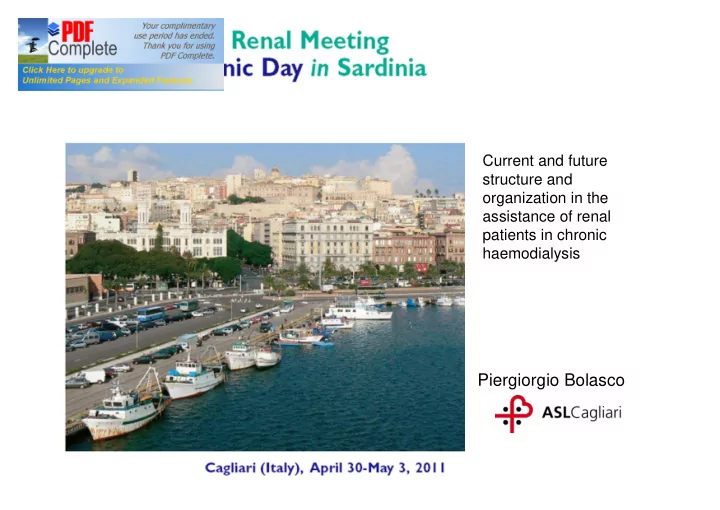
Current and future structure and
- rganization in the
assistance of renal patients in chronic haemodialysis
Piergiorgio Bolasco Definitions according to regional regulations - - PowerPoint PPT Presentation
Current and future structure and organization in the assistance of renal patients in chronic haemodialysis Piergiorgio Bolasco Definitions according to regional regulations (resolution 25/29 dated 1st July 2010) The Dialysis Reference
Piergiorgio Bolasco
Current and future structure and
assistance of renal patients in chronic haemodialysis
Definitions according to regional regulations (resolution 25/29 dated 1st July 2010)
The Dialysis Reference Centre is an intensive support centre, belonging to an Operational Nephrology Unit equipped with in-patient beds. The centre is in charge of providing assistance to clinically unstable and high-comorbidity patients and emergency patients. The Territorial Assistance Dialysis Centre (CAD) is a specialized structure the aim of which is to guarantee dialysis treatment to clinically unstable patients thanks to the continuous presence of a nephrologist throughout the dialysis session. This type of assistance is reserved to patients devoid of intensive or sub-intensive critical characteristics. The Territorial Careful Assistance Dialysis Centre (CAL) is a specialized structure aimed at guaranteeing dialysis treatment to patients judged as being clinically stable by nephrologist. The opening and support of this type
service not requiring the presence of a nephrologist during treatment, and lower costs.
Hospital with high hospitalization rates - G. Brotzu Hospital
to patients in chronic dialysis, also providing specialist care for contagious patients (HBV+ and HIV+) ASL Cagliari
coordination CAD, one hospital CAD, one hospital CAL, 2 community CALs ASL Cagliari
Local distribution of Public Centres for Local distribution of Public Centres for Nephrology and Dialysis Nephrology and Dialysis
Province of Cagliari Province of Cagliari
The only centre with in-patient beds (the increasing demand results in an
Hospital (managed by a different authority to the ASL in Cagliari). Critical lack of renal beds in the ASL of Cagliari capable of lightening the load
In the area covered by the ASL of Cagliari renal patients are only accepted in two suburban hospitals, usually on General Medical Wards. The territory is affected by numerous geographical issues and poor road
There is no political-administrative impetus to formalize the relationships and procedures between the two HS centres. High incidence of new dialysis patients controlled by the three private dialysis centers that already provide assistance to over 200 patients.
The figures in the public structures The figures in the public structures The figures in the public structures
Brotzu Hospital: 110 haemodialysis patients, 47 receiving peritoneal dialysis, 6 hemodialysis emergency beds, 26 beds for residential renal and 10 transplant patients, 2 D.H. places, >750 transplant patients followed up periodically + biopsies & vascular access activities, 13 operational outpatients clinics. ASL Cagliari: total 240 haemodialysis patients in 6 centres, 0 beds for residential renal patients, vascular access activity,14
clinics in the territory (Cagliari & surroundings).
The modus operandi we adhere to in the lack
a brotherhood policy Hub: Hub:
Brotzu
à
spokes spokes
Muravera Muravera Quartu Quartu Sant Sant
Elena Isili Isili Sarroch Sarroch Monastir Monastir Others in Others in progress progress
To what extent do sick people still feel protected in hospital?
feels better taken care of than anywhere else
be cured
environment is better
serious problem
their stays in hospital
facilities have developing
Programmatic integration: a fundamental aspect for the definition of strategic choices and priorities, in relation to the awareness of territorial requirements, from the services provided to the resources available within each health area; Institutional integration: which requires the establishing of collaborations between different institutions (ASL, local authorities etc.) arranged with a view to achieving mutual objectives for global health, extended also to the life of a person in his/her community; Managerial integration: in the organizational and operative choices between the different operative structures: unitary within health area throughout the different services comprised; Professional integration: strictly linked to the adoption of company profiles and guidelines aimed at steering inter-professional work towards the production of home, semi-residential and residential health services
The solution is to avoid conflicts of The solution is to avoid conflicts of authority and provide a reciprocal authority and provide a reciprocal guarantee of maximum availability in guarantee of maximum availability in accepting patients for treatment accepting patients for treatment whenever staff and resources allow whenever staff and resources allow
H requests that the territory solve the problems it cannot control unaided
Integration: focus on the sector
The territory dumps the problems it cannot control on the hospital T Integration: global focus
The assistance programme is
synergistic manner
By defining scheduled methodological procedures and assistance to be applied in both a routine and emergency situation. By requesting that Institutions unify the functional government in
integrated functional network By attempting to unify the organization of services By implementing comparable technological acquisitions common to both the Hospitals and the territory based on clinical involvement and patients needs By developing integrated economic programmes: unity determines a positive impact on the acquisition of goods
Functional programmes conceived for specific pathologies with admission of patients with particular problems to HUB hospitals; Functional programmes according to the type of patient: stable or not heavy unstable: allocation of the patient to the territory nearest their place of residence; The critical patient should temporarily or momentarily stay in the HUB hospital; The territory should be provided with patient transportation facilities for use under routine and emergency conditions; ideal target: integrated hospital-territory departments?
More effective assistance; Rationalization of organization; Focus the attention of the Health Services on the PATIENT; Cost-effectiveness and rationalization of expenditure;
Guarantee application of the Essential Assistance Limits (LEA) for all citizens, irrespective of their health care facility; Improvement through homogeneous procedures of hospital and territorial
clinics with a strong focus on prevention aimed at slowing down the race to dialysis. Creation of highly specialized nephrology clinics: e.g. nutrition, doppler ultrasonography, study of vascular access, treatment of CKD-MBD etc.
Establish a productive and collaborative dialogue with General Phisicians (including their active participation in the definition of Hospital-territory assistance programmes); Avoid self-referencing: promoting exchanges of teams capable of undertaking control audits, either internal or managed by external agencies. Protected shared tele-network accessible to both parties (e.g. access to updated medical charts in Hospital and
Cultural delay of the territory Cultural delay of the territory Cultural delay of the territory
H T integration is linked to:
New culture throughout the territory medical: medical: focused on socio focused on socio-
sanitary programmes for chronic programmes for chronic conditions conditions
centres, to be integrated IN THE LACK OF A NEW CULTURE FOR THE TERRITORY
⇓
TERRITORIAL HOSPITALIZATION WILL PREVAIL
These models would enhance a homogenization of procedures An allocation method would be developed, becoming almost automatic and natural for nephrologists and patients, who would be assigned to a Reference Centre
CALs would be destined to would be destined to
extinction
: justifications associated to the reduced availability of financial associated to the reduced availability of financial resources are no longer acceptable: resources are no longer acceptable: a patient at risk a patient at risk should no longer be should no longer be
left alone
.
minimum requirements should be defined with the legislator by expert nephrologists as: legislator by expert nephrologists as:
s SAFETY takes priority over all other issues: legislators or Doctors who do not : legislators or Doctors who do not
take into account account
the problems encountered by renal patients frequently overlook this, which should likewise invariably frequently overlook this, which should likewise invariably be determined in medical and legal terms; be determined in medical and legal terms;
s safety does not derive solely from financial availability (in acquiring operators and technology) but also from a detailed knowledge of local territorial situations.
No models or declarations are needed for a successful synergy between Hospitals and the Territory All it takes is a dose of good will The project doesn t refers to a long-term time frame The role of the professionals is therefore strategic The territory has room for growth in terms of
Improve information exchange systems between H and T and General Practitioners: from admission to discharge and beyond Local Authorities and Municipalities should be involved: they should not be allowed to shirk their share of assistance to Citizens Regional and National politics must officially formalize a Hospital-Territorial model
The renal patient should travel freely from the Hospital (where he has lived his acute moments) to the Territory (as a chronic patient, where he knows he will receive the same type of care he received in the hospital but close to home) in the smoothest possible way......... this is true continuity in healthcare!