
SLIDE 1
Pistonless Pump for Safe and Reliable Space Access
A& D Forum 2016
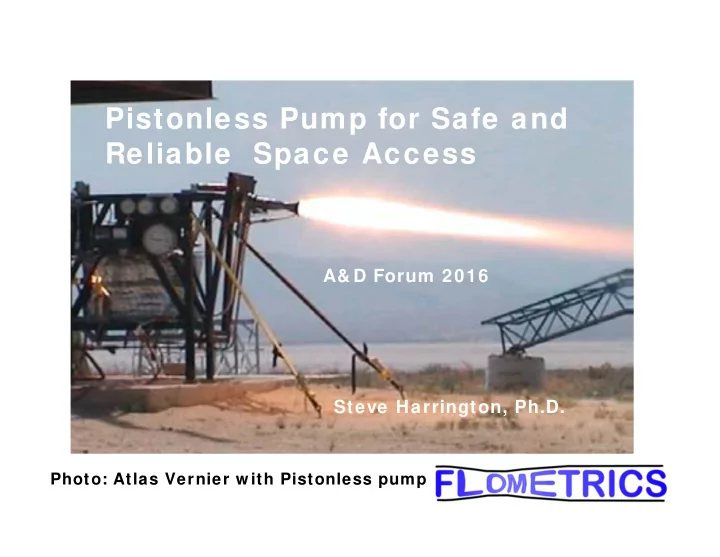
Photo: Atlas Vernier w ith Pistonless pump
Steve Harrington, Ph.D.
Pistonless Pump for Safe and Reliable Space Access A& D Forum - - PowerPoint PPT Presentation
Pistonless Pump for Safe and Reliable Space Access A& D Forum 2016 Steve Harrington, Ph.D. Photo: Atlas Vernier w ith Pistonless pump Problem: Turbopumps are Unreliable 1 out of 300 orbital launches fail due to turbopump problems. In Oct
A& D Forum 2016
Photo: Atlas Vernier w ith Pistonless pump
Steve Harrington, Ph.D.
generator turbopump systems
vehicle cost.
pressures are low er
pump fed is simple and quick.
$203B in global revenue for 2014 of the satellite industry
average cost $72M. Most launchers use turbopumps w hich cost approximately $10M per vehicle, the rocket propellant pump market is $820M
*Tauri Group 2015 State of the Satellite Industry Report
national security missions, not available.
for 25% of the turbopump w ith good margins
market is $100M
Source: ULA
pump must be proven to be considered.
w ith engines of increasing thrust levels to prove scalability.
to moderate size vehicle for a reference mission
w hen a new vehicle is on the draw ing board, or w hen an existing vehicle explodes spectacularly due to turbopump problems. Sea Launch 2007
– Scalable rocket pow ered vehicle for DARPA programs – Small thrusters for attitude control and backup propulsion for a vehicle w ith a turbopump main engine. (NASA) – Cyrogenic propellant transfer on orbit w ithout adding heat (DARPA/NASA) – Cubesat Launch vehicles – Space Tourism Vehicles – Scalable Launch Vehicles
penalty, primarily for pump propellant
pressurant has a 1.3% DV penalty, primarily for pump mass
Competitor Product Description Competitive Analysis Barber- Nichols/AJR Turbopumps Expensive Long Time to Develop Various Standard Pressure Fed System Long History of Use Tank Mass Cold gas pressurant+tanks LLNL Piston Pumps Has been used for flight Issues Sealing Xcor Piston Pumps Under Development
How it works:
1. Drain the main tank at low pressure into a pump chamber. 2. Pressurize the pump chamber and feed to the engine. 3. Run two in parallel, venting and filling one faster than the other is emptied. 4. Overlap allow s for steady flow and pressure
Pump Animation
1. Pump starts w ith both chambers full, in thermal equilibrium. 2. One chamber is pressurized, and fuel is delivered until level gets low in that chamber. 3. The pressure is applied to both chambers, and fuel is delivered briefly from both chambers. 4. Then the nearly empty chamber is vented and refilled and the cycle repeats.
Rocket Pump Development SBIR
Built pump for NASA Glenn, met all technical milestones, plus demonstrated operation in Zero gee plane. Current DARPA SBIR for 100 & 1000 lbf
LOX-Methane Pump For RCS system for Lunar Lander
Student Experiment: Space Urinal Flow Vis Pump test. Flow n on zero gee plane as a secondary experiment run at the Microgravity University at JSC
liquid cooling systems in production (Chilldyne)
(LOX/RP) rocket systems.
fluid sprayers and regulators
– Airlife constant positive airw ay pressure device. – Eclipse portable oxygen concentrator – Cymer NanoLithTM 7000 Lithography Light Source – Philips Espirit Medical Ventilator – Scrubbing Bubbles Automatic Toilet Cleaner
w ith increased safety and reliability.
– Team up w ith vehicle and engine builders to make launch vehicle and space propulsion systems more safe, reliable and affordable.