Pittsburgh to Paris: problems involving science, technology, and - - PowerPoint PPT Presentation

pittsburgh to paris
SMART_READER_LITE
LIVE PREVIEW

Pittsburgh to Paris: problems involving science, technology, and - - PowerPoint PPT Presentation

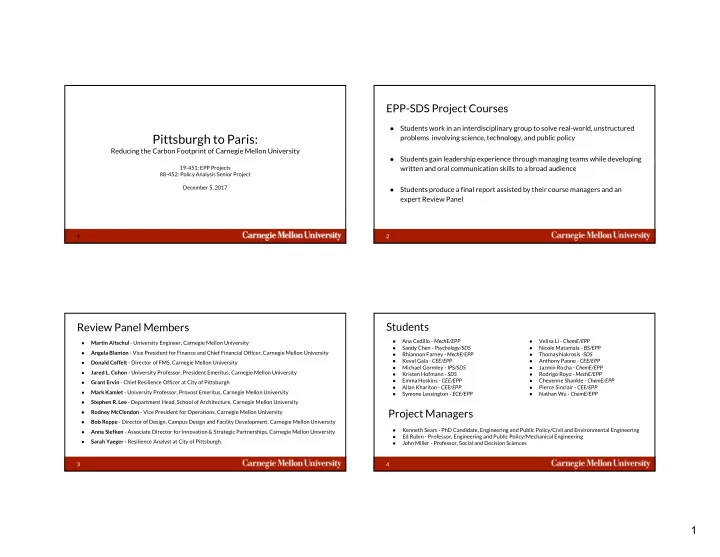
EPP-SDS Project Courses Students work in an interdisciplinary group to solve real-world, unstructured Pittsburgh to Paris: problems involving science, technology, and public policy Reducing the Carbon Footprint of Carnegie Mellon


slide-1
SLIDE 1

1

Pittsburgh to Paris:

Reducing the Carbon Footprint of Carnegie Mellon University

19-451: EPP Projects 88-452: Policy Analysis Senior Project December 5, 2017 1

EPP-SDS Project Courses

  • Students work in an interdisciplinary group to solve real-world, unstructured

problems involving science, technology, and public policy

  • Students gain leadership experience through managing teams while developing

written and oral communication skills to a broad audience

  • Students produce a final report assisted by their course managers and an

expert Review Panel

2

Review Panel Members

  • Martin Altschul - University Engineer, Carnegie Mellon University
  • Angela Blanton - Vice President for Finance and Chief Financial Officer, Carnegie Mellon University
  • Donald Coffelt - Director of FMS, Carnegie Mellon University
  • Jared L. Cohon - University Professor, President Emeritus, Carnegie Mellon University
  • Grant Ervin - Chief Resilience Officer at City of Pittsburgh
  • Mark Kamlet - University Professor, Provost Emeritus, Carnegie Mellon University
  • Stephen R. Lee - Department Head, School of Architecture, Carnegie Mellon University
  • Rodney McClendon - Vice President for Operations, Carnegie Mellon University
  • Bob Reppe - Director of Design, Campus Design and Facility Development, Carnegie Mellon University
  • Anna Siefken - Associate Director for Innovation & Strategic Partnerships, Carnegie Mellon University
  • Sarah Yaeger - Resilience Analyst at City of Pittsburgh

3

Students

4

  • Ana Cedillo - MechE/EPP
  • Sandy Chen - Psychology/SDS
  • Rhiannon Farney - MechE/EPP
  • Keval Gala - CEE/EPP
  • Michael Gormley - IPS/SDS
  • Kristen Hofmann - SDS
  • Emma Hoskins - CEE/EPP
  • Allan Khariton - CEE/EPP
  • Symone Lessington - ECE/EPP
  • Velisa Li - ChemE/EPP
  • Nicole Matamala - BS/EPP
  • Thomas Nakrosis -SDS
  • Anthony Paone - CEE/EPP
  • Jazmin Rocha - ChemE/EPP
  • Rodrigo Royo - MechE/EPP
  • Cheyenne Shankle - ChemE/EPP
  • Pierce Sinclair - CEE/EPP
  • Nathan Wu - ChemE/EPP

Project Managers

  • Kenneth Sears - PhD Candidate, Engineering and Public Policy/Civil and Environmental Engineering
  • Ed Rubin - Professor, Engineering and Public Policy/Mechanical Engineering
  • John Miller - Professor, Social and Decision Sciences
slide-2
SLIDE 2

2

5

December 12, 2015: The Paris Climate Accord

  • Keep global temperature "well below" 2.0 oC (3.6 oF) rise above pre-industrial times and "endeavor to limit"

the rise to 1.5oC

  • Establish binding commitments for “nationally determined contributions” to emission reductions, and to

pursue measures to achieve them, with regular reporting

  • Every five years submit new plans that “represent a progression” in cutting emissions beyond previous levels

June 1, 2017: Trump Withdraws U.S. from Paris Accord

6

“I was elected to represent the citizens of Pittsburgh, not Paris.”

Project Objectives

Imagine that Carnegie Mellon is a nation state that plans to comply with the Paris Accord. Recommend a greenhouse gas mitigation commitment for the University for the first 5-year time horizon period.

To do this:

7

  • Understand CMU historic trends and current level of GHG emissions (“carbon

footprint”).

  • Understand and quantify likely future GHG emissions based on current

university plans and practices.

  • Define and analyze mitigation options for reducing emissions (including technical

and behavioral approaches).

  • Based on this analysis recommend a level of University commitment and

strategies for future GHG commitments and planning

At our Mid-Semester Presentation We ...

  • Defined the Carnegie Mellon campus scope for this study
  • Showed historical trends in campus energy use and related GHG emissions
  • Showed current projections of future campus growth and GHG implications
  • Discussed a number of potential measures to mitigate GHG emissions

8

slide-3
SLIDE 3

3 Campus Activities Affecting GHG Emissions

9

Technologie s

Off-Campus Emission Sources Campus Emissions Sources

Inflows

9

Steam Grid Electricity Electricity Use

Outflows

Wastewater Treatment Water Treatment Natural Gas Landfill of Solid Waste

Associated Emissions Sources

Commuting Travel Air Travel Fuel Use for Vehicles

Behavior

Supply Side Solutions Demand Side Solutions

Non-energy Activities Campus Heating

Campus Size

Average growth rate

  • f 1.4% per year

10

Historical Projected

Campus Population

Average growth rate of 2.8% per year

11

Historical Projected

12

Average decrease

  • f 0.7% per year

Average increase

  • f 3.2% per year

Campus GHG Emissions

slide-4
SLIDE 4

4

Campus GHG Emissions

13

Source Actual 2017 Emissions % Projected 2022 Emissions % Heating 29 29 36 30 Electricity 48 48 56 48 Transportation 19 19 21 18 Non-Energy 4.4 4 5 4 Total 101 100 116 100

In Thousand Metric Tons of CO2e

Mitigation Framework

In order to recommend a greenhouse gas mitigation commitment for the University, we analyzed a number of opportunities that we will summarize here today. Further details are in the draft report:

14

  • Mitigation Strategy
  • Cost-Effectiveness Analysis
  • Implementation Strategy
  • Policy Options for CMU

15

Campus Survey

Today’s Presentation will Summarize Our Results for:

Campus Heating Use Campus Electricity Use Campus Transportation Use Campus Non-Energy Sources of GHGs Mitigation Analysis and Policy Recommendations

Campus Survey

16

slide-5
SLIDE 5

5 Objectives

Support analysis of mitigation and policy options by filling in data gaps about the CMU community’s:

  • Behavior impacting energy consumption
  • Willingness to reduce energy usage
  • Attitudes and beliefs about climate change

17

Survey Design

  • Respondents saw 50 - 60 questions across 6 categories
  • Comparable questions for faculty, staff and students

○ Some unique questions based on differences in living and transportation habits

  • Presented as multiple choice, Likert scales, and short answer questions

Sample Question: How many hours a day does your laptop computer (or the laptop computer you use most often if more than one) spend completely powered off?

0-2 hours 3-5 hours 6-8 hours 9-11 hours 12-14 hours 15 or more hours

18

NOTE: The full survey is included in the final report

Survey Distribution

  • Students

○ Distributed to a random samples of 500 undergraduates and graduates provided by the CMU Registrar ○ Response rate of 18%

  • Faculty and Staff

○ Distributed to all department heads/office heads requesting they forward it to their department members ○ Approximate response rate of 7% of responding departments 19

Survey Respondents

Total Responses - 193 faculty, staff, and students

20

slide-6
SLIDE 6

6

21

At Least 23 Academic Departments Represented

Campus Concern Regarding Climate Change

  • “How concerned are you, if at all, about global climate change?”
  • On campus: 92 % are “Very” or “Somewhat” concerned

22

Other Campus Attitudes

  • 5 response choices on scale of 1 ( “Strongly Disagree”) to 5 (“Strongly Agree”)

○ Middle point is “Neither agree nor disagree”

  • Risk Perception of Climate Change

○ Sample Response: “I have already noticed some signs of climate change” ○ Mean: 4.32

  • Personal Experience with Climate Change

○ Sample Response: “Climate change will bring about some serious negative consequences.” ○ Mean: 4.20 23 2 Question: "Is Carnegie Mellon a leader among universities at being a green campus?" n = 163 Question: "Is Carnegie Mellon a leader among universities at being a green campus?" Question: "Should Carnegie Mellon be a leader among universities at being a green campus?" 24 n = 163 n=184 3

slide-7
SLIDE 7

7 Conclusions

  • The CMU community:

○ Is concerned about climate change its negative effects ○ Believes CMU is not currently a green campus leader ○ Believes CMU should be a green campus leader

  • Additional results will be presented by following speakers in the

context of the issues they analyzed

25

Campus Heating Use

26

Objectives

  • Determine major sources of heating on campus
  • Analyze historical trends in heating use
  • Quantify GHG emissions associated with heating
  • Project future use and GHG emissions
  • Identify potential mitigation measures

27

CMU’s Steam Demand

28

slide-8
SLIDE 8

8 CO2 Emissions from Campus Heating

29

CO2 Mitigation Strategies

Some possibilities:

  • Combined Heat and Power
  • Thermostatic Radiator Valves
  • Lowering Thermostat Set Points
  • Thermostatic Radiator Enclosures
  • Replacing historic windows
  • Improving room insulation
  • Education on heating practices

30

Combined Heat and Power (CHP)

  • CHP is a process for

generating electricity and steam for heating at a higher

  • verall thermal efficiency
  • To be installed at Bellefield to

supplement existing plant

31

Cost Effectiveness of CHP:

  • Total installed capital cost: $20 million

○ Annualized cost (12% ROR, 30 yr life) = ($20M)(0.124) = $2.48M/yr

  • Steam Generated: Current steam demand as of 2017
  • Electricity Generated: 48 million kWh/yr (~35% of total CMU usage)

○ Cost of Electricity Generated: $.025/kWh

  • Net electricity savings: 48 GWh/yr * ($0.08/kWh - $0.025/kWh)= $2.64M/yr
  • Total annualized cost of CHP project = $2.48M - $2.64M = - $0.16M/yr
  • Net reduction of CO2: 12,000 metric tons/yr (including increased gas use)

Cost effectiveness: -$13/metric ton CO2 reduced

32

slide-9
SLIDE 9

9 Thermostatic Radiator Valves (TRV)

  • Temperature

sensitive valves that seal when a desired temperature is

  • reached. TRV’s are

shown to reduce heating energy use and cost by 10%.

  • Already installed on

60% of radiators on campus.

33

Cost Effectiveness Analysis of TRV:

If we were to install TRVs on every remaining radiator in Baker-Porter Hall (~40):

  • Unit Capital Cost: $20-$30
  • Installation Labor Cost: $45/hr x 0.5 to 6.0 hrs
  • Total Unit Cost: $50 to $290 per unit (depending on labor hours)
  • Estimated Steam Savings: ~800,000 pounds of steam
  • Steam Cost: $9.68/thousand pounds of steam
  • GHG Reduction: 60 metric tons of CO2 reduced

Cost Effectiveness: -$95 to $65 /metric ton of CO2 reduced

34

Lowering Thermostat Set Points

Survey Question: “During cold weather the university sets all buildings to the same temperature. What is the lowest temperature you would want that temperature to be?” Reducing daytime temperatures to 68°F and 55°F at night. Current Assumed Set Point: 72°F New Set Point from Survey: 68°F

Estimated Savings ~5,000 metric tons CO2

35

CMU’s Heating Systems

There are several types of systems on campus:

  • Individual controls (radiators, AC window units, space heaters)
  • Cluster controls: One thermostat controls a group of rooms/wing
  • Large area controls: Newer buildings with central heat and air have

temperatures set by FMS and AC engineers

  • FMS does have the capability to view and control steam heat output on site

36

slide-10
SLIDE 10

10 Lowering Thermostat Set Points - Feasibility

  • A universal temperature control project would be costly.
  • Alternatively, CMU could institute a decentralized approach at a much lower

cost, but also with likely lower effectiveness.

  • Could be done in conjunction with cooling for increased savings.

*Requires further analysis

37

Thermostatic Radiator Enclosures (TRE)

Enclosures control air around the radiator, allowing heat to build up in the enclosure. Hot air is then pushed into the room by a fan until a desired temperature is reached. Unit Cost: Quote can be made for CMU’s specific needs

38

TRE:

  • Have reduce heating costs and fuel usage in dormitories by ~30% (based on the

vendor’s report)

  • Can control room temperature via phone
  • Automatically save digital records of heating and temperature data

39

Summary/Comparison of Mitigation Options

40

slide-11
SLIDE 11

11

Campus Electricity Use

41

Objectives

  • Analyze historical trends in electricity use
  • Determine major sources of electricity use on campuses
  • Quantify GHG emissions associated with electricity use
  • Project future electricity use and GHG emissions
  • Identify potential mitigation measures

42

Campus Electricity Use

Source: CMU utilities data, FMS

Average increase of 1.9% per year Historical Projected 7% jump 43

CO2 Emissions from Electricity Use

Source: CMU utilities data, FMS; PA carbon intensity data

Historical Future 44

slide-12
SLIDE 12

12 Electricity Intensity (kWh/m2) by Academic Buildings

45

Potential Mitigation Options

  • Solar power installations
  • Computer energy savings programs
  • Lighting shutdowns
  • Heating/cooling temperature policies
  • Energy reduction competitions
  • Vending machine misers
  • In-depth building metering
  • Lighting replacement to LEDs
  • Other more energy-efficient devices and structures

46

Cost Effectiveness of Solar Panel on Building Roofs

If we installed solar panel arrays on the roofs of the Warehouse on Penn Avenue and Hamburg Hall:

  • Capital Cost: $2.8 M

○ Annualized at 12% ROR, 20 year project life

  • Electricity savings for both projects: 1.1 million kWh/year
  • Net electricity cost savings: $87,600/yr
  • Net reduction of CO2: 403 metric tons/yr

Cost Effectiveness: ~$700/metric ton of CO2 reduced

47

Cost Effectiveness of Computer Cluster Option

If we were to put cluster computers in sleep mode during off peak hours:

  • Off-peak hours: 12 am - 7am [24/7 during summer]
  • Total Cost: N/A
  • Average electricity savings per computer (120 watts/hour) = 466 kWh/year
  • Cost per computer = -$37/year
  • Net reduction of CO2: 0.17 metric tons of CO2/year
  • Apply to confirmed cluster computers: 361

○ Total Annual Savings: $13,400/year ○ Total Annual CO2 Reduction: 62 metric tons/year

Cost Effectiveness: -$220/metric ton of CO2 reduced

48

slide-13
SLIDE 13

13 Implementation - Results from Survey

Question: “Which computer clusters on campus do you use most frequently? Check all that apply.”

Of those who do, ~85% would support this policy 79% of students do not use cluster computers 49

Cost Effectiveness of Nightly Shutdown of Lights

  • Gates Hall Case Study: Shutting down floors 6-9 during off peak hours and

installing occupancy sensors ○

Uncertainties: Commercial building wattage per square foot of area, ratio of T8 to T5 lamps,

  • ccupancy sensor type
  • Electricity saved: 360,000 kWh per year (~3.9% of Gates electricity)
  • Cost savings: $29,000/year
  • Net reduction of CO2: 150 metric tons/year

Cost Effectiveness: -$200/metric ton of CO2 reduced

50

Cost Effectiveness of Raising Building Temperatures

If we raised building temperatures 1˙F to reduce energy use from cooling:

  • Unit Cost: N/A
  • Estimated electricity savings: ~2.4 million kWh/year
  • Cost Savings: $190,000/year
  • 878 metric tons of CO2 reduced/year

Cost Effectiveness: -$220 /metric ton of CO2 reduced.

51

Renewable Energy Credits (RECs)

REC: Issued when one megawatt-hour (MWh) of electricity is generated and delivered to the electricity grid from a renewable energy source. 2011: CMU became the first university to offset 100 percent of its electricity usage

  • 2013: $0.75/REC ($2.00/ton CO2)
  • 2016: $0.46/REC ($1.30/ton CO2)
  • 2017: $0.41/REC ($1.10 /ton CO2)

November 2017: New contract with ENGIE at a price lock of $3.2/REC ($8.70/ton CO2)

52

slide-14
SLIDE 14

14 Summary of Lowest Cost Mitigation Options

Option Cost Effectiveness ($/metric ton of CO2e)

Computer cluster savings

  • 220

Turning off lights

  • 200

Changing cooling policy

  • 220

Total GHG Reduction

1,160 metric tons CO2/yr 53

Campus Transportation

54

Objectives

  • Define transportation requirements of CMU
  • Examine historical energy use trends for campus transportation
  • Estimate GHGs associated with historical trends
  • Forecast the future of campus based transportation GHGs
  • Identify mitigation strategies to reduce GHG emissions

55

Sources of Transportation Emissions

56 Student Activities Campus Operations

Daily Commuting

Faculty /Staff Activities

Student Organizations University Sponsored Travel Athletics Daily Commuting University Sponsored Travel Facilities Management Services Vehicles Police Vehicles Campus Shuttles

slide-15
SLIDE 15

15 New Data Findings

Survey Findings

  • Faculty/staff commuters

○ 54% by car ○ 18% by bus

  • Student commuters

○ 7% by car ○ 44% by bus

  • Average faculty/staff commute = 2.9 miles
  • Average student commute = 1.9 miles
  • Average bus commute = 8.1 stops

New Data from Procurement Office

  • Aggregated totals spent on airfare for

faculty and staff from FY2012-2017

○ Includes travel agencies and reimbursed expenses

New Data from Student Activities Office

  • Aggregated totals spent on airfare & gas

for student organizations from FY2013- 2017 57 Question: Would you be willing to reduce your frequency of air travel for university-related business? (Faculty & staff)

Example Survey Result

58

Survey Results (cont’d)

Q55 - What would it take for you to reduce your frequency of air travel for university-related business? (Faculty & staff) Common Survey Responses-

  • Ability to drive given distance within reason
  • Effective virtual conferencing
  • Reasonable alternatives to travel
  • Compensation for differences in travel time (financial incentives)
  • Just the suggestion
  • Time off

59

CO2 Emissions From Bus Travel

Estimate: 3 Stops/Ride Survey: 8.1 Stops/Ride 60

slide-16
SLIDE 16

16

Revised Transportation Emissions FY2012 - 2022

61

Transportation Mitigation Focus

62 University Travel

Campus Operations Driving Commuters

Commuters

Car Travel Bus or Rail Air Travel Public Transportation Facilities Management Services Police Vehicles Campus Shuttles Primary Focus Secondary Focus If Possible

Mitigation Option 1: University Air Travel

  • Sign up for a program that offsets air

travel ○ Pennsylvania or a nearby state based program ○ Programs focuses include: ■ Renewable energy ■ Reforestation ■ Energy efficiency

  • Financial incentives for

teleconferencing and more teleconferencing options

Offset Company Type Cost Location NativeEnergy Build a carbon

  • ffset program or

give to one that is currently being funded $15/metric ton Pennsylvania; International The Nature Conservancy Reforestation $15/metric ton Pennsylvania; International Conservation Fund Reforestation $9/metric ton West Virginia Carbon Fund Reforestation; energy efficiency; renewable energy $10/metric ton International programs

63

Mitigation Option 1: University Air Travel

  • Offsetting 100% of Air Travel

○ Current CMU average appr. 13,500 metrics tons of CO2 each year ○ Average offset program cost $15/metric ton ○ Offset cost annually = about $203,000 ■ 1.3% of $16 million/yr spent on airfare ○ Reduces overall transportation emissions by 69%

  • Offsetting 50% of Air Travel

○ Cost $101,000/yr ○ 34% Reduction in Emissions 64

slide-17
SLIDE 17

17 Mitigation Option 1: University Air Travel

Scenario A: Domestic flight PIT - SFO in April

  • Weekday Trip
  • $610 Delta Airlines as of 12/3

○ Comfort Ticket

  • 4500 Miles Round Trip

○ 0.85 Metric Tons of CO2 ○ $12.70 to offset

  • University now pays $623

Scenario B: International flight PIT -DOH in March

  • Week Long Trip
  • $1,800 American Airlines as of 12/3

○ Main Cabin

  • 13,900 Miles Round Trip

○ 2.60 Metric Tons of CO2 ○ $39.00 to Offset

  • University now pays $1,840

65

Mitigation Option 2: Commuters

  • Driving Commuters

Switch to public transportation

Educational campaign to inform campus of their emissions

Signs in the parking lot with information on GHG

Seminars discussing current campus carpooling and vanpooling options

  • Public Transportation commuters

Relatively low footprint already 66 67

Commuter CO2 Savings

  • Average CO2 released by car commute per year = 2100 metric tons
  • Bus emissions per passenger are appr. 1/6th of car emissions
  • Cost of posters and are negligible, campus seminars are free
  • Depending on how effective the educational campaign is, a portion of the

emissions figure will be saved

68

slide-18
SLIDE 18

18

Average Distance from Campus = 2.87 miles However, there are people who live up to 62 miles away. 69

Survey Result

Mitigation Summary

  • Focus mitigation on university air travel

○ Air travel is the largest transportation producer of GHG emissions ○ Campus operations and commuters are very small comparatively

  • Offset university air travel with a carbon offset program

○ Carbon neutral

  • Create incentives to increase teleconferencing and reduce flight purchases
  • Educational campaign for driving commuters to switch to public transportation

70

Non-Energy Sources

  • f Greenhouse Gases

71

Objectives

  • Determine non-energy sources of GHG emissions on campus
  • Analyze current and historic trends
  • Quantify GHG emissions
  • Project future use and GHG emissions
  • Investigate mitigation options to reduce GHG emissions

72

slide-19
SLIDE 19

19 Non-Energy Sources of GHG Emissions

  • Treatment from Sewage
  • Solid Waste Disposal
  • Landscaping Chemicals
  • Disposal of Other Chemical Wastes

73

Midterm Update: Water Use

Source: CMU FMS

74

+ 4 % / yr

Midterm Update: CO2e Emissions from Sewage

Source: CMU FMS

75

+ 4 % / yr

Midterm Update: Solid Waste Generation

Source: CMU FMS

76

  • 2 % / yr
slide-20
SLIDE 20

20

Midterm Update: CO2e Emissions from Solid Waste Disposal

Source: CMU FMS

77

  • 2 %/yr

Non-Energy Sources of GHG Emissions

  • Treatment from Sewage
  • Solid Waste Disposal
  • Landscaping Chemicals
  • Disposal of Other Chemical Wastes

78

  • FMS reseeds/resods green-spaces on campus twice a year

○ Orientation (Fall) ○ Commencement (Spring)

  • FMS uses fertilizers with higher nitrogen content than a typical landscaping

renovation schedule would require

  • GHG emissions from landscaping come from fertilizer usage

○ Fertilizer emits N2O, which can be compared to CO2 through its GWP

Landscaping Overview

79

Annual Fertilizer Usage on Campus (FY 2017)

Source: CMU FMS

80 Total: 6000 lbs of fertilizer / yr

slide-21
SLIDE 21

21 CO2e Emissions from Fertilizer Usage (FY 2017)

Calculated using EPA’s Global Warming Potential for N2O

81 Total: 4.6 metric tons of CO2e / yr

Laboratory Chemical Waste Overview

  • CMU produces ~500 barrels of chemical waste each year from research

laboratories on Main Campus and the Mellon Institute

  • Environmental Health and Safety (EHS) staff gather waste from labs at

Carnegie Mellon and process it in Hamerschlag hall:

○ 10% of non-poisonous waste is recycled in-house and reused ○ Rest of non-poisonous waste is sent to incineration plants in Texas/Illinois to be used as fuel

  • Chemical waste emissions come from incinerated chemicals
  • Does not include additional direct releases of GHG chemicals (freeons, other

refrigerants)

○ Data exists, not available to publish 82

Hazardous Chemical Waste Generated

Source: CMU FMS

83

+0.6 %/yr

CO2 Emissions from Hazardous Chemical Waste Incineration

84

+0.6 %/yr

slide-22
SLIDE 22

22 Non-Energy Sources’ CO2e Total Emissions

85

Non-Energy Sources’ CO2e Emissions (FY 2017)

Non-Energy Source CO2e Emissions (metric tons) Percentage of Non-Energy CO2e Emissions Sewage 4400 85.8 % Solid Waste 710 13.8 % Fertilizer 5 0.1 % Chemical Waste 14 0.3% 5129 100 % 86

Potential Mitigation Options

  • Water/Wastewater Reduction Methods

○ Stormwater collection system for water reuse ■ Irrigation (3,000 kgal/year) ■ Toilets ○ Low-flow fixtures for restrooms and kitchens ○ High-efficiency washers and dryers ○ More efficient cooling tower technologies (sensors and controls) ○ Inspect and replace broken sprinklers used for irrigation ○ More water bottle refilling stations incorporated within water foundations ○ Educational campaign to promote conscientious water use in restrooms

  • Implement more water meters and better monitoring of water usage

87

  • Solid Waste Disposal Reduction Methods

○ Convert all containers from dining services to compostable materials ○ Convert all containers from dining services to biodegradable materials (staff council has already sent a petition for this to happen) ○ Increase awareness of composting guidelines and promote composting in areas where it is available ○ Implement programs to reduce waste during moving out season ■ Donation drives ■ Clothing swap/yard sale type event (live version of For Sale@CMU page)

  • Better monitoring of sources of solid waste amongst departments/buildings

Potential Mitigation Options

88

slide-23
SLIDE 23

23 Non-Energy Sources Conclusions

  • Methods are available to reduce emissions from water usage and decrease solid

waste disposal

  • Unable to thoroughly analyze these methods due to

○ Limited metering and monitoring of water usage ○ Limited tracking of solid waste sources

  • Recommend an overall increase in metering and monitoring of water and solid

waste, preferably per-building

89

Mitigation Synthesis

90

GHG Emission Reduction Scenarios:

91

0% increase 10% decrease 15% decrease 20% decrease 2030 Challenge Benchmark

Mitigation Options Analyzed

92

Mitigation Strategy Annualized Cost ($/year) Annual CO2e Reduced (metric ton) Cost-Effectiveness ($/metric ton of CO2e reduced) Computer Clusters

  • 13,500

62

  • 220

Change Cooling Thermal Set Point

  • 191,000

878

  • 220

Building Policy – Gates-Hillman

  • 29,200

147

  • 200

Change Heating Thermal Set Point

  • 706,000

5,050

  • 140

Thermostatic Radiator Valves

  • 5,800 to 3,800

60

  • 95 to 65

Combined Heating and Power

  • 160,000

12,300

  • 13

Air Travel Offsets 203,000 13,500 15 Solar Panel Installation – Hamburg 209,000 221 560 Solar Panel Installation –Penn Ave 265,000 182 730 Automobile to Bus Commuting

  • 106

N/A

slide-24
SLIDE 24

24 Five-year Mitigation Recommendation

15 % reduction using...

93

Mitigation Strategy Net Annualized Cost ($/year) Cost-Effectiveness ($/metric ton of CO2e reduced) Cumulative CO2e Prevented (metric tons) Computer Clusters

  • 13,500
  • 220

62 Change Cooling Thermal Set Point

  • 204,500
  • 220

940 Change 24/7 Building Policy – Gates-Hillman Center

  • 29,200
  • 200

1090 Change Heating Thermal Set Point

  • 706,000
  • 140

6140 Thermostatic Radiator Valves

  • 5,800 to 3,800
  • 95 to 65

6200 Combined Heating and Power

  • 160,000
  • 13

18,500 Air Travel Offsets 203,000 15 32,000

Benchmarks from Peer Institutions

Peer institutions:

  • Four-year institutions
  • Including campus housing
  • In an urban area
  • Private
  • Non-profit
  • With greater than 5,000 students
  • With at least 50 PhDs
  • In a similar climate zone

94

Implementing Mitigation Measures - Peer Benchmarking

95

Peer Benchmarks

Initial Commitment

  • 12 out of 23 peer institutions had initiated commitment/set goals prior to 2012
  • Only have not articulated goals

Target Structure

  • 7 used some combination of short and long-term goals
  • All 21 with clearly articulated goals had set target % for greenhouse gas reduction

Focus Areas

  • Common goals revolved around electricity conservation, water conservation, recycling, data

management, campus education, transportation, and more Campus Management

  • 18 out of 23 created a distinct office dedicated to sustainability management
  • 19 out of 23 had clearly articulated presidential support in campus sustainability plan

Success

  • 8 out of 11 reporting institutions were on track to meet goals and/or within 10% of annual targets

96

slide-25
SLIDE 25

25

Observations from Peer Institutions

  • Clearly articulated goal for GHG emission reductions
  • Presidential commitment to emission targets
  • Clear institutional structures to implement emission targets
  • Very few have RECs as a major component of emission targets

97

Social Cost of Carbon

  • Climate change resulting from GHG

emissions causes damage to:

○ The environment ○ Human health ○ Property

  • There is currently no direct cost for

emitting these damaging GHGs

  • EPA has estimated the economic costs

to society, called the Social Cost of Carbon ($ 2017)

98

Source EPA

Implementing a CMU Carbon Price

  • CHG emissions are an externality
  • Pricing externalities helps internalize their cost
  • Strategies

○ Shadow Price ○ Nominal Price ○ Internal Price 99

Shadow Price

  • Used to calculate costs, but not actually paid by the university
  • Building and renovation cost estimates would include the cost of carbon
  • MIT uses this method

100

slide-26
SLIDE 26

26 Nominal Price

  • Assume that each equivalent ton of CO2 emitted costs CMU $0.01
  • Benefits

○ Improved tracking of GHG emissions ■ Building level electric and natural gas data ■ Department level travel data ■ Campus level steam, water, and sewage data ○ Increase campus awareness ■ 3% reduction in electricity usage 101

Internal Price

  • Each ton of CO2 is taxed at some rate

○ We use the EPA SC-CO2 for this analysis

  • Potential implementations

○ Simple model ■ Each ton of CO2 is charged a price ■ Money could be collected by a central authority to pay for mitigation options ○ Microsoft model ■ Cost of annual mitigation projects is determined ■ Carbon price set to just offset this cost ○ Yale model ■ Revenue neutral ■ A benchmark level of CO2 is established ■ Each department pays in proportion to its contribution of GHG emissions ■ Each department is repaid in proportion to its reduction from benchmark level 102

Recommendations

  • Learn from peer institutions

○ Clear, measurable, goals ○ Clearly defined institutional structure ○ Top level administration buy-in

  • Pursue the following mitigation options:

○ Computer clusters ○ Change cooling set point ○ Change 24/7 building policy - Gates-Hillman Center ○ Change heating thermal set point ○ Thermostatic radiator valves ○ Combined heating and power ○ Air travel offsets

  • Adopt either a shadow price or actual carbon price
  • Paris pledge of 15% reduction from 2017 level by 2022
  • Appoint a high-level officer to oversee the implementation of GHG emission reductions

103

Questions and Feedback?

104