Plan for the 2nd hour What is an agent? EDAF70: Applied Artificial - - PowerPoint PPT Presentation

plan for the 2nd hour
SMART_READER_LITE
LIVE PREVIEW

Plan for the 2nd hour What is an agent? EDAF70: Applied Artificial - - PowerPoint PPT Presentation

Agents Agents Plan for the 2nd hour What is an agent? EDAF70: Applied Artificial Intelligence PEAS (Performance measure, Environment, Actuators, Agents (Chapter 2 of AIMA) Sensors) Agent architectures. Jacek Malec Environments Dept. of


slide-1
SLIDE 1

Agents

EDAF70: Applied Artificial Intelligence Agents (Chapter 2 of AIMA)

Jacek Malec

  • Dept. of Computer Science, Lund University, Sweden

January 17th, 2018

Jacek Malec, http://rss.cs.lth.se, jacek.malec@cs.lth.se 1(27) Agents

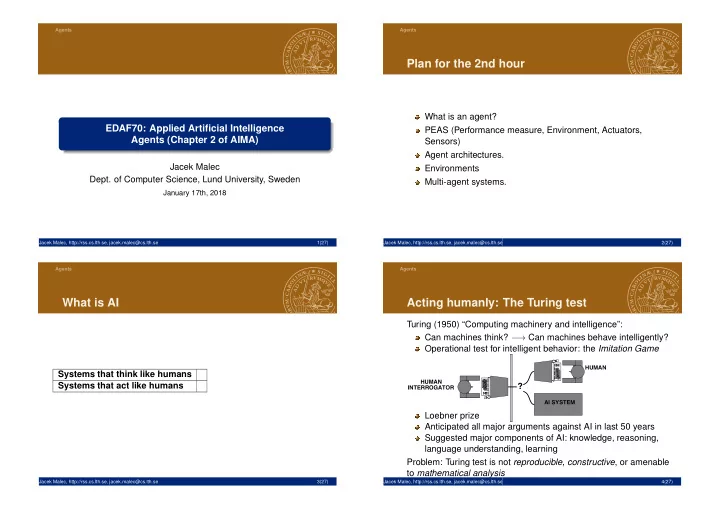
Plan for the 2nd hour

What is an agent? PEAS (Performance measure, Environment, Actuators, Sensors) Agent architectures. Environments Multi-agent systems.

Jacek Malec, http://rss.cs.lth.se, jacek.malec@cs.lth.se 2(27) Agents

What is AI

Systems that think like humans Systems that act like humans

Jacek Malec, http://rss.cs.lth.se, jacek.malec@cs.lth.se 3(27) Agents

Acting humanly: The Turing test

Turing (1950) “Computing machinery and intelligence”: Can machines think? − → Can machines behave intelligently? Operational test for intelligent behavior: the Imitation Game

AI SYSTEM HUMAN

?

HUMAN INTERROGATOR

Loebner prize Anticipated all major arguments against AI in last 50 years Suggested major components of AI: knowledge, reasoning, language understanding, learning Problem: Turing test is not reproducible, constructive, or amenable to mathematical analysis

Jacek Malec, http://rss.cs.lth.se, jacek.malec@cs.lth.se 4(27)

slide-2
SLIDE 2

Agents

Thinking humanly: cognitive science

1960s “cognitive revolution”: information-processing psychology replaced the then prevailing orthodoxy of behaviorism Requires scientific theories of internal activities of the brain What level of abstraction? “Knowledge” or “circuits”? How to validate? Requires

Predicting and testing behavior of human subjects (top-down),

  • r Direct identification from neurological data (bottom-up)

Both approaches (roughly, Cognitive Science and Cognitive Neuroscience) are now distinct from AI Both share with AI the following characteristic: the available theories do not explain (or engender) anything resembling human-level general intelligence Hence, all three fields share one principal direction!

Jacek Malec, http://rss.cs.lth.se, jacek.malec@cs.lth.se 5(27) Agents

What is AI

Systems that think like humans Systems that think rationally Systems that act like humans Systems that act rationally

Jacek Malec, http://rss.cs.lth.se, jacek.malec@cs.lth.se 6(27) Agents

Thinking rationally: laws of thought

Aristotle: what are correct arguments/thought processes? Several Greek schools developed various forms of logic: notation and rules of derivation for thoughts; may or may not have proceeded to the idea of mechanization Direct line through mathematics and philosophy to modern AI Problems: Not all intelligent behavior is mediated by logical deliberation What is the purpose of thinking? What thoughts should I have

  • ut of all the thoughts (logical or otherwise) that I could have?

Jacek Malec, http://rss.cs.lth.se, jacek.malec@cs.lth.se 7(27) Agents

Acting rationally

Rational behavior: doing the right thing The right thing: that which is expected to maximize goal achievement, given the available information Doesn’t necessarily involve thinking—e.g., blinking reflex—but thinking should be in the service of rational action Aristotle (Nicomachean Ethics): Every art and every inquiry, and similarly every action and pursuit, is thought to aim at some good

Jacek Malec, http://rss.cs.lth.se, jacek.malec@cs.lth.se 8(27)

slide-3
SLIDE 3

Agents

Rational agents

An agent is an entity that perceives and acts This course is about designing rational agents Abstractly, an agent is a function from percept histories to actions: f : P∗ → A For any given class of environments and tasks, we seek the agent (or class of agents) with the best performance Caveat: computational limitations make perfect rationality unachievable → design best program for given machine resources

Jacek Malec, http://rss.cs.lth.se, jacek.malec@cs.lth.se 9(27) Agents

Agent

Agents include humans, robots, web-crawlers, thermostats, etc. The agent function maps from percept histories to actions: f : P∗ → A The agent program runs on a physical architecture to produce f.

Jacek Malec, http://rss.cs.lth.se, jacek.malec@cs.lth.se 10(27) Agents

The vacuum-cleaning world

Percepts: location and contents, e.g. < A, Dirty > Actions: Left, Right, Suck, NoOp

Jacek Malec, http://rss.cs.lth.se, jacek.malec@cs.lth.se 11(27) Agents

A vacuum-cleaning agent

Percept sequence Action < A, Clean > Right < A, Dirty > Suck < B, Clean > Left < B, Dirty > Suck < A, Clean >, < A, Clean > Right < A, Clean >, < A, Dirty > Suck . . . . . . function Reflex_Vacuum_Agent (location, status) if status == Dirty then return Suck if location == A then return Right if location == B then return Left What is the RIGHT function?

Jacek Malec, http://rss.cs.lth.se, jacek.malec@cs.lth.se 12(27)

slide-4
SLIDE 4

Agents

Rationality

Fixed performance measure evaluates the environment sequence:

  • ne point per square cleaned up in time T?
  • ne point per clean square per time step, minus one per

move? penalize for > k dirty squares? A rational agent chooses whichever action maximizes the expected value of the performance measure given the percept sequence to date Rational is not omniscient as percepts may not supply all relevant information Rational is not clairvoyant as action outcomes may not be as expected Hence, rational is not necessarily successful!

Jacek Malec, http://rss.cs.lth.se, jacek.malec@cs.lth.se 13(27) Agents

A rational agent

[Wooldridge, 2000] An agent is said to be rational if it chooses to perform actions that are in its own best interests, given the beliefs it has about the world. Properties of rational agents: Autonomy (they decide); Proactiveness (they try to achieve their goals); Reactivity (they react to changes in the environment); Social ability (they negotiate and cooperate with other agents).

Jacek Malec, http://rss.cs.lth.se, jacek.malec@cs.lth.se 14(27) Agents

PEAS

PEAS: Performance measure, Environment, Actuators, Sensors Must first specify the setting for intelligent agent design Consider, e.g., the task of designing an automated taxi driver:

Performance measure Environment Actuators Sensors

Jacek Malec, http://rss.cs.lth.se, jacek.malec@cs.lth.se 15(27) Agents

PEAS, example

AUTOMATED TAXI DRIVER: Performance measure: Safe, fast, legal, comfortable trip, maximize profits Environment: Roads, other traffic, pedestrians, customers Actuators: Steering, accelerator, brake, signal, horn Sensors: Cameras, radars, speedometer, GPS, odometer, engine sensors, car-human interface

Jacek Malec, http://rss.cs.lth.se, jacek.malec@cs.lth.se 16(27)

slide-5
SLIDE 5

Agents

Autonomous agents

Can make decisions on their own. Why do they need to? Because of the following properties of real environments (cf. Russell and Norvig): the real world is inaccessible (partially observable); the real world is nondeterministic (stochastic, sometimes strategic); the real world is nonepisodic (sequential); the real world is dynamic (non-static); the real world is continuous (non-discrete).

Jacek Malec, http://rss.cs.lth.se, jacek.malec@cs.lth.se 17(27) Agents

Agent taxonomy

simple reflex agents reflex agents with state goal-based agents utility-based agents learning agents - independent property from the list above

Jacek Malec, http://rss.cs.lth.se, jacek.malec@cs.lth.se 18(27) Agents

Simple reflex agent

Jacek Malec, http://rss.cs.lth.se, jacek.malec@cs.lth.se 19(27) Agents

Reflex agent with state

Jacek Malec, http://rss.cs.lth.se, jacek.malec@cs.lth.se 20(27)

slide-6
SLIDE 6

Agents

Goal-based agent

Jacek Malec, http://rss.cs.lth.se, jacek.malec@cs.lth.se 21(27) Agents

Utility-based agent

Jacek Malec, http://rss.cs.lth.se, jacek.malec@cs.lth.se 22(27) Agents

Learning agent

Jacek Malec, http://rss.cs.lth.se, jacek.malec@cs.lth.se 23(27) Agents

Rationality: John McCarthy 1956

Rationality is a very powerful assumption. It allows us to compute things we wouldn’t otherwise be able to dream of! 30+ first years of AI were based solely on this assumption.

Jacek Malec, http://rss.cs.lth.se, jacek.malec@cs.lth.se 24(27)

slide-7
SLIDE 7

Agents

Subsumption: Rodney Brooks, 1985

Jacek Malec, http://rss.cs.lth.se, jacek.malec@cs.lth.se 25(27) Agents

Physical Grounding Hypothesis

situatedness “the world is its own best model” embodiment intelligence “intelligence is determined by the dynamics of interaction with the world” emergence “intelligence is in the eye of the observer”

Jacek Malec, http://rss.cs.lth.se, jacek.malec@cs.lth.se 26(27) Agents

Summary

Agents interact with environments through actuators and sensors The agent function describes what the agent does in all circumstances The performance measure evaluates the environment sequence A perfectly rational agent maximizes expected performance Agent programs implement (some) agent functions PEAS descriptions define task environments Environments are categorized along several dimensions:

  • bservable? deterministic? episodic? static? discrete?

single-agent? Several basic agent architectures exist: reflex, reflex with state, goal-based, utility-based

Jacek Malec, http://rss.cs.lth.se, jacek.malec@cs.lth.se 27(27)