Pluto and Charon From SINFONI Observations Francesca DeMeo and - PowerPoint PPT Presentation
Pluto and Charon From SINFONI Observations Francesca DeMeo and Christophe Dumas June 17, 2008 My Project at ESO PhD student at the Paris Observatory DCDG student at ESO for 3 months to work with Christophe Dumas Model Pluto and
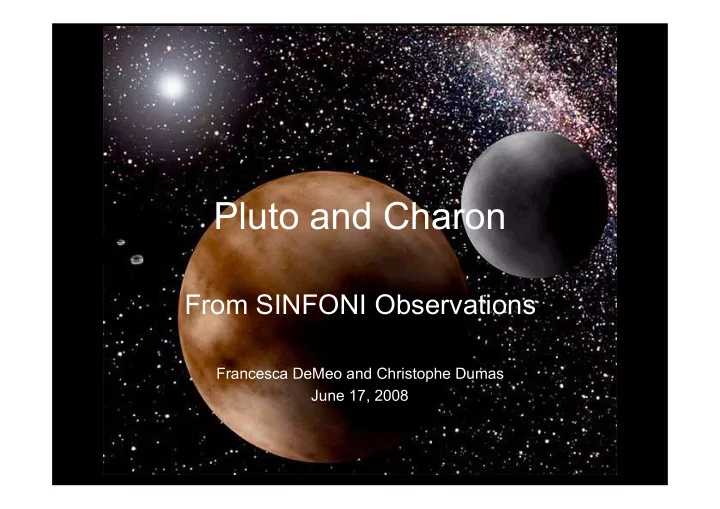
Pluto and Charon From SINFONI Observations Francesca DeMeo and Christophe Dumas June 17, 2008
My Project at ESO • PhD student at the Paris Observatory • DCDG student at ESO for 3 months to work with Christophe Dumas – Model Pluto and Charon spectra over different dates. – Extract spectra of hemispheres of Pluto from each data set.
The Data • VLT observations of Pluto and Charon with SINFONI instrument • Dates: May 13, June 9, and August 9, 2005 • Wavelengths: 1.4-2.4 µ m • Field of view: 0.8” x 0.8” • Exposure times: – 5 min for Pluto – 25 min for Charon
The Reduction: Bad Line Correction
Reduction • SINFONI Pipeline + bad pixel maps from IDL • IDL routines: – second sky subtraction – Alignment of object through cube by finding gaussian center and shifting flux maximum to a fixed center value. • Spectra extracted in qfitsview program – Spectra of hemispheres extracted using IDL routine.
Pluto in the Solar System
Pluto has 3 Moons
Definition of a Planet • A planet is a celestial body that: – is in orbit around the Sun – has a nearly round shape – has cleared the neighborhood around its orbit. • A dwarf planet is a celestial body that: – is in orbit around the Sun, – has a nearly round shape – has NOT cleared area around its orbit – is not a satellite. • All other objects except satellites shall be referred to as Small Solar System Bodies.
The Model • Radiative Transfer Model based on Hapke Theory • Creates intimate mixtures of input materials • Finds the “best fit” amounts of each input by minimizing X 2
Materials Modeled Charon Pluto • Crystalline H 2 0 ice • Methane • Amorphous H 2 0 ice • Nitrogen • Carbon • Titan Tholin • Titan Tholin
Charon NH 3 H 2 0 Crystalline H 2 0 H 2 0
Best Fits
Close Up NH 3 H 2 0 Pure NH 3 ??
Cryovolcanism • Cryovolcanoes are icy volcanoes. • Rather than molten rock, these volcanoes erupt volatiles such as water, ammonia, or methane. • Heat source comes from tidal heating or radioactive decay. • It is thought to exist on: Europa, Ganymede, Enceladus, Titan, Triton, Charon
Pluto CO CH 4 N 2 CO
Pluto Models
Increasing Grain Size (microns)
Separating Pluto’s Hemispheres N S
When will we know more? New Horizons Pluto fly-by in July 2015 • Primary objectives – Characterize the global geology and morphology of Pluto and Charon – Map chemical compositions of Pluto and Charon surfaces – Characterize the neutral (non-ionized) atmosphere of Pluto and its escape rate
Thank You
Recommend
More recommend
Explore More Topics
Stay informed with curated content and fresh updates.