PNG 2 nd NATIONAL AMR FORUM 2020 Supported by FLEMING FUND COUNTRY - - PowerPoint PPT Presentation

png 2 nd national amr forum 2020
SMART_READER_LITE
LIVE PREVIEW

PNG 2 nd NATIONAL AMR FORUM 2020 Supported by FLEMING FUND COUNTRY - - PowerPoint PPT Presentation

PNG 2 nd NATIONAL AMR FORUM 2020 Supported by FLEMING FUND COUNTRY GRANT WORLD ANTIMICROBIAL AWARENESS WEEK 18 -24 Nov United to Preserve Antimicrobials ONE HEALTH COLLABORATION BUILDS MICROBIOLOGY LAB CAPACITY AND SUVEILLANCE FOR RESISTANT


slide-1
SLIDE 1

1

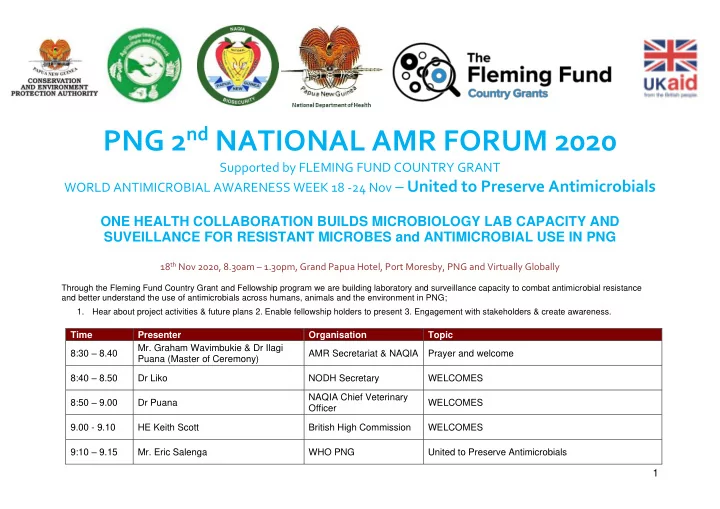
PNG 2nd NATIONAL AMR FORUM 2020

Supported by FLEMING FUND COUNTRY GRANT WORLD ANTIMICROBIAL AWARENESS WEEK 18 -24 Nov – United to Preserve Antimicrobials ONE HEALTH COLLABORATION BUILDS MICROBIOLOGY LAB CAPACITY AND SUVEILLANCE FOR RESISTANT MICROBES and ANTIMICROBIAL USE IN PNG

18th Nov 2020, 8.30am – 1.30pm, Grand Papua Hotel, Port Moresby, PNG and Virtually Globally

Through the Fleming Fund Country Grant and Fellowship program we are building laboratory and surveillance capacity to combat antimicrobial resistance and better understand the use of antimicrobials across humans, animals and the environment in PNG;

  • 1. Hear about project activities & future plans 2. Enable fellowship holders to present 3. Engagement with stakeholders & create awareness.

Time Presenter Organisation Topic 8:30 – 8.40

  • Mr. Graham Wavimbukie & Dr Ilagi

Puana (Master of Ceremony) AMR Secretariat & NAQIA Prayer and welcome 8:40 – 8.50 Dr Liko NODH Secretary WELCOMES 8:50 – 9.00 Dr Puana NAQIA Chief Veterinary Officer WELCOMES 9.00 - 9.10 HE Keith Scott British High Commission WELCOMES 9:10 – 9.15

  • Mr. Eric Salenga

WHO PNG United to Preserve Antimicrobials

slide-2
SLIDE 2

2

9:15 -9:20 Dr Mark Schipp OIE -President of World Assembly of Delegates To handle antimicrobials with care 9:20 -9:25 FAO country rep (TBC) FAO PNG AMR is here and now: United to strengthen food systems and secure livelihoods 9.25 – 9.35

  • Dr. Ben Coghlan
  • Dr. Stenard Hiasihri

Burnet Institute PNG Overview FFCG and first year 9:35 – 10.05 Professor Robyn Alders FFCG project steering committee, Director Kyeema Foundation Keynote speaker: United to preserve antimicrobials - focus poultry, One Health, women/chickens – creating an enabling environment whilst securing livelihoods 10.05- 10.20 break 10:20 – 10.50 All Fleming Fellows Fleming Fellows Summary of Fellowship Objectives for each fellow 10:50 – 11.10 Panel discussion on Fleming Fund Principles moderated by Professor Glenn Browning Fleming Fellows & Asia Pacific Centre Animal Health Realising synergies and challenges between Human and Animal Health in AMR 11:10 -11:20

  • Dr. Chris Lozada

Zenag Chicken - Poultry industry Stakeholder The intensive poultry industry PNG, over 10,000 SME’s supported and preserving antibiotics 11:20 -11.30

  • Mr. Elias Taia

Agro Food Safety & Codex International, DAL Food safety 11.30 -11.40 Rep TBC CEPA Environment – role in mitigating AMR 11.40 -12:00 CLOSE AMR Secretariat Concluding remarks 12:00 – 1:30 Lunch

slide-3
SLIDE 3

“United to Preserve the Antimicrobials” World Antimicrobial Awareness Week 18th – 24th November, 2020 2nd Papua New Guinea National AMR Forum 18 November 2020 Salutations I. Senior Officials of the Quadripartite Alliance Organisations – National Department

  • f Health, Department of Agriculture and Livestock, National Quarantine and

Inspection Authority and Conservation and Environment Protection Authority II. British High Commissioner to PNG, His Excellency Keith Scott III. Development Partner Representatives (FAO, OIE, DFAT) IV. Fleming Fund Country Grantee Representatives and Implementing Partners V. Members of the Media VI. Friends, Ladies and Gentlemen We are gathered once again at the beginning of this week-long commemoration to consolidate our efforts in securing the future of the next generation by preserving the power

  • f our antimicrobials. Since 2015, Papua New Guinea has been joining the international

community in celebrating the WAAW, which was previously called the World Antibiotic Awareness Week. From this year, WAAW stands for World Antimicrobial Awareness Week to reflect the broadened scope of this important event to include all antimicrobials including antibiotics, antifungals, antiparasitics and antivirals. It was also decided to set all future WAAW dates as 18 to 24 November, starting with WAAW 2020. For many, this is a just simple global campaign that aims to raise awareness of antimicrobial resistance worldwide and encourage best practices among the general public, health workers and policy makers to slow the development and spread of drug-resistant infections. But for us who truly know the grim reality and the negative repercussions of antimicrobial resistance, we know that this event is critical in bolstering our individual and collective efforts to contain

  • it. No action today means no cure tomorrow.
slide-4
SLIDE 4

Infections become drug-resistant when the microorganisms such as bacteria and viruses that cause them adapt and change over time, allowing them to develop the ability to resist the drugs designed to kill them. The result is that many antimicrobials – like antibiotics – are becoming less effective at treating diseases. Our overuse of antimicrobials in both humans and animals is speeding up this process. The microorganisms are clever, we should

  • utsmart them!

Without working antimicrobials, routine surgeries, common illnesses like diarrhea, and minor injuries from accidents, even simple cuts, can become life-threatening. The costs to individual patients, to their families, to the government and to the society as a whole are far greater. Previous estimates indicate that by 2050, the death toll could be a staggering one person every three seconds if antimicrobial resistance is not tackled now. We have made wonders in modern medicine to increase our chances of surviving. Now, we are losing that

  • advantage. People from all walks of life are already dying from drug-resistant infections, and

as more antimicrobials lose their power, more lives will be put in danger. When we lose our antimicrobials, we also lose our power! Drug-resistant infections can affect anyone; we are all at risk. No one – including yourself and your loved ones - is exempted! Antimicrobial resistance is documented in all countries and in all regions of the world. It is closer to our homes and communities more than we thought it is! But it is not yet too late. We must work together to address this public health challenge. We work together, we fight better, we finish stronger! The World Health Organization has been working with the Government of Papua New Guinea from the very beginning. PNG started discussions in 2015 and WHO was a proud co-host of the Government for the consultative workshops in 2016 and 2017 where relevant stakeholders from health, agriculture and environment were engaged to provide direction, concluding in the development of the PNG Country Action Plan on Antimicrobial Resistance 2019 – 2023. Together with FAO and NDOH, we supported the country’s first- ever National AMR Forum last year which firmly provided the platform for further consolidating and renewing individual, institutional and whole-of-government commitment to fighting AMR in this 2nd National AMR Forum. We, at WHO, remain committed to support the Government and the people of Papua New Guinea in their fight to preserve the power of antimicrobials. Together we can recast AMR as a social issue and ingrain collective behaviour change through incremental, yet sustained, awareness-raising and adoption of good practices to
slide-5
SLIDE 5

reach a level whereby acting responsibly to combat AMR will become a societal norm and a way of life in Papua New Guinea. Together, let’s create that social movement! We thank our partners - the British Government through the Fleming Fund, the other two members of the Global Tripartite Alliance – FAO and OIE, and most especially the four national agencies - NDOH, NAQIA, DAL and CEPA, for working together in realizing the

  • bjectives and targets set by the National AMR Action Plan. We request our media partners

to continue working with us in bringing to all corners of PNG and to every citizen the call to action to unite in preserving the antimicrobials and to be stewards for the future! We all have a role to play; let us all play it well for our future and for the generations to come. I wish everyone a fruitful meeting here at the 2nd National AMR Forum and a meaningful World Antimicrobial Awareness Week! Thank you and good morning. Dr Tauhidul Islam OIC, WHO Representative in Papua New Guinea

slide-6
SLIDE 6

DAL PRESENTATION ON 2ND

ND AMR WORKSHOP,

GRAND PAPUA HOTEL, L, 18 NOVEMBER, , 2020

BY

  • Mr Elias Taia,

Program Manager & Codex Contact Point, Agro Food Safety & Codex International Food Standards Unit, Science & Technology Branch, Provincial Agricultural Technical Services Division, Department of Agriculture & Livestock,

  • P. O. Box 2033,

Port Moresby, NCD, Papua New Guinea. Phone *(675) 300 7800, Mobile (675) 70564274, Email: codexcontactpoint.png@gmail.com or eliastaia101@gmail.com

slide-7
SLIDE 7

IN INTRODUCTION

▪ Codex Alimentarius Commission (CAC) was established by FAO/WHO in 1963 to develop international Food Standards to protect health of consumers and promote food trade

  • Almost 99% of countries in the world are members of CAC
  • PNG became a member of CAC in 1989
  • CAC has developed international food standards, guidelines and codes of practices
  • CAC has developed Code of Practice to Minimise and Contain Antimicrobial Resistance

CAC/RCP 61-2005

  • CAC has developed guidelines for Risk Analysis of Foodborne Antimicrobial Resistance

CAC/GL 77-2011

  • Recently during the CAC43 Virtual Session held on 24-26 September, 2020, conducted

from FAO Rome, Italy, the Ad Hock Task Force on AMR was considered at Step 5. It was a review of CAC/RCP 61-2005

slide-8
SLIDE 8

The FAO Action Plan on Antimicrobial Resistance 2016 2016-2020 2020

slide-9
SLIDE 9

The FAO Action Plan on Antimicrobial Resistance AWARENESS, SURVEILLANCE, GOVERNANCE, GOOD PRACTICES

slide-10
SLIDE 10

Relevant Policies for AMR in DAL

  • National Sanitary & Phytosanitary (SPS) Compliance Policy 2011

(under review)

  • National Food Security Policy 2016-2026 (Draft)
  • AMTDP 2020-2022 launched 6th November, 2020
slide-11
SLIDE 11

DAL TWG Strategy

  • Develop TOR for DAL TWG
  • Align with NAP in Policy formulation, advisory role and create

awareness in the Provinces

  • Involve DAL Codex Secretariat to work with DAL Livestock Advisors in

the four (4) Regions in PNG

  • Involve Provincial Livestock Advisors to convey the message to local

farmers

  • Promote AMR during World Food Safety Day on 7 June each year
  • Presentations on AMR during National Codex Committee meetings
slide-12
SLIDE 12

DAL TWG TOR

  • Policy & Advisory on AMR to incorporate into SPS Compliance Policy

2011 (currently under review)

  • To create AMR awareness to Regional DAL & Provincial Livestock

Advisors including Livestock Development Corporation (LDC)

  • Continue to disseminate FAO information to NCC, AMR Secretariat &
  • ther relevant stakeholders
  • Involve educational instutitions such as PNG UNITECH Department of

Agriculture & UNRE Department of Sustainable Livestock Production for students to have first hand information on AMR and for students to persue Masters & PhD programmes

slide-13
SLIDE 13

DAL TWG TOR (continued)

  • To involve Livestock Research Institutes such as NARI for research on AMR

& LDC to enhance production in the country

  • Promote Good Agricultural Practices (GAP) at the farm level to farmers as

primary producers along the value chain to ensure AMR Stewardship

  • Organize national workshops on AMR for Agriculture stakeholders to

present on veterinary drug resistance & residues, animal feed safety including pesticide residues in PNG which NAQIA will be heavily involved

  • Promote AMR during World Food Safety Day on 7 June each year
  • Assist to facilitate and management of NAP on AMR as ONE Health

Approach in terms of governance

slide-14
SLIDE 14

Way Forward

  • DAL TWG TOR to be endorsed by AMR Secretariat
  • DAL to continue to share Codex AMR Information to NCC, AMR

Secretariat and other relevant stakeholders

  • Fleming Fund to assist with the review of National SPS Compliance

Policy 2011 to accommodate new interventions such as AMR, modern agriculture Biotechnology, etc

  • DAL to submit wish a list for assistance from Fleming Fund to execute

the DAL TWG TOR

  • AMR Secretariat in NDOH to incorporate AMR into the Phamarcetical

& Medicines Act for ease of governance as legal framework

slide-15
SLIDE 15

25/11/2020

Mirriam Mondia FAO Papua New Guinea GLOBAL ACTION

PLAN F A O

ACTION

PLAN

The FAO Action Plan on Antimicrobial Resistance 2016-2020

  • FAO is uniquely positioned to contribute to international efforts to address AMR,

having expertise in a variety of disciplines

  • FAO, World Health Organization (WHO) and the World Organization for Animal

Health (OIE) form the global tripartite in support of the Global Action Plan on AMR, promoting a One Health approach to reducing AMR globally.

  • Support is provided to ensure that multi-sectoral National Action Plans are in place,

being represented by all relevant health, agriculture and environmental sectors and that Plans are aligned with the Global Action Plan

SURVEILLANCE GOVERNANCE GOOD PRACTICES AWARENESS

  • Improve Awareness on AMR and related threats through;
  • Development of KAP + Guidelines
  • Communication and advocacy
  • Regional toll kit and develop communication products
  • Specific country awareness and activities
  • Surveillance- Developing capacities for AMU/AMR Surveillance;
  • Regional AMR Surveillance Guidelines
  • FAO Assessment Tool for AMR Surveillance (ATLASS)
  • Facilitate establishment of FAO Reference Center
  • Collaboration with ASEAN Reference Food Laboratory
  • Proficiency Testing on AST
  • In-Country capacity building

1 2 3 4 5 6

slide-16
SLIDE 16

25/11/2020

  • Strengthening AMU/AMR Governance in Food agriculture system;
  • Policy Reviewed framework
  • Guideline Documentation
  • National Legislation Review
  • AMU-AMR Technical Advisory Group of SEA
  • FAO-OIE Regional initiatives mapping on AMR
  • Promote Good Practices in Food and Agriculture system
  • Documentation of AMU
  • Smart App System that links field diagnosis and clinical data with

Antimicrobial use guidelines. Pilot: A situational analysis of the usage of agrochemicals, the implications of food safety, and related ONE Health approaches in PNG Partners: DAL, NAQIA, CEPA, DOH, Sub-nat. Agencies & Private sector

PROJECT COMPONENTS

There were two (2) Components:

  • 1. Policy Component
  • 2. Field Component

PROJECT OUTCOMES

I.

A Technical Situational Analysis REPORT

II.

An OH MOU with NDOH, NAQIA, DAL and CEPA was signed in September 2019 to allow mandated sector to monitor the veterinary medicines and agro-chemicals. Launch of AMR NAP (same time)

PROJECT OUTCOMES

IV . An FAO ATLASS mission was conducted in October 2019, the objectives; a. map the structure of the national AMR surveillance system in the food and agriculture sectors, including laboratory capacities and network; b. Identify prioritized steps for action and advocacy to strengthen the national AMR surveillance system through a stepwise approach; c. Establish the baseline country capacities for AMR monitoring and surveillance in the food and agriculture sectors; and d. Describe the linkages with AMR surveillance in other sectors in support of the One Health approach.

THANK YOU!

7 8 9 10 11 12

slide-17
SLIDE 17

Prof Robyn Alders, AO

Senior Consulting Fellow Global Health Programme, Chatham House, London, UK Fleming Fund Country Grant Papua New Guinea AMR Symposium 18 November 2020

United to preserve antimicrobials:

building on history for a better future

slide-18
SLIDE 18

Chatham House | The Royal Institute of International Affairs 2

Acknowledgements

slide-19
SLIDE 19

A brief history of AMR

Chatham House | The Royal Institute of International Affairs 3

slide-20
SLIDE 20

Chatham House | The Royal Institute of International Affairs 4

  • 1928 – penicillin discovered by Fleming
  • 1938 – Florey and Chain amplify production and

harvesting of penicillin

  • 1943 – penicillin first used during WWII in PNG
  • 1944 - penicillin saves my Father’s life in PNG

during WWII

  • 1945 – Fleming, Florey and Chain receive Nobel

Prize and warn of bacterial resistance

A brief history of antimicrobials (I)

slide-21
SLIDE 21

Chatham House | The Royal Institute of International Affairs 5

  • 1953 – research identified ‘growth

promotant’ effects of antibiotics in chickens

  • 1999 – WHO guidelines for drug

donations

  • 2019 – PNG National Action Plan on

antimicrobial resistance

  • 2019 – PNG Quadripartite One Health

Arrangement

A brief history of antimicrobials (II)

slide-22
SLIDE 22

Our world today

Chatham House | The Royal Institute of International Affairs 6

slide-23
SLIDE 23

CABI 2020

African Swine Fever

¼ global pig population killed

Fall armyworm

USD 6 billion/yr in 12 African countries

High path avian influenza H5N1

> USD 60 billion

AMR Climate change Biodiversity & agro-diversity Malnutrition

FOOD

slide-24
SLIDE 24

One Health

Environment Humans Plants Animals

Aim: policy framework that positively reinforces good practice, good outcomes and effective and efficient use of funds across all sectors

slide-25
SLIDE 25

Chatham House | The Royal Institute of International Affairs 9

Animals

  • Animal production and income generation
  • Animal production and social cohesion
  • Animal welfare, disease control and

antimicrobial use Humans

  • Impact of antimicrobial failure when Human

Health Services are already a second choice

  • Animal-source food and maternal and child

nutrition: ‘One Health, Zero Hunger’

Antimicrobial use and One Health

Plants

  • All WHO regions of the world are using

antibiotics on crop plants (except Africa)

  • Eleven antibiotics are being recommended on

crops (often blended together)

(Taylor & Reeder 2020)

Environment

  • Unused antibiotics are thrown into landfills or

flushed down drains or toilets

  • Antibiotics in manure and other waste-based

fertilizers run off crop and grazing fields into waterways

slide-26
SLIDE 26

Why animal-source food is so important for maternal and child nutrition

Chatham House | The Royal Institute of International Affairs 10

slide-27
SLIDE 27

Chatham House | The Royal Institute of International Affairs 11

Percentage of children aged 6–23 months fed food groups, by type, global, 2018

(UNICEF 2019)

slide-28
SLIDE 28

Tanzanian Food and Nutrition Centre, 2014

Challenges for women in resource-limiting settings

Environment where breastfeeding women live Nutritional information for breastfeeding women

Alders, 2014 Alders, 2014

slide-29
SLIDE 29

Chicken liver, fried 9g

Micronutrient content

Recommended Nutrient Intake (RNI) for Vitamin A for a breastfeeding mother: 950 µg/d

Fresh papaya 704 g Orange sweet potato, cooked 220 g Spinach, cooked 148 g

Credit: Julia de Bruyn 2016

slide-30
SLIDE 30

Nutrient distribution in chicken carcases

Distribution of iron amongst a whole chicken carcass

① = Head ② = Neck ③ = Back ④ = Wing ⑤ = Giblets ⑥ = Breast ⑦ = Drumstick ⑧ = Thigh ⑨ = Feet

Chan, et al. 2017. What’s in a Chicken? Comparing the nutrient value, potential to meet nutrient requirements and health-cost effectiveness of whole and frozen

  • chickens. BVSc Honours Dissertation, University of Sydney.
slide-31
SLIDE 31

Moving forward together

Chatham House | The Royal Institute of International Affairs 15

slide-32
SLIDE 32

Chatham House | The Royal Institute of International Affairs 16

  • Active diagnosis and sensitivity

testing

  • Reliable cold chains
  • Disposal
  • Labelling

Antimicrobial use and stewardship*

How many people in PNG could read this label? How many people can store antibiotics under 25 °C?

*Antimicrobial stewardship is a collective set of strategies to improve the appropriateness and minimise the adverse effects of antibiotic use including resistance, toxicity and costs

slide-33
SLIDE 33
  • Transectoral responses

essential - make optimal use of human and financial resources

  • Tailored information and

education material prepared in consultation with local communities

Key messages

Environment Humans Plants Animals

slide-34
SLIDE 34

Chatham House | The Royal Institute of International Affairs 18

  • Alders, R., Dar, O., Kock, R. and Rampa, F. (2020). One Health, Zero Hunger: 2020 Global Hunger Index Essay

(pier reviewed). https://www.globalhungerindex.org/issues-in-focus/2020.html

  • Alders, R.G., Dumas, S.E., Rukambile, E., Magoke, G., Maulaga, W., Jong, J. and Costa, R. (2018). Family poultry:

multiple roles, systems, challenges and options for sustainable contributions to household nutrition security through a Planetary Health lens. Matern Child Nutr. 2018;14(S3):e12668, https://doi.org/10.1111/mcn.12668

  • Taylor, P., Reeder, R. (2020). Antibiotic use on crops in low and middle-income countries based on recommendations

made by agricultural advisors. CABI Agric Biosci 1, 1. https://doi.org/10.1186/s43170-020-00001-y

  • UNICEF (2019). The State of the World’s Children 2019. Children, Food and Nutrition: Growing well in a changing
  • world. UNICEF, New York. https://www.unicef.org/media/63016/file/SOWC-2019.pdf
  • WHO. (1999). Guidelines for drug donations.

https://www.who.int/hac/techguidance/guidelines_for_drug_donations.pdf?ua=1

  • Wikipedia. (2018). Percival Bazeley. https://en.wikipedia.org/wiki/Percival_Bazeley

Bibliography

slide-35
SLIDE 35

Chatham House | The Royal Institute of International Affairs 19

Comments and queries welcome

RAlders@chathamhouse.org

Thank you for your attention

slide-36
SLIDE 36

25/11/2020

Human Health AMR Laboratory Fellowship-PG02

  • Dr. Gabriella Ak
General Pathologist (UPNG)-Dip in Medical Microbiology (PRIDA) Port Moresby General Hospital Host Institution: Doherty Institute, University of Melbourne

Fellowship Objectives

  • 1. General TOR for all Fellowship
The Fellowship will provide support and mentoring to all Professional Fellows to: 1) Improve One Health collaboration including the design of a collaborative project with other Fellows 2) Contribute to capacity building in Beneficiary Institutions and by facilitating and contributing to professional communities of practice across the One Health domains 3) Improve the use and interpretation of AMR & AMU data
  • 2. Specific TOR for fellowship
 OBJECTIVES: i. To train the Fellow in laboratory diagnosis, data recording and interpretation, and laboratory systems which are appropriate to the AMR surveillance system in Papua New Guinea ii. To train and support the Fellow in the maintenance and use of biorepositories in reference and surveillance laboratories iii. To train the Fellow in improved quality control in the laboratory, including supporting training and mentoring activities for others in the surveillance system Key areas for development of this Fellowship: 1) Strengthening the quality of AMR diagnostic results and use of advanced diagnostic methods 2) Development and maintenance of a secure inventoried biorepository of microbial isolates 3) Laboratory quality management systems (LQMS) and training programs

Fellowship activities

  • Current and Planned
 The maintenance and use of biorepositories in reference and surveillance laboratories
  • Mini project (retrospective), Port Moresby General Hospital extended MRO testing for 67 resistant isolates from 2017 and 2019
  • Major Project (prospective) on MRO’s in ICU -once construction, QC in-place and reagents and consumables are bought
by early 2021
  • Genotypic analysis of MRO’s from each sites
  • Enhancing research in each beneficiary site
 Improve the use and interpretation of AMR & AMU data  Training in laboratory diagnosis, data recording and interpretation, and laboratory systems which are appropriate to the AMR surveillance system in PNG
  • Generating the 2019 Antibiogram
  • Sessions on antibiogram generation at PMGH, and educate other beneficiary sites
  • LIMS-Senaite/WHONET
  • Designing laboratory form to capture surveillance data
  • Result to disseminate to the clinicians
  • How to update surveillance data to CPHL, regional etc…

Fellowship activities

  • Current and Planned
 Contribute to capacity building in Beneficiary Institutions and by facilitating and contributing to professional communities of practice across the One Health domains  Improve the use and interpretation of AMR & AMU data
  • Awareness/Education on AMR to the beneficiary sites
  • AMR status in the WPR and PNG- collaboration within human health
  • Waste management-Introducing ‘One health Approach’
  • Starting IPC, AMS- HH working on TOR’s for the committee
  • Identifying key clinicians at each site to address AMR issues
 To train the Fellow in improved quality control in the laboratory, including supporting training and mentoring activities for others in the surveillance system  Laboratory quality management systems (LQMS) and training programs
  • Appointment of Quality Officers and Biosafety officer
  • Working through the WHO LQMS and using LQSI working toward accreditation (ISO 15189)

Waste Management –One Health Concept

1 2 3 4 5 6

slide-37
SLIDE 37

25/11/2020

ABHR Facility in PMGH Opportunities and Challenges

  • Opportunities:
  • Fleming Fund addressing AMR is the first ever project in PNG to use a One Health Approach
  • Participate in establishing the genotypic patterns of MRO’s in PNG
  • This whole project is an opportunity!!!
  • Challenges:
  • Change of culture-laboratory procedures, antimicrobial prescribing
  • Internet connectivity at all sites
  • Communication
  • LIMS-regional connectivity
  • Involvement of NDOH
  • Personally:
  • Doing clinical duties, fellowship activities, country grant activities…….

7 8

slide-38
SLIDE 38

11/25/2020

Fleming Fund – Fellowship Program

PNG 2nd National AMR Forum 2020

National Agriculture Quarantine & Inspection Authority Elaine Hevoho Technical Officer Animal Health AMR Surveillance Fellow Host Institution: Doherty Institute, University of Melbourne 18th November 2020

NAQIA

Fellowship Objectives: Animal Health (NAQIA) – PG07

To provide training which strengthens epidemiology-related capabilities and competencies in AMR surveillance in NAQIA To support the Fellow to make better use of scientifically robust AMR surveillance evidence to inform polices or actions or reduce AMR in PNG. To contribute to the sustainability of AMR surveillance in Papua New Guinea by developing training expertise and contributing to training programs.

Fellowship Activities

  • Desk Based Training
  • Meetings and conferences
  • Mentoring from Host Institution
  • Fellowship Webinar
  • WOHC
  • FF Fellowship Symposium
  • NAQIA AMR TWG
  • Working Group (Poultry surveillance)
  • Invitation letters for poultry
industry engagements
  • Development of Protocols
  • AMR Poultry Surveillance plan
(Dr. Andrea Britton).

Current Activities

  • Face-to-face training
  • Collaborative project
  • Development of an AMR
database
  • Analysis of AMR data to be
accessible to policy makers.

Planned Activities

Challenges

COVID-19 Pandemic Workload in working environment Time difference especially for virtual conferences/webinars

Thank you Question to be asked:

What are the opportunities for One Health activities as part of the Fellowship program? 1 2 3 4 5 6

slide-39
SLIDE 39

25/11/2020

Fleming Fund Fellowship Program -HH AMR advisory fellowship

Ms Judith Nui [Quality Assurance Lead ] [National Department of health ] Host Institution: Doherty Institute, University of Melbourne

Fellowship

  • bjectives
  • To strengthen the Fellow’s capability to compile and

review evidence, advise on policies and programs on AMR in the human health sector

  • To develop leadership skills in AMR epidemiology,

policy and practice

1 2

slide-40
SLIDE 40

25/11/2020

Fellowship activities

  • Current

Online AMR Course completed with certification AMR knowledge and attitudes survey project under

review for Ethical Clearance ( base-line study).

Development of AMR communication /campaign

resources for PNG

  • Planned

 Establishing a Provincial AMR Network Collaboration between Fellows in a One Health project

Challenges and

  • pportunities
  • Balancing primary work load with fellowship activities
  • Opportunity for operational studies capitalizing on

mentorship provided.

3 4

slide-41
SLIDE 41

25/11/2020

PNG 2nd NATIONAL AMR FORUM 2020 Fleming Fund Fellowship Program 18th November 2020 Fellow Name: Mathew Agive (Mr) Fellow Position: Technical Officer - Microbiology Beneficiary Institution: National Agriculture Quarantine & Inspection Authority Host Institution: University of Melbourne

Fellowship Objectives

AMR Laboratory Fellowship – Animal Health (NAQIA) – PG06 Fellows;

  • to be trained in laboratory diagnosis, data recording and interpretation, and laboratory

systems which are appropriate to the AMR surveillance system in Papua New Guinea

  • to be trained in the maintenance and use of biorepositories in reference and surveil-lance

laboratories

  • to be trained in improving quality control in the laboratory, including supporting training

and mentoring activities for others in the surveillance system

1 2

slide-42
SLIDE 42

25/11/2020

Fellowship Activities

Fellowship Program is currently in its Second Quarter. Current Activities

  • Developing Test Procedures for Salmonella spp., Escherichia coli, Enterococcus spp. and

Campylobacter spp.

  • Weekly teleconference meetings with the Animal Health Mentors
  • Discissions with Animal Health mentors on LIMS development

Planned Activities 1) 3rd , 4th , 5th , and 6th Quarter activities of the Fellowship workplan. 2) Animal Health Projects

  • Mastitis in Diary: Still in the discussion phase

3) One Health Projects

  • Plan to do awareness/camping through survey questionnaire to obtain a Baseline Data.

Challenges

  • Doing normal routine daily work with Fellowship.
  • Developing Test Procedures outside of Internationally Recognized Standard

Test Methods for compliance purposes of various sample types.

  • Internet Data to attend Webinar Conferences, Congress, etc. after working

hours.

  • Travel restrictions due to Pandemic causing delay in Face to Face training at

the Host Institution and unable to attend Conferences.

Opportunities

  • Building Testing Capacity, especially in Antibiotic Sensitivity Testing
  • Professional Development in of AMR Laboratory work.
  • Share and learn experiences on AMR related activities with fellows from
  • ther countries.

3 4

slide-43
SLIDE 43

25/11/2020

Thank You

5

slide-44
SLIDE 44

25/11/2020

Fleming Fund Fellowship Program

Fellow Name: Temas Ikanofi Fellow position: PG02 - LQMS Beneficiary Institution: Central Public Health Host Institution: Doherty Institute, University of Melbourne

Key areas for Development of this Fellowship

  • Strengthening the quality of AMR diagnostics results and use of

advanced diagnostic methods

  • Development and maintenance of a secure inventoried

biorepository of microbial isolates

  • Laboratory quality management systems (LQMS) and training

programmes

2 25-Nov-20

Fellowship activities

  • Current:
  • Completed AMR online course
  • In progress with LQMS online course
  • Attending weekly zoom tutorial with my mentors
  • Desktop activities- already completed lab baseline assessment for

3 AMR surveillance sites (CPHL, PMGH & Goroka)

  • Planned:
  • After the completion of LQMS course, planning for a mini project.
  • Continue with the lab assessment for the other 3 surveillance

sites (Nonga, Angau and Mt Hagen

3 25-Nov-20

Challenges and opportunities

Challenges:

  • LQMS lab baseline assessment:
  • No proper orientation done prior to the lab assessment
  • Communication problem
  • Online Courses:

Internet connectivity

Opportunities:

  • Gain more knowledge on AMR and LQMS
4 25-Nov-20

Thank you all.

25-Nov-20 5

1 2 3 4 5

slide-45
SLIDE 45

25/11/2020 1

PNG 2nd NATIONAL AMR FORUM – 2020

Supported by Fleming Fund Country Grant

World Antimicrobial Awareness Week 18-24 Nov – United to Preserve Antimicrobials

ONE HEALTH COLLABORATION BUILDS MICROBIOLOGY LAB CAPACITY AND SURVEILLANCE FOR RESISTANT MICROBES & ANTIMICROBIAL USE IN PAPUA NEW GUINEA

Fellowship PG08: Animal Health AMU/C Surveillance

Fellow presenter: Daniel KELLY Beneficiary organisation: NAQIA

Venue: Grand Papua Hotel (Port Moresby)

Training Objectives

 AMU/C for priority animal production systems  Training to improve accuracy & completeness of AMC data  Support AMU surveillance through implementation of training activities

Progress to date

 Completed two online courses on AMR in Bacterial pathogens  Discussion and training on AMU/C surveillance  Attend internationally organized virtual congress, seminars, meetings, etc.,  Development of AMU data collection survey  Selected sampling sites (Port Moresby & Lae)  Selected target animal species (poultry & dairy cattle)  Developing specific questionnaires (farmers, vets, suppliers/distributors, etc.,)  Developing messages for target-audience for a collaborative AMR Awareness

1 2

slide-46
SLIDE 46

25/11/2020 2

Implementation

 Ongoing meetings with mentors  Ongoing collaborative meeting and interaction with Human Health Fellows  A joint/collaborative Awareness at sampling sites with Human Health Fellows  Use Animal Health Technical Working Group to drive AMR awareness & AMU/C projects  Data collection through questionnaires  Share data with Human Health AMU/C Fellow  Develop a proper database system

Challenges

 COVID-19 pandemic  ASF outbreak and emergency response  Usual NAQIA work (under staff)  Time difference, especially for webinar & virtual meetings  Usage of own internet data (very expensive internet data rates)  Transportation after hours  No proper database system in NAQIA  Awareness AMR/AMC to farmers, companies, general public remains a mammoth task  Willingness of farms to share their records of antibiotics (types, names, usage/dosages, etc.,

Challenges

 COVID-19 pandemic  ASF outbreak and emergency response  Usual NAQIA work (under staff)  Time difference, especially for webinar & virtual meetings  Usage of own internet data (very expensive internet data rates)  Transportation after hours  No proper database system in NAQIA  Awareness AMR/AMC to farmers, companies, general public remains a mammoth task  Willingness of farms to share their records of antibiotics (types, names, usage/dosages, etc.,

Opportunities

 Develop professionalism  Establish country’s AMU/C database for animal health  Window to develop pharmacovigilance systems for vet drugs/medicines in PNG  NAQIA to have a concrete database system for AMC/U

3 4

slide-47
SLIDE 47

25/11/2020 3

END

5

slide-48
SLIDE 48

ZENAG FARM

slide-49
SLIDE 49

Location: Mumeng, Morobe Province

  • 3000ft Altitude
  • 18-25°C Average Temperatures
  • 1,200 Employees
slide-50
SLIDE 50

Ch Chicken Parent St Stoc

  • ck

Arrive as day old chicks from New Zealand Takes 30 weeks from when we receive a parent chick to when the first broiler chick hatches

slide-51
SLIDE 51

Me Meat Ch Chickens ( (Br Broi

  • ilers)

After hatching, broilers are either sold as DOC’s to 1000s of SME farmers or placed onto our farm for growing.

  • 35 days for a broiler to grow to 2.2kg
  • Feed conversion of 1.5kg feed per kg

meat produced

slide-52
SLIDE 52

Comme Commercial La Layer r Hens

  • Farmed in cages
  • Live to 90 weeks age
  • Lay up to 200 eggs in their life
slide-53
SLIDE 53

St Stri rict ct Bi Bios

  • secu

curi rity

  • Only authorized employees allowed in contact

with live chickens. Visitors limited.

  • Uniform, iodine footbaths and entry protocols

to comply with biosecurity standards

  • Sheds are deep cleaned between batches and

litter composted at 60°C for minimum 10 days to reduce bacterial and viral build-up

slide-54
SLIDE 54

Mi Minima mal u use of

  • f A

Antibiot

  • tics
  • Thanks to years of strict biosecurity policy enforced by NAQIA, PNG

has very few serious pathogenic poultry diseases

  • This means we very rarely use Antibiotics on chickens
  • On the infrequent event where antibiotics are required, before use

permission has to be given by Dr Phillip Leahy. The abuse of antibiotics resulting in multi-resistant bacteria is a serious concern to Zenag, and we fully support the work associated with this

  • project. Look forward to working with everyone when required!