1/24
Point-wise map recovery Task : Recover a point-to-point map from its - - PowerPoint PPT Presentation
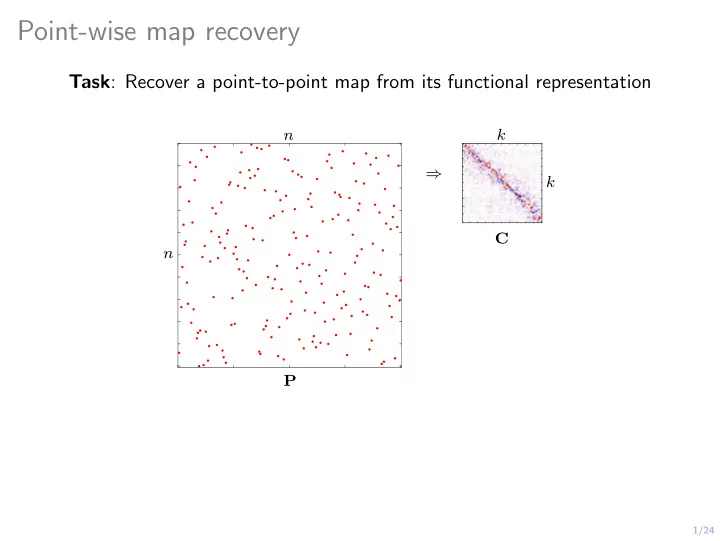
Point-wise map recovery Task : Recover a point-to-point map from its functional representation n k k C n P 1/24 Point-wise map recovery Task : Recover a point-to-point map from its functional representation n k k rank( C )
1/24
Point-wise map recovery
Task: Recover a point-to-point map from its functional representation
n n k k rank(C) ≤ k ≪ n rank(P) ≤ n ⇒ ⇐
The inverse problem is highly underdetermined
1/24
Point-wise map recovery
Task: Recover a point-to-point map from its functional representation
n n k k rank(C) ≤ k ≪ n rank(P) ≤ n ⇒ ⇐
The inverse problem is highly underdetermined Need to use priors on the expected structure of the underlying map (e.g. bijectivity, smoothness, partiality, etc.)
2/24
Mapping delta functions
Algorithm: For each x ∈ M construct the delta function δx : M → R
x ∈ M
2/24
Mapping delta functions
Algorithm: For each x ∈ M construct the delta function δx : M → R
δx : M → R
2/24
Mapping delta functions
Algorithm: For each x ∈ M construct the delta function δx : M → R Compute its image δx → Tδx
δx : M → R Tδx : N → R
2/24
Mapping delta functions
Algorithm: For each x ∈ M construct the delta function δx : M → R Compute its image δx → Tδx Find argmaxy∈N Tδx(y)
δx : M → R Tδx : N → R
2/24
Mapping delta functions
Algorithm: For each x ∈ M construct the delta function δx : M → R Compute its image δx → Tδx Find argmaxy∈N Tδx(y) Doing this for all points is costly The maximum is delocalized due to the band-limited approximation of T!
δx : M → R Tδx : N → R
3/24
Linear assignment problem
For orthogonal bases ΦM, ΦN we can write C = Φ⊤
N PΦM
If the underlying map is known to be bijective, solve the LAP: min
Π∈{0,1}n×n −Π, ΦN CΦ⊤ M
s.t. Π⊤1 = 1 , Π1 = 1
Rodol` a et al. 2015
3/24
Linear assignment problem
For orthogonal bases ΦM, ΦN we can write C = Φ⊤
N PΦM
If the underlying map is known to be bijective, solve the LAP: min
Π∈{0,1}n×n CΦ⊤ M − Φ⊤ N Π2 F
s.t. Π⊤1 = 1 , Π1 = 1
Rodol` a et al. 2015
3/24
Linear assignment problem
For orthogonal bases ΦM, ΦN we can write C = Φ⊤
N PΦM
If the underlying map is known to be bijective, solve the LAP: min
Π∈{0,1}n×n CΦ⊤ M − Φ⊤ N Π2 F
s.t. Π⊤1 = 1 , Π1 = 1 The delta function δx has coefficients ai = φM
i (x) (a column of Φ⊤ M)
⇒ the image of all delta functions on M is simply CΦ⊤
M
Rodol` a et al. 2015; Ovsjanikov et al. 2012
3/24
Linear assignment problem
For orthogonal bases ΦM, ΦN we can write C = Φ⊤
N PΦM
If the underlying map is known to be bijective, solve the LAP: min
Π∈{0,1}n×n CΦ⊤ M − Φ⊤ N Π2 F
s.t. Π⊤1 = 1 , Π1 = 1 The delta function δx has coefficients ai = φM
i (x) (a column of Φ⊤ M)
⇒ the image of all delta functions on M is simply CΦ⊤
M
Interpretation: Seek the permutation aligning the k-dimensional spectral embeddings CΦ⊤
M and Φ⊤ M in the ℓ2 sense
Rodol` a et al. 2015; Ovsjanikov et al. 2012
3/24
Linear assignment problem
For orthogonal bases ΦM, ΦN we can write C = Φ⊤
N PΦM
If the underlying map is known to be bijective, solve the LAP: min
Π∈{0,1}n×n CΦ⊤ M − Φ⊤ N Π2 F
s.t. Π⊤1 = 1 , Π1 = 1 The delta function δx has coefficients ai = φM
i (x) (a column of Φ⊤ M)
⇒ the image of all delta functions on M is simply CΦ⊤
M
Interpretation: Seek the permutation aligning the k-dimensional spectral embeddings CΦ⊤
M and Φ⊤ M in the ℓ2 sense
Inefficient for large shapes
Rodol` a et al. 2015; Ovsjanikov et al. 2012
3/24
Linear assignment problem
For orthogonal bases ΦM, ΦN we can write C = Φ⊤
N PΦM
If the underlying map is known to be bijective, solve the LAP: min
Π∈{0,1}n×n CΦ⊤ M − Φ⊤ N Π2 F
s.t. Π⊤1 = 1 , Π1 = 1 The delta function δx has coefficients ai = φM
i (x) (a column of Φ⊤ M)
⇒ the image of all delta functions on M is simply CΦ⊤
M
Interpretation: Seek the permutation aligning the k-dimensional spectral embeddings CΦ⊤
M and Φ⊤ M in the ℓ2 sense
Inefficient for large shapes Lack of desirable properties on the recovered map (e.g. smoothness)
Rodol` a et al. 2015; Ovsjanikov et al. 2012
4/24
Nearest neighbors
Relaxing bijectivity to stochasticity constraints: min
P∈{0,1}n×m CΦ⊤ M − Φ⊤ N P2 F
s.t. P⊤1 = 1
Rodol` a et al. 2015
4/24
Nearest neighbors
Relaxing bijectivity to stochasticity constraints: min
P∈{0,1}n×m CΦ⊤ M − Φ⊤ N P2 F
s.t. P⊤1 = 1 Can be solved efficiently by a nearest-neighbor search in Rk
CΦ⊤
M
Φ⊤
N
Rodol` a et al. 2015; Ovsjanikov et al. 2012
5/24
Orthogonal refinement (ICP)
Orthogonal C ⇔ Area-preserving map Idea: Treat C as a pre-alignment, do orthogonal refinement to improve map quality
Ovsjanikov et al. 2012
5/24
Orthogonal refinement (ICP)
Orthogonal C ⇔ Area-preserving map Idea: Treat C as a pre-alignment, do orthogonal refinement to improve map quality Algorithm (ICP): P-step (nearest neighbors): P∗ = arg min
P∈{0,1}n×m C∗Φ⊤ M − Φ⊤ N P2 F
s.t. P⊤1 = 1
Ovsjanikov et al. 2012
5/24
Orthogonal refinement (ICP)
Orthogonal C ⇔ Area-preserving map Idea: Treat C as a pre-alignment, do orthogonal refinement to improve map quality Algorithm (ICP): P-step (nearest neighbors): P∗ = arg min
P∈{0,1}n×m C∗Φ⊤ M − Φ⊤ N P2 F
s.t. P⊤1 = 1 C-step (orthogonal Procrustes): C∗ = arg min
C∈Rk×k CΦ⊤ M − Φ⊤ N P∗2 F
s.t. C⊤C = I
Ovsjanikov et al. 2012
6/24
Non-orthogonal refinement (CPD)
For more general deformations (e.g. non-area preserving, non-isometric), do non-rigid refinement: min
P∈{0,1}n×m
DKL(CΦ⊤
M, Φ⊤ N P) + λ CΦ⊤ M − Φ⊤ N P2 Ω
s.t. P⊤1 = 1
Rodol` a et al. 2015
6/24
Non-orthogonal refinement (CPD)
For more general deformations (e.g. non-area preserving, non-isometric), do non-rigid refinement: min
P∈{0,1}n×m
DKL(CΦ⊤
M, Φ⊤ N P)
- Kullback−Leibler
+ λ CΦ⊤
M − Φ⊤ N P2 Ω
- coherence
s.t. P⊤1 = 1
Rodol` a et al. 2015
6/24
Non-orthogonal refinement (CPD)
For more general deformations (e.g. non-area preserving, non-isometric), do non-rigid refinement: min
P∈{0,1}n×m
DKL(CΦ⊤
M, Φ⊤ N P)
- Kullback−Leibler
+ λ CΦ⊤
M − Φ⊤ N P2 Ω
- coherence
s.t. P⊤1 = 1 · 2
Ω promotes smooth displacements
Rodol` a et al. 2015
6/24
Non-orthogonal refinement (CPD)
For more general deformations (e.g. non-area preserving, non-isometric), do non-rigid refinement: min
P∈{0,1}n×m
DKL(CΦ⊤
M, Φ⊤ N P)
- Kullback−Leibler
+ λ CΦ⊤
M − Φ⊤ N P2 Ω
- coherence
s.t. P⊤1 = 1 · 2
Ω promotes smooth displacements
λ controls the regularity (rigid for λ → ∞)
Rodol` a et al. 2015
6/24
Non-orthogonal refinement (CPD)
For more general deformations (e.g. non-area preserving, non-isometric), do non-rigid refinement: min
P∈{0,1}n×m
DKL(CΦ⊤
M, Φ⊤ N P)
- Kullback−Leibler
+ λ CΦ⊤
M − Φ⊤ N P2 Ω
- coherence
s.t. P⊤1 = 1 · 2
Ω promotes smooth displacements
λ controls the regularity (rigid for λ → ∞) Solved by coherent point drift
Rodol` a et al. 2015; Myronenko and Song 2010
6/24
Non-orthogonal refinement (CPD)
For more general deformations (e.g. non-area preserving, non-isometric), do non-rigid refinement: min
P∈{0,1}n×m
DKL(CΦ⊤
M, Φ⊤ N P)
- Kullback−Leibler
+ λ CΦ⊤
M − Φ⊤ N P2 Ω
- coherence
s.t. P⊤1 = 1 · 2
Ω promotes smooth displacements
λ controls the regularity (rigid for λ → ∞) Solved by coherent point drift Does not scale well
Rodol` a et al. 2015; Myronenko and Song 2010
7/24
Comparison
Reference Nearest neighbors Ovsjanikov et al. 2012; Rodol` a et al. 2015
7/24
Comparison
Reference Nearest neighbors ICP Ovsjanikov et al. 2012; Rodol` a et al. 2015
7/24
Comparison
Reference Nearest neighbors ICP CPD Ovsjanikov et al. 2012; Rodol` a et al. 2015
8/24
Product manifold filter (PMF)
Given P0 point-to-point (e.g. from nearest-neighbors), consider the LAP: max
Π∈{0,1}n×n trace(Π⊤KMP0K⊤ N )
s.t. Π⊤1 = 1 , Π1 = 1 with KM = exp(−D2
M/σ2) and KN = exp(−D2 N /σ2)
Vestner, Rodol` a, Litman, Bronstein, Cremers 2016
8/24
Product manifold filter (PMF)
Given P0 point-to-point (e.g. from nearest-neighbors), consider the LAP: max
Π∈{0,1}n×n trace(Π⊤KMP0K⊤ N )
s.t. Π⊤1 = 1 , Π1 = 1 with KM = exp(−D2
M/σ2) and KN = exp(−D2 N /σ2)
Interpretation as an inference problem from stochastic data
Vestner, Rodol` a, Litman, Bronstein, Cremers 2016
8/24
Product manifold filter (PMF)
Given P0 point-to-point (e.g. from nearest-neighbors), consider the LAP: max
Π∈{0,1}n×n trace(Π⊤KMP0K⊤ N )
s.t. Π⊤1 = 1 , Π1 = 1 with KM = exp(−D2
M/σ2) and KN = exp(−D2 N /σ2)
Interpretation as an inference problem from stochastic data The similarity induces smooth maps
Vestner, Rodol` a, Litman, Bronstein, Cremers 2016
8/24
Product manifold filter (PMF)
Given P0 point-to-point (e.g. from nearest-neighbors), consider the LAP: max
Π∈{0,1}n×n trace(Π⊤KMP0K⊤ N )
s.t. Π⊤1 = 1 , Π1 = 1 with KM = exp(−D2
M/σ2) and KN = exp(−D2 N /σ2)
Auction algorithm: O(n2 log n) average complexity
Vestner, Rodol` a, Litman, Bronstein, Cremers 2016; Bertsekas 1998
8/24
Product manifold filter (PMF)
Given P0 point-to-point (e.g. from nearest-neighbors), consider the LAP: max
Π∈{0,1}n×n trace(Π⊤KMP0K⊤ N )
s.t. Π⊤1 = 1 , Π1 = 1 with KM = exp(−D2
M/σ2) and KN = exp(−D2 N /σ2)
Auction algorithm: O(n2 log n) average complexity Multi-scale acceleration reduces complexity by orders of magnitude
Vestner, Rodol` a, Litman, Bronstein, Cremers 2016; Bertsekas 1998
8/24
Product manifold filter (PMF)
Given P0 point-to-point (e.g. from nearest-neighbors), consider the LAP: max
Π∈{0,1}n×n trace(Π⊤KMP0K⊤ N )
s.t. Π⊤1 = 1 , Π1 = 1 with KM = exp(−D2
M/σ2) and KN = exp(−D2 N /σ2)
Auction algorithm: O(n2 log n) average complexity Multi-scale acceleration reduces complexity by orders of magnitude
Vestner, Rodol` a, Litman, Bronstein, Cremers 2016; Bertsekas 1998
8/24
Product manifold filter (PMF)
Given P0 point-to-point (e.g. from nearest-neighbors), consider the LAP: max
Π∈{0,1}n×n trace(Π⊤KMP0K⊤ N )
s.t. Π⊤1 = 1 , Π1 = 1 with KM = exp(−D2
M/σ2) and KN = exp(−D2 N /σ2)
Auction algorithm: O(n2 log n) average complexity Multi-scale acceleration reduces complexity by orders of magnitude
Vestner, Rodol` a, Litman, Bronstein, Cremers 2016; Bertsekas 1998
9/24
Examples
1% 3% 5% 7% ×diam
ICP CPD
Vestner, Rodol` a, Litman, Bronstein, Cremers 2016
9/24
Examples
1% 3% 5% 7% ×diam
ICP CPD ICP+PMF CPD+PMF
Vestner, Rodol` a, Litman, Bronstein, Cremers 2016
10/24
Comparison
50 60 70 80 90 100
% correspondences
2 4 6 8 10
Geodesic error (in % of the diameter)
NN Bijective NN NN+PMF
- Bij. NN+PMF
CPD CPD+PMF
Vestner, Rodol` a, Litman, Bronstein, Cremers 2016
11/24
Application: Point-to-point map improvement
Refinement can be used to improve noisy maps obtained with any point-wise matching pipeline
reference input improved Kim et al. 2011; Ovsjanikov et al. 2012
12/24
Application: Segmentation transfer
Transfer indicator functions for each segment, without resorting to a point-to-point correspondence
input segment image transfer Ovsjanikov et al. 2012
13/24
Application: Simultaneous shape editing
Coupled bases allow to solve for the deformation field in the functional domain, and transfer pose to multiple shapes simultaneously
Kovnatsky, Bronstein, Bronstein, Glashoff, Kimmel 2013; Rong et al. 2008
14/24
Application: Partial scanning
Litany, Rodol` a, Bronstein, Bronstein, Cremers 2016
14/24
Application: Partial scanning
Litany, Rodol` a, Bronstein, Bronstein, Cremers 2016
14/24
Application: Partial scanning
Litany, Rodol` a, Bronstein, Bronstein, Cremers 2016
14/24
Application: Partial scanning
Litany, Rodol` a, Bronstein, Bronstein, Cremers 2016
14/24
Application: Partial scanning
Litany, Rodol` a, Bronstein, Bronstein, Cremers 2016
15/24
Application: Shape retrieval
The average ratio of the norms of the diagonal and off-diagonal elements
- f C can be used as a global similarity criterion
Kovnatsky, Bronstein, Bronstein, Glashoff, Kimmel 2013
16/24
Application: Object detection and recognition
The final energy can be used as an indicator that the object is present in the scene; localization does not require a point-wise correspondence
query retrieved object query retrieved object Cosmo, Rodol` a, Masci, Torsello, Bronstein 2016
17/24
Application: Improving map collections
The pairwise maps can be improved by considering the context
Nguyen et al. 2011; Ovsjanikov, Ben-Chen, Solomon, Butscher, Guibas 2012; Kovnatsky, Glashoff, Bronstein 2016
17/24
Application: Improving map collections
The pairwise maps can be improved by considering the context Compose maps along cycles mX,Y = mZ,Y ◦ mX,Z = CZ,Y CX,Z
Nguyen et al. 2011; Ovsjanikov, Ben-Chen, Solomon, Butscher, Guibas 2012; Kovnatsky, Glashoff, Bronstein 2016
17/24
Application: Improving map collections
The pairwise maps can be improved by considering the context Compose maps along cycles mX,Y = mZ,Y ◦ mX,Z = CZ,Y CX,Z Compare to the identity C − IF
Nguyen et al. 2011; Ovsjanikov, Ben-Chen, Solomon, Butscher, Guibas 2012; Kovnatsky, Glashoff, Bronstein 2016
17/24
Application: Improving map collections
The pairwise maps can be improved by considering the context Compose maps along cycles mX,Y = mZ,Y ◦ mX,Z = CZ,Y CX,Z Compare to the identity C − IF Replace faulty maps with composites along shortest paths
Nguyen et al. 2011; Ovsjanikov, Ben-Chen, Solomon, Butscher, Guibas 2012; Kovnatsky, Glashoff, Bronstein 2016
17/24
Application: Improving map collections
The pairwise maps can be improved by considering the context Compose maps along cycles mX,Y = mZ,Y ◦ mX,Z = CZ,Y CX,Z Compare to the identity C − IF Replace faulty maps with composites along shortest paths Optimize over cycle-consistent functional maps minC C∗ + λ
(i,j)∈G CijAij − Bij2,1
Nguyen et al. 2011; Ovsjanikov, Ben-Chen, Solomon, Butscher, Guibas 2012; Kovnatsky, Glashoff, Bronstein 2016; Huang, Wang, Guibas 2014
18/24
Application: Analysis of shape collections
Find structural similarities in heterogeneous shape collections
consistent basis functions ⇒ Huang, Wang, Guibas 2014
18/24
Application: Analysis of shape collections
Find structural similarities in heterogeneous shape collections
co-segmentation ⇒ Huang, Wang, Guibas 2014
18/24
Application: Analysis of shape collections
With shape differences we can compare shapes as well as deformations, and therefore find similar shapes
query ROI 1 2 3 4 query ROI 1 2 3 4 Huang, Wang, Guibas 2014
18/24
Application: Analysis of shape collections
With shape differences we can compare shapes as well as deformations, and therefore find similar shapes find similar deformations
Huang, Wang, Guibas 2014; Rustamov, Ovsjanikov, Azencot, Ben-Chen, Chazal, Guibas 2013
18/24
Application: Analysis of shape collections
With shape differences we can compare shapes as well as deformations, and therefore find similar shapes find similar deformations
Huang, Wang, Guibas 2014; Rustamov, Ovsjanikov, Azencot, Ben-Chen, Chazal, Guibas 2013
18/24
Application: Analysis of shape collections
With shape differences we can compare shapes as well as deformations, and therefore find similar shapes find similar deformations / synthesize new deformations
Huang, Wang, Guibas 2014; Rustamov, Ovsjanikov, Azencot, Ben-Chen, Chazal, Guibas 2013; Boscaini, Eynard, Kourounis, Bronstein 2015
18/24
Application: Analysis of shape collections
With shape differences we can compare shapes as well as deformations, and therefore find similar shapes find similar deformations / synthesize new deformations
Huang, Wang, Guibas 2014; Rustamov, Ovsjanikov, Azencot, Ben-Chen, Chazal, Guibas 2013; Boscaini, Eynard, Kourounis, Bronstein 2015
19/24
Application: Shape exploration
Using shape differences we can interpolate/extrapolate the difference between corresponding regions of a shape pair
source target interpolate extrapolate Huang, Wang, Guibas 2014
19/24
Application: Shape exploration
Using shape differences we can interpolate/extrapolate the difference between corresponding regions of a shape pair
source interpolated target Huang, Wang, Guibas 2014; Rustamov, Ovsjanikov, Azencot, Ben-Chen, Chazal, Guibas 2013
20/24
Application: Shape interpolation
Linear interpolation in shape differences space: Dα = (1 − α)I + αD α = 1
20/24
Application: Shape interpolation
Linear interpolation in shape differences space: Dα = (1 − α)I + αD α = 1 α = 0 α = . 5 α = 1 . 5
21/24
Application: Image co-segmentation
Network of maps can be used for co-segmentation of images
consistent functional maps segmentations Wang, Huang, Guibas 2013; Wang, Huang, Ovsjanikov, Guibas 2014
21/24
Application: Image co-segmentation
Network of maps can be used for co-segmentation of images
Wang, Huang, Guibas 2013; Wang, Huang, Ovsjanikov, Guibas 2014
22/24
Things we did not cover
Point-wise map recovery by vector field flow Point-wise map recovery for partial functional maps Functional fluids Visualization and analysis of functional maps Matching via quotient spaces Permuted sparse coding Functional correspondence via matrix completion Coupled functional maps Functional maps for image data . . .
Corman et al. 2015; Rodol` a et al. 2016; Azencot et al. 2015; Vantzos et al. 2016; Ovsjanikov et al. 2013; Pokrass et al. 2013; Kovnatsky et al. 2015; Eynard et al. 2016; Wang et al. 2013
23/24
Summary
Considering mappings through their action on functions is simpler and more flexible
23/24
Summary
Considering mappings through their action on functions is simpler and more flexible The size of these objects can be controlled in the discrete setting
23/24
Summary
Considering mappings through their action on functions is simpler and more flexible The size of these objects can be controlled in the discrete setting Shape differences provide a way to compare shapes and deformations in an informative way
23/24
Summary
Considering mappings through their action on functions is simpler and more flexible The size of these objects can be controlled in the discrete setting Shape differences provide a way to compare shapes and deformations in an informative way Functional maps provide a common language in which many problems in geometry and data processing can be expressed
23/24
Summary
Considering mappings through their action on functions is simpler and more flexible The size of these objects can be controlled in the discrete setting Shape differences provide a way to compare shapes and deformations in an informative way Functional maps provide a common language in which many problems in geometry and data processing can be expressed Very easy to pick up!
23/24
Summary
Considering mappings through their action on functions is simpler and more flexible The size of these objects can be controlled in the discrete setting Shape differences provide a way to compare shapes and deformations in an informative way Functional maps provide a common language in which many problems in geometry and data processing can be expressed Very easy to pick up! Code and course notes available at: http://www.lix.polytechnique.fr/~maks/fmaps_course/
24/24