Polarimetry: a primary tool for the physical characterization of the - - PowerPoint PPT Presentation

polarimetry a primary tool for the physical
SMART_READER_LITE
LIVE PREVIEW

Polarimetry: a primary tool for the physical characterization of the - - PowerPoint PPT Presentation

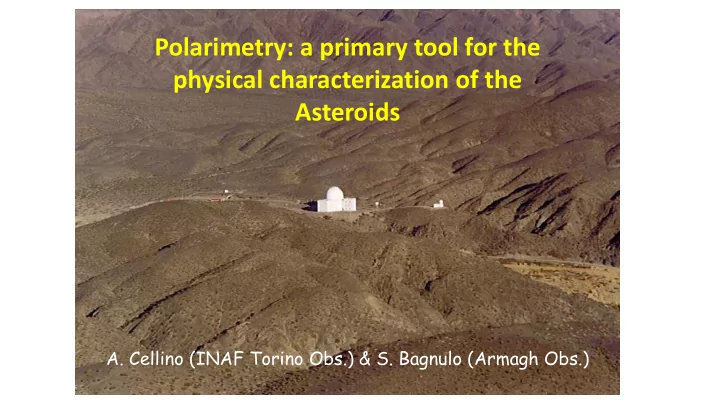
Polarimetry: a primary tool for the physical characterization of the Asteroids A. Cellino (INAF Torino Obs.) & S. Bagnulo (Armagh Obs.) Some fundamental problems in current asteroid science: The measurement of asteroid sizes and

slide-1
SLIDE 1

Polarimetry: a primary tool for the physical characterization of the Asteroids

  • A. Cellino (INAF Torino Obs.) & S. Bagnulo (Armagh Obs.)
slide-2
SLIDE 2

Some fundamental problems in current asteroid science:

  • The measurement of asteroid sizes and composition
  • The interpretation in terms of composition of taxonomic

classification based on reflectance spectra

  • The physical characterization of potential Earth impactors

In all the above problems a crucial role is played by the problem of determining asteroid albedos

) log( 5 . 2 . 1236 . 3 ) log(

V

p H D − − =

where: D = size, H = absolute magnitude, pV = geometric albedo

slide-3
SLIDE 3

The Thermal Radiometry technique. Good for sizes, less good for albedo (errors > 30% due to thermal model limitations and rough estimates of the brightness in the Visible).

slide-4
SLIDE 4

General properties of asteroid linear polarization.

A few classical parameters:

  • Pmin
  • Inversion angle αinv
  • Polarimetric slope h
slide-5
SLIDE 5

α

α

C e A P

B r

+ − =

) 1 (

/

The phase – polarization curves of asteroids can be adequately fit by an exponential – linear relation:

Where α is the phase angle A, B, C are three parameters to be determined by best-fit procedures This allows us to better determine “classical” parameters like Pmin and h, and also to build new polarimetric parameters

slide-6
SLIDE 6

The derivation of the Albedo from polarimetric properties: the classical slope – albedo relation. log pV = C1 log (h) + C2

(from Geake and Dollfus, 1986)

Currently, Different authors use different calibration coefficients…

The slope-albedo relation needs to be recalibrated, and the best way is to use

  • nly high-quality V-band polarimetry of

asteroids having accurately derived albedos. The best target list at present is the

  • ne by Shevchenko and Tedesco

(2006), including objects whose albedos were derived from both

  • ccultation and in situ (four objects)

size measurements, coupled with reliable estimates of absolute magnitudes.

slide-7
SLIDE 7

We have used all the polarimetric measurements for asteroids belonging to the Shevchenko & Tedesco list available in the literature, as well as a number of new data obtained by us at the CASLEO observatory (Argentina)

  • We limit our analysis to polarimetric measurements
  • btained in the standard V filter.
  • we only use values of linear polarization Pr having

nominal errors less than 0.2.

  • We use only polarimetric measurements obtained at

phase angles larger than or equal to 14 degrees of phase, a value well in the region of the negative polarization branch where Pr starts to increase linearly with phase.

  • We require to have at least 5 available measurements,

and that the interval of phase angles covered by the data is not less than 3 degrees.

slide-8
SLIDE 8

A possible reassessment of the classical slope – albedo relation

slide-9
SLIDE 9

The new Ψ – albedo relation, where Ψ = Pr(30°) – Pr(10°)

slide-10
SLIDE 10

This is what “normal” asteroids do...

slide-11
SLIDE 11

... And these are Barbarians, so-called after the prototype, (234) Barbara (Cellino et al., 2006).

Strong negative polarization around 20° of phase. Very high values of the inversion angle! Only six objects mentioned in the literature until a few months ago.

slide-12
SLIDE 12

Barbarians have anomalous spectral abundances of the spinel mineral, found in CAIs in meteorites. Barbarians could be remnants of the oldest and most primitive planetesimals accreted in

  • ur Solar System!

For more information, see the Barbarian Poster!

The Watsonia dynamical family is a reservoir

  • f Barbarians.

The Barbarian properties are not simply due to surface properties

slide-13
SLIDE 13

Peculiar properties (inversion angles)

  • f F-class Asteroids

Some F-class asteroids exhibit evidence of a cometary nature (Phaeton, Wilson- Harrington). 2008 TC3 was an F-class. Important for the interpretation of the future Gaia data.

(Belskaya et al., 2005)

slide-14
SLIDE 14

Dollfus et al. (1989, Asteroids II book)

slide-15
SLIDE 15

Unique example of rotation-dependent polarization found so far among

  • asteroids. Possibility to link remote-sensing polarization measurements to

local surface properties observed in situ by the DAWN probe. This can be done computing the sub-Earth points at the epochs of ground-based observations.

The case of (4) Vesta

slide-16
SLIDE 16
slide-17
SLIDE 17
slide-18
SLIDE 18
slide-19
SLIDE 19
slide-20
SLIDE 20
slide-21
SLIDE 21
  • We have now new coefficients to calibrate the classical slope -

albedo relation. New polarimetric parameters can also be used to derive more reliable albedo estimates.

  • DAWN observations of Vesta can provide a first “ground truth” for

the calibration of the polarimetry – albedo relations.

  • Barbarian Polarimetric behaviour very likely linked to spinel abundance,

which is diagnostic of extremely ancient bodies.

  • The Barbarian properties are not limited to the surface of the objects.

The parent body of Watsonia was “homogeneously Barbarian”. (A really wild asteroid!)

  • A lot of empirical evidence! Need of better theoretical models.
  • Polarimetry and Spectroscopy nicely complement each other!
  • See Bagnulo’s presentation to better understand the advantages of a

marriage of Spectroscopy and Polarimetry!