SLIDE 1 Polygon Filling
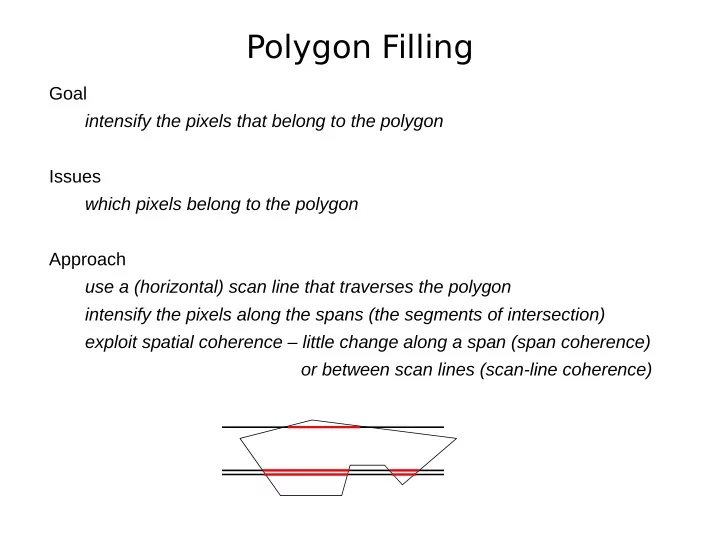
Goal intensify the pixels that belong to the polygon Issues which pixels belong to the polygon Approach use a (horizontal) scan line that traverses the polygon intensify the pixels along the spans (the segments of intersection) exploit spatial coherence – little change along a span (span coherence)
- r between scan lines (scan-line coherence)
SLIDE 2 Rectangle Filling
Special case filling rectangles specified by xmin, xmax, ymin, ymax
def drawRectangle(xmin, xmax, ymin, ymax): for y in [ymin : ymax]: # for each vertical scan line: for x in [xmin : xmax]: # for each horizontal span: setPixel(x, y, color)
SLIDE 3
Rectangle Filling
Issues in rectangle (and polygon) filling draw R1(8, 5, 16, 10) and R2(16, 5, 24, 10) 4 12 8 16 20 16 24 5 10
SLIDE 4
Rectangle Filling
Issues in rectangle (and polygon) filling draw R1(8, 5, 16, 10) and R2(16, 5, 24, 10) 5 10 4 12 8 16 20 16 24
SLIDE 5
Rectangle Filling
Issues in rectangle (and polygon) filling draw R1(8, 5, 16, 10) and R2(16, 5, 24, 10) shared edge at x = 16 – order of drawing gives different visual results 5 10 4 12 8 16 20 16 24
SLIDE 6
Rectangle Filling
Issues in rectangle (and polygon) filling adjacent rectangles (shared vertices, edges) Solution do not draw the right-most and top-most edges of the rectangle (arbitrary decision – could have chosen to omit left-most, bottom-most) 5 10 4 12 8 16 20 16 24
SLIDE 7
Rectangle Filling
Issues in rectangle (and polygon) filling adjacent rectangles (shared vertices, edges) Solution do not draw the right-most and top-most edges of the rectangle 5 10 4 12 8 16 20 16 24
SLIDE 8
Polygon Filling
Same solution for general polygons do not draw the right-most and top-most edges of the polygon draw only pixels interior to the polygon Example polygon outline if we used the line drawing algorithm for each edge
SLIDE 9
Polygon Filling
Same solution for general polygons do not draw the right-most and top-most edges of the polygon draw only pixels interior to the polygon Example polygon outline if we used the line drawing algorithm for each edge line drawing algorithm may pick pixels that are outside the ideal boundary
SLIDE 10
Polygon Filling
Same solution for general polygons do not draw the right-most and top-most edges of the polygon draw only pixels interior to the polygon Example polygon outline if we used the line drawing algorithm for each edge line drawing algorithm may pick pixels that are outside the ideal boundary
SLIDE 11
Polygon Filling
Same solution for general polygons do not draw the right-most and top-most edges of the polygon draw only pixels interior to the polygon Example polygon outline if we used the line drawing algorithm for each edge line drawing algorithm may pick pixels that are outside the ideal boundary
SLIDE 12
Polygon Filling
Same solution for general polygons do not draw the right-most and top-most edges of the polygon draw only pixels interior to the polygon Example polygon outline if we used the line drawing algorithm for each edge line drawing algorithm may pick pixels that are outside the ideal boundary
SLIDE 13
Polygon Filling
Check the x-coordinate of intersections between scan line and edges if entering the polygon (i.e. left edge ), round x up (11.4 12) → if leaving the polygon (i.e. right edge), round x down (16.7 16) → If the intersection occurs at integer x-coordinate left edge – draw pixel at x (11 11) → right edge – draw pixel at x-1 (11 10) → 11.4 12 → 16.7 16 → 11 11 → 16 15 →
SLIDE 14
Polygon Filling
Check the x-coordinate of intersections between scan line and edges if entering the polygon (i.e. left edge ), round x up (11.4 12) → if leaving the polygon (i.e. right edge), round x down (16.7 16) → If the intersection occurs at integer x-coordinate: left edge – draw pixel at x, right edge – draw pixel at x-1 4 12 8 16 20 16 24 4
SLIDE 15 Polygon Filling
Horizontal edges are ignored: either they don't need to be drawn, since they are top edges
- r they will be drawn as part of a longer span
4 12 8 16 20 16 24 4 should be ignored will be filled
SLIDE 16
Polygon Filling
Scan line at level y = 4 intersects edges at x = 11.4, 16.7, 21.6, 26 Every pair of intersections represents a span that needs to be filled s1 = (11.4, 16.7) s2 = (21.6, 26) 4 12 8 16 20 16 24 4
SLIDE 17
Polygon Filling
Scan line at level y = 4 intersects edges at x = 11.4, 16.7, 21.6, 26 Every pair of intersections represents a span that needs to be filled s1 = (11.4, 16.7) s2 = (21.6, 26) For each span round up left coordinate, round down the right coordinate s1 = (12, 16) s2 = (22, 25) Intensify pixels at scan line y = 4 and x = [12..17] and x = [23..25] 4 12 8 16 20 16 24 4
SLIDE 18
Polygon Filling
Move the scan line by one unit (to draw the next row of pixels) Scan line now intersects edges at x = 11, 26 ignore horizontal edges and edges whose top vertex is on the scan line Every pair of intersections represents a span that needs to be filled s1 = (11, 26) round up/down s1 = (11, 25) Intensify pixels at scan line y = 5 and x = [11..25] 4 12 8 16 20 16 24 4
SLIDE 19
Polygon Filling
Algorithm discard all horizontal edges set up a scan line at the bottom of the polygon repeat find the x intersections of scan line with the edges (active edges) every pair of intersections represents a span to fill/intensify move the scan line up, discard edges with top vertex on scan line until scan line reaches top of polygon
SLIDE 20
Polygon Filling
Algorithm discard all horizontal edges set up a scan line at the bottom of the polygon repeat find the x intersections of scan line with the edges (active edges) every pair of intersections represents a span to fill/intensify move the scan line up, discard edges with top vertex on scan line until scan line reaches top of polygon
SLIDE 21
Polygon Filling
Algorithm discard all horizontal edges set up a scan line at the bottom of the polygon repeat find the x intersections of scan line with the edges (active edges) every pair of intersections represents a span to fill/intensify move the scan line up, discard edges with top vertex on scan line until scan line reaches top of polygon
SLIDE 22
Polygon Filling
Algorithm discard all horizontal edges set up a scan line at the bottom of the polygon repeat find the x intersections of scan line with the edges (active edges) every pair of intersections represents a span to fill/intensify move the scan line up, discard edges with top vertex on scan line until scan line reaches top of polygon
SLIDE 23
Polygon Filling
Algorithm discard all horizontal edges set up a scan line at the bottom of the polygon repeat find the x intersections of scan line with the edges (active edges) every pair of intersections represents a span to fill/intensify move the scan line up, discard edges with top vertex on scan line until scan line reaches top of polygon
SLIDE 24
Polygon Filling
Algorithm discard all horizontal edges set up a scan line at the bottom of the polygon repeat find the x intersections of scan line with the edges (active edges) every pair of intersections represents a span to fill/intensify move the scan line up, discard edges with top vertex on scan line until scan line reaches top of polygon
SLIDE 25
Polygon Filling
Algorithm discard all horizontal edges set up a scan line at the bottom of the polygon repeat find the x intersections of scan line with the edges (active edges) every pair of intersections represents a span to fill/intensify move the scan line up, discard edges with top vertex on scan line until scan line reaches top of polygon
SLIDE 26
Polygon Filling
Algorithm discard all horizontal edges set up a scan line at the bottom of the polygon repeat find the x intersections of scan line with the edges (active edges) every pair of intersections represents a span to fill/intensify move the scan line up, discard edges with top vertex on scan line until scan line reaches top of polygon
SLIDE 27
Polygon Filling
Algorithm discard all horizontal edges set up a scan line at the bottom of the polygon repeat find the x intersections of scan line with the edges (active edges) every pair of intersections represents a span to fill/intensify move the scan line up, discard edges with top vertex on scan line until scan line reaches top of polygon filled as desired
SLIDE 28
Polygon Filling
Algorithm discard all horizontal edges set up a scan line at the bottom of the polygon repeat find the x intersections of scan line with the edges (active edges) every pair of intersections represents a span to fill/intensify move the scan line up, discard edges with top vertex on scan line until scan line reaches top of polygon
SLIDE 29
Polygon Filling
Algorithm discard all horizontal edges set up a scan line at the bottom of the polygon repeat find the x intersections of scan line with the edges (active edges) every pair of intersections represents a span to fill/intensify move the scan line up, discard edges with top vertex on scan line until scan line reaches top of polygon
SLIDE 30
Polygon Filling
Algorithm discard all horizontal edges set up a scan line at the bottom of the polygon repeat find the x intersections of scan line with the edges (active edges) every pair of intersections represents a span to fill/intensify move the scan line up, discard edges with top vertex on scan line until scan line reaches top of polygon
SLIDE 31
Polygon Filling
Algorithm discard all horizontal edges set up a scan line at the bottom of the polygon repeat find the x intersections of scan line with the edges (active edges) every pair of intersections represents a span to fill/intensify move the scan line up, discard edges with top vertex on scan line until scan line reaches top of polygon
SLIDE 32
Polygon Filling
Algorithm discard all horizontal edges set up a scan line at the bottom of the polygon repeat find the x intersections of scan line with the edges (active edges) every pair of intersections represents a span to fill/intensify move the scan line up, discard edges with top vertex on scan line until scan line reaches top of polygon
SLIDE 33
Polygon Filling
Algorithm discard all horizontal edges set up a scan line at the bottom of the polygon repeat find the x intersections of scan line with the edges (active edges) every pair of intersections represents a span to fill/intensify move the scan line up, discard edges with top vertex on scan line until scan line reaches top of polygon
SLIDE 34
Polygon Filling
Algorithm discard all horizontal edges set up a scan line at the bottom of the polygon repeat find the x intersections of scan line with the edges (active edges) every pair of intersections represents a span to fill/intensify move the scan line up, discard edges with top vertex on scan line until scan line reaches top of polygon
SLIDE 35
Polygon Filling
Algorithm discard all horizontal edges set up a scan line at the bottom of the polygon repeat find the x intersections of scan line with the edges (active edges) every pair of intersections represents a span to fill/intensify move the scan line up, discard edges with top vertex on scan line until scan line reaches top of polygon ignored as desired
SLIDE 36
Polygon Filling
Algorithm discard all horizontal edges set up a scan line at the bottom of the polygon repeat find the x intersections of scan line with the edges (active edges) every pair of intersections represents a span to fill/intensify move the scan line up, discard edges with top vertex on scan line until scan line reaches top of polygon
SLIDE 37
Polygon Filling
Algorithm discard all horizontal edges set up a scan line at the bottom of the polygon repeat find the x intersections of scan line with the edges (active edges) every pair of intersections represents a span to fill/intensify move the scan line up, discard edges with top vertex on scan line until scan line reaches top of polygon
SLIDE 38
Polygon Filling
Algorithm discard all horizontal edges set up a scan line at the bottom of the polygon repeat find the x intersections of scan line with the edges (active edges) every pair of intersections represents a span to fill/intensify move the scan line up, discard edges with top vertex on scan line until scan line reaches top of polygon
SLIDE 39
Polygon Filling
Algorithm discard all horizontal edges set up a scan line at the bottom of the polygon repeat find the x intersections of scan line with the edges (active edges) every pair of intersections represents a span to fill/intensify move the scan line up, discard edges with top vertex on scan line until scan line reaches top of polygon
SLIDE 40
Polygon Filling
Algorithm discard all horizontal edges set up a scan line at the bottom of the polygon repeat find the x intersections of scan line with the edges (active edges) every pair of intersections represents a span to fill/intensify move the scan line up, discard edges with top vertex on scan line until scan line reaches top of polygon
SLIDE 41
Polygon Filling
Algorithm discard all horizontal edges set up a scan line at the bottom of the polygon repeat find the x intersections of scan line with the edges (active edges) every pair of intersections represents a span to fill/intensify move the scan line up, discard edges with top vertex on scan line until scan line reaches top of polygon ignored as desired
SLIDE 42 Polygon Filling
Data structures Edge – representation of a polygon edge ET (edge table) – all edges sorted by ymin, of their lower vertex AEL (active edge list) – the edges intersected by current scan line Algorithm
store all edges in ET buckets based on ymin of their lower vertex yscan = lowest y coordinate of the polygon AEL = empty list do move from ET to AEL all edges whose ymin = yscan sort edges in AEL based on their x-intersection with yscan fill pixels between successive pairs in AEL yscan = yscan + 1 remove from AEL all edges whose ymax = yscan for each edge in AEL update x-intersection with yscan while AEL not empty
SLIDE 43
Polygon Filling
Data structures Edge – representation of a polygon edge ymin, ymax – y coordinate of lower and higher vertex x – intersection with current scan line m – slope of the edge (to update the x intersection) ET (edge table) –all edges sorted by ymin, of their lowest vertex a Hash Map with integer key (ymin) and list values (edges) AEL (active edge list) – a Linked List of edges edges with ymin = 10 edges with ymin = 5 edges with ymin = 4 edges with ymin = 1 ymin | ymax | x | m
SLIDE 44
Polygon Filling
Data structures Edge updateX – adds 1/m to current x value (m is slope of the edge) leftX – rounds up the x value (if left side of a span) rightX – rounds down the x value (if right side of a span) ET (edge table) STL map sorted on the key (ymin) AEL (active edge list) – from STL list sort remove merge
SLIDE 45 Polygon Filling
Incremental computation of x-coordinate of the scan line and edge intersection Use scan line coherence – relatively small change between scan lines scan line equation y = mx + k → x = y/m + n , n = -k/m to find x” x” = y”/m + n = (y’ + 1)/m + n since y” = y'+1 = y’/m + 1/m + n = y’m + n + 1/m = x’ + 1/m To get the next x intersection just add 1/m to the previous one
x’ x” y’ y”
SLIDE 46
Integer Arithmetic
Integer arithmetic for computing x-coordinate of the scan line and edge intersection x” = x’ + 1/m m = dy/dx 1/m = dx/dy From earlier slide we keep adding 1/m = dx/dy , so the sequence of intersections is x, x + dx , x + 2dx , x + 3dx , x + 4dx , etc. dy dy dy dy Example: edge = (x0, y0, x1, y1) = (3, 2, 5, 7) dx = 5-3 = 2, dy = 7-5 = 5 3, 3 + 2 , 3 + 4 , 3 + 6 = 4 + 1 , 4 + 3 , 4 + 5 = 5 + 0 5 5 5 5 5 5 5
SLIDE 47 Integer Arithmetic
Integer arithmetic for computing x-coordinate of the scan line and edge intersection x” = x’ + 1/m m = dy/dx 1/m = dx/dy From earlier slide we keep adding 1/m = dx/dy , so the sequence of intersections is x, x + dx , x + 2dx , x + 3dx , x + 4dx , etc. dy dy dy dy To handle overflow in numerator, keep track of its value (i.e. k*dx) and current x
if numer >= dy:
numer = numer - dy x = x + 1 Example: edge = (x0, y0, x1, y1) = (3, 2, 5, 7) dx = 5-3 = 2, dy = 7-5 = 5 3, 3 + 2 , 3 + 4 , 3 + 6 = 4 + 1 , 4 + 3 , 4 + 5 = 5 + 0 5 5 5 5 5 5 5
SLIDE 48
Integer Arithmetic
Calculating the x intersection given the previous sequence 3, 3 + 2 , 3 + 4 , 3 + 6 = 4 + 1 , 4 + 3 , 4 + 5 = 5 + 0 5 5 5 5 5 5 5 if a left edge (i.e. entering the polygon) – round up when numer > 0 3, 4, 4, 5, 5, 5 if a right edge (i.e. leaving the polygon) – round down, including integer values 2, 3, 3, 4, 4, 4 left edge right edge
SLIDE 49
Integer Artihmetic
Integer arithmetic for slope 0 < m < 1 x” = x’ + 1/m m = dy/dx 1/m = dx/dy Same idea, but dx/dy has a whole part, w, and fractional part, f Example: edge = (x0, y0, x1, y1) = (3, 2, 8, 5) dx = 8-3 = 5, dy = 5-2 = 3 w = dx/dy = 5/3 = 1 f = dx%dy = 5%3 = 2 3 3 + 5/3 =
SLIDE 50
Integer Artihmetic
Integer arithmetic for slope 0 < m < 1 x” = x’ + 1/m m = dy/dx 1/m = dx/dy Same idea, but dx/dy has a whole part, w, and fractional part, f Example: edge = (x0, y0, x1, y1) = (3, 2, 8, 5) dx = 8-3 = 5, dy = 5-2 = 3 w = dx/dy = 5/3 = 1 f = dx%dy = 5%3 = 2 3 3 + 5/3 = 3 + 3/3 + 2/3 = 3 + w + f/3 = 4 + f/3 = 4 + 2/3 4 + 2/3 + 5/3 = 4 + 2/3 + w + f/3 = 5 + (2+f)/3 = 5 + 4/3 = 5 + 1 + 1/3 = 6 + 1/3 6 + 1/3 + 5/3 = 6 + 1/3 + w + f/3 = 7 + (1+f)/3 = 7 + 3/3 = 7 + 1 + 0/3 = 8 + 0/3 Procedure always add to x the whole part, w (for slopes m > 1, w = 0) always add to numer the fract. part, f, and adjust if numer >= dy