Polymorphism 1 2/19/2011 Aims Assess if polymorphic change - - PDF document

polymorphism
SMART_READER_LITE
LIVE PREVIEW

Polymorphism 1 2/19/2011 Aims Assess if polymorphic change - - PDF document

2/19/2011 The effect of Ethanol Various solid state composition Depends on the spray dry conditions (i.e temperature, humidity) Polymorphism 1 2/19/2011 Aims Assess if polymorphic change follows the trend linked to the particle


slide-1
SLIDE 1

2/19/2011 1

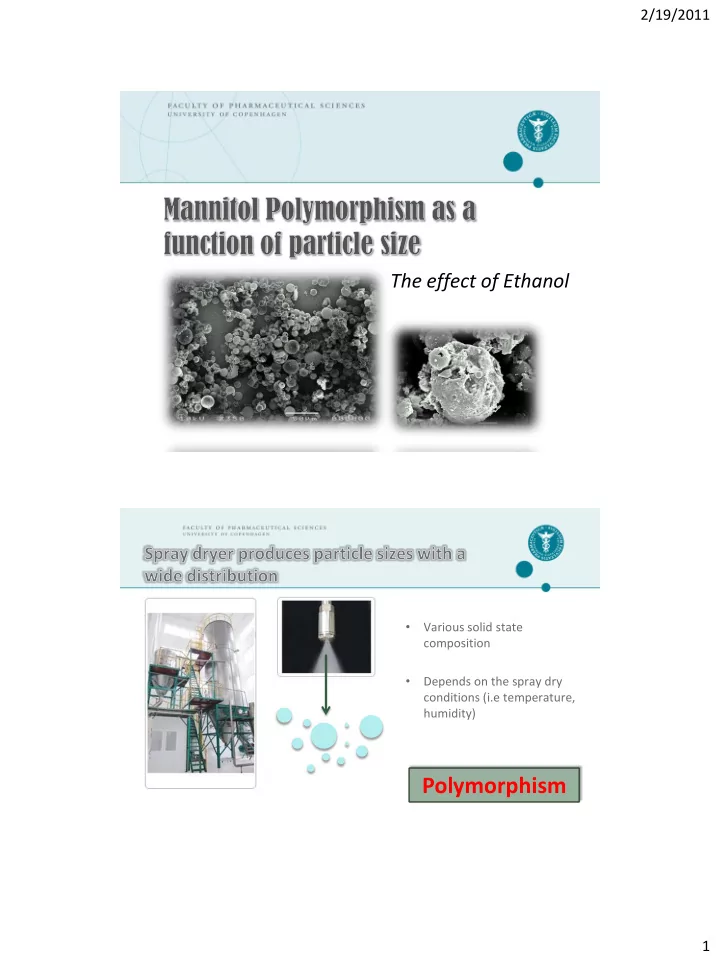
The effect of Ethanol

  • Various solid state

composition

  • Depends on the spray dry

conditions (i.e temperature, humidity)

Polymorphism

slide-2
SLIDE 2

2/19/2011 2

Aims

Assess if polymorphic change follows the trend linked to the particle size distribution that is normally obtained during spray dry process. To investigate the effect of ethanol on drying kinectics, which then affect the crystal growth and drying behavior of polymorphs .

Methods

MATERIALS

  • D-Mannitol

α,β,δ and hemihydrate

  • Ethanol

DATA INTERPRE- TATION Identify polymrphic change according to particle size

4

Raman Microscopy CHEMO-METRICS Multivariate Data Analysis PLS-DA SPRAY DRY Mannitol in 10% Ethanol

1

NGI Separate to different particle size fractions (Stage 1 – Stage 8)

2

SOLID STATE ANALYSIS Characterize mannitol polymophrs

3

X-RAY Diffracto- metry Scanning Electron Micrograph / Thermogravi- metric Analysis

slide-3
SLIDE 3

2/19/2011 3

Results – SEM / TGA

Stage 1 10.9 ± 3.4 µm Stage 4 2.7 ± 1.7 µm Stage 7,8 1.0 ± 0.4 µm

TGA - No detectable weight loss

Results - XRD

5 10 15 20 25 30 35 40

Offset Y values 2 Theta S78 S6 S5 S4 S3 S2 S1 Bulk 10% Ethanol

α α β β

  • All samples contain

α and β-mannitol.

  • Comparing the ratio
  • f two polymorphs

at indicated positions, α contents increase relatively at smaller particle size.

Bulk Stage 1 Stage 2 Stage 3 Stage 4 Stage 5 Stage 6 Stage 7,8

slide-4
SLIDE 4

2/19/2011 4

Results – Raman Microscopy

400 600 800 1000 1200 1400 5000 10000 15000 20000 25000 30000

Intensity Wavenumber (cm

  • 1)

alpha mannitol beta mannitol

(a)

400 600 800 1000 1200 1400

  • 0.15
  • 0.10
  • 0.05

0.00 0.05 0.10 0.15

Wavenumber (cm

  • 1)

Loading 1, 86.54% Loading 2, 13.15% Loading 3, 0.25%

(b)

  • 3 principal components
  • 100% specificity and sensitivity
  • 0% misclassification rate

Results – Raman Microscopy

  • - Bulk powder --

S 1 S 2 S 3 S 4 S 5 S 6 S 7 S 8 10 20 30 40 50 60 70 80 90 100

Percentage of beta mannitol (%) NGI stage

(c)

  • Content of

β-mannitol decreased from NGI Stage 1 to 8

slide-5
SLIDE 5

2/19/2011 5 Different drying rates for droplets with various sizes 1 sec 5 secs

  • Smaller droplets are likely to dry faster than larger droplets
  • Ostwald rules of stages

– more meta-stable α-mannitol in small particles

  • Moisture as ‘lubricant’ for stable crystal arrangement

– more stable β-mannitol in large particles

Conclusions

  • Ethanol increases drying rate of mannitol in the

spray drying system, leading to the presence of meta-stable α-mannitol in addition to stable β- mannitol.

  • Polymorphic form of mannitol changes according

to particle size from spray drying process.