Population Health Management healthcare design through strategic - - PDF document

population health management
SMART_READER_LITE
LIVE PREVIEW

Population Health Management healthcare design through strategic - - PDF document

Population Health Management healthcare design through strategic planning Barry Bittman, MD Senior Vice President Chief Population Health Officer Highmark Allegheny Health Network Senior Fellow Estes Park Institute Perhaps Its Time to Tear


slide-1
SLIDE 1

1

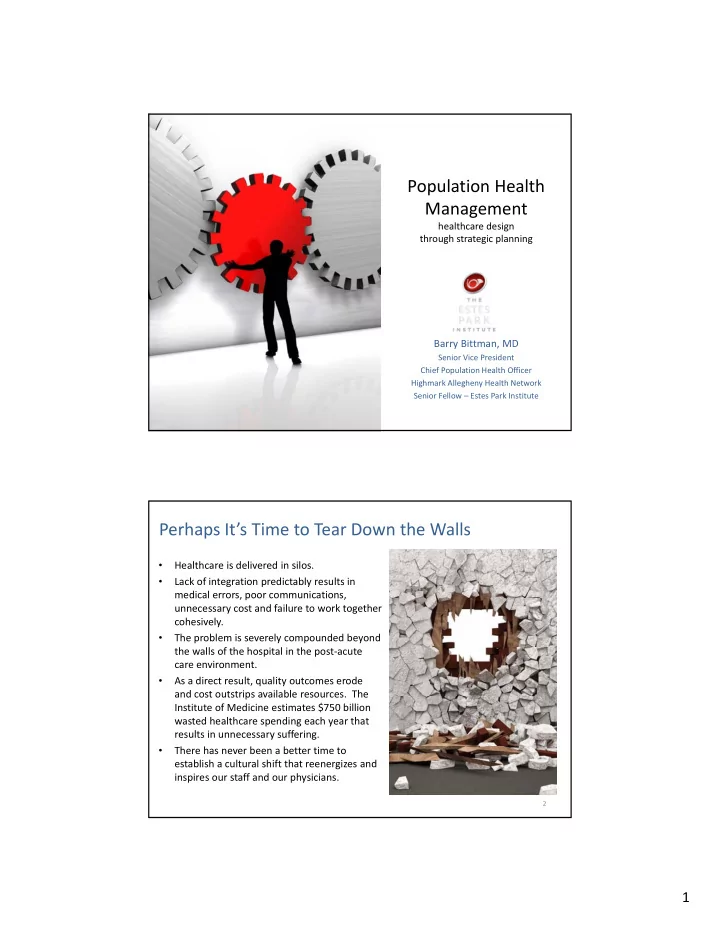
Population Health Management

healthcare design through strategic planning Barry Bittman, MD

Senior Vice President Chief Population Health Officer Highmark Allegheny Health Network Senior Fellow – Estes Park Institute

Perhaps It’s Time to Tear Down the Walls

  • Healthcare is delivered in silos.
  • Lack of integration predictably results in

medical errors, poor communications, unnecessary cost and failure to work together cohesively.

  • The problem is severely compounded beyond

the walls of the hospital in the post‐acute care environment.

  • As a direct result, quality outcomes erode

and cost outstrips available resources. The Institute of Medicine estimates $750 billion wasted healthcare spending each year that results in unnecessary suffering.

  • There has never been a better time to

establish a cultural shift that reenergizes and inspires our staff and our physicians.

2

slide-2
SLIDE 2

2

PHM Definition

We have redefined Population Health Management as: “an amalgamated series of integrated strategies that achieve Triple Aim objectives through four essential pillars:

Clinical Integration Provider Integration Payor Integration Technology Integration

Key Advantages

  • Population Health Management establishes the infrastructure for aligning and

coordinating clinical services, while building a collaborative sustainable culture among hospitals, physicians and post acute care providers.

  • Our future depends to a great extent on alignment − among patients, hospitals,

physician, employers and community partners.

  • The value added components delivered through PHM enable us to advance toward

Triple Aim objectives in a fragmented challenging healthcare environment.

4

slide-3
SLIDE 3

3

Why should you be concerned?

  • We are in the midst of moving

from a fee‐for‐service model to risk‐based contracts.

  • Quality achievement now plays

a significant role in payment.

  • Hospitals and physicians can

no longer function independently.

  • The ultimate survival of

community‐based healthcare is at stake.

5

PHM: Foundational Insights

Our nation’s healthcare system is fragmented, unaffordable and unsustainable. Numerous factors including poor patient outcomes, excess readmissions, physician burnout and the radical transformation from fee‐for‐service to global payments and risk‐based contracts threaten the survival of our healthcare system. Our purpose is to offer the highest quality healthcare through an innovative patient‐centric PHM model that focuses on the

  • ptimization of patient outcomes and patient/family care

experiences, along with lower per capita costs. MISSION

slide-4
SLIDE 4

4

Objectives

  • To create a Triple Aim‐based high quality,

cost‐effective, fully integrated patient‐ centered population health management (PHM) strategy system‐wide.

  • To design, progressively refine and deploy a

system‐based comprehensive fully‐ integrated strategy that enables us to

  • ptimally serve our communities in the

healthcare reform environment and well into the future.

  • To build a sustainable coordinated

healthcare strategy that optimizes efficiency and care alignment.

7

Rationale

  • Successful healthcare reform requires

the development and deployment of comprehensive innovative redesign strategies.

  • We have an unprecedented
  • pportunity to optimize outcomes‐

based quality through: – innovative clinical population health management strategies – physician integration and leadership – Cutting edge technological innovation – payor alignment

8

slide-5
SLIDE 5

5

Developing A Connection With Each Patient

Meadville Medical Center Allegheny College

  • St. Vincent Hospital

Gannon University Jefferson Hospital Washington & Jefferson College Wooster Community Hospital College Of Wooster Pocono Hospital East Stroudsburg University White River Medical Center Lyon College (Arkansas) Canton-Pottsdam Hospital

  • St. Lawrence University

Rochester General Hospital Rochester Institute of Technology Washington Regional Medical Center University of Arkansas Shannon Medical Center University of Texas

A Sample of Health Coach Programs

slide-6
SLIDE 6

6

  • Planning is essential. Benchmarking is critical.

Knowing where you are is essential.

  • An extraordinary need exists for PHM care

coordination toolsets as well as algorithms and protocols that enable quantitative real‐time tracking.

  • Care coordination tools must be shared among

hospitals, physicians, navigators, health coaches and post‐acute care partners.

11

PHM: A Practical Analogy

slide-7
SLIDE 7

7

Airline Industry PHM

Objectives To safely and efficiently transport a group of people from one location to another (Point A to Point B) in a cost effective manner. To safely and efficiently transform the health of a population from sickness to enhanced health and well‐being in a cost effective manner. Goals Safety Timely departures and arrivals Efficiency Convenience Customer Satisfaction Affordability Safety Positive Health Outcomes Efficiency Convenience Patient/Family Satisfaction Affordability Strategies Streamlined processes Reproducible algorithms Best practices Numerous checks and balances Real‐time assessments Streamlined processes Reproducible algorithms Best practices Numerous checks and balances Real‐time assessments

PHM: A Practical Analogy Airline Cockpit

slide-8
SLIDE 8

8

PHM Cockpit

Best Practices Data Management Meaningful Incentives Clinician Training Prevention Wellness Palliation Hospice Chronic Conditions Acute Disease Physicians Hospitals Outpatient Centers PAC Providers Care Managers Health Coaches Data Managers Navigators

Patient Family

Airline Command Center

Airport Control Tower

Collision Avoidance Flight Routing Gate Scheduling Runway Clearance Flight Redirection Weather Warning

slide-9
SLIDE 9

9

PHM Command Center

Call Center Patient & Physician Support Consult Referral Center Post‐Acute Care Providers Physician Integration Education Quality and Adherence Monitoring No‐ Discharge Care Continuum

Your Hospital

It takes a coordinated team to take off and land safely.

slide-10
SLIDE 10

10

TO DO List

Re‐evaluate your clinical strategies with a critical perspective for ensuring quality, efficiency and seamless delivery. Coordinate your providers (employed and non‐ employed) and provide the leadership for fostering cohesive working relationships. Learn the ropes − focus on the clinical and

  • perational benchmarks that are critical for your

success. Build the toolset, and learn to function effectively as a Control Tower. Focus on Strategic Planning that does not serve to reinvent a better yesterday. This is an extraordinarily challenging new environment that requires innovation and out‐of‐the‐box thinking. Celebrate your successes and build a new culture that truly inspires your vision for the future.

19

When they entrust their lives to us, we owe them more...

slide-11
SLIDE 11

11

Thank You

For more information: bbittman@iihealthcare.or g