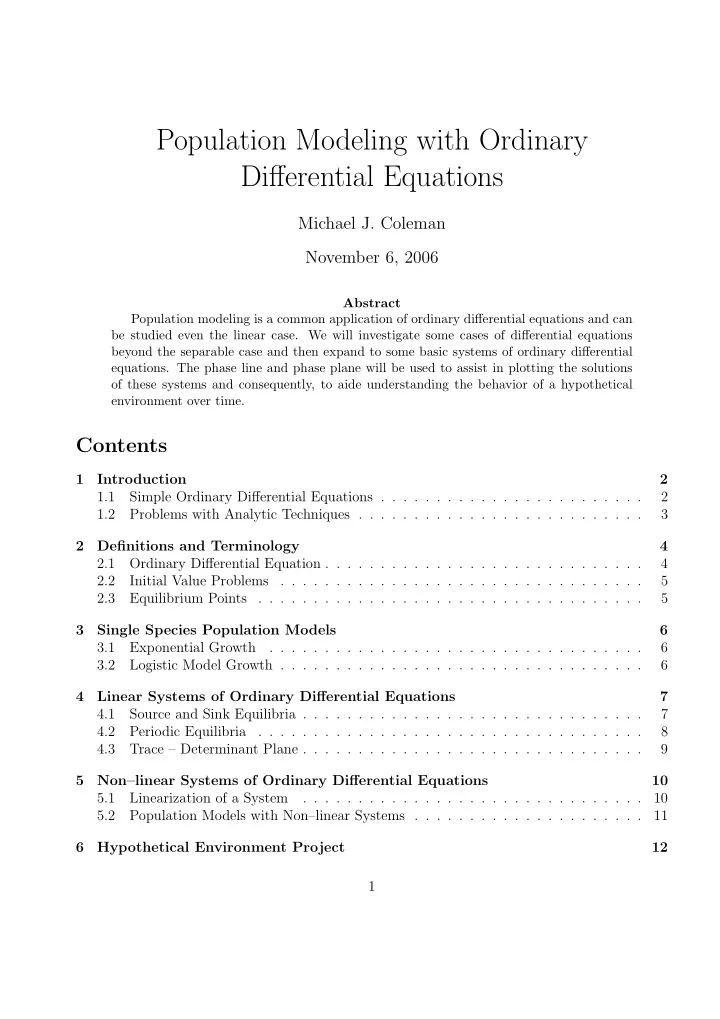
Population Modeling with Ordinary Differential Equations Michael J. - - PDF document

population modeling with ordinary differential equations
SMART_READER_LITE
LIVE PREVIEW

Population Modeling with Ordinary Differential Equations Michael J. - - PDF document

Population Modeling with Ordinary Differential Equations Michael J. Coleman November 6, 2006 Abstract Population modeling is a common application of ordinary differential equations and can be studied even the linear case. We will investigate


slide-1
SLIDE 1

Population Modeling with Ordinary Differential Equations

Michael J. Coleman November 6, 2006

Abstract Population modeling is a common application of ordinary differential equations and can be studied even the linear case. We will investigate some cases of differential equations beyond the separable case and then expand to some basic systems of ordinary differential

  • equations. The phase line and phase plane will be used to assist in plotting the solutions
  • f these systems and consequently, to aide understanding the behavior of a hypothetical

environment over time.

Contents

1 Introduction 2 1.1 Simple Ordinary Differential Equations . . . . . . . . . . . . . . . . . . . . . . . . 2 1.2 Problems with Analytic Techniques . . . . . . . . . . . . . . . . . . . . . . . . . . 3 2 Definitions and Terminology 4 2.1 Ordinary Differential Equation . . . . . . . . . . . . . . . . . . . . . . . . . . . . . 4 2.2 Initial Value Problems . . . . . . . . . . . . . . . . . . . . . . . . . . . . . . . . . 5 2.3 Equilibrium Points . . . . . . . . . . . . . . . . . . . . . . . . . . . . . . . . . . . 5 3 Single Species Population Models 6 3.1 Exponential Growth . . . . . . . . . . . . . . . . . . . . . . . . . . . . . . . . . . 6 3.2 Logistic Model Growth . . . . . . . . . . . . . . . . . . . . . . . . . . . . . . . . . 6 4 Linear Systems of Ordinary Differential Equations 7 4.1 Source and Sink Equilibria . . . . . . . . . . . . . . . . . . . . . . . . . . . . . . . 7 4.2 Periodic Equilibria . . . . . . . . . . . . . . . . . . . . . . . . . . . . . . . . . . . 8 4.3 Trace – Determinant Plane . . . . . . . . . . . . . . . . . . . . . . . . . . . . . . . 9 5 Non–linear Systems of Ordinary Differential Equations 10 5.1 Linearization of a System . . . . . . . . . . . . . . . . . . . . . . . . . . . . . . . 10 5.2 Population Models with Non–linear Systems . . . . . . . . . . . . . . . . . . . . . 11 6 Hypothetical Environment Project 12 1

slide-2
SLIDE 2

1 Introduction

1.1 Simple Ordinary Differential Equations

The simplest type of differential equation is the standard case you find in calculus

  • Completely non–autonomous differential equations. These

are nothing more than some of those MATH–032 integrals. Example: dx dt = t2 + t Solution: x(t) = t2 + t

  • dt =

t3 3 + t2 2 + C.

  • Separable differential equations are types that you’ve probably

encountered before and are not too hard to work out. Example: dx dt = (x + 1) t Solution: Separate variables and integrate both sides with respect to the given variable.

  • dx

x + 1 =

  • t dt

Then we can integrate these equations to obtain a general solution ln

  • x + 1
  • =

t2 2 + C

2

slide-3
SLIDE 3

1.2 Problems with Analytic Techniques

There are many different examples that arise in differential equa- tions which raise problems with these analytic techniques. Here are just a couple. Example: The following differential equation is separable. [1] dx dt = x x + 1 Solution: We can separate and integrate easily as follows. 1 x + x

  • dx =
  • dt

Problem: There is no way to algebraically solve the equation ln

  • x
  • + x2

2 = t + C. Example: This is a perfectly separable differential equation. [1] dx dt = sec(x2) Problem: It’s a pity the left hand integration is perhaps impossible.

  • cos(x2) dx =
  • dt

3

slide-4
SLIDE 4

2 Definitions and Terminology

2.1 Ordinary Differential Equation

An ordinary differential equation [2] relates the ordinary deriva- tives of an unknown function and possibly the function x(t) itself. It has the general form G

  • t, x, dx

dt , d 2x dt2 , d 3x dt3 , . . .

  • = 0.

where the function G determines which derivatives are involved in the equations and the extent to which each is involved. Familiar differential equations, such as the following, take this form. Examples: t2 + t − dx dt = 0 x + dx dt = 0 x2 + x + d 4x dt4 = 0 Newton’s Law: One the most common differential equations used in physical application is Newton’s F = ma. Acceleration is the second derivative of a displacement function x(t) so, we have the differential equation F − m d 2x dt2 = 0.

4

slide-5
SLIDE 5

2.2 Initial Value Problems

  • An initial value problem involves both a differential equation

and a prescribed value for the unknown function x(t) at some initial time t0. Express such a problem as F

  • t, x, dx

dt , d 2x dt2 , d 3x dt3 , . . .

  • = 0

with x(t0) = x0

  • A solution to an initial value problem must satisfy both the differen-

tial equation as well as the initial value prescribed at the particular initial time t0.

2.3 Equilibrium Points

An equilibrium point x∗ is one where a solution of the differential equation remains fixed at x∗ for all time. In other words x(t) = x∗ for all t ∈ R. Equivalently, equilibrium points are determined by locating the points where dx dt = 0. For a system of differential equations, we will have something like: dx dt = f(x, y) and dy dt = g(x, y). In this instance, equilibrium points are all such points (x∗, y∗) which satisfy both f(x, y) = 0 and g(x, y) = 0.

5

slide-6
SLIDE 6

3 Single Species Population Models

3.1 Exponential Growth

We just need one population variable in this case. The simplest (yet– incomplete model) is modeled by the rate of growth being equal to the size of the population. Exponential Growth Model: A differential equation of the separable class. dP dt = kP with P(0) = P0 We can integrate this one to obtain

  • dP

kP =

  • dt

= ⇒ P(t) = Aekt where A derives from the constant of integration and is calculated using the initial condition. This solution may be easier to see on a phase line.

3.2 Logistic Model Growth

Exponential growth is not quite accurate since the environmental sup- port system for a given species is likely not infinite. Logistic Model: dP dt = kP(M − P) where M is some maximum population or what environmentalists might call the “carrying capacity”. We can better capture the behavior of a population model on a phase line and derivative field.

6

slide-7
SLIDE 7

4 Linear Systems of Ordinary Differential Equations For linear systems, we consider the effects of two unknown functions on each other. A two by two system of linear ordinary differential equations has the form   

dx dt = ax + by dy dt = cx + dy

  • r

d dt x y

  • =

a b c d

  • ·

x y

  • If we set Y to be the unknown vector and let A be the coefficient matrix,

then we have a matrix equation dY dt = AY. (1)

4.1 Source and Sink Equilibria

Theorem: [1] If A has distinct real eigenvalues λ1 and λ2 with corre- sponding eigenvectors v1 and v2, then the general solution of (1) is Y(t) = k1 exp ( λ1 t ) v1 + k2 exp ( λ2 t ) v2. Example: An unstable system of differential equations dx

dt = x dy dt = 2y

  • r

d dt x y

  • =

1 0 0 2

  • ·

x y

  • The coefficient matrix A has λ+ = 2 and λ− = 1 with eigenvectors

v+ = (0, 1) and v− = (1, 0). Then the general solution is Y(t) = k1et 1

  • + k2e2t

1

  • .

7

slide-8
SLIDE 8

4.2 Periodic Equilibria

Theorem: [1] If the eigenvalues of the coefficient matrix A are complex (having the form λ = α ± iβ), then the solution of (1) is Y(t) = eαt cos(βt) + i sin(βt)

  • v

where v is an eigenvector of A. Example: Periodic solutions.   

dx dt = −y dy dt = x

  • r

d dt x y

  • =

0 −1 1

  • ·

x y

  • We get Char(A) = λ2 + 1 = 0. Hence λ = ±i.

Only one of the eigenvectors is necessary in this case. Take v = i 1

  • ,

corresponding to λ = i and coming from Av = 0 −1 1 v1 v2

  • =

iv1 iv2

  • = λv

So, the solution works out to be Y(t) =

  • cos(t) + i sin(t)

i 1

  • =

− sin(t) + i cos(t) cos(t) + i sin(t)

  • Then we have

Y(t) = − sin(t) cos(t)

  • + i

cos(t) sin(t)

  • = YRe(t) + iYIm(t)

The real and imaginary parts are each independent solutions to the sys- tem of differential equations.

8

slide-9
SLIDE 9

4.3 Trace – Determinant Plane

One can essentially learn about the behavior of a linear system of the form d dt x y

  • =

a b c d

  • ·

x y

  • simply by knowing the eigenvalues of the coefficient matrix. These are

encapsulated in the characteristic equation Char(A) = λ2 − Tr(A)λ + Det(A) = 0. Let T denote the trace and D the determinant of the matrix so that we may write (more compactly) the discriminant of this quadratic: T 2 − 4D. When this quantity is larger than 0, there exist two real roots (hence there are two real eigenvalues for the system). When this quantity is less than 0, there exist two complex roots (and hence there are two complex eigenvalues for the system). To better assess how differing values of D and T affect the eigenvalues, we plot the curve D =

T 2 4 in the plane and isolate regions of varying

eigenvalue characteristics.

9

slide-10
SLIDE 10

5 Non–linear Systems of Ordinary Differential Equations

5.1 Linearization of a System

We will first determine some global properties of the system and then linearize to approximate some more local behavior. A nullcline is a line in the phase plane where either the rate of change of x vanishes (x–nullcline) or where the rate of change of y van- ishes (y–nullclines). Nullclines help determine global behavior. Example: Consider the system of differential equations given by dx dt = x (2 − x) − xy dy dt = y (3 − y) − 2xy The x–nullclines are lines that satisfy the equation dx dt = x (2 − x) − xy = x (2 − x − y) = 0. So, we find x–nullclines of x = 0 and y = 2 − x. The y–nullclines need to satisfy the equation dy dt = y (3 − y) − 2xy = y (3 − y − 2x) = 0. So, the y–nullclines are y = 0 and y = 3 − 2x.

10

slide-11
SLIDE 11

5.2 Population Models with Non–linear Systems

Just like many phenomena in calculus, we can discover a sufficient amount of information from these systems by linearizing them. We can linearize the system at each equilibrium point to learn how the solution curves behave locally for each of those points. Proposition: The solutions to the linearized system near an equilibrium point are a close approximation to the solutions of the actual system provided that the linearized system is neither a center nor a system with a zero eigenvalue. To linearize a system of differential equations given by dx dt = f(x, y) and dy dt = g(x, y), at an equilibrium point (x0, y0), we use the system dY dt =   ∂f

  • ∂x

∂f

  • ∂y

∂g

  • ∂x

∂g

  • ∂y

 

(x0,y0)

Y. Example: Consider the system of differential equations given in (5.1) The linearized system at the equilibrium point (0,0) is dY dt = 2 0 0 3

  • Y.

The eigenvalues are λ+ = 3 and λ− = 2, so the system behaves like a source in the viscinity of (0,0).

11

slide-12
SLIDE 12

6 Hypothetical Environment Project

  • For the following differential equation, fill in some appropriate con-

stants to define the rate of growth of your rabbit population. Recall that in the equation dR dt = aR − bRF a represents the growth rate of your rabbit population and b repre- sents the effect of the foxes preying on your rabbits. a = > 0 b = > 0

  • Find a partner in the room who has a differential equation for a

fox population. Combine your models to form a system of ordinary differential equations representing a predator–prey system.   

dR dt

= aR − bRF

dF dt

= −cF + dRF

  • Use R and F nullclines and linearization to determine the behavior
  • f your model and whether your populations survive harmoniously
  • r not. Do the initial conditions have a drastic impact on the out-

come of your environment?

12

slide-13
SLIDE 13

References [1] Blanchard, Paul , Robery L. Devaney and Glen R. Hall. Differential

  • Equations. Brooks Cole Publishing: Washington, 1998.

[2] Boyce, William E. and Richard C. DiPrima. Elementary Differ- ential Equations and Boundary Value Problems. Third Edition. John Wiley and Sons: New York, 1977 [3] Chauvet, Erica, Joseph E. Paullet, Joseph P. Previte and Zac Walls. A Lotka–Volterra Three–Species Food Chain. 2002. [4] Devaney, Robert L. , Morris W. Hirsch and Stephen Smale. Dif- ferential Equations, Dynamical Systems and an Introduction to

  • Chaos. Second Edition. Elsevier Acadmeic Press: New York, 2004.

13