
SLIDE 1
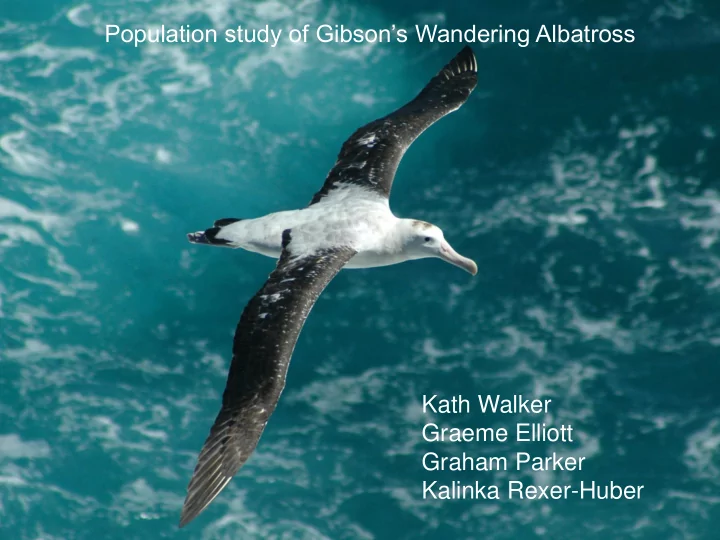
Population study of Gibsons Wandering Albatross Kath Walker Graeme - - PowerPoint PPT Presentation
Population study of Gibsons Wandering Albatross Kath Walker Graeme Elliott Graham Parker Kalinka Rexer-Huber 3000 2500 2000 Number of adults 1500 1000 All as in 1991 adsurv as in 1991 500 Psuccess as in 1991 Breeding proportion as
1990 2000 2010 2020 2030 500 1000 1500 2000 2500 3000 All as in 1991 adsurv as in 1991 Psuccess as in 1991 Breeding proportion as in 1991 Status quo Number of adults
Macquarie (Aus) Bounties Antipodes Campbell Aucklands Snares Chathams
Macquarie (Aus) Bounties Antipodes Campbell Aucklands Snares Chathams
× ×
100 200 300 400 500 600 1998 2003 2008 2013 Number of nests Rhys's Ridge A to A Fly Square
2.7%
200 250 300 350 400 450 500 1998 2000 2002 2004 2006 2008 2010 2012 2014 2016 Number of breeding birds Females Males
0.1 0.2 0.3 0.4 0.5 0.6 0.7 1995 2000 2005 2010 2015 Proportion of females breeding
0.8 0.9 1 1993 1998 2003 2008 2013 Annual survival male female
20 40 60 80 100 120 140 160 10 20 30 40 50 60 70 80 90 1991 1996 2001 2006 2011 2016 Chicks produced in study area Nesting success (%) Nesting success Chicks produced
0.1 0.2 0.3 0.4 0.5 0.6 0.7 0.8 0.9
0.5 1 1.5 2 1993 1998 2003 2008 2013 Nesting succcess Southern Oscillation index
La Niña - warmer Low nesting success High nesting success El Niño - cooler
0.1 0.2 0.3 0.4 0.5 0.6 0.7 0.8
0.5 1 1.5 1995 2000 2005 2010 2015 Proportion breeding PDO
PDO prop breeding
warmer cooler
Before 2005 23 Males