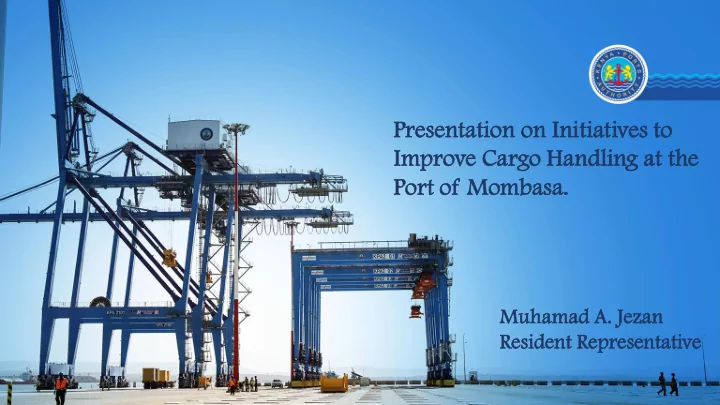
Port of Mo Momb mbas asa. a. Muhama mad d A. Jeza zan n Re - - PowerPoint PPT Presentation

port of mo momb mbas asa a
SMART_READER_LITE
LIVE PREVIEW

Port of Mo Momb mbas asa. a. Muhama mad d A. Jeza zan n Re - - PowerPoint PPT Presentation

Presen sentation tation on I n Ini nitia iati tives s to Improve e Ca Cargo Han andli ling g at at the he Port of Mo Momb mbas asa. a. Muhama mad d A. Jeza zan n Re Resident dent Re Representati esentative Outl tline


slide-1
SLIDE 1

Presen sentation tation on I n Ini nitia iati tives s to Improve e Ca Cargo Han andli ling g at at the he Port of Mo Momb mbas asa. a.

Muhama mad d A. Jeza zan n Re Resident dent Re Representati esentative

slide-2
SLIDE 2

Outl tline ine

  • 1. Introdu

duct ction ion

  • 2. Role

e of Ports s in Econom nomic ic Develop elopment ment

  • 3. Mombas

asa a Port Perf rfor

  • rman

mance ce & Deman mand Fo Forec ecast st

  • 4. Trade

de Facil ilitat itation ion Through ugh Competiti petitive Port Services vices

  • 5. Conclusion

lusion

19th April 2018 2

slide-3
SLIDE 3

Intr trodu ductio ction n

  • The transportation sector is a strong factor in economic and

regional balanced development, as well as a great influence

  • n national integration to the world economic market.
  • Greater transport costs lead to lower levels of foreign

investment, a lower savings ratio, reduced exports of services, reduced access to technology and knowledge, and a decline in employment and general economic development.

19th April 2018 3

slide-4
SLIDE 4

The Ro Role le of

  • f Por
  • rts

ts

  • Ports can be considered as "funnels" to economic development since they act

as a catalyst and incite development to take place in specific economic sectors and locations nearby ports or along corridors. They have a direct effect on certain economic variables such as export competitiveness and final import prices.

19th April 2018 4

slide-5
SLIDE 5

Kenya’s Coastal li line

Kenya is blessed with a wide coas astal tal line ne with th

  • cea

ean n water ters estima timated ted to stretc etch h about

  • ut

128,0 8,015 15 squa uare e kilo lometr metres es, and a distance istance of 200 0 nautical utical miles les offsho fshore, with inland waterways estimated at 10,7 ,700 00 squa uare e kilo lometr etres es

Indian Ocean Lake Victoria

Kenya

slide-6
SLIDE 6

Est stabli ablish shment ment of

  • f KP

KPA

Established as a Statutory Body in 1978 by an Act of Parliament (KPA Act Cap 391 of the laws of Kenya). Identified as a Commercial State Corporation with Strategic Functions. Main in Ro Role of

  • f the Author

thority ity:-

  • Develop;
  • Maintain;
  • Operate;
  • Improve; and
  • Regulate

all scheduled seaports along Kenya’s coastline and Inland Waterways. Main in Laws s regul gulatin ating g the e Indus dustr try: y:-

  • Kenya Maritime Act;
  • Merchant Shipping Act;
  • National Transport Policy;
  • Harbour Regulations; and
  • East African Customs Management

Act.

19th April 2018 6

slide-7
SLIDE 7

The Role le of KPA

The powers/functions of KPA are as provided in Sec. 12 of the KPA Act;

  • Port Infrastructure development;
  • Port operations;
  • Maintaining port facilities;
  • Aids to navigation;
  • Pilotage and other port services;

and

  • Regulation of port business;
  • Among others.

19th April 2018 7

slide-8
SLIDE 8

Core Values:

  • Excellence
  • Integrity
  • Teamwork
  • Caring

MI MISSIO ION, VI VISION N & CO CORE VAL ALUES ES

Mission: n: To facilitate and promote global maritime trade through provision of competitive port services. Vision: “World class seaports of choice”.

19th April 2018 8

slide-9
SLIDE 9

Growing Business, Enriching Lives

Sc Schedul eduled/Gazetted ed/Gazetted Por

  • rts

ts unde der r KP KPA

Mombasa basa and Other Small ports:

1. Kiunga 2. Lamu 3. Ngomeni 4. Malindi 5. Kilifi 6. Takaungu 7. Mtwapa 8. Funzi 9. Shimoni

  • 10. Vanga

26/04/2018 9

slide-10
SLIDE 10

Mombasa is The Gateway To Kenya, Uganda da, Rwanda da, Burundi, ndi, South Sudan, Northe hern n Tanzania, ia, Easter ern n DRC, Ethi hiopi pia and Somalia ia The Port Serves Over 33 Shippi ping g Lines That Call Regularly and Provides Connectivity to Over r 80 Sea Ports ts Worldwide ide

slide-11
SLIDE 11

Momb mbasa asa Port Pe t Perf rfor

  • rmance

mance

19th April 2018 11

slide-12
SLIDE 12

Con

  • ntai

tainer ner Tr Traf afic ic (TE TEUs Us): ): 2008 - 2017 2017

Rate of growt wth for the period

  • d:

: 7.6%

19th April 2018 12

slide-13
SLIDE 13

Port Throughput (DWT ‘’000’’): 2008 2008 – 2017 2017

Rate of increa ease for the period: d: 7.1%

26/04/2018 13

slide-14
SLIDE 14

Transit Traffic (DWT ‘’000’’): 2008 - 2017 2017

4,874 4,981 5,382 5,596 6,626 6,709 7,199 7,667 7,749 8,638

1,000 2,000 3,000 4,000 5,000 6,000 7,000 8,000 9,000 10,000 2008 2009 2010 2011 2012 2013 2014 2015 2016 2017

Transit

Rate e of increase se for the period:

  • d: 6.6%

19th April 2018 14

slide-15
SLIDE 15

Tran ansi sit Ma Markets ets by y Co Coun untry y Sha hare: e: 20 2017 17

19th April 2018 15

slide-16
SLIDE 16

Deman and d Forecast cast

  • Latest traffic forecast indicates Tot
  • tal

al Car Cargo Thr hrou

  • ugh

ghput put wil will rise ise fr from

  • m

30 30.345 345million tons in 2017, to 32 32.658 658million in 2018

  • Contain

Container Traf Traffic fic forecast – projected to move from 1.190 190million TEUs in 2017, to 1.252 252million in 2018

  • Targeting to be a regional Trans

Transit it and Tr Transh anshipment ipment Hu Hub by 2022.

19th April 2018 Kampala Uganda 16

slide-17
SLIDE 17

Mom

  • mbasa

asa Por

  • rt

t Fa Faci cili lities ties

  • The Port of Mombasa is a natural deep harbor with good shelter and a

maximum dredged depth of -15 meters. Port facilities include;

  • 19 deep water berths with an average of 15meter draft and total quay length of

3,284 meters. Of the 19 berths, six are container berths with a quay length of 1,190meters (840meters CT1 and 350meters CT2).

  • 2 bulk oil berths; Kipevu Oil Terminal (KOT) for crude and refined oil and

Shimanzi Oil Terminal (SOT) for refined oil and chemicals. KOT and SOT have drafts of -13.4 meters and -9.8 meters respectively.

  • 2 dry bulk wharves with a total length of 315 meters and 2 dhow jetties at the

Old Port.

  • The other facilities include a modern training institution – the Bandari College,

ultra-modern bulk grain handling facility at Berths 3 and 4 that is operated by Grain Bulk Handling Company Limited (GBHL) and specialized facilities for handling bulk cement and fluorspar at Mbaraki as well as soda ash through conveyors at Berth No. 9.

19th April 2018 17

slide-18
SLIDE 18

Tr Trad ade e Fac acili ilita tation tion th throu

  • ugh

gh Com

  • mpeti

petiti tive e Por

  • rt

t Se Services ices

19th April 2018 18

slide-19
SLIDE 19

Init itiatives iatives & Effo fforts rts To Towar ards ds Fa Faci cili litating tating Tr Trad ade

  • Port capacity has been expanded to enable handling of

increased cargo for the region;

  • KPA fully automated thus shortened import and export

processes;

  • Documentation processes have been simplified;
  • Gates have been modernized to ease cargo flow, enhance

security and reduce delays;

  • Equipment has been modernized; and
  • Conventional cargo Berths have been used for multiple

purposes.

19th April 2018 19

slide-20
SLIDE 20

Init itiatives iatives & Effo fforts rts To Towar ards ds Fa Faci cili litating tating Tr Trad ade

  • Inter-Agency Co-ordination to support growth of the

sector with other partner agencies such Uganda Revenue Authority, Kenya Revenue Authority, Kenya Railways , Kenha etc.

  • Stakeholder and Customer Engagement through

Sensitization workshops & Forums;

  • Streamlining Internal Processes and Cost Reduction

Strategies.

19th April 2018 20

slide-21
SLIDE 21

Sy Syst stems ems Integ tegration ration

  • In order to facilitate trade, the following system

improvements have been developed and implemented;

  • East African Single Customs Territory (EAC SCT)
  • National Single Window System (NSWS)
  • Kilindini Water Front Terminal Operating System (KWATOS)
  • Enterprise Resource Planning (ERP)
  • These have improved port operations and documentation;

increased competitiveness and reduced the cost of doing business.

19th April 2018 21

slide-22
SLIDE 22

Ship p Waiti ting g Time – the average was 4.5 hours in December 2017, against 1 day in 2012. Ship p Turnar around nd Time – the average was 2.6 days in 2017 against 4.4days in 2012. Ship p Producti uctivi vity ty (moves per hour) – 30.6 moves per hour were achieved in December 2017, against 17.4 moves in 2012. Cargo Dwell l Time – 3.8 days was achieved in December 2017, against 7.1 days in 2012. Truck k Turn n Around Time – this was at 4.50 hours in December 2017 against a recorded high of 18hours (before KWATOS).

Impr provements ements in in KPI Targ rgets ets

slide-23
SLIDE 23

PHASE SE I COMPLETED PLETED ON 29TH H FEBRUARY 2016

ADDITTI DDITTION ONAL L CAPA PACIT ITY OF

550,000 00 TEUs

PHASE SE II – EXPEC ECTED TED COMPLETIO PLETION DATE E 2019

ADDITTI DDITTION ONAL L CAPA PACIT ITY OF

450,000 00 TEUs

Phase ase III ADDITTI DDITTION ONAL L CAPA PACIT ITY OF

450,000 00 TEUs Second cond Container ainer Terminal minal – MPDP P Phase se I – achie hieved ahe head ad of schedule hedule

slide-24
SLIDE 24
  • This project entails the construction of the 2nd Container Terminal at the

Port of Mombasa

  • Total project area covers 100 acres of reclaimed land
  • On completion of the project, this would increase the container handling

capacity to 2.6m TEUs

  • The first phase of the project covering berth number 20 & 21 is complete

and operational since April 2016

  • Phase II construction is expected to commence in the first quarter of 2018

and will bring additional capacity of 450, 000 TEUs at Berth No. 22 (250meters long)

Se Secon cond d Co Container tainer Te Termina minal: l:

slide-25
SLIDE 25
  • Over the period April 2016 to date, CT2 has performed as indicated

below:

  • This combined performance (April 2016 – December 2017)

accounts for about 35.7% of total container traffic handled in 2017.

CT CT2 Phase ase 1 Perf erfor

  • rmance

mance

Period No. of Vessels TEUs April - December 2016 81 144,368 January - December 2017 174 280,828 Total 255 255 425,196

slide-26
SLIDE 26
  • KPA is developing the First 3 Berths of Lamu Port, which is envisaged to have 23 berths,

under the LAPSSET Corridor Programme.

  • The project is 42% complete with the 1st Berth expected to be ready before end of 2018,

whereas the other 2 will be completed by December 2020.

  • The remaining berths are to be developed through Public Private Partnership (PPP).
  • Considering its location and the natural deep water harbor, Lamu Port will be able to

handle larger ships and therefore making it attractive for transshipment business.

  • Operations are considered under the PPP framework with a proposal under negotiation with

the Lamu Port Consortium.

La Lamu mu Port t

slide-27
SLIDE 27

Constructi uction

  • n of Lamu Port

t at about ut 42% 42%

Admin inis istra trati tion n Block complet ete Police ice Statio ion n complet ete

Ongoin ing Dredging Works

slide-28
SLIDE 28

Conver ersi sion

  • n of Berth

h 11 - 14 into Contain tainer er Berths hs – detailed ailed desi signs gns completed, pleted, negotiat tiatin ing g for fundin ing.

Expecte ected d Addition ditional al Capacity ty of:

45 450, 0,000 000 TE TEUs

slide-29
SLIDE 29
  • The project is expected to receive funding through a commercial

loan from the European Investment Bank and French Development Agency, and a grant from the European Union;

  • It is expected to take about 3years from early 2018;
  • It will provide an additional 450,000TEUs; and
  • Increase port capacity.

Be Berth th 11 – 14 Development elopment

slide-30
SLIDE 30

Development of Small Ports – Shimoni Port Feasibility Study underway Kisumu Port

Lake Victoria Port

Shimoni Port

Kisumu Port

slide-31
SLIDE 31
  • A master plan for Kisumu and other Lake Victoria ports is under

consideration and should be ready within the next 6months;

  • KPA

will undertake infrastructure development and enable successful operations of the ports;

  • This is expected to revive the economies of the lake region and

increase demand for port services across lake Victoria; and

  • This will in turn create employment and uplift the living standards
  • f the populace around the area.

Kis isumu umu and d Oth ther er Lake e Vic ictoria toria Ports ts

slide-32
SLIDE 32

The SG SGR

slide-33
SLIDE 33

Key Projec ject Fe Featur tures es

  • 490 Kms of SGR Rail from Mombasa to Nairobi
  • Cargo Trains at speed of 80 Kms/Hr.
  • To handle 1,100 TEUs per day
  • Nairobi ICD capacity increased from 180,000 to 450,000 TEUs
  • Passenger Speed is 120 Kms/Hr.
  • Phase II & III to connect MBA to the Uganda and other Transit Markets.

SGR: :

slide-34
SLIDE 34
  • Increased cargo off take – 40% of Throughput by Rail;
  • Timely export deliveries;
  • Reduced Freight Cost & Time;
  • Reduced dwell time thus enhanced yard capacity in Mombasa;
  • Increased capacity and operational efficiency at Nairobi ICD;

and

  • Reduced cost to shipping lines on empty container returns due

to direct delivery to the Port.

Impact act of

  • f th

the SG SGR

slide-35
SLIDE 35

New w Nai airob

  • bi

i ICD D

  • The project is complete and
  • perations have commenced;
  • Capacity has increased to

450,000 TEUs up from 180,000 TEUs; and

  • 40% of Throughput

expected to be by Rail.

19th April 2018 35

slide-36
SLIDE 36

Dredgin ging Capital ital Dredgin ging g – Phase se I completed, pleted, Phase se II scheduled eduled

Panam amax ax Vessel – to access MPDP Phase II, III and SEZ

slide-37
SLIDE 37

Kipe pevu vu Oil l Termin inal al – Reloca

  • cati

tion

  • n

Transformatio ation n of Bandari i College

slide-38
SLIDE 38

Dongo Kun undu S u SEZ

  • 1. This is a Vision 2030 project.
  • 2. Involves development of an SEZ and Free Port facilities on 3,200 acres of

land owned by KPA at Dongo Kundu.

  • 3. KPA will develop and operate the first two (2) berths to facilitate
  • perations of the Zone.

26/04/2018 38

slide-39
SLIDE 39

Co Conc nclu lusi sion

  • 1. KPA continues to consistently improve its operational

performance and efficiency;

  • 2. There is close interconnection between roles played by other

agencies, such as roads; rail; power; customs; security; and special economic zones;

  • 3. This requires coordination and collaboration of all agencies

under the Ministry of Transport and Infrastructure to ensure effective cargo handling, evacuation and delivery to domestic and regional markets; and

  • 4. KPA will continue to strive for excellence towards fulfilling

the promise of delivering world class port operations.

26/04/2018 39

slide-40
SLIDE 40

Su Summa mmary y of Co Costs sts for r Major jor Projects

  • jects

Thank nk You

26/04/2018 40