Possible modes of operation of CMSQIE (1) Use noninverting mode of - - PowerPoint PPT Presentation

possible modes of operation of cms qie
SMART_READER_LITE
LIVE PREVIEW

Possible modes of operation of CMSQIE (1) Use noninverting mode of - - PowerPoint PPT Presentation

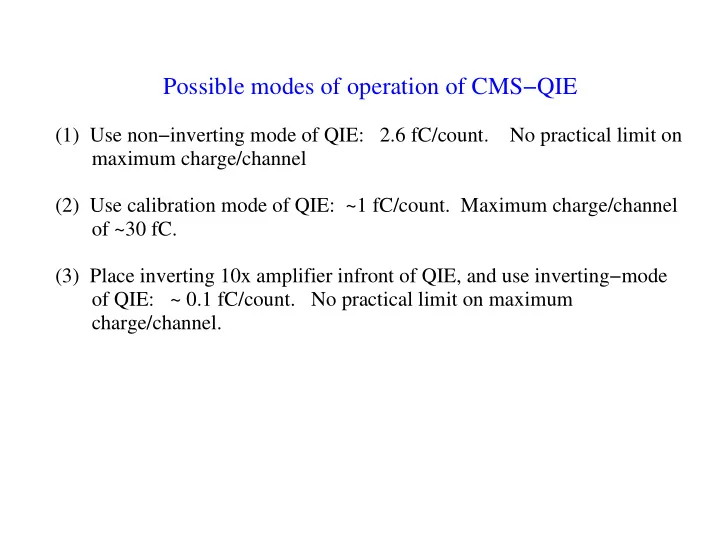
Possible modes of operation of CMSQIE (1) Use noninverting mode of QIE: 2.6 fC/count. No practical limit on maximum charge/channel (2) Use calibration mode of QIE: ~1 fC/count. Maximum charge/channel of ~30 fC. (3) Place


slide-1
SLIDE 1

Possible modes of operation of CMS−QIE

(1) Use non−inverting mode of QIE: 2.6 fC/count. No practical limit on maximum charge/channel (2) Use calibration mode of QIE: ~1 fC/count. Maximum charge/channel

  • f ~30 fC.

(3) Place inverting 10x amplifier infront of QIE, and use inverting−mode

  • f QIE: ~ 0.1 fC/count. No practical limit on maximum

charge/channel.

slide-2
SLIDE 2

We simulate how well we can reconstruct the beam shape under the following constraints: (1) It is hard to predict the noise level. So we simulate over a wide variety of noise levels (2) The beam width varies from 1.7 mm (at TeV injection) to 0.5 mm (at flattop) (3) The pbar beam amplitude is smaller than protons by ~10x. So we will have to perform a digital sum of many pbar bunches to get adequate resolution. (4) Typical parameters: Number of primary ionizations/bunch: 1000 (p), 100 (pbars) Microchannel plate gain = 1000 (Assume no gain fluctuations and 100% efficiency) Anode strip width = 0.25 mm

slide-3
SLIDE 3

Counts (.1 fC/cnt) vs Strip Number

97.92 / 93 P1 99.10 4.213 P2

  • 0.7483E-01

0.7992E-01 P3 1.697 0.8794E-01

Counts (1.0 fC/cnt) vs Strip Number

131.1 / 93 P1 9.593 0.3192 P2

  • 0.1093

0.5843E-01 P3 1.584 0.6427E-01

Counts (2.6 fC/cnt) vs Strip Number

383.1 / 93 P1 3.442 0.5159E-01 P2

  • 0.3392E-01

0.2443E-01 P3 1.420 0.2466E-01

  • 20

20 40 60 80 100 120

  • 10

10

  • 2

2 4 6 8 10 12

  • 10

10 0.5 1 1.5 2 2.5 3 3.5 4 4.5

  • 10

10

Example: protons at injection (1.7 mm bw), Noise=6500e, 1 Sample

Note: Errors on the gaussian peaks not quite correct.

slide-4
SLIDE 4

Counts (.1 fC/cnt) vs Strip Number

98.88 / 93 P1 336.1 6.844 P2

  • 0.8471E-02

0.1138E-01 P3 0.4879 0.1153E-01

Counts (1.0 fC/cnt) vs Strip Number

116.4 / 93 P1 33.36 0.4503 P2

  • 0.1351E-01

0.7475E-02 P3 0.4798 0.7429E-02

Counts (2.6 fC/cnt) vs Strip Number

288.9 / 93 P1 12.91 0.9047E-01 P2

  • 0.1333E-01

0.3679E-02 P3 0.4539 0.3656E-02

50 100 150 200 250 300 350

  • 10

10 5 10 15 20 25 30 35

  • 10

10 2 4 6 8 10 12 14

  • 10

10

Example: protons at flattop (0.5 mm bw), Noise=6500e, 1 Sample This operation nearly saturates QIE calibration mode

slide-5
SLIDE 5

Counts (.1 fC/cnt) vs Strip Number

97.68 / 93 P1 327.4 22.06 P2

  • 0.1261

0.1329 P3 1.755 0.1388

Counts (1.0 fC/cnt) vs Strip Number

107.8 / 93 P1 22.27 1.539 P2

  • 0.2108

0.1362 P3 1.731 0.1365

Counts (2.6 fC/cnt) vs Strip Number

186.8 / 93 P1 2.798 0.2178 P2 0.1018 0.1145 P3 1.277 0.1092

  • 200
  • 100

100 200 300 400

  • 10

10

  • 10
  • 5

5 10 15 20 25 30 35

  • 10

10

  • 1

1 2 3 4 5

  • 10

10

Example: pbars at injection (1.7 mm bw), Noise=6500e, 36 Samples

slide-6
SLIDE 6

Counts (.1 fC/cnt) vs Strip Number

112.0 / 93 P1 1138. 34.57 P2 0.4514E-01 0.1737E-01 P3 0.4999 0.1759E-01

Counts (1.0 fC/cnt) vs Strip Number

122.9 / 93 P1 95.05 2.736 P2 0.4665E-01 0.1582E-01 P3 0.4814 0.1607E-01

Counts (2.6 fC/cnt) vs Strip Number

179.3 / 93 P1 28.73 0.4871 P2 0.5150E-01 0.6136E-02 P3 0.3195 0.6543E-02

200 400 600 800 1000 1200

  • 10

10 20 40 60 80 100

  • 10

10 5 10 15 20 25 30

  • 10

10

Example: pbars at flattop (0.5 mm bw), Noise=6500e, 36 Samples

slide-7
SLIDE 7

Counts (.1 fC/cnt) vs Strip Number

78.85 / 93 P1 121.2 14.57 P2 0.1296E-01 0.6767E-01 P3 0.5001 0.6911E-01

Counts (1.0 fC/cnt) vs Strip Number

76.65 / 93 P1 10.13 1.166 P2 0.7138E-02 0.5940E-01 P3 0.4509 0.6144E-01

Counts (2.6 fC/cnt) vs Strip Number

193.2 / 93 P1 2.540 0.1326 P2

  • 0.9112E-01

0.2458E-01 P3 0.4011 0.2241E-01

  • 50
  • 25

25 50 75 100 125 150

  • 10

10

  • 4
  • 2

2 4 6 8 10 12 14

  • 10

10

  • 1
  • 0.5

0.5 1 1.5 2 2.5 3 3.5

  • 10

10

Example: pbars at flattop (0.5 mm bw), Noise=6500e, 4 Samples

slide-8
SLIDE 8

Fitted Sigma Vs Noise with 0.1 fC/count Fitted Sigma Vs Noise with 1 fC/count Fitted Sigma Vs Noise with 2.6 fC/count 0.5 1 1.5 2 2.5 3 10000 20000 0.5 1 1.5 2 2.5 3 10000 20000 0.5 1 1.5 2 2.5 3 10000 20000

Fitted beamwidth (mm) versus electronic noise for protons at injection (1.7 mm bw), 1 samples

slide-9
SLIDE 9

Fitted Sigma Vs Noise with 0.1 fC/count Fitted Sigma Vs Noise with 1 fC/count Fitted Sigma Vs Noise with 2.6 fC/count 0.5 1 1.5 2 2.5 3 10000 20000 0.5 1 1.5 2 2.5 3 10000 20000 0.5 1 1.5 2 2.5 3 10000 20000

Fitted beamwidth (mm) versus electronic noise for protons at flattop (0.5 mm bw), 1 samples

slide-10
SLIDE 10

Fitted Sigma Vs Noise with 0.1 fC/count Fitted Sigma Vs Noise with 1 fC/count Fitted Sigma Vs Noise with 2.6 fC/count 0.5 1 1.5 2 2.5 3 10000 20000 0.5 1 1.5 2 2.5 3 10000 20000 0.5 1 1.5 2 2.5 3 10000 20000

Fitted beamwidth (mm) versus electronic noise for pbars at injection (1.7 mm bw), 36 samples

slide-11
SLIDE 11

Fitted Sigma Vs Noise with 0.1 fC/count Fitted Sigma Vs Noise with 1 fC/count Fitted Sigma Vs Noise with 2.6 fC/count 0.5 1 1.5 2 2.5 3 10000 20000 0.5 1 1.5 2 2.5 3 10000 20000 0.5 1 1.5 2 2.5 3 10000 20000

Fitted beamwidth (mm) versus electronic noise for pbars at flattop (0.5 mm bw), 36 samples

slide-12
SLIDE 12

Fitted Sigma Vs Noise with 0.1 fC/count Fitted Sigma Vs Noise with 1 fC/count Fitted Sigma Vs Noise with 2.6 fC/count 0.5 1 1.5 2 2.5 3 10000 20000 0.5 1 1.5 2 2.5 3 10000 20000 0.5 1 1.5 2 2.5 3 10000 20000

Fitted beamwidth (mm) versus electronic noise for pbars at flattop (0.5 mm bw), 4 samples

slide-13
SLIDE 13

QIE versus SVX3 The SVX3 appears to have the correct sensitivity, polarity, and noise performance that we need. However, we need the higher rate capability of the QIE. We need digitized output from every bucket, especially during TeV injection. We’d be using the SVX3 not in the way that it was intended, so more R&D is needed to know for sure if it would work. The QIE is a known quantity. And our CMS colleages believe they have sufficient spares for our needs (~200). They are willing to give us ~ 20 production QIEs now.

slide-14
SLIDE 14

Conclusion

QIE in calibration mode appears to have the sensitivity we need. QIE with an 10x inverting amplifier is slightly better and has less

"control" overhead. Being able to measure the pedestal rms accurately will probably improve our fits and chi2’s.

Radiation tolerance issues may force us to use preamps We can tolerate noise between 6000e and 10000e. We still need to

do more homework to specify cabling and shielding from MCP to QIE.

slide-15
SLIDE 15

The TeV IPM, with this kind of FE, would fill a unique role in TeV

  • monitoring. It is would be the only device that measures the beam

profile during the critical period of TeV injection and ramping. We now need coordinated and substantive help on this project:

We would like to ask Ray’s group for a prototype FE board containing 8

QIE’s and a prototype board containing 8 preamps.

We would like Vince’s group to suggest and prepare a DAQ system to

readout the QIE boards.

We are near completion of vacuum teststand dedicated to MCP’s. This is

a natural place to tryout these prototype boards.