Potential for Offsite Exposures Associated with Contaminants from - - PowerPoint PPT Presentation

potential for offsite exposures associated with
SMART_READER_LITE
LIVE PREVIEW

Potential for Offsite Exposures Associated with Contaminants from - - PowerPoint PPT Presentation

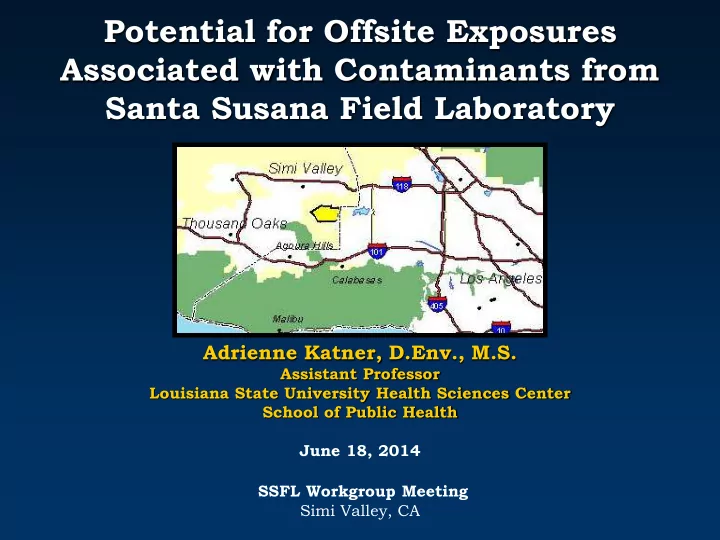
Potential for Offsite Exposures Associated with Contaminants from Santa Susana Field Laboratory Adrienne Katner, D.Env., M.S. Assistant Professor Louisiana State University Health Sciences Center School of Public Health June 18, 2014 SSFL


slide-1
SLIDE 1

Potential for Offsite Exposures Associated with Contaminants from Santa Susana Field Laboratory

Adrienne Katner, D.Env., M.S.

Assistant Professor Louisiana State University Health Sciences Center School of Public Health June 18, 2014

SSFL Workgroup Meeting

Simi Valley, CA

slide-2
SLIDE 2

Project Team

  • Dr. Yoram Cohen (UCLA)

Adrienne Katner (LSU-HSC)

  • Dr. Debora Glik (UCLA)
  • Dr. Thomas Harmon (UC Merced)
  • Dr. Jordi Grifoll (URV)

Lyle Chinkin (Sonoma Technologies) Neil Wheeler (Sonoma Technologies)

  • Dr. Patrick Ryan (Sonoma Technologies)

This study was funded by the Agency for Toxic Substances and Disease Registry (ATSDR)

slide-3
SLIDE 3

Limitations

  • Conservative assumptions used to estimate some

contaminant concentrations and exposures

– Report characterizes potential exposures – No conclusions made with regards to real risks – Results most useful for prioritizing future monitoring and remediation efforts

  • Report based on data collected up to 2003

– Report characterizes potential exposures up to 2003 – No knowledge of current status of site

slide-4
SLIDE 4

OBJECTIVES

TIER I: WHAT WERE THE CONTAMINANTS

OF POTENTIAL CONCERN (COCs)?

TIER II: WHAT WERE THE POTENTIAL

EXPOSURE PATHWAYS OF CONCERN?

TIER III: WHAT WERE THE HOTSPOTS OF

POTENTIAL CONCERN?

slide-5
SLIDE 5

SCRAM to rank Contaminants of Potential Concern (COPCs) via Chemical-Specific Properties (Toxicity, Bioaccumulation, Persistence) Weight SCRAM scores with Air Emissions Weight SCRAM scores with Number

  • f Positive Detections

Weight SCRAM scores with Health- Based Standards Estimate Contaminant Concentrations (Monitored and Modeled), Establish Dose Ratios using EPA’s RAIS for different pathways & Screen for Pathways with Dose Ratios > 1 Refine Dose Ratios for Areas

  • f Exposure Concern Based on

Accessibility and Identify Hotspots

METHODOLOGY

Tier I. Contaminants of Concern (COCs) Tier II. Exposure Pathways Tier III. Hotspots

slide-6
SLIDE 6

Data Sources

  • US Agency for Toxic Substances & Disease

Registry (ATSDR)

  • US Environmental Protection Agency (EPA)
  • US Dept of Energy (DOE)
  • US Nuclear Regulatory Commission (NRC)
  • US Geological Survey (USGS)
  • CA Dept of Toxic Substances Control

(DTSC)

  • CA Dept of Health Services (DHS)
  • CA Office of Environmental Health and

Human Affairs (OEHHA)

  • Ventura County Air Pollution District

(VCAPD)

  • LA Regional Water Quality Control Board

(RWQCB)

  • Southern CA Water Quality Dept
  • Washington Mutual Bank
  • Atomics International (AI)
  • Committee to Bridge the Gap
  • Rocketdyne / Boeing Company
  • UCLA
  • National Research Council
  • Oak Ridge Institute
  • Rockwell
  • Techlaw
  • Ogden
  • McLaren-Hart
  • Montgomery-Watson
  • Klinefelder
  • ITC
  • ICF Kaiser
  • Hargis and Associates
  • Haley and Aldrich
  • GRC
  • ERG
  • ERD
  • ERC
  • EG&G
  • CH2MHill
  • Sonoma Technology
  • ABB Environmental
slide-7
SLIDE 7

Data Gaps

  • Inadequate assessment of

vertical & horizontal hydraulic gradients

  • Insufficient delineation of

extent of groundwater contamination in areas east of facility

  • Lack of current well use

surveys in areas east, northeast & south of facility

  • Inadequate monitoring data

for offsite areas east and northeast of facility

  • Insufficient long-term (>4

years) historical onsite meteorological data

  • Insufficient air monitoring data

(historical) for chemicals & radionuclides

  • Potential for non-detection of

significant concentrations in past monitoring programs due to the detection limits of monitoring devices (1948- 1980s)

  • Questionable data quality
slide-8
SLIDE 8

Location of Receptor Communities used in Exposure Analysis

9 9

3796 3 795 3794 3793 3792 3791 3790 3789 3788 3787 3786 3785 3784 3783 3782 3781 UTME (km)

5 4 2 10 11 3 1 7 6 8

337 338 339 340 341 342 343 344 345 346 347 348 349 350 351 352 UTME (km)

COMMUNITIES

  • 1. Bell Canyon
  • 2. West Hills
  • 3. Dayton Canyon
  • 4. Woodland Hills
  • 5. Simi Valley
  • 6. Chatsworth
  • 7. Canoga Park
  • 8. Hidden Hills
  • 9. Santa Susana Knolls
  • 10. Sage Ranch

/ Woolsey Canyon

  • 11. Brandeis-Bardin Inst.

9

slide-9
SLIDE 9

Air Dispersion Modeling

CONTAMINANTS ANALYZED FOR EMISSIONS (1940s-2002) Organics Metals

Benzene Arsenic 1,3-butadiene Beryllium Hydrazine Cadmium TCA—methyl chloroform Chromium TCE—trichloroethylene Lead Toluene Manganese Xylene

  • Emissions from rocket engine testing & flushing, storage

tanks, groundwater stripping towers & open-pit burning

  • f waste were analyzed
  • Radionuclide emissions were not evaluated via air

dispersion due to the lack of data

  • Limitations included incomplete reporting of chemical

usage, site activities and accidental discharges and emissions.

slide-10
SLIDE 10

Air Pathway Results

  • Largest source of toxic organic emissions

– Use of TCE for cleaning of rocket engines

  • Largest source of toxic metal emissions

– Rocket engine exhaust

  • Wind mostly from Northeast (11am-8pm;

‘94-’97)

– Greatest impact may have been to southeast

  • Estimated air concentrations

did not consider atmospheric degradation or dry or wet deposition

slide-11
SLIDE 11

Offsite Wells or Spring Contamination

RD-59 RD-32, RD-43 RD-38

Not To Scale

Manganese 390 µg/L, 3/94, 7.8X>MCL Lead 50 µg/L, 12/94, 4.2 X> MCL

OS-5

Chloromethane 19 µg/L, 4/86, Livestock well 12X>TWSL

Outfall 002

Chromium 75 µg/L, 1/93, 1.5 X>MCL

Outfall 001

Lead 40 µg/L, 1/95, 3.3 X>MCL

RD-56

Vinyl Chloride 64 µg/L, 3/94, 32X>MCL TCE 670 µg/L, 8/94, 134X>MCL Carbon Tetrachloride 4.5 µg/L, 2/95, 9X>MCL Benzene 3.8 µg/L, 11/94, 3.8X>MCL 1,1-DCE 19 µg/L, 5/96, 3X>MCL Trans-1,2-DCE 38 µg/L, 5/96, 3X>MCL cis1,2-DCE 27 µg/L, 5/96, 3X>MCL

All concentrations above standards and

  • backgrounds. Dates range from 1992-’94.

Light Agricultural Rural Agricultural
slide-12
SLIDE 12

Offsite Soil Contamination

Offsite Soil Contamination

Not To Scale

Beryllium 500-1000mg/kg 8/96; Bell Canyon 0.5-1.0’ deep 3-6X>RSSL Lead 383mg/kg 6/99; Bell Canyon Residence 2.6X>RSSL Arsenic 1-3mg/kg 10/98; Las Virgenes Creek; 2-7X>RSSL Arsenic 24mg/kg 1992; BBI; 61.5X>RSSL Arsenic 8.2mg/kg 1992; SMMC; 21X>RSSL Plutonium-238 0.19-0.22 pCi/g 1992 24mg/kg 1992; BBI; 9.5-11X>Background Cesium-137 ND- 0.32 pCi/g 1/27/00 Ahmanson Ranch, 0.5’ 0-2.9X>Background Cesium-137 0.22- 0.39 pCi/g 1994 BBI, 2-3.5X>Background All above standards and backgrounds. Dates range from 1992-’94.

slide-13
SLIDE 13

Exposure Assessment

  • Due to significant data gaps absolute exposures and health risks could not

be determined

– Conservative exposure assumptions and maximum site-specific contaminant concentrations were used to develop an upper exposure range – Results were used to rank and prioritize areas of potential concern for the purpose of future monitoring and review

  • Field visits were conducted to identify potential exposure pathways

– For example, contaminants may have migrated from Dayton Creek through Orcutt Ranch which is used to grow community vegetables – Contaminants may have migrated from Bell Creek through Bell Canyon which is accessible to children and hikers

  • Exposure scenarios considered: residential, occupational & recreational use

– Transport routes considered: surface water flow/runoff; groundwater transport; air dispersion – Exposures routes considered: direct and secondary ingestion, inhalation, dermal contact

slide-14
SLIDE 14

TCE DOSE RATIOS for Worst Case Scenarios

Exposure to Contaminated Groundwater

NOTE: Groundwater is a potable water source;

  • Avg. lifetime dose range: 1.2x10⁻⁴ - 1.1x10⁻² mg/kg-d.

Chemical Exposure Pathway Dose Ratioa

TCE

Detected in groundwater

(.01 - .9 mg/L)

TCE MCL=.005 mg/L

Inhalation ~200 -

20,000

Ingestion

~50 – 4000

Vegetable Ingestion

~40 – 4000

Dermal Contact

~10 - 1000

a – order of magnitude ranges

MCL “Maximum contaminant level” drinking water standard

slide-15
SLIDE 15

Dose Ratios for Worst Case Scenarios

  • f Exposure to Contaminated Groundwater

Chemical Concentration Locale Media /Year

  • f Detection

Pathway Exposure Scenario Recreational Occupational Residential Dose Ratio Dose Ratio Dose Ratio TCE (10- 900 µg/L) North- east Groundwater 1994 Ingestion 0 - 14 10 – 1100 48 – 4200 Inhalation

  • 230 - 21,000

Dermal

  • 12 – 1000
  • Veg. Ing.
  • 44 - 4000

Vinyl Chloride (64 µg/L) North- east Groundwater 1994 Ingestion 3 270 1100 Inhalation

  • 120

Dermal

  • 29

1,1-DCE (19 µg/L) North- east Groundwater 1996 Ingestion

  • 23

89 Inhalation

  • 200

Dermal

  • 5
  • Veg. Ing.
  • 20
slide-16
SLIDE 16

Inhalation Dose Ratios (DR) for Worst Case Scenarios

Dose ratio (DR) = (Lifetime average daily dose) / (Acceptable lifetime daily dose; ALADD).

Notes: a. DRs are based on 1953–2004 air emission estimates; max receptor concentrations derived from dispersion models; and lifetime exposure scenarios for an adult male. The ALADDs to which exposure doses are compared are based

  • n EPA’s Chronic Inhalation Cancer Slope Factor (for 1 × 10⁻⁶ cancer risk).
  • b. Hydrazine derivatives include hydrazine, and UDMH (unsymmetrical-dimethylhydrazine).

Location DRa - TCE Location DR - Hydrazine & Derivativeb

West Hills 19-67 Bell Canyon 3-38 Bell Canyon 14-55 West Hills 2-15 Dayton Canyon 16-53 Dayton Canyon 3-13 Simi Valley 14-44 Woodland Hills <9 Santa Susana Knolls 5-15 Canoga Park <7 Canoga Park 4-14 Simi Valley <4 Chatsworth 4-12 Hidden Hills <3 Woodland Hills 3-10 Hidden Hills 2-8

slide-17
SLIDE 17

Potential Offsite Hotspots

9

3796 3 795 3794 3793 3792 3791 3790 3789 3788 3787 3786 3785 3784 3783 3782 3781 UTME (km)

4 1 3 2

337 338 339 340 341 342 343 344 345 346 347 348 349 350 351 352 UTME (km)

Pote tenti ntial Hotspots

1. Northeast Quadrant 2. Bell Canyon 3. Dayton Canyon 4. West Hills 5. Woolsey Canyon 6. Northwest Quadrant

Potential “Hot Spot”

Area where:

  • i. contaminant levels exceed

health-based standards;

  • ii. exposure is possible;
  • iii. exposure could result in

an adverse health effect at the levels detected. 5 6

slide-18
SLIDE 18

Ranking of Exposure Pathways

  • f Potential Concern

1. Exposure to groundwater contaminants from private wells or gardens north and east of facility

a) COPCs: TCE; vinyl chloride; 1,1-DCE b) Health effects: cancers of the liver, lung, bladder, kidney, biliary tract and skin; non-Hodgkin’s lymphoma; liver, kidney, and nervous system toxicity; peripheral neuropathy; anemia; skin diseases.

2. Exposure to soil south, north and east of facility

a) COPCs: arsenic, lead b) Health effects: nausea, abdominal pain, diarrhea, cramps; constipation, headache, fatigue, neurodevelopmental effects

3. Exposure to air contaminants (early ‘50s to early ’80s)

a) COPCs: TCE, hydrazine (and oxidation products like NDMA) b) Health effects (hydrazine): Cancer of lung, liver, mammary gland, nose; kidney and liver damage

slide-19
SLIDE 19

RECOMMENDATIONS

  • Areas to monitor

– Dayton & Woolsey Canyons, Meier & Runckle Canyons, Bell Canyon campgrounds & playgrounds, Bell Creek, Dayton Canyon & Creek, Orcutt Ranch, Santa Monica Mountains Conservancy/Sage Ranch, Black Canyon, West Hills, & Brandeis- Bardin Institute campground & garden

  • Contaminants to monitor

– Perchlorate, beryllium, chromium, NDMA, PCDD/PCDFs, mercury, PCBs, asbestos, arsenic, lead, TCE, DCE & radionuclides

  • Conduct well-use survey for areas NE & E of SSFL (within 1

km) to assess private well use & contamination

  • Municipal water supply companies using wells in Ventura &

LA Counties (within 3 miles of site) should monitor perchlorate, NDMA, 1,4-dioxane & chromium

  • Onsite unrestricted SSFL land use not recommended
slide-20
SLIDE 20

Contact

Adrienne Katner akatn1@lsuhsc.edu (504) 568-5942

Louisiana State University Health Sciences Center School of Public Health Environmental and Occupational Health Program 2020 Gravier St., New Orleans, LA 70112

Disc isclaim imer: r: Any opinions expressed today are the sole opinions of the presenter and do not express the opinions of UCLA , LSU or ATSDR

slide-21
SLIDE 21