
SLIDE 1
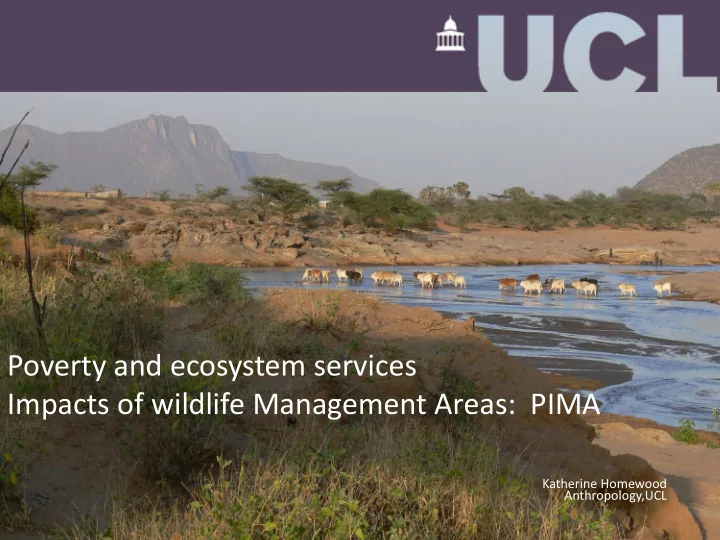
Poverty and ecosystem services Impacts of wildlife Management Areas: PIMA
Katherine Homewood Anthropology,UCL
Poverty and ecosystem services Impacts of wildlife Management Areas: - - PowerPoint PPT Presentation
Poverty and ecosystem services Impacts of wildlife Management Areas: PIMA Katherine Homewood Anthropology,UCL Poverty and ES Impacts of wildlife Management Areas (PIMA) PIMA project and partners Research design and methods Progress
Katherine Homewood Anthropology,UCL
Aidan Keane (Imperial), Maurus Msuha (TAWIRI), Joseph Olila (TNRF), Jens Friis Lund (Copenhagen), Neil Burgess (WCMC)
What are the social and ecological outcomes of WMAs?
From WWF-USAID WMA status report 2013
– BACI / CI design (Jagger et al: CIFOR; Glew: WWF-US) – Matching ‘Inside’ WMA vs ‘outside’ controls
dry forest
viewing
– Ecological ± Social-economic-cultural variables?
– Within/between pastoral rangeland vs miombo woodland – For each WMA, 4 villages ‘inside ‘ and 4 ‘outside’ – For each village, 45 hh – For each hh, one male and one female respondent
– Survey data: Android tablet/opendatakit – Focus group and KI: hard copy ± e-recording
– Livelihoods / Resource use histories – Individual wellbeing change – By gender/wealth etc
collection
villages
Aidan Keane (Imperial), Maurus Msuha (TAWIRI), Joseph Olila (TNRF), Jens Friis Lund (Copenhagen), Neil Burgess (WCMC)