Powering a number (a bit easier than the recursive mystery question - - PowerPoint PPT Presentation

powering a number
SMART_READER_LITE
LIVE PREVIEW

Powering a number (a bit easier than the recursive mystery question - - PowerPoint PPT Presentation

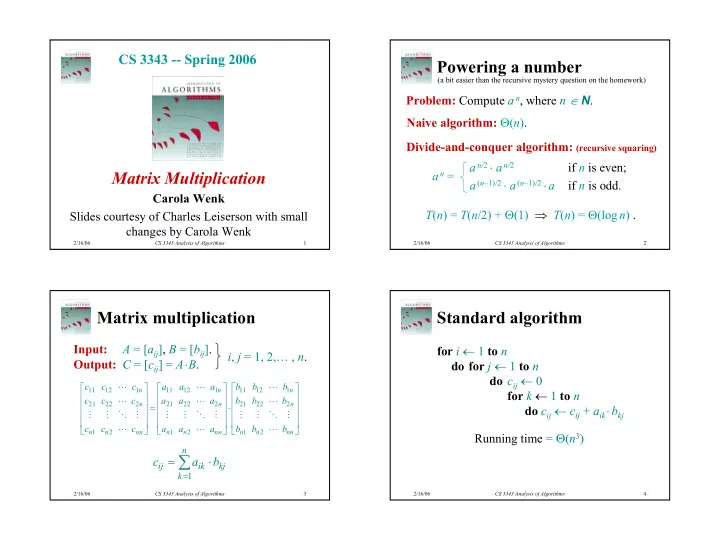
CS 3343 -- Spring 2006 Powering a number (a bit easier than the recursive mystery question on the homework) Problem: Compute a n , where n N . Naive algorithm: ( n ). Divide-and-conquer algorithm: (recursive squaring) a n/ 2 a n/ 2 if n


slide-1
SLIDE 1

1

2/16/06 CS 3343 Analysis of Algorithms 1

CS 3343 -- Spring 2006

Matrix Multiplication

Carola Wenk Slides courtesy of Charles Leiserson with small changes by Carola Wenk

2/16/06 CS 3343 Analysis of Algorithms 2

Powering a number

Problem: Compute a n, where n ∈ N. a n = a n/2 ⋅ a n/2 if n is even; a (n–1)/2 ⋅ a (n–1)/2 ⋅ a if n is odd. Divide-and-conquer algorithm: (recursive squaring) T(n) = T(n/2) + Θ(1) ⇒ T(n) = Θ(logn) . Naive algorithm: Θ(n).

(a bit easier than the recursive mystery question on the homework)

2/16/06 CS 3343 Analysis of Algorithms 3

Matrix multiplication

            ⋅             =            

nn n n n n nn n n n n nn n n n n

b b b b b b b b b a a a a a a a a a c c c c c c c c c L M O M M L L L M O M M L L L M O M M L L

2 1 2 22 21 1 12 11 2 1 2 22 21 1 12 11 2 1 2 22 21 1 12 11

=

⋅ =

n k kj ik ij

b a c

1

Input: A = [aij], B = [bij]. Output: C = [cij] = A⋅ B. i, j = 1, 2,… , n.

2/16/06 CS 3343 Analysis of Algorithms 4

Standard algorithm

for i ← 1 to n do for j ← 1 to n do cij ← 0 for k ← 1 to n do cij ← cij + aik⋅ bkj Running time = Θ(n3)

slide-2
SLIDE 2

2

2/16/06 CS 3343 Analysis of Algorithms 5

Divide-and-conquer algorithm

n×n matrix = 2×2 matrix of (n/2)×(n/2) submatrices: IDEA:       ⋅       =       h g f e d c b a u t s r C = A ⋅ B r = a·e+b·g s = a·f+ b·h t = c·e+d·h u = c·f +d·g

8 recursive mults of (n/2)×(n/2) submatrices 4 adds of (n/2)×(n/2) submatrices

2/16/06 CS 3343 Analysis of Algorithms 6

Analysis of D&C algorithm

nlogba = nlog28 = n3 ⇒ CASE 1 ⇒ T(n) = Θ(n3). No better than the ordinary algorithm. # submatrices submatrix size work adding submatrices T(n) = 8T(n/2) + Θ(n2)

2/16/06 CS 3343 Analysis of Algorithms 7

7 mults, 18 adds/subs. Note: No reliance on commutativity of mult! 7 mults, 18 adds/subs. Note: No reliance on commutativity of mult!

Strassen’s idea

  • Multiply 2×2 matrices with only 7 recursive mults.

P1 = a ⋅ ( f – h) P2 = (a + b) ⋅ h P3 = (c + d) ⋅ e P4 = d ⋅ (g – e) P5 = (a + d) ⋅ (e + h) P6 = (b – d) ⋅ (g + h) P7 = (a – c) ⋅ (e + f ) r = P5 + P4 – P2 + P6 s = P1 + P2 t = P3 + P4 u = P5 + P1 – P3 – P7

2/16/06 CS 3343 Analysis of Algorithms 8

Strassen’s idea

  • Multiply 2×2 matrices with only 7 recursive mults.

P1 = a ⋅ ( f – h) P2 = (a + b) ⋅ h P3 = (c + d) ⋅ e P4 = d ⋅ (g – e) P5 = (a + d) ⋅ (e + h) P6 = (b – d) ⋅ (g + h) P7 = (a – c) ⋅ (e + f ) s = P1 + P2 = a ⋅ (f – h) + (a + b)⋅h = af – ah + ah + bh = af + bh

slide-3
SLIDE 3

3

2/16/06 CS 3343 Analysis of Algorithms 9

Strassen’s algorithm

  • 1. Divide: Partition A and B into

(n/2)×(n/2) submatrices. Form P-terms to be multiplied using + and – .

  • 2. Conquer: Perform 7 multiplications of

(n/2)×(n/2) submatrices recursively.

  • 3. Combine: Form C using + and – on

(n/2)×(n/2) submatrices. T(n) = 7T(n/2) + Θ(n2)

2/16/06 CS 3343 Analysis of Algorithms 10

Analysis of Strassen

T(n) = 7T(n/2) + Θ(n2) nlogba = nlog27 ≈ n2.81 ⇒ CASE 1 ⇒ T(n) = Θ(nlog 7). Best to date (of theoretical interest only): Θ(n2.376L). The number 2.81 may not seem much smaller than 3, but because the difference is in the exponent, the impact on running time is significant. In fact, Strassen’s algorithm beats the ordinary algorithm

  • n today’s machines for n ≥ 30 or so.