SLIDE 1 ¡ Practical ¡on ¡the ¡use ¡of ¡k-‑SUBGROUPSMAG ¡and ¡MAGMODELIZE ¡of ¡the ¡Bilbao ¡ Crystallographic ¡Server ¡to ¡explore ¡possible ¡models ¡for ¡a ¡magnetic ¡structure. ¡ ¡ J.M. ¡Perez-‑Mato1, ¡S. ¡V. ¡Gallego1, ¡L. ¡Elcoro1, ¡M.I. ¡Aroyo1 ¡
1 ¡Depto. ¡Física ¡de ¡la ¡Materia ¡Condensada, ¡Fac. ¡de ¡Ciencia ¡y ¡Tecnología, ¡Universidad ¡del ¡
Pais ¡Vasco, ¡UPV/EHU, ¡Apdo. ¡644, ¡Bilbao, ¡Spain. ¡ ¡ k-‑SUBGROUPSMAG ¡is ¡a ¡freely ¡available ¡program ¡in ¡the ¡Bilbao ¡Crystallographic ¡ Server ¡(www.cryst.ehu.es), ¡which ¡allows ¡to ¡explore ¡online ¡all ¡possible ¡magnetic ¡ symmetries ¡which ¡are ¡consistent ¡with ¡one ¡or ¡more ¡observed ¡propagation ¡vectors. ¡ ¡ ¡ Introducing ¡the ¡space ¡group ¡of ¡the ¡paramagnetic ¡phase ¡(parent ¡space ¡group), ¡the ¡ propagation ¡vector(s), ¡and ¡the ¡Wyckoff ¡positions ¡of ¡the ¡magnetic ¡atoms, ¡the ¡ program ¡provides ¡all ¡possible ¡symmetries ¡of ¡the ¡magnetic ¡structure, ¡as ¡subgroups ¡
- f ¡the ¡parent ¡gray ¡group ¡and ¡shows ¡their ¡group-‑subgroup ¡hierarchy. ¡The ¡
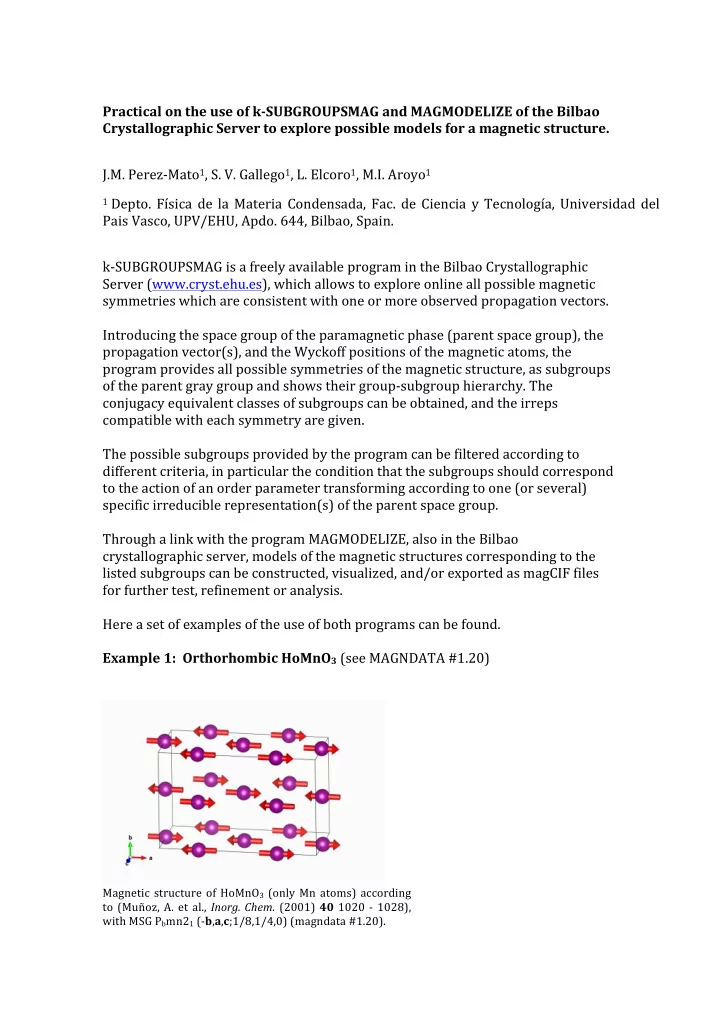
conjugacy ¡equivalent ¡classes ¡of ¡subgroups ¡can ¡be ¡obtained, ¡and ¡the ¡irreps ¡ compatible ¡with ¡each ¡symmetry ¡are ¡given. ¡ ¡ The ¡possible ¡subgroups ¡provided ¡by ¡the ¡program ¡can ¡be ¡filtered ¡according ¡to ¡ different ¡criteria, ¡in ¡particular ¡the ¡condition ¡that ¡the ¡subgroups ¡should ¡correspond ¡ to ¡the ¡action ¡of ¡an ¡order ¡parameter ¡transforming ¡according ¡to ¡one ¡(or ¡several) ¡ specific ¡irreducible ¡representation(s) ¡of ¡the ¡parent ¡space ¡group. ¡ ¡ Through ¡a ¡link ¡with ¡the ¡program ¡MAGMODELIZE, ¡also ¡in ¡the ¡Bilbao ¡ crystallographic ¡server, ¡models ¡of ¡the ¡magnetic ¡structures ¡corresponding ¡to ¡the ¡ listed ¡subgroups ¡can ¡be ¡constructed, ¡visualized, ¡and/or ¡exported ¡as ¡magCIF ¡files ¡ for ¡further ¡test, ¡refinement ¡or ¡analysis. ¡ ¡ ¡ Here ¡a ¡set ¡of ¡examples ¡of ¡the ¡use ¡of ¡both ¡programs ¡can ¡be ¡found. ¡ ¡ ¡ Example ¡1: ¡ ¡Orthorhombic ¡HoMnO3 ¡(see ¡MAGNDATA ¡#1.20) ¡ ¡ ¡
¡ ¡ Magnetic ¡structure ¡of ¡HoMnO3 ¡(only ¡Mn ¡atoms) ¡according ¡ to ¡(Muñoz, ¡A. ¡et ¡al., ¡Inorg. ¡Chem. ¡(2001) ¡40 ¡1020 ¡-‑ ¡1028), ¡ with ¡MSG ¡Pbmn21 ¡(-‑b,a,c;1/8,1/4,0) ¡(magndata ¡#1.20). ¡
SLIDE 2 ¡
The ¡paramagnetic ¡structure ¡of ¡ ¡HoMnO3 ¡can ¡be ¡summarized ¡as ¡(Muñoz, ¡A. ¡et ¡al., ¡Inorg. ¡
- Chem. ¡(2001) ¡40 ¡1020 ¡-‑ ¡1028): ¡
Space ¡group: ¡Pnma ¡(#62) ¡ Lattice ¡parameters: ¡ 5.83536 ¡7.36060 ¡5.25722 ¡ ¡ Asymmetric ¡unit: ¡ Ho1 ¡-‑ ¡0.08390 ¡0.25000 ¡0.98250 ¡ Mn1 ¡-‑ ¡0.00000 ¡0.00000 ¡0.50000 ¡ O1 ¡-‑ ¡0.46220 ¡0.25000 ¡0.11130 ¡ O2 ¡-‑ ¡0.32810 ¡0.05340 ¡0.70130 ¡ ¡ ¡ This ¡case ¡is ¡also ¡used ¡as ¡an ¡example ¡in ¡a ¡the ¡tutorial ¡that ¡we ¡prepared ¡for ¡the ¡ program ¡MAXMAGN. ¡Here ¡we ¡can ¡see ¡the ¡additional ¡possibilities ¡that ¡k-‑ SUBGROUPSMAG ¡provides. ¡ ¡ a) ¡Introduce ¡the ¡parent ¡space, ¡the ¡propagation ¡vector ¡and ¡the ¡Mn ¡Wyckoff ¡ position ¡(4b) ¡in ¡the ¡first ¡input ¡pages ¡of ¡k-‑SUBGROUPSMAG, ¡ ¡and ¡derive ¡the ¡ graph ¡of ¡all ¡magnetic ¡subgroups ¡(conjugate ¡classes) ¡consistent ¡with ¡the ¡observed ¡ propagation ¡vector, ¡and ¡check ¡that ¡apart ¡from ¡the ¡monoclinic ¡k-‑maximal ¡ subgroups ¡there ¡is ¡only ¡a ¡third ¡possible ¡centrosymmetric ¡symmetry, ¡namely ¡a ¡ subgroup ¡of ¡type ¡Ps-‑1, ¡which ¡a ¡common ¡subgroup ¡of ¡the ¡two ¡centrosymmetric ¡ monoclinic ¡groups ¡of ¡maximal ¡symmetry ¡(Figure ¡1). ¡
¡ ¡ ¡ ¡ ¡ ¡ ¡ ¡ ¡
SLIDE 3 Figure ¡1. ¡Output ¡page ¡of ¡k-‑SUBGROUPSMAG ¡showing ¡the ¡group-‑subgroup ¡hierarchy ¡of ¡all ¡possible ¡ magnetic ¡symmetries ¡of ¡a ¡magnetic ¡ordering ¡for ¡a ¡paramagnetic ¡structure ¡with ¡space ¡group ¡Pnma ¡ and ¡a ¡propagation ¡vector ¡(1/2 ¡0 ¡0) ¡(the ¡condition ¡of ¡the ¡magnetic ¡site ¡to ¡be ¡4b, ¡does ¡not ¡produce ¡ any ¡further ¡restriction ¡on ¡the ¡possible ¡subgroups) ¡. ¡Only ¡the ¡BNS ¡label ¡of ¡the ¡corresponding ¡group ¡ type ¡is ¡indicated. ¡The ¡k-‑maximal ¡magnetic ¡groups ¡are ¡highlighted ¡with ¡elliptical ¡frames. ¡Only ¡one ¡ subgroup ¡per ¡conjugate ¡class ¡is ¡shown. ¡Except ¡for ¡the ¡two ¡monoclinic ¡k-‑maximal ¡subgroups ¡and ¡its ¡ common ¡subgroup ¡Ps-‑1, ¡all ¡other ¡possible ¡symmetries ¡are ¡polar ¡and ¡allow ¡an ¡induced ¡electric ¡
¡
The ¡numbers ¡below ¡the ¡label ¡of ¡each ¡conjugate ¡class ¡allows ¡to ¡identify ¡the ¡class ¡in ¡ the ¡listing ¡provided ¡by ¡the ¡program ¡(Figure ¡2). ¡These ¡numbers ¡can ¡be ¡removed ¡to ¡
- btain ¡a ¡tidier ¡figure. ¡The ¡ouput ¡page ¡includes ¡several ¡menus ¡to ¡manipulate ¡the ¡
graph, ¡restricting ¡its ¡extent. ¡ ¡
¡ ¡ Figure ¡2. ¡List ¡provided ¡by ¡k-‑SUBGROUPSMAG ¡of ¡all ¡possible ¡magnetic ¡symmetries ¡of ¡a ¡magnetic ¡
- rdering ¡for ¡a ¡paramagnetic ¡structure ¡with ¡space ¡group ¡Pnma ¡and ¡a ¡propagation ¡vector ¡(1/2 ¡0 ¡0) ¡
(the ¡condition ¡of ¡the ¡magnetic ¡site ¡to ¡be ¡4b, ¡does ¡not ¡produce ¡any ¡further ¡restriction ¡on ¡the ¡ possible ¡subgroups) ¡. ¡Only ¡the ¡BNS ¡label ¡of ¡the ¡corresponding ¡group ¡type ¡is ¡indicated. ¡The ¡k-‑ maximal ¡magnetic ¡groups ¡are ¡highlighted ¡with ¡elliptical ¡frames. ¡Only ¡one ¡subgroup ¡per ¡conjugate ¡ class ¡is ¡shown. ¡By ¡clicking ¡on ¡the ¡button ¡“conjugacy ¡class” ¡a ¡list ¡of ¡all ¡distinct ¡subgroups ¡belonging ¡ to ¡the ¡conjugacy ¡class ¡is ¡shown. ¡The ¡button ¡“Get ¡irreps” ¡is ¡a ¡direct ¡link ¡to ¡the ¡program ¡Get_mirreps, ¡ which ¡allows ¡to ¡obtain ¡all ¡the ¡irreps ¡of ¡the ¡parent ¡space ¡group ¡that ¡are ¡compatible ¡with ¡listed ¡ subgroup ¡of ¡the ¡gray ¡parent ¡group. ¡The ¡last ¡column ¡allows ¡to ¡choose ¡those ¡symmetries ¡that ¡one ¡ wants ¡to ¡transmit ¡to ¡MAGMODELIZE ¡for ¡further ¡analysis ¡of ¡the ¡corresponding ¡magnetic ¡structure ¡
¡
b) ¡Check ¡the ¡button ¡“more ¡options” ¡on ¡the ¡page ¡with ¡the ¡list ¡or ¡with ¡the ¡ graph ¡of ¡the ¡possible ¡subgroups ¡(conjugacy ¡classes). ¡This ¡gives ¡the ¡possibility ¡ to ¡further ¡filter ¡the ¡possible ¡magnetic ¡symmetries ¡with ¡the ¡condition ¡of ¡allowing ¡a ¡
SLIDE 4 non-‑zero ¡magnetic ¡moment ¡of ¡all ¡magnetic ¡sites ¡(Figure ¡3) ¡(The ¡subgroups ¡can ¡be ¡ further ¡limited ¡to ¡those ¡allowing ¡a ¡collinear ¡spin ¡arrangement, ¡which ¡in ¡the ¡ present ¡case ¡does ¡not ¡mean ¡any ¡additional ¡restriction). ¡One ¡can ¡see ¡in ¡Figure ¡3, ¡ that ¡all ¡possible ¡symmetries ¡allowing ¡magnetic ¡order ¡of ¡all ¡Mn ¡sites ¡are ¡polar. ¡ ¡ ¡ ¡ c) ¡Notice ¡that ¡ ¡in ¡Figure ¡3 ¡there ¡are ¡two ¡distinct ¡conjugacy ¡classes ¡of ¡the ¡same ¡ type ¡Pa21. ¡Although ¡the ¡MSG ¡label ¡is ¡the ¡same ¡for ¡both ¡classes ¡because ¡the ¡groups ¡ are ¡of ¡the ¡same ¡type, ¡as ¡subgroups ¡of ¡Pnma1’, ¡they ¡are ¡quite ¡different. ¡The ¡binary ¡ axis ¡of ¡the ¡Pnma ¡group ¡that ¡is ¡maintained ¡in ¡one ¡or ¡the ¡other ¡case ¡are ¡different. ¡Go ¡ to ¡the ¡listing ¡of ¡the ¡subgroups ¡of ¡Figure ¡3, ¡and ¡from ¡the ¡transformation ¡to ¡the ¡ standard ¡setting ¡given ¡there, ¡conclude ¡that ¡in ¡one ¡case ¡the ¡binary ¡axis ¡is ¡along ¡the ¡
- ne ¡along ¡c, ¡and ¡in ¡the ¡other ¡case ¡along ¡b, ¡in ¡the ¡Pnma ¡setting. ¡This ¡can ¡also ¡be ¡
checked, ¡clicking ¡on ¡the ¡option ¡that ¡provides ¡the ¡subgroups ¡within ¡the ¡conjugacy ¡ class, ¡and ¡clicking ¡further ¡on ¡the ¡listing ¡of ¡the ¡symmetry ¡operations ¡in ¡matrix ¡
¡
Figure ¡3: ¡Graph ¡of ¡all ¡possible ¡subgroups ¡(conjugacy ¡classes) ¡of ¡the ¡parent ¡gray ¡group ¡Pnma1’ ¡ allowing ¡a ¡non-‑zero ¡magnetic ¡moment ¡at ¡all ¡sites ¡described ¡by ¡the ¡4b ¡Wyckoff ¡position ¡of ¡the ¡ parent ¡space ¡group ¡Pnma. ¡
¡ ¡ d) ¡Go ¡back ¡to ¡the ¡main ¡menu ¡and ¡check ¡the ¡option ¡“Only ¡maximal ¡subgroups”. ¡ This ¡will ¡produce ¡a ¡list ¡and/or ¡graph ¡of ¡only ¡the ¡k-‑maximal ¡subgroups ¡(Figure ¡4 ¡). ¡ ¡
SLIDE 5 ¡
¡ ¡ Figure ¡4. ¡Graph ¡and ¡list ¡of ¡the ¡k-‑maximal ¡symmetries ¡for ¡the ¡parent ¡space ¡group ¡Pnma ¡and ¡ k=(1/2,0,0). ¡The ¡condition ¡of ¡the ¡magnetic ¡site ¡being ¡4b ¡does ¡not ¡restrict ¡further ¡the ¡list. ¡ ¡
This ¡is ¡a ¡similar ¡result ¡to ¡the ¡one ¡provided ¡by ¡the ¡first ¡ouput ¡of ¡MAXMAGN ¡(see ¡ tutorial ¡example ¡of ¡this ¡program). ¡ ¡By ¡checking ¡on ¡the ¡last ¡column ¡of ¡the ¡list ¡for ¡all ¡ subgroups, ¡and ¡using ¡the ¡option ¡at ¡the ¡bottom ¡of ¡the ¡subgroup ¡list, ¡one ¡can ¡ transmit ¡the ¡subgroups ¡to ¡MAGMODELIZE, ¡which ¡can ¡then ¡do ¡a ¡job ¡similar ¡to ¡ MAXMAGN ¡for ¡these ¡symmetries, ¡and ¡initial ¡magCIF ¡files ¡for ¡the ¡corresponding ¡ magnetic ¡structure ¡models ¡can ¡be ¡created ¡ ¡ ¡ Thus, ¡k-‑SUBGROUPSMAG ¡combined ¡with ¡MAGMODELIZE ¡somehow ¡supersedes ¡ this ¡previous ¡program, ¡as ¡they ¡can ¡do ¡what ¡MAXMAGN ¡does, ¡but ¡not ¡restricted ¡to ¡ maximal ¡symmetries, ¡and ¡to ¡a ¡single ¡propagation ¡vector. ¡In ¡addition, ¡using ¡these ¡ programs ¡one ¡can ¡filter ¡further ¡the ¡possible ¡subgroups ¡and ¡the ¡resulting ¡possible ¡ magnetic ¡structures ¡using ¡representation ¡analysis ¡(see ¡following ¡steps). ¡ ¡However, ¡
- ne ¡should ¡be ¡aware ¡that ¡MAXMAGN, ¡being ¡a ¡much ¡simpler ¡program, ¡is ¡less ¡prone ¡
to ¡bugs. ¡Furthermore, ¡it ¡has ¡been ¡massively ¡tested ¡during ¡the ¡development ¡of ¡the ¡ MAGNDATA ¡database, ¡and ¡its ¡debugging ¡is ¡therefore ¡much ¡more ¡complete. ¡ ¡ ¡ e) ¡Go ¡back ¡to ¡the ¡main ¡input ¡page ¡of ¡k-‑SUBGROUPSMAG, ¡uncheck ¡the ¡“only ¡ maximal ¡subgroup” ¡option ¡and ¡come ¡back ¡to ¡the ¡default ¡choice ¡(the ¡first ¡one). ¡ In ¡the ¡option ¡“choose ¡irreps” ¡click ¡on ¡“representations”. ¡The ¡program ¡provides ¡ then ¡an ¡output ¡page ¡with ¡the ¡irrep ¡decompositions ¡of ¡the ¡magnetic ¡representation ¡ for ¡the ¡Wyckoff ¡site ¡4b ¡(Figure ¡5). ¡The ¡irrep ¡labels ¡in ¡the ¡output ¡are ¡those ¡also ¡ used ¡in ¡the ¡ISOTROPY ¡webpage, ¡and ¡one ¡can ¡always ¡inspect ¡the ¡actual ¡irreps ¡by ¡
SLIDE 6 going ¡to ¡the ¡programs ¡in ¡the ¡section ¡“Representations ¡and ¡Applications” ¡of ¡the ¡ Bilbao ¡Crystallographic ¡Server, ¡taking ¡into ¡account ¡that ¡the ¡symbol ¡m ¡in ¡the ¡irrep ¡ label ¡only ¡indicates ¡that ¡the ¡irrep ¡is ¡odd ¡for ¡time ¡reversal. ¡ ¡ Figure ¡5 ¡shows ¡that ¡if ¡the ¡magnetic ¡structure ¡is ¡assumed ¡to ¡originate ¡from ¡ the ¡condensation ¡of ¡an ¡order ¡parameter ¡transforming ¡according ¡to ¡a ¡single ¡irrep, ¡ two ¡different ¡irreps ¡for ¡the ¡order ¡parameter ¡are ¡possible. ¡ ¡ ¡
¡ Figure ¡5. ¡Irrep ¡decomposition ¡of ¡the ¡magnetic ¡representation ¡for ¡the ¡site ¡4b ¡of ¡Pnma, ¡as ¡given ¡by ¡k-‑
- SUBGROUPSMAG. ¡ ¡Irrep ¡labels ¡are ¡those ¡used ¡by ¡the ¡ISOTROPY ¡webpage. ¡In ¡parenthesis, ¡after ¡the ¡
irrep ¡label ¡the ¡dimension ¡of ¡the ¡full ¡irrep ¡is ¡indicated. ¡As ¡in ¡this ¡case ¡the ¡irrep ¡star ¡has ¡only ¡one ¡arm, ¡ this ¡dimension ¡coincides ¡with ¡that ¡of ¡the ¡small ¡irrep. ¡The ¡output ¡shows ¡that ¡the ¡total ¡number ¡of ¡ spin ¡degrees ¡of ¡freedom ¡(12) ¡decomposes ¡into ¡6 ¡degrees ¡for ¡ ¡the ¡irrep ¡mX1 ¡and ¡6 ¡for ¡the ¡irrep ¡mX2. ¡ ¡ ¡
f) ¡On ¡the ¡mode ¡decomposition ¡output ¡page ¡(Figure ¡5) ¡check ¡the ¡irrep ¡mX1 ¡ and ¡submit. ¡The ¡program ¡them ¡provides ¡as ¡list ¡and/or ¡graph ¡the ¡possible ¡ subgroups ¡than ¡can ¡result ¡from ¡a ¡magnetic ¡ordering ¡complying ¡with ¡the ¡ transformation ¡properties ¡of ¡irrep ¡mX1 ¡(Figure ¡6). ¡ ¡ ¡
Figure ¡6. ¡Possible ¡MSGs ¡that ¡can ¡result ¡from ¡a ¡magnetic ¡ordering ¡according ¡to ¡the ¡irrep ¡mX1 ¡ (k=(1/2,0,0) ¡of ¡Pnma1’ ¡ ¡
SLIDE 7 g) ¡On ¡the ¡list ¡of ¡subgroups ¡corresponding ¡to ¡irrep ¡mX1, ¡and ¡for ¡the ¡ subgroups ¡Pbmn21 ¡and ¡Pam, ¡click ¡on ¡the ¡button ¡“Get_irreps”. ¡The ¡output ¡ (Figure ¡7) ¡shows ¡that ¡mX1 ¡is ¡the ¡only ¡magnetic ¡irrep ¡allowed ¡for ¡these ¡symmetries, ¡ so ¡that ¡no ¡secondary ¡spin ¡degrees ¡of ¡freedom ¡corresponding ¡to ¡additional ¡irreps ¡ compatible ¡with ¡the ¡MSG ¡exist ¡for ¡these ¡symmetries. ¡In ¡the ¡MSG ¡Pbmn21 ¡, ¡after ¡the ¡ irrep ¡label ¡mX1, ¡the ¡necessary ¡direction ¡of ¡the ¡order ¡parameter ¡ ¡is ¡indicated ¡as ¡(a,-‑ a). ¡This ¡means ¡that ¡each ¡pair ¡of ¡spin ¡basis ¡functions ¡transforming ¡according ¡to ¡the ¡ irrep ¡mX1 ¡must ¡combine ¡in ¡a ¡particular ¡form, ¡forming ¡a ¡single ¡basis ¡function ¡ complying ¡with ¡this ¡specific ¡MSG. ¡This ¡implies ¡that ¡the ¡number ¡of ¡spin ¡degrees ¡of ¡ freedom ¡in ¡this ¡MSG ¡is ¡only ¡3, ¡instead ¡of ¡the ¡6 ¡in ¡an ¡arbitrary ¡combination ¡of ¡the ¡ mX1 ¡basis ¡functions. ¡This ¡happens ¡in ¡the ¡lower ¡irrep ¡kernel ¡ ¡Pam, ¡where ¡the ¡order ¡ parameter ¡is ¡allowed ¡an ¡arbitrary ¡direction: ¡(a,b). ¡ ¡ ¡ ¡
Figure ¡7. ¡Output ¡of ¡the ¡option ¡“Get_irreps” ¡showing ¡all ¡the ¡irreps ¡(magnetic ¡and ¡non-‑magnetic ¡that ¡ are ¡compatible ¡with ¡a ¡specific ¡subgroup ¡of ¡Pnma1’ ¡of ¡type ¡Pbmn21. ¡The ¡transformation ¡to ¡the ¡ standard ¡setting, ¡indicated ¡in ¡the ¡output, ¡fully ¡defines ¡the ¡subgroup ¡which ¡is ¡being ¡considered. ¡
¡ g) ¡Come ¡back ¡to ¡the ¡mode ¡decomposition ¡and ¡check ¡instead ¡the ¡irrep ¡mX2 ¡to ¡
- btain ¡the ¡possible ¡magnetic ¡symetries ¡for ¡this ¡alternative ¡irrep. ¡ ¡ ¡ ¡
¡ ¡ ¡ ¡
SLIDE 8 Example ¡2: ¡Ba3Nb2NiO9 ¡(magndata ¡#1.13) ¡ ¡ [Hwang, ¡J. ¡et ¡al., ¡Phys. ¡Rev. ¡Lett. ¡(2012) ¡109, ¡257205] ¡ ¡ (file: ¡Ba3Nb2NiO9_parent.cif) ¡ ¡ ¡
Magnetic ¡ structure ¡ of ¡ Ba3Nb2NiO9 ¡ (only ¡ Ni ¡ atoms), ¡ according ¡ to ¡ (Hwang, ¡ J. ¡ et ¡ al., ¡ Phys. ¡Rev. ¡Lett. ¡ (2012) ¡ 109, ¡ 257205), ¡with ¡MSG ¡Pc31c ¡(2/3a+1/3b, ¡
- ‑1/3a+1/3b, ¡c;1/9,2/9,0) ¡(magndata ¡ ¡#1.13). ¡
¡ The ¡paramagnetic ¡structure ¡of ¡Ba3Nb2NiO9 ¡can ¡be ¡summarized ¡as ¡(Lufaso, ¡Chem. ¡
- Mat. ¡16, ¡2148 ¡(2004) ¡and ¡Hwang, ¡J. ¡et ¡al., ¡Phys. ¡Rev. ¡Lett. ¡(2012) ¡109, ¡257205 ¡): ¡
Space ¡group: ¡P-‑3m1 ¡(N. ¡164) ¡ Lattice ¡parameters: ¡5.7550, ¡5.7550, ¡7.0656 ¡ ¡ ¡90 ¡90 ¡120 ¡ Asymmetric ¡unit: ¡ Ba1 ¡0.33333 ¡0.66667 ¡0.66380 ¡ ¡ Ba2 ¡0.00000 ¡0.00000 ¡0.00000 ¡ ¡ Ni1 ¡0.00000 ¡0.00000 ¡0.50000 ¡ ¡ Nb2 ¡0.33333 ¡0.66667 ¡0.17700 ¡ ¡ O1 ¡0.50000 ¡0.00000 ¡0.00000 ¡ ¡ O2 ¡0.16978 ¡0.33960 ¡0.32623 ¡ ¡ (The ¡small ¡occupancy ¡mixing ¡reported ¡in ¡the ¡older ¡reference ¡is ¡neglected) ¡ Magnetic ¡atom: ¡Ni ¡ Observed ¡propagation ¡vector: ¡(1/3,1/3,1/2) ¡ ¡ We ¡will ¡use ¡k-‑SUBGROUPSMAG ¡and ¡MAGMODELIZE ¡to ¡explore ¡the ¡possible ¡ magnetic ¡orderings ¡compatible ¡with ¡the ¡observed ¡propagation ¡vector. ¡The ¡ exploration ¡is ¡done ¡in ¡a ¡hierarchical ¡way ¡starting ¡with ¡those ¡orderings ¡having ¡as ¡ much ¡symmetry ¡as ¡possible. ¡The ¡restriction ¡to ¡a ¡single ¡irrep ¡can ¡also ¡be ¡included. ¡ ¡ ¡ a) ¡Open ¡the ¡main ¡page ¡of ¡k-‑SUBGROUPSMAG, ¡introduce ¡the ¡number ¡of ¡ ¡the ¡ space ¡group ¡of ¡the ¡paramagnetic ¡phase ¡and ¡the ¡propagation ¡vector, ¡and ¡ submit ¡with ¡the ¡rest ¡of ¡optiond ¡in ¡their ¡default ¡values. ¡A ¡list ¡of ¡25 ¡possible ¡ MSGs ¡are ¡obtained. ¡The ¡Ni ¡atom ¡lies ¡on ¡a ¡special ¡positio, ¡and ¡some ¡of ¡the ¡listed ¡ symmetries ¡may ¡be ¡irrelevant ¡because ¡they ¡force ¡a ¡zero ¡magnetic ¡moment ¡on ¡the ¡
SLIDE 9
position ¡of ¡all ¡Ni ¡atoms. ¡We ¡can ¡then ¡filter ¡the ¡possible ¡symmetries ¡with ¡the ¡ condition ¡that ¡non-‑zero ¡magnetic ¡moments ¡are ¡allowed ¡at ¡least ¡for ¡some ¡Ni ¡atoms ¡ ¡ b) ¡Go ¡back ¡to ¡the ¡main ¡menu ¡and ¡introduce ¡the ¡Wyckoff ¡position ¡occupied ¡by ¡ the ¡Ni ¡atoms. ¡The ¡list ¡of ¡possible ¡MSGs ¡now ¡reduces ¡to ¡17, ¡and ¡some ¡of ¡the ¡ maximal ¡MSGs ¡are ¡of ¡quite ¡low ¡symmetry ¡(Figure ¡8) ¡ ¡ ¡ ¡
Figure ¡8. ¡Possible ¡MSGs ¡that ¡can ¡be ¡realized ¡in ¡a ¡structure ¡with ¡parent ¡space ¡group ¡P-‑3m1 ¡and ¡ propagation ¡vector ¡(1/3,1/3,1/2), ¡if ¡the ¡magnetic ¡atom ¡is ¡at ¡the ¡Wyckoff ¡position ¡1b. ¡ ¡
¡ c) ¡Press ¡the ¡button ¡“more ¡options” ¡and ¡filter ¡further ¡the ¡posible ¡subgroups ¡ with ¡the ¡conditions ¡that ¡they ¡allow ¡non-‑zero ¡magnetic ¡moments ¡at ¡all ¡Ni ¡sites. ¡ The ¡number ¡of ¡possible ¡symmetries ¡is ¡then ¡further ¡reduced ¡to ¡13 ¡(Figure ¡9) ¡. ¡The ¡ subgroup ¡conjugacy ¡classes ¡numbered ¡1, ¡2, ¡3 ¡and ¡7 ¡are ¡maximal ¡under ¡these ¡ conditions ¡and ¡therefore ¡the ¡first ¡candidates ¡to ¡explore ¡in ¡an ¡eventual ¡fit ¡of ¡ experimental ¡diffraction ¡data. ¡The ¡structure ¡reported ¡for ¡Ba3Nb2NiO9 ¡corresponds ¡ to ¡one ¡of ¡these ¡four ¡MSGs, ¡namely ¡Pc31c, ¡which ¡is ¡polar. ¡In ¡fact, ¡ ¡two ¡of ¡these ¡four ¡ possible ¡maximal ¡symmetries ¡are ¡polar ¡along ¡the ¡trigonal ¡axis, ¡and ¡therefore ¡ correspond ¡to ¡a ¡magnetic ¡phase ¡bound ¡to ¡have ¡some ¡magnetically ¡induced ¡electric ¡ polarization ¡(type ¡II ¡multiferroic). ¡ ¡
SLIDE 10 ¡ ¡ ¡
Figure ¡9. ¡Possible ¡MSGs ¡that ¡can ¡be ¡realized ¡in ¡a ¡structure ¡with ¡parent ¡space ¡group ¡P-‑3m1 ¡and ¡ propagation ¡vector ¡(1/3,1/3,1/2), ¡if ¡the ¡magnetic ¡atom ¡is ¡at ¡the ¡Wyckoff ¡position ¡1b, ¡and ¡with ¡the ¡ additional ¡condition ¡that ¡all ¡magnetic ¡atoms ¡should ¡be ¡allowed ¡ ¡to ¡have ¡non-‑zero ¡magnetic ¡
- moments. ¡These ¡are ¡therefore ¡the ¡MSGs ¡that ¡allow ¡a ¡complete ¡magnetic ¡ordering ¡of ¡all ¡magnetic ¡
- atoms. ¡ ¡ ¡ ¡
SLIDE 11 ¡ Linking ¡the ¡output ¡shown ¡in ¡Figure ¡8 ¡with ¡MAGMODELIZE ¡one ¡can ¡obtain ¡ the ¡magnetic ¡structure ¡model ¡corresponding ¡to ¡these ¡four ¡maximal ¡symmetries. ¡ d) ¡In ¡the ¡last ¡column ¡of ¡the ¡list ¡reproduced ¡in ¡Figure ¡8, ¡check ¡the ¡mentioned ¡ subgroups ¡numbered ¡1 ¡,2 ¡,3 ¡and ¡7 ¡and ¡at ¡the ¡bottom ¡of ¡the ¡page ¡, ¡check ¡ “include ¡structure ¡data ¡of ¡the ¡parent ¡phase” ¡and ¡ ¡submit ¡to ¡MAGMODELIZE. ¡A ¡ first ¡page ¡appears ¡to ¡introduce ¡the ¡structure ¡of ¡the ¡paramagnetic ¡phase. ¡Submit ¡ the ¡cif ¡file ¡of ¡Ba3Nb2NiO9_parent.cif ¡ ¡or ¡introduce ¡by ¡hand ¡the ¡parent ¡structure ¡ that ¡is ¡described ¡at ¡the ¡beginning ¡of ¡this ¡example. ¡In ¡the ¡next ¡page, ¡check ¡the ¡Ni ¡ site ¡as ¡the ¡only ¡magnetic ¡atom. ¡The ¡resulting ¡output ¡page ¡(Figure ¡10) ¡listing ¡the ¡ subgroups ¡that ¡have ¡been ¡anayzed ¡is ¡similar ¡to ¡the ¡first ¡output ¡page ¡of ¡MAXMAGN, ¡ with ¡similar ¡capabilities. ¡
Figure ¡10. ¡Output ¡page ¡of ¡MAGMODELIZE ¡for ¡the ¡four ¡subgroups ¡of ¡maximal ¡symmetry ¡that ¡were ¡ transmitted ¡from ¡ ¡k-‑SUBGROUPSMAG. ¡
¡ e) ¡Construct ¡the ¡magnetic ¡structures ¡corresponding ¡to ¡the ¡second ¡subgroup ¡
- n ¡the ¡list ¡reproduced ¡in ¡Fig. ¡9, ¡namely ¡the ¡one ¡of ¡type ¡Pc31c ¡by ¡clicking ¡on ¡
the ¡last ¡column. ¡The ¡resulting ¡output ¡page ¡(Figure ¡11) ¡shows ¡that ¡the ¡Ni ¡site ¡ remains ¡unsplit, ¡with ¡a ¡single ¡symmetry-‑independent ¡atom. ¡ ¡
SLIDE 12 ¡ ¡
Figure ¡11. ¡Partial ¡view ¡of ¡the ¡output ¡of ¡MAGMODELIZE ¡describing ¡the ¡magnetic ¡structure ¡under ¡ the ¡subgroup ¡of ¡type ¡Pc31c ¡listed ¡in ¡Figure ¡9. ¡ ¡
The ¡heading ¡of ¡the ¡page ¡(see ¡Figure) ¡indicates ¡the ¡parent-‑like ¡setting ¡being ¡used, ¡ and ¡the ¡transformation ¡to ¡a ¡standard ¡setting ¡from ¡the ¡unit ¡cell ¡parameters ¡and ¡
- rigin ¡of ¡the ¡parent ¡space ¡group. ¡Both ¡a ¡transformation ¡to ¡a ¡standard ¡setting ¡
description ¡or ¡to ¡one ¡chosen ¡by ¡the ¡user ¡are ¡possible. ¡ One ¡can ¡see ¡in ¡this ¡output ¡that ¡the ¡Ni ¡spins ¡have ¡only ¡two ¡free ¡parameters, ¡with ¡ the ¡spin ¡direction ¡on ¡the ¡xy ¡plane ¡of ¡the ¡independent ¡Ni ¡atom ¡being ¡symmetry ¡ dictated, ¡and ¡an ¡additional ¡free ¡z ¡component. ¡Let ¡us ¡assume ¡for ¡the ¡moment ¡that ¡ the ¡z ¡spin ¡component ¡is ¡zero, ¡and ¡write ¡only ¡a ¡non-‑zero ¡arbitrary ¡value ¡of ¡1 ¡for ¡the ¡ my ¡component. ¡ ¡ f) ¡Click ¡on ¡“Export ¡data ¡to ¡MCIF ¡file/Visualize”. ¡A ¡magCIF ¡file ¡of ¡the ¡model ¡is ¡ then ¡created, ¡which ¡is ¡shown ¡on ¡a ¡non-‑editable ¡window. ¡Save ¡the ¡magCIF ¡file ¡by ¡ clicking ¡on ¡the ¡link ¡“bcs_file.mcif”. ¡Inspect ¡the ¡text ¡of ¡the ¡magCIF ¡and ¡locate ¡the ¡ place ¡where ¡the ¡transformation ¡to ¡the ¡standard ¡setting ¡from ¡the ¡one ¡used ¡in ¡the ¡ file ¡is ¡indicated. ¡Check ¡that ¡this ¡transformation ¡is: ¡ ¡ (1/3a-‑1/3b, ¡1/3a+2/3b, ¡c; ¡7/9, ¡8/9, ¡0) ¡ Compare ¡with ¡the ¡transformation ¡to ¡standard ¡given ¡in ¡the ¡output ¡page ¡obtained ¡in ¡ step ¡e) ¡(see ¡Figure ¡11). ¡Why ¡do ¡they ¡differ? ¡
SLIDE 13 ¡ g) ¡Click ¡on ¡the ¡button ¡“submit ¡to ¡MVISUALIZE” ¡to ¡visualize ¡the ¡structure ¡
- nline ¡with ¡JSmol, ¡using ¡the ¡MVISUALIZE ¡tool. ¡On ¡the ¡webpage ¡that ¡appears, ¡
use ¡the ¡button ¡“toggle ¡parent ¡cell” ¡to ¡visualize ¡simultaneously ¡the ¡parent ¡unit ¡cell, ¡ and ¡the ¡one ¡that ¡is ¡being ¡used ¡in ¡the ¡description ¡of ¡the ¡magCIF ¡file. ¡(Figure ¡12). ¡ ¡ ¡
Figure ¡12. ¡Representation ¡of ¡the ¡magnetic ¡structure ¡with ¡symmetry ¡Pc31c ¡as ¡obtained ¡with ¡ MVISUALIZE, ¡and ¡showing ¡both ¡the ¡parent ¡unit ¡cell ¡and ¡the ¡one ¡of ¡the ¡parent-‑like ¡setting ¡used. ¡
Use ¡the ¡button ¡“toggle ¡standard” ¡to ¡visualize ¡the ¡standard ¡unit ¡cell ¡proposed ¡by ¡the ¡ transformation ¡indicated ¡in ¡the ¡magCIF ¡file. ¡(Figure ¡13). ¡ ¡ ¡
Figure ¡13. ¡Representation ¡of ¡the ¡magnetic ¡structure ¡with ¡symmetry ¡Pc31c ¡as ¡obtained ¡with ¡ MVISUALIZE, ¡and ¡showing ¡both ¡the ¡standard ¡unit ¡cell ¡indicated ¡in ¡the ¡magCIF ¡file ¡and ¡the ¡one ¡of ¡ the ¡parent-‑like ¡setting ¡used. ¡
SLIDE 14 In ¡the ¡button-‑menu ¡entitled ¡“select ¡cell”, ¡select ¡“standard ¡cell” ¡to ¡visualize ¡the ¡ structure ¡using ¡the ¡standard ¡unit ¡cell ¡proposed ¡in ¡the ¡magCIF ¡file ¡(Figure ¡14). ¡ Explore ¡the ¡explicit ¡control, ¡editing, ¡and ¡export ¡buttons ¡that ¡the ¡page ¡offers. ¡An ¡ addition ¡window ¡to ¡introduce ¡any ¡Jmol ¡command ¡is ¡also ¡available. ¡In ¡addition, ¡by ¡ right-‑clicking ¡on ¡the ¡symbol ¡JSmol ¡of ¡the ¡graphic ¡window, ¡a ¡menu ¡is ¡open, ¡and ¡in ¡ particular ¡a ¡Jmol ¡console ¡can ¡be ¡opened ¡to ¡control ¡the ¡graphic ¡window. ¡ ¡
Figure ¡14. ¡Representation ¡of ¡the ¡magnetic ¡structure ¡with ¡symmetry ¡Pc31c ¡as ¡obtained ¡with ¡ MVISUALIZE, ¡using ¡the ¡standard ¡unit ¡cell ¡indicated ¡in ¡the ¡magCIF ¡file. ¡
h) ¡Do ¡analogous ¡steps ¡to ¡e), ¡f) ¡and ¡g) ¡for ¡the ¡other ¡three ¡subgroups ¡in ¡the ¡list ¡
- f ¡Figure ¡9 ¡to ¡obtain ¡magCIF ¡files ¡of ¡the ¡corresponding ¡magnetic ¡structures ¡
and ¡visualize ¡them ¡either ¡with ¡Jmol ¡or ¡with ¡VESTA. ¡(Figure ¡15) ¡ ¡ ¡ ¡ ¡ Pc31m ¡ Pc-‑31c ¡ Cc2/m ¡
Figure ¡15. ¡Scheme ¡of ¡the ¡magnetic ¡structures ¡with ¡the ¡indicated ¡maximal ¡symmetries ¡listed ¡in ¡ Figure ¡9, ¡as ¡obtained ¡with ¡MVISUALIZE ¡using ¡the ¡corresponding ¡magCIF ¡files ¡created ¡with ¡
- MAGMODELIZE. ¡For ¡the ¡case ¡of ¡Pc-‑31c ¡and ¡Cc2/m, ¡the ¡Ni ¡site ¡splits ¡into ¡two ¡symmetry ¡independent ¡
sites, ¡each ¡with ¡a ¡single ¡free ¡parameter, ¡and ¡they ¡have ¡been ¡given ¡arbitrary ¡different ¡values ¡to ¡ distinguish ¡the ¡two ¡sites. ¡In ¡the ¡case ¡of ¡Pc31m, ¡the ¡single ¡Ni ¡site ¡has ¡only ¡one ¡free ¡parameter, ¡with ¡ no ¡z ¡spin ¡component ¡allowed. ¡
SLIDE 15 Up ¡to ¡now ¡we ¡have ¡only ¡made ¡use ¡of ¡the ¡condition ¡that ¡the ¡MSG ¡describing ¡the ¡ symmetry ¡of ¡the ¡magnetic ¡structure ¡should ¡be ¡a ¡subgroup ¡of ¡the ¡gray ¡group ¡ ¡ ¡ ¡ ¡ ¡ ¡ ¡ ¡ ¡ ¡ ¡ P-‑3m11’, ¡and ¡be ¡consistent ¡with ¡the ¡observation ¡of ¡(1/3,1/3,1/2) ¡as ¡single ¡ propagation ¡vector. ¡But ¡k-‑SUBGROUPSMAG ¡can ¡also ¡introduce ¡the ¡additional ¡filter ¡ that ¡the ¡symmetry ¡break ¡should ¡be ¡the ¡result ¡of ¡a ¡spin ¡arrangement ¡according ¡to ¡
- ne ¡(or ¡more) ¡specific ¡irrep(s). ¡ ¡
i) ¡Go ¡back ¡to ¡the ¡main ¡input ¡page ¡of ¡k-‑SUBGROUPSMAG ¡and ¡in ¡the ¡option ¡ “choose ¡irreps” ¡click ¡on ¡“representations”. ¡The ¡program ¡provides ¡then ¡an ¡
- utput ¡page ¡with ¡the ¡irrep ¡decomposition ¡of ¡the ¡magnetic ¡representation ¡for ¡the ¡
Wyckoff ¡site ¡1b ¡(Figure ¡16). ¡ ¡ ¡
Figure ¡16. ¡Irrep ¡decomposition ¡of ¡the ¡magnetic ¡representation ¡for ¡the ¡propagation ¡vector ¡ (1/3,1/3,1/2) ¡and ¡the ¡site ¡1b, ¡as ¡given ¡by ¡k-‑SUBGROUPSMAG. ¡The ¡number ¡in ¡parenthesis ¡after ¡ each ¡irrep ¡indicate ¡the ¡dimension ¡of ¡the ¡full ¡irrep, ¡which ¡in ¡this ¡case ¡is ¡twice ¡the ¡dimension ¡of ¡the ¡ small ¡irrep ¡(the ¡star ¡of ¡k, ¡includes ¡k ¡and ¡–k). ¡ ¡
The ¡irrep ¡labels ¡in ¡the ¡output ¡are ¡those ¡also ¡used ¡in ¡the ¡ISOTROPY ¡webpage, ¡and ¡
- ne ¡can ¡always ¡inspect ¡the ¡actual ¡irreps ¡by ¡going ¡to ¡the ¡programs ¡in ¡the ¡section ¡
“Representations ¡and ¡Applications” ¡of ¡the ¡Bilbao ¡Crystallographic ¡Server, ¡taking ¡ into ¡account ¡that ¡the ¡symbol ¡m ¡in ¡the ¡irrep ¡label ¡only ¡indicates ¡that ¡the ¡irrep ¡is ¡odd ¡ for ¡time ¡reversal. ¡One ¡can ¡see ¡that ¡two ¡irreps ¡are ¡possible. ¡ ¡ ¡ j) ¡Check ¡irrep ¡mH1 ¡and ¡submit ¡to ¡include ¡this ¡condition ¡in ¡the ¡input. ¡Submit ¡ the ¡new ¡input ¡page. ¡ ¡The ¡list ¡and ¡graph ¡of ¡possible ¡MSGs ¡for ¡this ¡irrep ¡can ¡then ¡be ¡
- btained ¡(Figures ¡17). ¡
SLIDE 16 ¡ Figure ¡17. ¡Graph ¡of ¡the ¡possible ¡MSGs ¡that ¡can ¡be ¡realized ¡by ¡a ¡magnetic ¡ordering ¡according ¡to ¡the ¡ 2-‑dim ¡irrep ¡mH1. ¡ ¡
The ¡two ¡epikernels ¡of ¡mH1, ¡of ¡type ¡Pc-‑31c ¡and ¡Pc-‑31m, ¡shown ¡in ¡Figure ¡17 ¡are ¡two ¡
- f ¡the ¡six ¡k-‑maximal ¡subgroups ¡that ¡were ¡already ¡obtained ¡above ¡in ¡step ¡b) ¡and ¡
shown ¡in ¡Figure ¡8. ¡The ¡second ¡one, ¡Pc-‑31m, ¡forces ¡a ¡cero ¡magnetic ¡moment ¡at ¡ some ¡of ¡the ¡Ni ¡sites, ¡as ¡can ¡be ¡checked, ¡using ¡the ¡button ¡“more ¡options” ¡in ¡the ¡page ¡ showing ¡the ¡graph ¡or ¡the ¡list. ¡This ¡is ¡the ¡reason ¡why ¡this ¡subgroup ¡disappeared ¡in ¡ step ¡c) ¡and ¡is ¡not ¡present ¡in ¡Figure ¡9. ¡ ¡ ¡ A ¡word ¡of ¡caution ¡is ¡obliged ¡here: ¡magnetic ¡structures ¡with ¡some ¡fraction ¡of ¡ the ¡magnetic ¡sites ¡having ¡zero ¡average ¡magnetic ¡moments ¡are ¡not ¡common, ¡and ¡ therefore ¡one ¡can ¡consider ¡them ¡less ¡probable ¡to ¡be ¡realized, ¡but ¡there ¡is ¡no ¡ reason ¡to ¡discard ¡them ¡completely, ¡and ¡magnetic ¡structures ¡of ¡this ¡type ¡are ¡ reported ¡(see ¡for ¡instance ¡the ¡structure ¡of ¡Gd2Ti2O7 ¡(magndata ¡#1.56)). ¡ k) ¡Come ¡back ¡to ¡the ¡output ¡page ¡with ¡the ¡irrep ¡decomposition ¡and ¡check ¡ irrep ¡mH3, ¡instead ¡of ¡mH1, ¡and ¡submit ¡to ¡include ¡this ¡condition ¡in ¡the ¡input. ¡ Submit ¡the ¡new ¡input ¡page. ¡The ¡list ¡and ¡graph ¡of ¡possible ¡MSGs ¡that ¡can ¡be ¡ realized ¡by ¡a ¡magnetic ¡ordering ¡according ¡to ¡this ¡irrep ¡can ¡then ¡be ¡obtained ¡ (Figures ¡18). ¡ ¡ ¡
Figure ¡18. ¡Graph ¡of ¡the ¡possible ¡MSGs ¡that ¡can ¡be ¡realized ¡by ¡a ¡magnetic ¡ordering ¡according ¡to ¡the ¡ 4-‑dim ¡irrep ¡mH3. ¡ ¡
SLIDE 17 The ¡large ¡dimension ¡of ¡this ¡irrep ¡makes ¡that ¡the ¡number ¡of ¡possible ¡distinct ¡ magnetic ¡symmetries ¡also ¡quite ¡large, ¡namely ¡fourteen, ¡with ¡13 ¡distinct ¡irrep ¡ epikernels, ¡from ¡which ¡six ¡are ¡maximal. ¡Some ¡of ¡these ¡maximal ¡subgroups ¡split ¡the ¡ 1b ¡site, ¡with ¡some ¡of ¡the ¡resulting ¡split ¡sites ¡being ¡symmetry ¡forced ¡to ¡have ¡zero ¡
- spin. ¡These ¡groups ¡can ¡be ¡filtered ¡and ¡droped ¡out ¡using ¡the ¡first ¡option ¡that ¡
appears ¡clicking ¡the ¡“more ¡options” ¡button. ¡(Figure ¡19) ¡The ¡number ¡of ¡possible ¡ MSGs ¡reduces ¡then ¡to ¡11, ¡and ¡the ¡number ¡of ¡maximal ¡epikernels ¡to ¡4. ¡Three ¡of ¡ these ¡maximal ¡epikernel ¡can ¡be ¡identified ¡with ¡the ¡remaining ¡three ¡k-‑maximal ¡ MSGs ¡obtained ¡in ¡step ¡c) ¡and ¡Figure ¡9. ¡The ¡fourth ¡maximal ¡epikernel, ¡of ¡type ¡Cc2/c, ¡ is ¡not ¡k-‑maximal. ¡This ¡means ¡that ¡there ¡is ¡MSG ¡consistent ¡with ¡the ¡propagation ¡ vector, ¡allowing ¡magnetic ¡order ¡at ¡all ¡Ni ¡sites, ¡which ¡is ¡a ¡supergroup ¡of ¡this ¡group ¡
- f ¡type ¡Cc2/c. ¡This ¡supergroup ¡can ¡be ¡easily ¡seen ¡on ¡Figure ¡8: ¡it ¡is ¡the ¡subgroup ¡ ¡ ¡
Pc-‑31c, ¡which ¡has ¡been ¡discussed ¡in ¡step ¡j). ¡ ¡ ¡
Figure ¡19. ¡Graph ¡of ¡the ¡possible ¡MSGs ¡that ¡can ¡be ¡realized ¡by ¡a ¡magnetic ¡ordering ¡according ¡to ¡the ¡ 4-‑dim ¡irrep ¡mH3, ¡with ¡the ¡additional ¡restriction ¡that ¡the ¡MSG ¡should ¡allow ¡non-‑zero ¡magnetic ¡ moments ¡at ¡all ¡sites ¡derived ¡from ¡the ¡Wyckoff ¡positions ¡1b ¡of ¡the ¡parent ¡space ¡group ¡P-‑3m1. ¡ ¡
l) ¡Check ¡the ¡link ¡“Get_irreps” ¡for ¡subgroup ¡of ¡type ¡Cc2/c ¡in ¡the ¡listing ¡of ¡ subgroups ¡corresponding ¡to ¡Figure ¡18. ¡The ¡resulting ¡output ¡(Figure ¡20) ¡shows ¡ that ¡the ¡irrep ¡mH1 ¡is ¡also ¡compatible ¡with ¡this ¡symmetry. ¡ ¡
SLIDE 18 ¡
Figure ¡20. ¡Output ¡of ¡the ¡link ¡Get ¡irreps ¡for ¡the ¡epikernel ¡of ¡mH3 ¡of ¡type ¡Cc2/c. ¡
As ¡the ¡magnetic ¡representation ¡of ¡site ¡1b ¡decomposes ¡in ¡the ¡form ¡(Figure ¡16): ¡ 1 ¡mH1 ¡+ ¡1 ¡mH3 ¡ and ¡the ¡output ¡reproduced ¡in ¡Figure ¡19 ¡indicates ¡a ¡fixed ¡direction ¡within ¡both ¡ irrep ¡spaces, ¡a ¡spin ¡arrangement ¡complying ¡with ¡the ¡subgroup ¡Cc2/c, ¡will ¡have ¡a ¡ single ¡degree ¡of ¡freedom ¡corresponding ¡to ¡each ¡irrep. ¡Figure ¡20 ¡shows ¡however ¡ that ¡irreps ¡for ¡the ¡wave ¡vector ¡A: ¡(0,0,1/2), ¡are ¡also ¡allowed. ¡This ¡wave ¡vector ¡is ¡in ¡ fact ¡associated ¡to ¡a ¡third ¡harmonic ¡of ¡the ¡primary ¡spin ¡wave ¡with ¡propagation ¡ vector ¡(1/3,1/3,1/2). ¡These ¡secondary ¡irreps ¡with ¡label ¡A ¡can ¡be ¡the ¡symmetry ¡of ¡ additional ¡degrees ¡of ¡freedom ¡of ¡the ¡Cc2/c ¡structure. ¡ ¡ ¡ One ¡can ¡use ¡the ¡representations ¡input ¡option ¡of ¡k-‑SUBGROUPSMAG ¡to ¡ derive ¡the ¡irrep ¡decomposition ¡of ¡the ¡magnetic ¡representation ¡for ¡any ¡wave ¡
- vector. ¡In ¡this ¡way, ¡one ¡can ¡obtain ¡that ¡it ¡is: ¡1 ¡mA1-‑ ¡+ ¡1 ¡mA3-‑. ¡Taking ¡into ¡account ¡
the ¡output ¡reproduced ¡in ¡Figure ¡20, ¡this ¡means ¡that ¡a ¡structure ¡according ¡to ¡the ¡ subgroup ¡Cc2/c ¡will ¡have ¡4 ¡free ¡parameters, ¡and ¡these ¡four ¡degrees ¡of ¡freedom ¡can ¡ be ¡decomposed ¡on ¡4 ¡basis ¡functions, ¡one ¡for ¡each ¡of ¡the ¡magnetic ¡irreps ¡listed ¡in ¡ Figure ¡20. ¡The ¡primary ¡ ¡spin ¡basis ¡function ¡will ¡correspond ¡to ¡the ¡primary ¡irrep ¡ mH3, ¡but ¡a ¡refinement ¡under ¡this ¡symmetry ¡can ¡explore ¡the ¡presence ¡of ¡the ¡other ¡ three ¡degrees ¡of ¡freedom. ¡The ¡decomposition ¡of ¡the ¡four ¡degrees ¡of ¡freedom ¡in ¡ terms ¡of ¡four ¡spin ¡basis ¡functions, ¡adapted ¡to ¡the ¡four ¡irreps ¡can ¡be ¡done ¡using ¡
- ISODISTORT. ¡This ¡is ¡not ¡provided ¡by ¡k-‑SUBGROUPSMAG, ¡which ¡through ¡
MAGMODELIZE, ¡only ¡provides ¡the ¡magnetic ¡structure ¡model ¡under ¡this ¡MSG ¡with ¡ the ¡four ¡free ¡parameters ¡as ¡spin ¡components ¡of ¡the ¡symmetry ¡independent ¡sites. ¡ ¡
SLIDE 19 m) ¡Submit ¡to ¡MAGMODELIZE ¡the ¡subgroup ¡Cc2/c ¡in ¡the ¡listing ¡of ¡subgroups ¡ reproduced ¡in ¡Figure ¡18, ¡using ¡the ¡option ¡at ¡the ¡bottom ¡of ¡the ¡listing, ¡and ¡ introducing ¡when ¡required ¡the ¡parent ¡structure ¡of ¡Ba3Nb2NiO9. ¡ ¡One ¡can ¡see ¡ the ¡four ¡free ¡parameters ¡for ¡the ¡spins, ¡as ¡components ¡of ¡two ¡split ¡Ni ¡sites ¡(Figure ¡ 21). ¡This ¡is ¡an ¡example ¡of ¡the ¡need ¡of ¡including ¡both ¡MSG ¡and ¡irreps ¡constraints ¡if ¡
- ne ¡wants ¡to ¡refine ¡the ¡structure ¡in ¡a ¡controlled ¡way: ¡if ¡only ¡the ¡traditional ¡method ¡
is ¡employed ¡and ¡the ¡refinement ¡is ¡restricted ¡to ¡the ¡mH3 ¡irrep, ¡ ¡one ¡will ¡have ¡four ¡ free ¡parameters, ¡and ¡the ¡symmetry ¡of ¡the ¡spin ¡arrangement ¡to ¡be ¡refined ¡is ¡ reduced ¡to ¡the ¡minimal ¡symmetry ¡allowed ¡by ¡the ¡irrep, ¡the ¡irrep ¡kernel, ¡i.e. ¡Ps1 ¡ (see ¡Figure ¡19), ¡while ¡if ¡the ¡structure ¡is ¡refined ¡under ¡only ¡the ¡constraints ¡of ¡MSG ¡ Cc2/c, ¡then ¡again ¡we ¡have ¡four ¡free ¡parameters ¡to ¡refine, ¡but ¡a ¡set ¡of ¡arbitrary ¡ values ¡of ¡them ¡combines ¡spin ¡modes ¡corresponding ¡to ¡the ¡irreps ¡mH3, ¡mH1, ¡mA1-‑ ¡ and ¡mA3-‑. ¡If ¡one ¡wants ¡to ¡refine ¡the ¡structure ¡under ¡the ¡condition ¡that ¡its ¡ symmetry ¡is ¡Cc2/c ¡and ¡that ¡only ¡the ¡irrep ¡present ¡is ¡mH3, ¡with ¡a ¡single ¡parameter ¡ to ¡refine, ¡then ¡one ¡needs ¡to ¡add ¡to ¡the ¡symmetry ¡constraints ¡coming ¡from ¡ ¡the ¡MSG ¡ the ¡additional ¡restrictions ¡of ¡the ¡irrep ¡mH3. ¡ ¡ ¡
Figure ¡21. ¡Partial ¡view ¡of ¡the ¡output ¡of ¡MAGMODELIZE ¡for ¡the ¡epikernel ¡of ¡mH3 ¡of ¡type ¡Cc2/c. ¡The ¡ Ni ¡atoms ¡split ¡into ¡two ¡independent ¡sites ¡and ¡four ¡free ¡parameters ¡exist. ¡An ¡arbitrary ¡set ¡of ¡values ¡ for ¡the ¡four ¡symmetry ¡independent ¡moment ¡components ¡implies ¡however ¡an ¡uncontrolled ¡ combination ¡of ¡spin ¡modes ¡corresponding ¡to ¡four ¡different ¡irreps ¡(see ¡text). ¡
¡ ¡ ¡ ¡
SLIDE 20 Example ¡3: ¡A ¡multi-‑k ¡structure. ¡Nd2CuO4 ¡(magndata ¡#2.6) ¡ [Skanthakumar, ¡S. ¡et ¡al., ¡PHYSICAL ¡REVIEW ¡B ¡(1993) ¡47 ¡6173 ¡-‑ ¡6176] ¡ ¡ (file: ¡Nd2CuO4_parent.cif) ¡ ¡ ¡
2k-‑magnetic ¡ structure ¡ of ¡ Nd2CuO4 ¡ (only ¡ Cu ¡ atoms), ¡ according ¡to ¡(Skanthakumar, ¡S. ¡et ¡al., ¡PHYSICAL ¡REVIEW ¡B ¡ (1993) ¡47, ¡6173 ¡-‑ ¡6176), ¡with ¡MSG ¡PC42/nnm ¡(1/2a+1/2b, ¡
- ‑1/2a+1/2b,c;0,0,0) ¡ ¡(magndata ¡ ¡#2.6). ¡
¡ The ¡paramagnetic ¡structure ¡of ¡Ba3Nb2NiO9 ¡can ¡be ¡summarized ¡as ¡(icsd ¡202885, ¡ Gopalakrishnan ¡et ¡al., ¡Mat. ¡Res. ¡Bull. ¡24, ¡321-‑330 ¡(1989)): ¡ Space ¡group: ¡I4/mmm ¡(N. ¡139) ¡ Lattice ¡parameters: ¡3.9385, ¡3.9385, ¡12.1465 ¡ ¡ ¡90 ¡90 ¡90 ¡ Asymmetric ¡unit: ¡ Cu1 ¡-‑ ¡0.00000 ¡0.00000 ¡0.00000 ¡ Nd1 ¡-‑ ¡0.00000 ¡0.00000 ¡0.35150 ¡ O1 ¡-‑ ¡0.00000 ¡0.50000 ¡0.00000 ¡ O2 ¡-‑ ¡0.00000 ¡0.50000 ¡0.25000 ¡ ¡ This ¡structure ¡is ¡reported ¡to ¡have ¡a ¡multi-‑k ¡magnetic ¡phase ¡with ¡two ¡propagation ¡ vectors ¡which ¡are ¡symmetry ¡related ¡by ¡the ¡parent ¡symmetry: ¡ k1= ¡(1/2,1/2,0) ¡ k2= ¡(-‑1/2,1/2,0) ¡ ¡ k-‑SUBGROUPSMAG ¡combined ¡with ¡MAGMODELIZE ¡can ¡be ¡used ¡to ¡explore ¡and ¡ enumerate ¡all ¡possible ¡multi-‑k ¡magnetic ¡structures ¡for ¡a ¡set ¡of ¡observed ¡ propagation ¡vector. ¡We ¡will ¡apply ¡it ¡here ¡to ¡this ¡case. ¡ ¡ a) ¡Introduce ¡in ¡the ¡input ¡page ¡of ¡k-‑SUBGROUPSMAG ¡the ¡parent ¡space ¡group, ¡ the ¡two ¡wave ¡vectors ¡(click ¡on ¡the ¡option ¡“more ¡wave ¡vectors ¡needed”), ¡the ¡ Wyckoff ¡position ¡of ¡the ¡Cu ¡atom, ¡and ¡submit. ¡A ¡list ¡and ¡graph ¡of ¡18 ¡possible ¡ MSGs ¡are ¡provided ¡by ¡the ¡program, ¡six ¡of ¡them ¡maximal. ¡(Figure ¡21) ¡ ¡
SLIDE 21 ¡
Figure ¡22. ¡Possible ¡MSGs ¡that ¡can ¡be ¡realized ¡in ¡a ¡structure ¡with ¡parent ¡space ¡group ¡I4/mmm, ¡by ¡ 2k ¡magnetic ¡ordering ¡with ¡propagation ¡vectors ¡(1/2,1/2,0) ¡and ¡(-‑1/2,1/2,0), ¡and ¡with ¡the ¡ magnetic ¡atom ¡at ¡the ¡site ¡2a ¡(0,0,0). ¡
¡ ¡ b) ¡Go ¡back ¡to ¡the ¡input ¡page ¡and ¡do ¡the ¡irrep ¡decomposition ¡for ¡the ¡site ¡2a. ¡ ¡ ¡ ¡
Figure ¡23. ¡Irrep ¡decomposition ¡of ¡the ¡magnetic ¡representation ¡for ¡the ¡site ¡2a ¡for ¡the ¡wave ¡vectors ¡ (1/2,1/2,0) ¡and ¡(-‑1/2,1/2,0). ¡The ¡parenthesis ¡behind ¡each ¡irrep ¡label ¡indicates ¡the ¡dimension ¡of ¡ the ¡full ¡irrep ¡(the ¡small ¡irrep ¡is ¡1-‑dim ¡in ¡all ¡cases). ¡
¡ ¡ c) ¡Choose ¡the ¡irrep ¡mX4+ ¡and ¡submit. ¡The ¡program ¡yields ¡two ¡possible ¡MSGs ¡ (Figure ¡24) ¡that ¡are ¡group-‑subgroup ¡related, ¡as ¡can ¡be ¡seen ¡by ¡looking ¡at ¡the ¡graph ¡
¡ ¡
SLIDE 22
¡ ¡
Figure ¡24. ¡Possible ¡MSGs ¡for ¡2k-‑ ¡magnetic ¡structures ¡with ¡the ¡the ¡indicated ¡wave ¡vectors, ¡and ¡with ¡ the ¡magnetic ¡ordering ¡according ¡to ¡the ¡irrep ¡mX4+ ¡of ¡the ¡parent ¡space ¡group ¡I4/mmm. ¡
¡ d) ¡Click ¡on ¡“Get ¡irreps” ¡for ¡the ¡two ¡subgroups. ¡The ¡resulting ¡output ¡shows ¡that ¡ while ¡in ¡the ¡higher ¡subgroup ¡the ¡direction ¡within ¡mX4+ ¡is ¡(a,-‑a), ¡meaning ¡that ¡the ¡ two ¡spin ¡waves ¡with ¡different ¡propagation ¡vector ¡combine ¡with ¡equal ¡amplitudes, ¡ in ¡the ¡lower ¡group, ¡the ¡two ¡spin ¡waves ¡having ¡different ¡amplitudes, ¡with ¡this ¡ direction ¡being ¡represented ¡by ¡(a,b) ¡. ¡The ¡possible ¡MSGs ¡resulting ¡from ¡the ¡ presence ¡of ¡only ¡one ¡of ¡the ¡two ¡spin ¡waves, ¡that ¡is ¡the ¡directions ¡(a,0) ¡or ¡(0,a), ¡are ¡ not ¡in ¡the ¡list. ¡These ¡are ¡a ¡single ¡k ¡magnetic ¡structures, ¡and ¡the ¡program ¡only ¡lists ¡ the ¡symmetries ¡correspondings ¡to ¡spin ¡arrangement ¡where ¡the ¡two ¡propagation ¡ vectors ¡are ¡involved, ¡as ¡demanded ¡in ¡the ¡input. ¡ ¡ e) ¡Come ¡back ¡to ¡step ¡c) ¡and ¡do ¡a ¡similar ¡process ¡for ¡ ¡irreps ¡mX3+ ¡and ¡mX2-‑. ¡ The ¡program ¡provides ¡again ¡a ¡tetragonal ¡MSG ¡as ¡maximal ¡symmetry ¡for ¡each ¡irrep. ¡ ¡ ¡ The ¡three ¡tetragonal ¡MSGs, ¡one ¡per ¡irrep, ¡obtained ¡in ¡these ¡steps, ¡are ¡the ¡same ¡as ¡ those ¡obtained ¡as ¡k-‑maximal ¡in ¡a ¡single ¡go ¡in ¡step ¡a). ¡But ¡what ¡type ¡of ¡spin ¡ arrangement ¡corresponds ¡to ¡the ¡other ¡three ¡maximal ¡MSGs ¡of ¡orthorhombic ¡ symmetry ¡that ¡were ¡obtained ¡in ¡step ¡a)? ¡ ¡ f) ¡Go ¡back ¡to ¡the ¡listing ¡of ¡subgroups ¡obtained ¡in ¡step ¡a) ¡and ¡click ¡on ¡“Get ¡ irreps” ¡for ¡any ¡of ¡these ¡three ¡k-‑maximal ¡orthorhombic ¡MSGs. ¡One ¡can ¡see ¡ (Figure ¡25) ¡that ¡these ¡MSGs ¡result ¡indeed ¡from ¡the ¡superpositions ¡of ¡two ¡spin ¡ waves ¡with ¡the ¡two ¡desired ¡propagation ¡vectors, ¡but ¡each ¡spin ¡wave ¡is ¡associated ¡ with ¡a ¡different ¡irrep. ¡This ¡type ¡of ¡orderings ¡are ¡in ¡principle ¡possible, ¡but ¡one ¡can ¡ assume ¡they ¡are ¡much ¡less ¡probable ¡than ¡the ¡three ¡orderings ¡of ¡maximal ¡ symmetry ¡corresponding ¡to ¡three ¡possible ¡irreps. ¡ ¡ ¡
SLIDE 23 ¡ ¡
Figure ¡25. ¡Irreps ¡and ¡OP ¡directions ¡compatible ¡with ¡the ¡indicated ¡subgroup ¡of ¡I4/mmm1’, ¡as ¡
- btained ¡with ¡“Get ¡irreps” ¡in ¡the ¡subgroup ¡lists ¡
¡ g) ¡Go ¡back ¡to ¡the ¡listing ¡of ¡subgroups ¡obtained ¡in ¡step ¡a) ¡and ¡check ¡in ¡the ¡last ¡ column ¡the ¡three ¡tetragonal ¡MSGs ¡at ¡the ¡head ¡of ¡the ¡list, ¡check ¡“include ¡ structure ¡data ¡of ¡the ¡parent ¡phase” ¡at ¡the ¡bottom ¡of ¡the ¡list ¡and ¡submit ¡to ¡ MAGMODELIZE ¡to ¡construct ¡the ¡structure ¡models ¡consistent ¡with ¡these ¡three ¡
- symmetries. ¡In ¡the ¡next ¡page ¡upload ¡the ¡cif ¡file ¡of ¡the ¡parent ¡phase ¡of ¡Nd2CuO4 ¡
(Nd2CuO4_parent.cif). ¡Choose ¡Cu ¡as ¡magnetic ¡and ¡submit. ¡ ¡ ¡ ¡ ¡
Figure ¡26. ¡Output ¡of ¡MAGMODELIZE ¡for ¡the ¡three ¡chosen ¡subgroups, ¡with ¡the ¡different ¡output ¡
¡ ¡ ¡ ¡
SLIDE 24 h) ¡Click ¡on ¡the ¡last ¡column ¡for ¡the ¡first ¡MSG. ¡ ¡ ¡ ¡ ¡
Figure ¡27. ¡Magnetic ¡structure ¡under ¡the ¡constraints ¡of ¡the ¡subgroup ¡PC42/ncm ¡(a+b,-‑a+b,c; ¡½, ¡½, ¡ 0) ¡ ¡
The ¡heading ¡of ¡the ¡output ¡page ¡indicates ¡the ¡unit ¡cell ¡(parent-‑like ¡setting) ¡being ¡ used ¡and ¡its ¡relation ¡with ¡respect ¡to ¡the ¡parent ¡unit ¡cell. ¡A ¡transformation ¡to ¡the ¡ standard ¡setting ¡of ¡the ¡MSG ¡and ¡a ¡list ¡of ¡the ¡atoms ¡of ¡an ¡asymmetric ¡unit ¡(second ¡ column), ¡the ¡corresponding ¡orbit ¡of ¡symmetry ¡related ¡atoms ¡within ¡the ¡unit ¡cell ¡ ¡ within ¡the ¡defined ¡unit ¡cell ¡(third ¡column), ¡the ¡number ¡of ¡atoms ¡of ¡each ¡orbit ¡ (fourth ¡column), ¡the ¡symmetry ¡constraints ¡of ¡the ¡magnetic ¡moments ¡for ¡the ¡ representative ¡magnetic ¡atoms ¡in ¡the ¡asymmetric ¡unit ¡(fifth ¡column), ¡and ¡a ¡ window ¡to ¡introduce ¡a ¡value ¡to ¡the ¡free ¡components ¡of ¡the ¡magnetic ¡moments ¡ (sixth ¡column). ¡ ¡ ¡ i) ¡Introduce ¡an ¡arbitrary ¡value, ¡say ¡1, ¡for ¡the ¡component ¡my ¡of ¡Cu1 ¡and ¡click ¡
- n ¡“Export ¡to ¡MCIF ¡file/Visualize” ¡. ¡A ¡magCIF ¡file ¡of ¡the ¡model ¡is ¡then ¡created, ¡
which ¡is ¡shown ¡on ¡a ¡non-‑editable ¡window. ¡Save ¡the ¡magCIF ¡file ¡by ¡clicking ¡on ¡the ¡ link ¡“bcs_file.mcif”. ¡This ¡magCIF ¡file ¡can ¡then ¡be ¡visualized ¡in ¡a ¡stand-‑alone ¡ ¡version ¡of ¡VESTA ¡or ¡Jmol, ¡or ¡introduced ¡for ¡refinement ¡in ¡JANA2006 ¡or ¡FullProf. ¡ ¡ ¡ ¡ ¡ ¡
SLIDE 25 J) ¡Click ¡on ¡the ¡button ¡“submit ¡to ¡MVISUALIZE” ¡to ¡visualize ¡the ¡structure ¡
- nline ¡with ¡JSmol, ¡using ¡the ¡MVISUALIZE ¡tool. ¡ ¡
¡
Figure ¡28. ¡Scheme ¡of ¡the ¡2k ¡magnetic ¡structure ¡of ¡Nd2CuO4 ¡(only ¡Cu ¡atoms), ¡if ¡the ¡MSG ¡were ¡ PC42/ncm ¡(a+b,-‑a+b,c; ¡½, ¡½, ¡0). ¡
¡ k) ¡Come ¡back ¡to ¡the ¡list ¡of ¡18 ¡subgroups ¡obtained ¡in ¡step ¡a) ¡and ¡click ¡on ¡the ¡ conjugacy ¡class ¡button ¡of ¡the ¡subgroup ¡ ¡P42/ncm ¡(a+b,-‑a+b,c; ¡½, ¡½, ¡0) ¡to ¡see ¡ the ¡set ¡of ¡subgroups ¡within ¡the ¡conjugacy ¡class. ¡ ¡ ¡ ¡Figure ¡29. ¡List ¡of ¡subgroups ¡within ¡the ¡discussed ¡conjugacy ¡class ¡ ¡ There ¡are ¡two ¡different ¡MSGs ¡in ¡the ¡conjugacy ¡class. ¡They ¡correspond ¡to ¡domain ¡ related ¡spin ¡arrangements. ¡ l) ¡Submit ¡to ¡MAGMODELIZE ¡the ¡second ¡subgroup ¡of ¡the ¡conjugacy ¡class, ¡and ¡ following ¡the ¡same ¡steps ¡as ¡above, ¡obtain ¡the ¡corresponding ¡magnetic ¡ structure ¡model. ¡This ¡spin ¡arrangement ¡is ¡physically ¡equivalent ¡to ¡the ¡one ¡
SLIDE 26
¡
Figure ¡30. ¡Scheme ¡of ¡the ¡2k ¡magnetic ¡structure ¡(only ¡Cu ¡atoms) ¡of ¡Nd2CuO4 ¡if ¡the ¡MSG ¡were ¡ PC42/ncm ¡(a+b,-‑a+b,c; ¡0, ¡0, ¡0) ¡(the ¡second ¡subgroup ¡in ¡the ¡conjugacy ¡class ¡listed ¡in ¡Figure ¡28). ¡This ¡ is ¡physically ¡equivalent ¡to ¡the ¡one ¡of ¡Figure ¡28, ¡and ¡corresponds ¡to ¡a ¡domain ¡related ¡configuration. ¡
m) ¡Go ¡back ¡to ¡the ¡listing ¡reproduced ¡in ¡Figure ¡26, ¡and ¡do ¡similar ¡steps ¡for ¡ the ¡two ¡other ¡MSGs ¡in ¡the ¡list ¡to ¡obtain ¡the ¡corresponding ¡magnetic ¡ structure ¡models. ¡(If ¡a ¡long ¡time ¡has ¡passed ¡since ¡the ¡creation ¡of ¡this ¡list ¡with ¡ MAGMODELIZE, ¡you ¡may ¡have ¡to ¡repeat ¡the ¡process ¡of ¡creating ¡this ¡list, ¡to ¡avoid ¡ errors) ¡Obtain ¡magCIF ¡files ¡for ¡each ¡model ¡and ¡Figures ¡similar ¡to ¡those ¡shown ¡ below ¡either ¡with ¡Jmol/MVISUALIZE ¡or ¡with ¡VESTA. ¡ ¡ ¡ Figure ¡31. ¡Scheme ¡of ¡the ¡2k ¡magnetic ¡structure ¡(only ¡Cu ¡atoms) ¡of ¡Nd2CuO4 ¡if ¡its ¡MSG ¡were ¡
PC42/nnm ¡in ¡its ¡two ¡equivalent ¡domain-‑related ¡configurations. ¡ ¡ ¡
SLIDE 27
¡ ¡ Figure ¡32. ¡Scheme ¡of ¡the ¡2k ¡magnetic ¡structure ¡(only ¡Cu ¡atoms) ¡of ¡Nd2CuO4 ¡if ¡its ¡MSG ¡were ¡
PC42/mbm ¡in ¡its ¡two ¡equivalent ¡domain-‑related ¡configurations ¡
¡