
SLIDE 1
Topological Phases of Matter Modeling and Classification
Zhenghan Wang Microsoft Station Q RTG in Topology and Geometry, UCSB Oct 21, 2011
Predictions of Quantum Theory Quantum computing is possible There - - PowerPoint PPT Presentation
Topological Phases of Matter Modeling and Classification Zhenghan Wang Microsoft Station Q RTG in Topology and Geometry, UCSB Oct 21, 2011 Predictions of Quantum Theory Quantum computing is possible There are non-abelian anyons Thm:
Zhenghan Wang Microsoft Station Q RTG in Topology and Geometry, UCSB Oct 21, 2011
0) L =𝒋 C2, H=∑𝑗 I⊗𝜏𝑨𝑗⊗I, g.s.=|1>⊗…⊗|1>, C2 =C |0>⊕C |1>
1) Toric code---𝑎2-homology (Turaev-Viro type TQFT or Levin-Wen model) 2) Hofstadter model---Chern number 𝑑1 (Free fermions )
=T2 L =𝒇𝒆𝒉𝒇𝒕 C2 Av=𝒇𝒘 z
𝒑𝒖𝒊𝒇𝒔𝒕 Ide,
Bp=𝒇𝒒 x 𝒑𝒖𝒊𝒇𝒔𝒕 Ide, v p
=T2
Where 𝒊 𝒏,𝒐 ,(𝒏′,𝒐′) L =𝒘𝒇𝒔𝒖𝒋𝒅𝒇𝒕 C2 =1 if m=𝐧′ ± 𝟐, 𝒐 = 𝒐′ =𝒇±𝟑𝝆𝒋𝒏𝝌 if n=𝒐′ ± 𝟐, 𝒏 = 𝒏′ =0 otherwise and v=(m,n), v’=(m’,n’) are vertices, 𝒃𝒘+ , 𝒃𝒘′ are fermion creation and annihilation operators at v, v’.
v
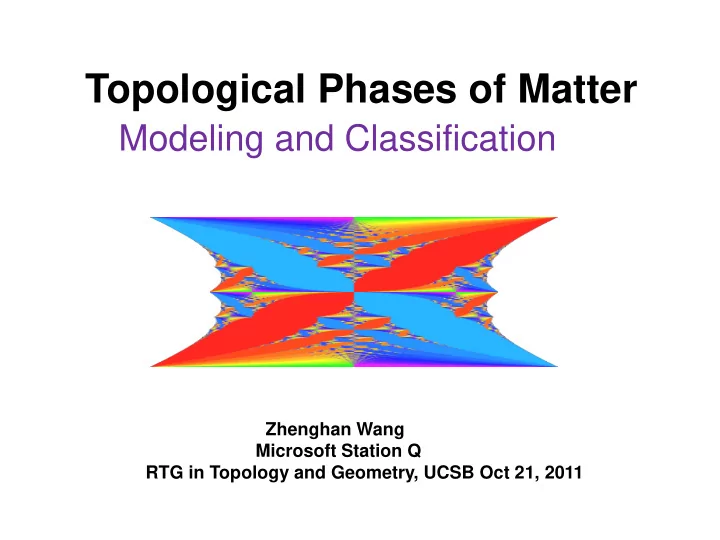
Fractal phase diagram of the Hofstadter model Each of the infinite phases is characterized by the Chern number of its Hall conductance. Warm colors indicate positive Chern numbers; cool colors, negative numbers, and white region Chern numbers=0 H-axis=chemical potential, V-axis=magnetic flux
Remarks: 1. Low energy physics might be modeled only partially 2. Stability is related to energy gap
Given a quantum theory H on a physical space Y with Hilbert space 𝑀𝑍 ⨁Vi(Y), where Vi(Y) has energy 𝜇𝑗, and V0(Y) is the ground state manifold. If H is topological, then the functor Y V(Y) is a part of a TQFT. Classification of topological phases of
e.g. n=2, V(Y)=C[𝐼1(Y;𝑎2)]
1980 Integral Quantum Hall Effect (QHE)---von Klitzing (1985 Nobel, now called Chern Insulators) 1982 Fractional QHE---Stormer, Tsui, Gossard at ν=1/3 (1998 Nobel for Stormer, Tsui and Laughlin) 1987 Non-abelian FQHE???---R. Willet et al at ν=5/2 (All are more or less Witten-Chern-Simons TQFTs)
N electrons in a plane bound to the interface between two semiconductors immersed in a perpendicular magnetic field
Fundamental Hamiltonian:
H =1
𝑂 1 2𝑛 [𝛼 𝑘−q A(𝑨𝑘)] 2 +𝑊 𝑐(𝑨𝑘)} + 𝑘<𝑙V(𝑨𝑘-𝑨𝑙)
Model Hamiltonian:
H=1
𝑂 1 2𝑛 [𝛼 𝑘−q A(𝑨𝑘)] 2 } + ?, e.g. 𝑘<𝑙 (𝑨𝑘-𝑨𝑙) 𝑨𝑘 position of j-th electron
Classes of ground state wave functions that have similar properties or no phase transitions as N (N 1011 𝑑𝑛−2) Interaction is dynamical entanglement and quantum order is materialized entanglement
On a new action of the magnet on electric currents
force which urges a conductor carrying a current across the lines of magnetic force, acts, not on the electric current, but on the conductor which carries it…”
These experimental data, available to the public 3 years before the discovery of the quantum Hall effect, contain already all information of this new quantum effect so that everyone had the chance to make a discovery that led to the Nobel Prize in Physics 1985. The unexpected finding in the night of 4./5.2.1980 was the fact, that the plateau values in the Hall resistance x-y are not influenced by the amount of localized electrons and can be expressed with high precision by the equation 𝑆𝐼 =
ℎ
𝑓2 New Method for High-Accuracy Determination of the Fine-Structure Constant Based on Quantized Hall Resistance,
Birth of Integer Quantum Hall Effect
In 1998, Laughlin, Stormer, and Tsui are awarded the Nobel Prize
“ for their discovery of a new form
charged excitations.”
position of the last IQHE between two fingers of
feature in this unit. He determined it to be three and exclaimed, “quarks!” H. Stormer The FQHE is fascinating for a long list of reasons, but it is important, in my view, primarily for one: It established experimentally that both particles carrying an exact fraction of the electron charge e and powerful gauge forces between these particles, two central postulates of the standard model of elementary particles, can arise spontaneously as emergent phenomena. R. Laughlin
Fractional Quantum Hall Effect
How Many Fractions Have Been Observed? 80
1/3 1/5 1/7 1/9 2/11 2/13 2/15 2/17 3/19 5/21 6/23 6/25 2/3 2/5 2/7 2/9 3/11 3/13 4/15 3/17 4/19 10/21 4/3 3/5 3/7 4/9 4/11 4/13 7/15 4/17 5/19 5/3 4/5 4/7 5/9 5/11 5/13 8/15 5/17 9/19 7/3 6/5 5/7 7/9 6/11 6/13 11/15 6/17 10/19 8/3 7/5 9/7 11/9 7/11 7/13 22/15 8/17 8/5 10/7 13/9 8/11 10/13 23/15 9/17 11/5 12/7 25/9 16/11 20/13 12/5 16/7 17/11 19/7 m/5, m=14,16, 19 Pan et al (2008)
5/2 7/2 19/8 =
𝑂𝑓 𝑂
filling factor or fraction 𝑂𝑓 = # of electrons 𝑂 =# of flux quanta
How to model the quantum state(s) at a filling fraction? What are the electrons doing at a plateau?
another electron
3 1/3 /4
i i
z z i j i j
/4 2 5/2
i j
z z i j i j i j
ν=1/3
ν=5/2 ?
U(1)-WCS theory, abelian anyons
Moore-Read
Ising TQFT or “SU(2)2” WCS theory, non-abelian anyons
Wave functions of bosonic FQH liquids
(z1,…,zN) is a polynomial (Ignore Gaussian)
symmetric=anti-symmetric divided by 𝑗<𝑘(zi-zj)
(z1+c,…,zN+c) = (z1,…,zN) for any c
=lim
𝑂 𝑂
, where 𝑂 is max degree of any zi
Conformal blocks of CFTs TQFTs
Physical Thm: Topological properties of abelian bosonic FQH liquids are modeled by Witten-Chern-Simons theories with abelian gauge groups 𝑈𝑜. Conjecture: Topological properties of FQH liquids at =2+
𝑙 𝑙+2 are modeled (partially) by 𝑇𝑉(2)𝑙-WCS theories.
k=1,2,3,4, =
7 3, 5 2, 13 5 , 8
Introduce Majorana operators 𝑰𝒀=𝒋
𝟓 j,k xj,k 𝜹𝒌+𝜹𝒍
“Gapped” , and “local”: the hopping matrix local xj,k =0 if |j-k| large.
Symm\Dim d 1 2 3 Q ZxU/UxU U ZxU/UxU U Q+SLS U ZxU/UxU U ZxU/UxU No or P.H.S O/U O ZxO/OxO U/O T only U/Sp O/U O ZxO/OxO T and Q Sp/SpxSpxZ U/Sp O/U O Three -1 Sp Sp/SpxSpxZ U/Sp O/U Four Sp/U Sp Sp/SpxSp xZ U/Sp Five U/O Sp/U Sp Sp/SpxSp xZ Six Zx O/OxO U/O Sp/U Sp Seven O Zx O/OxO U/O Sp/U
Symm\Dim d 1 2 3 A Z Z IQHE AIII Z Z D 𝑎2 𝑎2 Z DIII 𝑎2 𝑎2 HgTe Z AII Z 𝑎2 𝑎2 CII Z 𝑎2 C Z CI Z AI Z BDI 𝑎2 Z
Not equal
Laughlin 1983 Good trial wavefunction for N electrons at zi in ground state
𝟐/𝟒 i<j(zi-zj)3 e-i|zi|2/4
Physical Theorem:
Experimental Confirmation:
e/3 e/3 e i/3 𝟐/𝟒 k(𝟏-zj)3 i<j(zi-zj)3 e-i|zi|2/4 k(𝟐-zj) k(𝟑-zj) k(𝟒-zj) i<j(zi-zj)3 e-i|zi|2/4 n anyons at well-separated 𝑗, i=1,2,.., n, there is a unique ground state
Given n anyons of type x in a disk D, their ground state degeneracy dim(V(D,x,…,x))=𝐸𝑜𝑒𝑜 The asymptotic growth rate d is called the quantum dimension.
An anyon d=1 is called an abelian anyon, e.g. Laughlin anyon, d=1 An anyon with d >1 is an non-abelian anyon, e.g. the Ising anyon , d= 2. For n even, 𝐸𝑜=
1 2 2
𝑜 2 with fixed boundary conditions,
n odd, 𝐸𝑜=2
𝑜−1 2 . (Nayak-Wilczek 96)
Degeneracy for non-abelian anyons in a disk grows exponentially with # of anyons, while for an abelian anyon, no degeneracy---it is always 1.
…….
Pfaffian of a 2n2n anti-symmetric matrix M=(𝑏𝑗𝑘) is 𝑜 =n! Pf (M) d𝑦1d𝑦2…d𝑦2𝑜 if =𝑗<𝑘 𝑏𝑗𝑘 d𝑦𝑗 d𝑦𝑘
Physical Theorem:
1. Pfaffian state is gapped 2. Elementary excitations are non-abelian anyons, called Ising anyon …… Read 09
MR (maybe some variation) is a good trial state for 5/2
A landmark (physical) proof for the MR state
“Now we eagerly await the next great step: experimental confirmation.” ---Wilczek
Experimental confirmation of 5/2: gap and charge e/4 , but non-abelian anyons ???
Put a theory H on a closed surface Y with anyons a1, a2, …, an at 1,…,n (punctures), the (relative) ground states of the system “outside” 1,…,n is a Hilbert space V(Y; a1, a2, …, an). For anyons in a surface w/ boundaries (e.g. a disk), the boundaries need conditions. Stable boundary conditions correspond to anyon types (labels, super-selection sectors, topological charges). Moreover, each puncture (anyon) needs a tangent direction, so anyon is modeled by a small arrow (combed point), not just a point.
label l
Moore-Seiberg, Walker, Turaev,… Let L={a,b,c,…d} be the labels (particle types), a a*, and a**=a, 0 (or 1) =trivial type Disk Axiom: V(D2; a)=0 if a 0, C if a=0 Annulus Axiom: V(A; a,b)=0 if a b*, C if a=b* Gluing Axiom: V(Y; l) 𝑦𝑀 V(𝑍
𝑑𝑣𝑢; l,x,𝑦∗)
a a b x 𝑦∗
L={a,b,c,…d} a label set and 𝑄𝑏𝑐,𝑑 a pair of pants labeled by a,b,c. 𝑂𝑏𝑐,𝑑=dim V(𝑄𝑏𝑐,𝑑), then 𝑂𝑏𝑐,𝑑 is the fusion rule of the theory. c ab=𝑂𝑏𝑐,𝑑c
Every surface Y can be cut into disks D, annuli A, and pairs of pants. If V(D), V(A), V(𝑄𝑏𝑐,𝑑) are known, then V(Y) is determined by the gluing axiom. Conversely a TQFT can be constructed from V(Y) of disk, annulus and pair of
Unitary modular categories are algebraic data of unitary (2+1)-TQFTs and algebraic theories of anyons: anyon=simple object, fusion=tensor product, statistics of anyons are representations of the mapping class groups. a b
joint work w/ E. Rowell and R. Stong
A 1 Trivial A 2 Semion NA 2 Fib BU A 2 (U(1),3) NA 8 Ising NA 2 (SO(3),5) BU A 5 Toric code A 4 (U(1),4) NA 4 Fib x Semion BU NA 2 (SO(3),7) BU NA 3 DFib BU
The ith-row is the classification of all rank=i unitary modular tensor categories. Middle symbol: fusion rule. Upper left corner: A=abelian theoy, NA=non-
left corner BU=there is a universal braiding anyon.
Mathematically, define and classify unitary TQFTs
“All physics is geometry”---J. A. Wheeler Quantum topology + Quantum geometry to better understand quantum phases of matter
initialize create anyons applying gates braiding particles readout fusion Computation Physics
Topological Quantum Computation