Predictive Parsers LL(k) Parsing Can we avoid backtracking? Yes, if - - PDF document

predictive parsers ll k parsing
SMART_READER_LITE
LIVE PREVIEW

Predictive Parsers LL(k) Parsing Can we avoid backtracking? Yes, if - - PDF document

10/17/2012 Predictive Parsers LL(k) Parsing Can we avoid backtracking? Yes, if for a given input symbol and given non- LL(k) terminal, we can choose the alternative appropriately. L left to right scan L leftmost derivation


slide-1
SLIDE 1

10/17/2012 1

Predictive Parsers

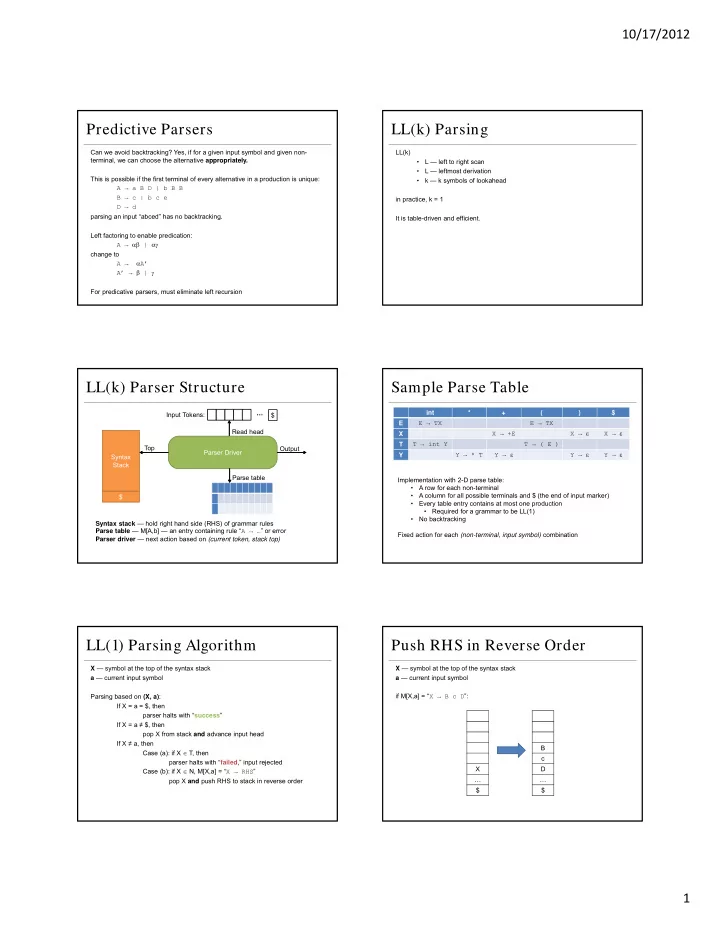
Can we avoid backtracking? Yes, if for a given input symbol and given non- terminal, we can choose the alternative appropriately. This is possible if the first terminal of every alternative in a production is unique: A → a B D | b B B B → c | b c e D → d parsing an input “abced” has no backtracking. Left factoring to enable predication: A →  |  change to A → A’ A’ →  |  For predicative parsers, must eliminate left recursion

LL(k) Parsing

LL(k)

  • L — left to right scan
  • L — leftmost derivation
  • k — k symbols of lookahead

in practice, k = 1 It is table-driven and efficient.

LL(k) Parser Structure

$ … Read head Syntax Stack $ Parser Driver Parse table Output Top Input Tokens: Syntax stack — hold right hand side (RHS) of grammar rules Parse table — M[A,b] — an entry containing rule “A → …” or error Parser driver — next action based on (current token, stack top)

Sample Parse Table

int * + ( ) $ E E → TX E → TX X X → +E X →  X →  T T → int Y T → ( E ) Y Y → * T Y →  Y →  Y →  Implementation with 2-D parse table:

  • A row for each non-terminal
  • A column for all possible terminals and $ (the end of input marker)
  • Every table entry contains at most one production
  • Required for a grammar to be LL(1)
  • No backtracking

Fixed action for each (non-terminal, input symbol) combination

LL(1) Parsing Algorithm

X — symbol at the top of the syntax stack a — current input symbol Parsing based on (X, a): If X = a = $, then parser halts with “success” If X = a ≠ $, then pop X from stack and advance input head If X ≠ a, then Case (a): if X  T, then parser halts with “failed,” input rejected Case (b): if X  N, M[X,a] = “X → RHS” pop X and push RHS to stack in reverse order

Push RHS in Reverse Order

X — symbol at the top of the syntax stack a — current input symbol if M[X,a] = “X → B c D”: X … $ B c D … $

slide-2
SLIDE 2

10/17/2012 2

LL(1) Grammars

Remove left recursive and perform left factoring Given the grammar: E → T + E | T T → int * T | int | ( E ) The grammar has no left recursion but requires left factoring. After rewriting grammar, we have: E → TX X → + E |  T → int Y | ( E ) Y → * T | 

LL(1) Parsing

E $ int * int $ int * + ( ) $ E E → TX E → TX X X → +E X →  X →  T T → int Y T → ( E ) Y Y → * T Y →  Y →  Y →  Parse table Input Tokens: Top Read head

LL(1) Parsing

E $ int * int $ int * + ( ) $ E E → TX E → TX X X → +E X →  X →  T T → int Y T → ( E ) Y Y → * T Y →  Y →  Y →  Parse table Input Tokens: Top Read head

LL(1) Parsing

T X $ int * int $ int * + ( ) $ E E → TX E → TX X X → +E X →  X →  T T → int Y T → ( E ) Y Y → * T Y →  Y →  Y →  Parse table Input Tokens: Top Read head

LL(1) Parsing

T X $ int * int $ Parse table Input Tokens: Top Read head int * + ( ) $ E E → TX E → TX X X → +E X →  X →  T T → int Y T → ( E ) Y Y → * T Y →  Y →  Y → 

LL(1) Parsing

int Y X $ int * int $ Parse table Input Tokens: Top Read head int * + ( ) $ E E → TX E → TX X X → +E X →  X →  T T → int Y T → ( E ) Y Y → * T Y →  Y →  Y → 

slide-3
SLIDE 3

10/17/2012 3

LL(1) Parsing

Y X $ int * int $ Parse table Input Tokens: Top Read head int * + ( ) $ E E → TX E → TX X X → +E X →  X →  T T → int Y T → ( E ) Y Y → * T Y →  Y →  Y → 

LL(1) Parsing

Y X $ int * int $ Parse table Input Tokens: Top Read head int * + ( ) $ E E → TX E → TX X X → +E X →  X →  T T → int Y T → ( E ) Y Y → * T Y →  Y →  Y → 

LL(1) Parsing

* T X $ int * int $ Parse table Input Tokens: Top Read head int * + ( ) $ E E → TX E → TX X X → +E X →  X →  T T → int Y T → ( E ) Y Y → * T Y →  Y →  Y → 

LL(1) Parsing

T X $ int * int $ Parse table Input Tokens: Top Read head int * + ( ) $ E E → TX E → TX X X → +E X →  X →  T T → int Y T → ( E ) Y Y → * T Y →  Y →  Y → 

LL(1) Parsing

T X $ int * int $ Parse table Input Tokens: Top Read head int * + ( ) $ E E → TX E → TX X X → +E X →  X →  T T → int Y T → ( E ) Y Y → * T Y →  Y →  Y → 

LL(1) Parsing

int Y X $ int * int $ Parse table Input Tokens: Top Read head int * + ( ) $ E E → TX E → TX X X → +E X →  X →  T T → int Y T → ( E ) Y Y → * T Y →  Y →  Y → 

slide-4
SLIDE 4

10/17/2012 4

LL(1) Parsing

Y X $ int * int $ Parse table Input Tokens: Top Read head int * + ( ) $ E E → TX E → TX X X → +E X →  X →  T T → int Y T → ( E ) Y Y → * T Y →  Y →  Y → 

LL(1) Parsing

X $ int * int $ Parse table Input Tokens: Top Read head int * + ( ) $ E E → TX E → TX X X → +E X →  X →  T T → int Y T → ( E ) Y Y → * T Y →  Y →  Y → 

LL(1) Parsing

$ int * int $ Parse table Input Tokens: Top Read head int * + ( ) $ E E → TX E → TX X X → +E X →  X →  T T → int Y T → ( E ) Y Y → * T Y →  Y →  Y → 

LL(1) Parsing

$ int * int $ Parse table Input Tokens: Top Read head int * + ( ) $ E E → TX E → TX X X → +E X →  X →  T T → int Y T → ( E ) Y Y → * T Y →  Y →  Y → 

Accept!

Action List

Stack Input Action E $ int * int $ E → TX T X $ int * int $ T → int Y int Y X $ int * int $ terminal Y X $ * int $ Y → * T * T X $ * int $ terminal T X $ int $ T → int Y int Y X $ int $ terminal Y X $ $ Y →  X $ $ X →  $ $ Halt and accept

Constructing the Parse Table

We need to know what non-terminals to place our productions in the table? We know that we have restricted our grammars so that left recursion is eliminated and they have been left factored. That means that each production is uniquely recognizable by the first terminal that production would derive. Thus, we can construct our table from 2 sets:

  • For each symbol A, the set of terminals that can begin a string derived

from A. This set is called the FIRST set of A

  • For each non-terminal A, the set of terminals that can appear after a

string derived from A is called the FOLLOW set of A

slide-5
SLIDE 5

10/17/2012 5

First()

First() = set of terminals that start string of terminals derived from . Apply following rules until no terminal or  can be added

  • 1. If t  T, then First( t ) = { t }.

For example First( + ) = { + }.

  • 2. If X  N and X →  exists (nullable), then add  to First( X ).

For example, First( Y ) = { *, }.

  • 3. If X  N and X → Y1Y2Y3 … Ym, where Y1, Y2, Y3, ... Ym are non-

terminals, then: for each i from 1 to m if Y1… Yi-1are all nullable (or if i = 1) First( X ) = First( X ) ∪ First( Yi )

Follow()

Follow( ) = { t | S ⇒ * t  }

  • Intuition: if X → A B, then First( B ) ⊆ Follow( A )
  • However, B may be  i.e.,

⇒ Apply following rules until no terminal or  can be added

  • 1. $  Follow( S ), where S is the start symbol.

e.g., Follow( E ) = {$ ... }.

  • 2. Look at the occurrence of a non-terminal on the right hand side of a

production which is followed by something If A →  B , then First( ) - {} ⊆ Follow( B )

  • 3. Look at N on the RHS that is not followed by anything,

if (A →  B) or (A →  B  and   First( )), then Follow( A ) ⊆ Follow( B )

Algorithm to Compute FIRST, FOLLOW, and nullable

Initialize FIRST and FOLLOW to all empty sets, and nullable to all false. foreach terminal symbol Z FIRST[Z] ← {Z} do foreach production X → Y1Y2 … Yk if Y1 … Yk are all nullable (or if k = 0) then nullable[X] ← true foreach i from 1 to k, each j from i + 1 to k if Y1 … Yi−1 are all nullable (or if i = 1) then FIRST[X] ← FIRST[X] ∪ FIRST[Yi] if Yi+1 … Yk are all nullable (or if i = k) then FOLLOW[Yi] ← FOLLOW[Yi] ∪ FOLLOW[X] if Yi+1 … Yj−1 are all nullable (or if i + 1 = j ) then FOLLOW[Yi] ← FOLLOW[Yi] ∪ FIRST[Yj ] until FIRST, FOLLOW, and nullable did not change in this iteration.

Example

Grammar: E → T X X → + E |  T → int Y | ( E ) Y → * T |  First Set: E → T X X → + E X →  T → int Y T → ( E ) Y → * T Y →  Follow Set: $ E → T X X → + E T → int Y T → ( E ) Y → * T Symbol First Follow ( ( ) ) + + * * int Int Y *,  $, ), + X +,  $, ) T (, int $, ), + E (, int $, )

Constructing LL(1) Parse Table

To construct the parse table, we check each A → 

  • For each terminal a  First(), add A →  to M[A, ].
  • If   First(), then for each terminal b  Follow(A),
  • add A →  to M[A, ].
  • If   First() and $  Follow(A), then add A →  to M[A, $].

Constructing LL(1) Parse Table

For each terminal a  First(), add A →  to M[A, ]. Grammar: E → T X X → + E X →  T → int Y T → ( E ) Y → * T Y → 

Symbol First Follow ( ( ) ) + + * * int int Y *,  $, ), + X +,  $, ) T (, int $, ), + E (, int $, )

int * + ( ) $ E E → T X E → T X X X → + E T T → int Y T → ( E ) Y Y → * T

slide-6
SLIDE 6

10/17/2012 6

Constructing LL(1) Parse Table

If   First(), then for each terminal b  Follow(A), add A →  to M[A, ]. Grammar: E → T X X → + E X →  T → int Y T → ( E ) Y → * T Y →  int * + ( ) $ E E → T X E → T X X X → + E X →  T T → int Y T → ( E ) Y Y → * T Y →  Y → 

Symbol First Follow ( ( ) ) + + * * int int Y *,  $, ), + X +,  $, ) T (, int $, ), + E (, int $, )

Constructing LL(1) Parse Table

If   First() and $  Follow(A), then add A →  to M[A, $]. Grammar: E → T X X → + E X →  T → int Y T → ( E ) Y → * T Y →  int * + ( ) $ E E → T X E → T X X X → + E X →  X →  T T → int Y T → ( E ) Y Y → * T Y →  Y →  Y → 

Symbol First Follow ( ( ) ) + + * * int int Y *,  $, ), + X +,  $, ) T (, int $, ), + E (, int $, )

Is a Grammar LL(1)?

Observation If a grammar is LL(1), then each of its LL(1) table entries contain at most one rule. Otherwise, it is not LL(1) Two methods to determine if a grammar is LL(1) or not:

  • 1. Construct LL(1) table, and check if there is a multi-rule entry
  • r
  • 2. Check each rule as if the table were being constructed:

G is LL1(1) iff for a rule A →  a) First() ∩ First() = ∅ b) at most one of  and  can derive  c) If  derives , then First() ∩ Follow() = ∅

Ambiguous Grammars

Some grammars may need more than one token of lookahead (k). However, some grammars are not LL regardless of how the grammar is changed. S → if C then S | if C then S else S | … C → b change to S → if C then S X | … X → else S |  C → b problem sentence: “if b then if b then a else a” “else”  First(X) First(X)- ⊆ Follow(S) X → else ... |  “else”  Follow(X)

Removing Ambiguity

To remove ambiguity, it is possible to rewrite the grammar. For the “if-then-else” example, how to rewrite? May not even need to rewrite in this case, we can just use the X → else S production over the X →  However, by changing the grammar,

  • It might make the other phases of the compiler more difficult
  • It becomes harder to determine semantics and generate code
  • It is less appealing to programmers

LL(1) Summary

LL(1) parsers operate in linear time and at most linear space relative to the length

  • f input because:

Time — each input symbol is processed constant number of times Space — stack is smaller than the input (in case we remove X → )

slide-7
SLIDE 7

10/17/2012 7

Summary

First and Follow sets are used to construct predictive parsing tables Intuitively, First and Follow sets guide the choice of rules:

  • For non-terminal A and input t, use a production rule A →  where t 

First()

  • For non-terminal A and input t, if A →  and t  Follow(A), use the

production A →  where   First() What is LL(0)? Why are LL(2) ... LL(k) are not widely used ?