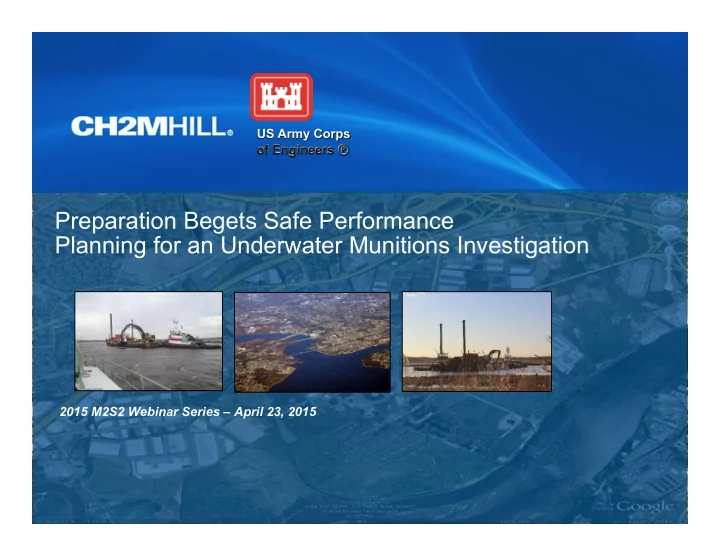
Preparation Begets Safe Performance Planning for an Underwater - - PowerPoint PPT Presentation

preparation begets safe performance planning for an
SMART_READER_LITE
LIVE PREVIEW

Preparation Begets Safe Performance Planning for an Underwater - - PowerPoint PPT Presentation

Preparation Begets Safe Performance Planning for an Underwater Munitions Investigation 2015 M2S2 Webinar Series April 23, 2015 Former Raritan Arsenal The former Raritan Arsenal covers approximately 3,200 acres of central New Jersey


slide-1
SLIDE 1

Preparation Begets Safe Performance Planning for an Underwater Munitions Investigation

2015 M2S2 Webinar Series – April 23, 2015

slide-2
SLIDE 2

Former Raritan Arsenal

  • The former Raritan Arsenal covers

approximately 3,200 acres of central New Jersey and lies alongside the Raritan River.

  • The vast majority of the former arsenal

is located in Woodbridge Township, within Middlesex County, approximately 20 miles south of lower Manhattan, New York City.

  • From 1917 to 1963, the arsenal

functioned as a manufacturing, warehousing and transportation center – storing, handling and shipping various classes of ordnance and military supplies.

slide-3
SLIDE 3

Former Raritan Arsenal

  • The Raritan River provided significant

access for shipments across the Atlantic Ocean to the European theater during WWI and WWII, and as a result infrastructure was established along the river to load and offload ships.

  • The lower Raritan River was periodically

dredged to maintain a channel and turning basin for ships loading and unloading at the arsenal.

  • Discarded military munitions (DMM)

discovered in the dredge spoils indicated that the river had the potential to contain munitions.

  • Dredge spoils were deposited on former

arsenal property as well as on the

  • pposing side of the river.
slide-4
SLIDE 4

~ ~

~

Planning and Underwater Investigation ~ The Three Phases of Control

Follow Up Phase Completed Mar 2014

  • the Follow-Up Phase occurs throughout

the task. For this phase, you should be monitoring the work on a daily basis to assure that all job requirements are being met in a timely manner, and verifying that the tasks are being performed correctly up until their completion Initial Phase Completed Feb 2014

  • the Initial Phase occurs just prior to

giving the go-ahead to begin work and ensures that the task will start correctly. For this phase, you should be checking all requirements for personnel, materials and equipment are in place.

Preparatory Phase Completed Jan 2014

  • the Preparatory Phase occurs usually days or

weeks in advance, before you begin each construction task or DFOW. For this phase, you should be reviewing all the requirements for the task, assessing the current situation, inspecting the jobsite, and reviewing the findings with your staff, subcontractors and your client.

slide-5
SLIDE 5

Preparatory Phase ~ Planning an Underwater Investigation

  • In 2013, during the remedial work planning process,

the USACE and CH2M HILL began a separate planning process for the underwater investigation of DMM in Areas 12 and 13.

  • The investigation would be performed using a long-

reach excavator mounted onto a barge platform with GPS positioning for location control. This was a new application of existing tools for stakeholders.

  • Implementing the three-phase control system, the

preparatory phase included: – Reviewing the requirements for the task, and discussing the proposed technical approach with all stakeholders. – The scope of the work was defined and site conditions reviewed. – Project instructions and Activity hazard analyses were developed and reviewed. – Preparatory meetings and conference calls were held weekly with key participants. – Roles and responsibilities were developed and agreed to. – Contact lists were developed.

slide-6
SLIDE 6

Key Participants

  • Edison Township
  • Borough of Sayreville
  • New Jersey DEP
  • UXOPro
  • Neptune RTS
  • Federal Business Centers
  • Summit Associates
  • General public
  • CH2M HILL (Mark

Callaghan, David Nelson, George DeMetropolis, Tamir Klaff)

  • USA Environmental
  • Landmark Surveying
  • NAEVA and 3D

Geophysics

  • Weeks Marine
  • USACE (Dorothy Richards,

Sandra Piettro, Debra Edwards, Brett Frazier, Emmet Hopkins)

  • US Coast Guard (LT.

Hanna Eko)

Federal Government Contractors State and Local Government

Stakeholders

slide-7
SLIDE 7

Neptune Regional Transmission System ~ Avoiding a High Voltage Power Cable

  • During the preparatory phase it was learned

that the river, although maintained and used for general transportation, also included utility corridors, and most significantly a high voltage underground power cable.

  • The Neptune RTS is a 65 mile undersea and

underground high voltage direct current line that provides 660MW of power to Long Island electricity consumers, approximately 600,000 homes and businesses, and provides more than 20% of Long Island’s electricity demand.

  • The cable system consists of three cables: a

main high voltage cable that carries up to 660MW of electricity at 550 kV, a medium- voltage return cable (for carrying current in a DC system) and fiber-optic cable.

  • The three cables are bundled and buried

4-6ft under the river and sea bed.

slide-8
SLIDE 8

Initial Phase ~ Ongoing Planning

  • Although this new information regarding the buried

cable was surprising, the team (which now included representatives for the Neptune RTS) smoothly discussed and incorporated the details into the overall planning process.

  • Meeting minutes and major documents (i.e., the work

plan and explosives site plan) included the new information developed during the preparatory phase, which allowed key stakeholders the opportunity to review and accept the planned approaches.

  • The initial phase of the project was completed at the

end of the field mobilization and as part of practice runs through the tasks.

  • Testing and practice was completed in February 2014,

discussion and review of practice measures were completed to ensure compliance with the quality plan. Once the team of subcontractors and stakeholders were satisfied, and any conflicts resolved, mobilization to the site began.

slide-9
SLIDE 9

Follow Up Phase ~ Underwater Digital Geophysical Mapping

  • Initially, underwater Digital

Geophysical Mapping (DGM) was conducted using the EM61-Flex3 time domain electromagnetic induction detector.

  • This was operated using the

3Dgeophysics (3Dg) Underwater UXO Towed Array (UUTA), with a Trimble 5700 real time kinematic (RTK) Global Positioning System (GPS), and a Trimble AgGPS FmX integrated navigation system.

slide-10
SLIDE 10

geostatistical density mapping tool in Visual Sample Plan (Pacific Northwest National Laboratory, 2013) to extrapolate the anomaly densities from the underwater DGM survey.

  • Based on the anomaly distribution and

density mapping, clusters of anomalies were identified for investigation to determine if MEC/MPPEH was present.

  • In consultation with representative from the

Neptune RTS, a 10-meter wide safety buffer was established either side of the high voltage power cable, and the team agreed no anomalies would be investigated within this safety buffer.

Follow Up Phase ~ Geophysical Evaluation

  • CH2M HILL geophysicists used the
slide-11
SLIDE 11

Follow Up Phase ~ Beginning the Intrusive Investigation

  • The US Coast Guard established a

Hazard Fragmentation Distance (HFD) = 450ft

safety zone within the waters of the Raritan River to provide for the protection of the maritime public and safety of navigation during removal of potentially explosive hazards in the Raritan River.

  • This safety zone restricted

unauthorized persons and vessels from travelling through or conducting underwater activities while the munitions investigation was on-going.

  • During the active investigation,

entry control points were established on land, additionally boats were also positioned in the river, and used to enforce the safety exclusion zones.

slide-12
SLIDE 12

Follow Up Phase ~ Intrusive Investigation

  • Within the cab of the excavator, a “3D indicate

guidance” system was used, which consisted of a cab mounted computer programed with the design position of the anomalies.

  • A dual-antenna RTK-GPS system was mounted on

the excavator, and angle sensors mounted on the body, boom, stick and clamshell-bucket.

  • RTK-GPS on the tug-boat was initially used to

position the barge at the location of the anomaly or anomaly cluster for investigation.

  • The excavator operator was then able to move the

clam-shell to the designated coordinates by utilizing the navigation system provided on the onboard computer.

  • Metallic debris removed from the river sediments

was then evaluated by UXO technicians after being placed on a raised screening table.

slide-13
SLIDE 13

Follow Up Phase

  • The Follow Up Phase included daily

check and reviews of the work process to ensure that the safety, control, and quality procedures were being maintained.

  • Daily production and quality control

reports kept the team and stakeholders aware of the progress and control on the project.

  • As a result of the extensive

preparation and planning processes enacted and agreed to by the entire team, the project was completed with no technical or safety related issues.

  • Only non-munitions scrap was

recovered from the metallic anomalies identified within the Raritan River. No MEC/MPPEH was recovered.

slide-14
SLIDE 14

Author/Presenter and Co-Authors

slide-15
SLIDE 15

Question & Answer Session