Preparing kids for their financial futures Simon Brown | COO - - PowerPoint PPT Presentation

preparing kids for their
SMART_READER_LITE
LIVE PREVIEW

Preparing kids for their financial futures Simon Brown | COO - - PowerPoint PPT Presentation

Preparing kids for their financial futures Simon Brown | COO www.banqer.co FinTech Engagement Numerous innovative FinTech solutions in New Zealand Consumers need to have a basic level of financial capability to engage in these


slide-1
SLIDE 1

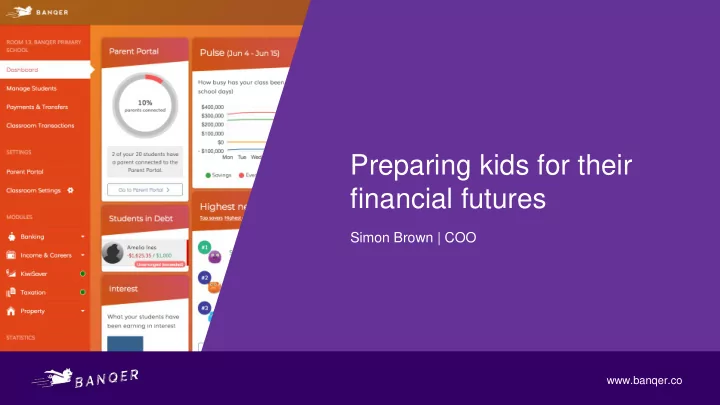
Preparing kids for their financial futures

Simon Brown | COO

www.banqer.co
slide-2
SLIDE 2

FinTech Engagement

  • Numerous innovative FinTech

solutions in New Zealand

  • Consumers need to have a basic

level of financial capability to engage in these products

www.banqer.co

slide-3
SLIDE 3

Ex-accountant, turned Software Developer Medbury School, Year 8 Team Lead

Let me take you back...

www.banqer.co

slide-4
SLIDE 4

www.banqer.co www.banqer.co

Why

  • Reliance on family
  • Students may understand some basic

financial concepts, but putting them into practice is another thing

www.banqer.co

slide-5
SLIDE 5

Ensure all kids are prepared for the financial world ahead

www.banqer.co

slide-6
SLIDE 6

Partnerships

www.banqer.co

slide-7
SLIDE 7

Reach

New Zealand Launched early 2015

850 schools 2,100 classrooms 61,000 students Australia Launched mid 2017 – 175 schools 320 classrooms 7,500 students

www.banqer.co

slide-8
SLIDE 8
  • Deepening and broadening our

social impact

  • Te reo Maori translation and

contextualisation

  • Exploring North America

www.banqer.co

Future

slide-9
SLIDE 9

Thanks!

– www.banqer.co @banqer_app

www.banqer.co

slide-10
SLIDE 10

Simon Brown

COO

Helena Lowe

NZ Sales Lead

Liz Phelan

AUS Sales Lead

Alex Miller

Developer

The Team

Kendall Flutey

CEO

Marc McHardy

Design Lead

Micah Hocquard

Pedagogy Lead

Ben Wigley

CTO

www.banqer.co

slide-11
SLIDE 11

www.banqer.co www.banqer.co www.banqer.co

What teachers say

slide-12
SLIDE 12

Personal

  • The best chance of making effective financial decisions and minimising the likelihood of being misled and

facing financial problems.(2)

  • Ignorance of basic financial concepts is linked to failing to plan for retirement, non-participation in the stock

market, and poor borrowing behaviour.(1) Societal

  • Financially secure families are better able to contribute to vital thriving communities and thereby foster further

community economic development. (1)

  • Financially literate consumers can make more informed decisions and demand higher quality services, which

will encourage competition and innovation in the market. (7)

  • Increase economic participation and social inclusion, drive competition and market efficiency in the financial

services sector, and potentially reduce regulatory intervention. (1)

  • Increasing financial literacy of the least financially literate by 10% would add $6bn per year to the Australian

economy and create 16,000 new jobs. (12)

Benefits of financial literacy

www.banqer.co

slide-13
SLIDE 13
  • The low overall level of financial literacy among young people should be of concern, particularly given the

profound impact financial literacy has on individuals’ ability to manage their money and maintain financial wellbeing (2)

  • The development and integration of financial habits and attitudes begin very early and probably before

children reach 7 years old (7)

  • Earlier financial education increases the likelihood of later financial education exponentially, with the latter

including informal education (1)

  • Financial education should start at school. People should be educated about financial matters as early as

possible in their lives (8)

  • Most 15-year-old students already have some experience with financial transactions, from using a bank

account to buying call-credit for their mobile phone. Developing the skills associated with financial literacy has thus become essential for young people on the brink of adulthood and poised to make complex financial decisions that could have an impact on the rest of their lives (15)

  • Having a bank account is associated with a higher score in financial literacy in many countries and
  • economies. On average, students in the 13 participating OECD countries and economies who hold a bank

account score 33 points higher than students who do not. This difference is largest in New Zealand (15)

Importance of starting early

www.banqer.co

slide-14
SLIDE 14

1. How Young New Zealanders Learn About Finance: A Longitudinal Study (Financial Education and Research Centre 2012) 2. Personal Financial Literacy Among High School Students in New Zealand, Japan and the United States (Economics Department University of Waikato 2013) 3. Financial literacy and its role in promoting a sound financial system (Reserve Bank Bulletin Vol 70 No 2, 2009) 4. Report on survey of financial literacy (Commission for Financial Literacy and Retirement Income 2012 ) 5. Financial Education Programmes in Schools (OECD, 2008) 6. PISA 2012 NZ Financial Literacy report (MOE 2014) 7. Financial Education for youth; The role of Schools (OECD 2014) 8. Improving Financial Literacy: Analysis of issues and policies (OECD 2005) 9. Improving financial literacy in Australian (Commonwealth Bank Foundation 2014)

References

www.banqer.co

slide-15
SLIDE 15
  • 10. Connected Learning: An Agenda for Research and Design (Connected Learning Research Network 2013)
  • 11. Towards a New End: New Pedagogies for Deep Learning (Fullan and Langworthy 2013)
  • 12. Improving financial literacy in Australian (Commonwealth Bank Foundation 2014)
  • 13. New Vision for Education: Unlocking the potential of technology (World Economic Forum, 2015)
  • 14. Making sense of financial capability surveys around the world (World Bank 2013)
  • 15. PISA 2012 results; Students and Money, Financial skills for the 21st century (OECD 2014)
  • 16. Advancing National Strategies for Financial Education (OECD 2103)
  • 17. High level principles on national strategies for Financial Education (INFE/OECD 2012)
  • 18. Financial education at School: international OECD/INFE guidelines (OECD 2011)
  • 19. The Economic Importance of Financial Literacy (Lusardi & Mitchell 2014, Journal of Economic Literature)

References cont.

www.banqer.co