SLIDE 1
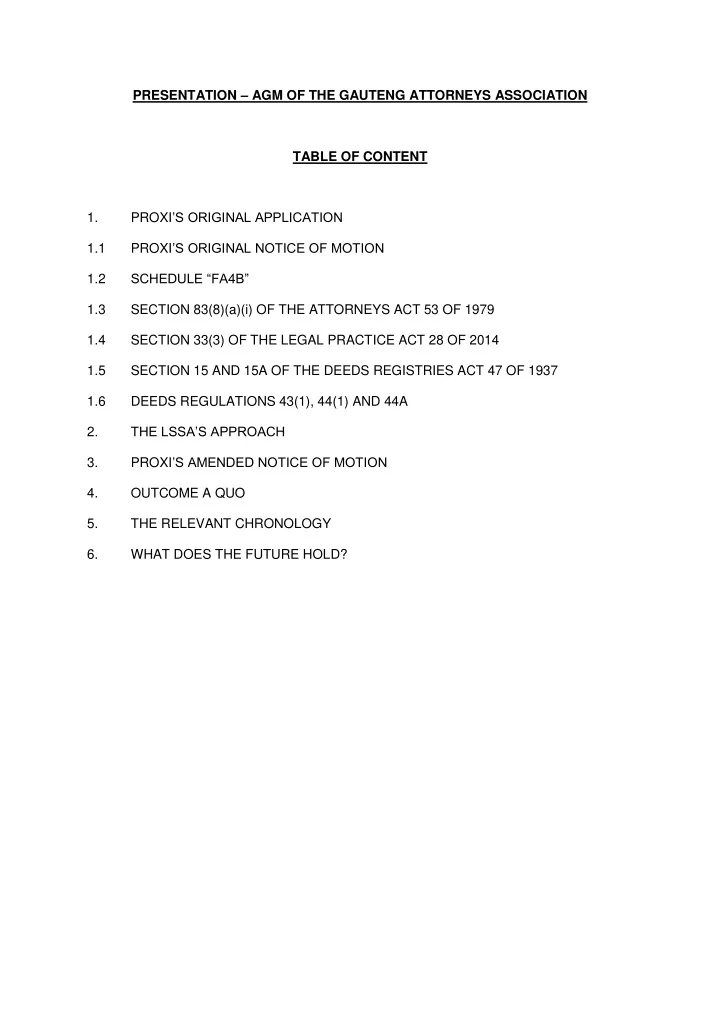
PRESENTATION – AGM OF THE GAUTENG ATTORNEYS ASSOCIATION TABLE OF CONTENT 1. PROXI’S ORIGINAL APPLICATION 1.1 PROXI’S ORIGINAL NOTICE OF MOTION 1.2 SCHEDULE “FA4B” 1.3 SECTION 83(8)(a)(i) OF THE ATTORNEYS ACT 53 OF 1979 1.4 SECTION 33(3) OF THE LEGAL PRACTICE ACT 28 OF 2014 1.5 SECTION 15 AND 15A OF THE DEEDS REGISTRIES ACT 47 OF 1937 1.6 DEEDS REGULATIONS 43(1), 44(1) AND 44A 2. THE LSSA’S APPROACH 3. PROXI’S AMENDED NOTICE OF MOTION 4. OUTCOME A QUO 5. THE RELEVANT CHRONOLOGY 6. WHAT DOES THE FUTURE HOLD?
SLIDE 2 P a g e | 2 1.
PROXI’S ORIGINAL APPLICATION
1.1
PROXI’S ORIGINAL NOTICE OF MOTION “1. Declaring that the performance of the steps involved in the process of transfer of
- wnership of immovable property (`the transfer process’) in accordance with the
model described more fully in the founding affidavit, and pursuant to which the Applicant performs the steps in the transfer process identified in schedule `FA4B’ hereto, does or would not: 1.1 Contravene or otherwise fall foul of: 1.1.1 s83(8)(a)(i) of the Attorneys Act 53 of 1979; 1.1.2 s33(3) of the Legal Practice Act 28 of 2014; 1.1.3 s15 and 15A of the Deeds Registries Act 47 of 1937 (`the Deeds Registries Act’); or 1.1.4 Regulations 43(1), 44(1) and 44A of the regulations made under the Deeds Registries Act and published in GN474 of 1963. 1.2 Otherwise constitute the performance by the Applicant of conveyancing work reserved by law to an attorney or conveyancer.”
1.2
SCHEDULE “FA4B” “SCHEDULE OF TASKS PERFORMED BY THE APPLICANT IN A TYPICAL TRANSFER OF IMMOVABLE PROPERTY TASK REMARKS CROSS
FA4A PRIOR TO CONCLUSION OF THE DEED OF SALE Proxi’s tasks commence from receipt of Proxi’s administration Services Appointment from the
- seller. This could occur prior to
the deed of sale being signed by seller and purchaser. 1 Proxi contacts the seller to obtain:
- a. A copy of the seller’s identity
document,
- b. Proof of the seller’s matrimonial
1
SLIDE 3 P a g e | 3
status,
details which could expedite the transfer process
- nce the deed of sale is
- delivered. These could include
FICA documents, tax documentation and banking details,
regarding a mortgage bond
the
- property. Proxi will notify the
seller
the benefits
providing the mortgagee bank with notice of cancellation of the existing mortgage to avoid penalties arising from insufficient notice
cancellation to the mortgagee bank. 2 In the event that the seller requests it, Proxi provides preliminary notice to the mortgagee bank as discussed at 1.d. 2 3 Proxi
a transfer administration file on its system in anticipation of receiving the signed deed of sale. This involves Proxi performing:
- a. an electronic search (available
to the public through various websites) on the property and seller and providing feedback to the estate agent if variances are found between the information provided by the seller in the Administration Services Appoint- ment and Proxi’s searches,
- b. creating an electronic FICA file
- f the seller’s information,
- c. capturing seller and property
details into the Proxi administration software capture fields
Proxi’s process administration software, Regarding 3.b. Proxi is an `accountable institution’ for FICA purposes (Schedule 1.12 to Act 38 of 2001). Regarding 3.c. The process administration software to be used by Proxi will not permit Proxi to perform any Reserve Work. 3 4 If the estate agency has captured buyer, seller or property-related information into the estate agency’s Estate agencies often capture client and property details on their office IT systems. This
SLIDE 4 P a g e | 4
transaction management software, then that data will populate Proxi’s process administration software capture fields by virtue of an API (i.e. an electronic interface) with Proxi. Proxi automatically verifies the estate agency-captured information and will follow up with the estate agency in the event
inconsistencies in information. Thus any issues in connection with the details of the identity of the seller or the property are resolved in advance of the sale, mitigating lost time later on. data can be utilised to populate Proxi’s data capture fields via a software interface between Proxi’s software and the estate agency software. Note: an API is an Application Programming Interface which allows one product or service to `talk to’ another product or service over the internet. AFTER DEED OF SALE IS RECEIVED FROM ESTATE AGENCY 5 A senior staff member of Proxi will:
- a. study the deed of sale and
establish the transaction timeline, potential bottlenecks and critical path (`the transfer program’) leading up to the agreed transfer date recorded in the deed of sale,
- b. program each step in the
transaction into Proxi’s work flow management system to ensure that each task is completed on time thereby assisting the `linked conveyancer’ (see the adjacent note) performing the Reserved work to procure timeous registration of transfer.
- c. upload a copy of the deed of
sale, Proxi’s Administration Services Appointment, the transfer program and the purchaser and/or seller’s FICA information to the e-HUB where the conveyancer performing the Reserved Work for the transfer and conveyancers performing linked (related) registrations will be given access to view or download documentation as applicable to their tasks and Regarding 5.a & b. Proxi will employ suitably experienced individuals to review the deeds
sale and program the sequence
the transfer documented in the deed of sale. Regarding 5.c. Proxi will provide a secure server on which it will house, in a document repository, transaction-specific information to be shared on a permissions basis with the `linked conveyancers’ appointed to register transfer and cancel
- r register bonds. `Linked
conveyancers’ include the conveyancer operating under a Legal Services Instruction, the conveyancer appointed by the bank to register the bank’s mortgage (`the bond attorney’)
- r the conveyancer instructed
by the current mortgagee bank to cancel the existing mortgage (`the bond cancellation attorney’). The server is referred to as the `e-HUB’ in this document. 5
SLIDE 5 P a g e | 5
responsibilities in the transaction. 6 As early as possible in the transfer process, Proxi contacts the local authority and/or body corporate for rates and/or levy clearance figures. Body corporates are approached for levy assess- ment should the property be part of a sectional title scheme. Different municipalities require different supporting documents when applying for rates clearance figures so it might not be possible to apply for figures at this stage in each case. If not, then it will be done as early as possible but preferably not later than the stage set out at para 20 below. 6 7 Proxi receives rates and/or levy clearance figures and a calculation is performed to prorate what is due between seller and purchaser based on the projected transfer or
The parties are each responsible for a portion of the clearance sum. 7 8 Proxi calculates the financial effects
- f the transfer for the purchaser
and seller. This information is set
- ut in a pro forma statement of
account for each party. The purchaser’s pro forma statement of account sets out, by way of illustration, the amount due to Proxi for its administration fee; amounts due to SARS for transfer duty and to the local authority for rates clearance; the deposit payable or paid on account of the purchase price; and the amount for which the purchaser’s bond will be registered, if applicable. The seller’s pro forma statement includes, by way of illustration, amounts due by the seller such as the estate agency’s commission and an amount to settle the existing home loan. The pro forma statement to the seller ensures that the seller’s
are adequately covered from the proceeds of sale, failing which Proxi asks the seller to make a payment equivalent to the shortfall into the seller’s client investment account. 8
SLIDE 6 P a g e | 6
(See the Remarks column relating to para 9 below for further detail in regard to the investment accounts
- pened in the name of the buyer
and seller respectively). 9 Proxi will prepare communications to:
- a. the conveyancer appointed by
the seller to perform the Reserved Work in terms of a Legal Services Instruction granted to the conveyancer directly from the seller. The communication will advise that Proxi is appointed by the seller to perform administration services in terms
an Administration Services Appointment, confirming that the seller has informed Proxi that the conveyancer is appointed to perform the Reserved Work in terms of the Legal Services Instruction and that the seller has required the transfer to be managed in accordance with the Parallel Mandate Management Agree- ment in place between the conveyancer and Proxi. The conveyancer will be provided with a password to gain access to the e-HUB on which the captured data source documents will be located. Source documents will include, by way of illustration, identity documents, FICA documents, proof of matrimonial status, deeds Registry printouts and searches and the like. The transfer program setting out Proxi’s service level timings and deliverables will also be located
conveyancer can then access whatever source documents he
- r she determines will be useful
in preparing the Reserved Work legal documents relating to that particular transfer.
- b. the purchaser advising that
If the property is a sectional title unit, a deeds search will be performed by conveyancer performing the Reserved Work to check on real rights of extension for the conveyancer to certify i.t.o. S15(B)3. 9
SLIDE 7 P a g e | 7
Proxi has been appointed by the seller to perform the Administration Services. Proxi will ask for proof of fulfilment of suspensive conditions and request date source documents such as identity documents and proof of address as part of Proxi’s required FICA process. Proxi also sends the purchaser a pro forma statement of account (for further information see para 8 above). Proxi opens a client investment account in the purchaser’s name and bank details are sent to the purchaser with a request to pay the amounts reflecting on the pro forma statement of account into the purchaser’s client investment account. The purchaser is sent Proxi’s banking mandate to sign and return to Proxi containing the purchaser’s instructions as to how Proxi is to manage the purchaser’s funds in processing the transfer together with all disclosures and other aspects as are required in terms of the Financial Services board’s requirements.
- c. the seller confirming that Proxi
has received the seller’s instructions to perform the administration services in terms
- f an Administration Services
Appointment and requesting any outstanding source docu-
- menttation. Proxi sends the
seller a pro forma statement of account (see para 8 above) and
- ther information relevant to the
- transfer. Proxi opens a client
investment account in the seller’s name and bank details are sent to the seller with a request to pay the amounts reflecting on the pro forma statement of account. The seller is also sent Proxi’s banking mandate to sign and return to Proxi containing the Proxi operates a client’s bank account under authority derived from the client’s banking
- mandate. Proxi’s external FSB
compliance officer is tasked with regular audits
Proxi’s activities under the banking mandates and Proxi’s auditors certify similar matters annually to the FSB. (This is in terms of ss 17 and 19 of the Financial Advisors and Intermediary Services Act 37 of 2002). As dealt with more fully in the founding affidavit, several categories of insurance are required – by the relevant banking institutions and the FSB as prerequisites for operating clients’ bank accounts.
SLIDE 8 P a g e | 8
seller’s instructions as to how Proxi is to manage the seller’s funds in processing the transfer and all such disclosures and
requirements
the Financial Services board.
- d. the existing mortgagee bank
notifying that a sale has been concluded in respect of the property, irrespective of whether
- r not preliminary notification
was given at the stage set out in para 2 above. The mortgagee bank will be asked to instruct its appointed attorneys to cancel the existing mortgage bond and to provide Proxi with copies of the title deed and existing bond and to provide details of the amount required to settle the
- utstanding home loan.
- e. the estate agency confirming
that Proxi has received the seller’s instructions to undertake the administration services in terms of the seller’s Admini- stration Services Appointment, that Proxi has received the deed of sale and that it has noted the estate agency’s sales commission that is payable against transfer. Arrangements are made as to who will instruct related service providers such as an entomologist, electrical installation inspector and
- thers. Where applicable, the
estate agency is asked to supply proof that the purchaser has paid the deposit on account
- f the purchase price into the
estate agency’s trust account and to confirm that the deposit will be available when called for before the lodgement date. The estate agency is required to provide its banking details for payment
the sales commission. 10 Proxi receives copies of the existing title deed, mortgage bond and the bank’s mortgage bond cancellation 13
SLIDE 9 P a g e | 9
figures with a request for a financial guarantee from a bank to settle the home loan balance against transfer and bond cancellation. These documents and requests come from the mortgage bank via the bond cancellation attorney. 11 Proxi uploads copies of the existing title deed, mortgage bond and the bank’s mortgage bond cancellation figures to the e-HUB for linked conveyancers to access as and when they consider it useful to do so. 14 12 Proxi receives notification and proof from the estate agency that the purchaser’s deposit has been received into the estate agency’s trust account, where applicable. 15 13 Proxi notifies the seller that the purchaser’s deposit has been received, where applicable. 16 14 Proxi receives notification from the estate agency that the purchaser’s bond is approved with a copy of the letter of approval. Proxi requests and receives notification that any
- ther conditions precedent are
fulfilled. 17 15 Proxi notifies the seller that the purchaser’s bond is approved and that any other conditions precedent are fulfilled. 18 16 Proxi receives a communication from the bond attorney with:
amount available
registration of the purchaser’s bond,
- b. a request for a `fly sheet’ (i.e.
the draft new title deed for the upcoming transfer). The fly sheet will be prepared by the conveyancer performing the Reserved Work and will be uploaded to the e-HUB, allowing the bond attorney access thereto. 19 17 Proxi will recheck the amount available on transfer and will advise the bond cancellation attorney of the amount available on transfer to satisfy the bond cancellation figures. The amount available will be a sum of the proceeds of the purchaser’s home loan, purchaser’s deposit on account
- f purchase price, and any
further cash contributions. Proxi regularly checks and recalculates the financial position of the transfer to ensure that all transaction creditors’ 20
SLIDE 10 P a g e | 10
claims (including SARS) can be met with the available funds. The transaction financial statements are revised and shared via the e-HUB as new information comes to light. 18 Proxi notifies the conveyancer performing the Reserved Work that–
- a. a copy of the existing title deed
has been added to the e-HUB
process administration software capture fields have been populated with additional information that the conveyancer may, at his or her election, use in preparing the transfer documents. 21 19 Proxi liaises with the purchaser and the seller to ensure that the costs set out in the pro forma statements
- f account (see para 8 above) are
paid into their respective individual client investment accounts. In compliance with its regulation by the Financial Services Board as a financial services provider, Proxi ensures that its banking mandate contains the necessary client authority to deal with client funds at all times. Proxi verifies that purchaser and seller monies have been transferred by those parties into their client investment accounts. 29 20 Rates clearance application documents ((some prepared by the conveyancer performing the Reserved Work and loaded by him
her to the e-HUB) are downloaded from the e-HUB by Proxi and sent to the local authority. The sum due to obtain rates clearance is advised by the local authority and paid by Proxi. Where necessary, arrangements are made with the relevant body corporate for payment to the body corporate for levy clearance. It is intended that rates and levy clearance figures be obtained at the stage set out at para 6
- above. If this is not possible,
then clearance figures are applied for at this stage. Different local authorities require different supporting documents which has the result that the earliest point at which rates clearance can be applied for differs per local authority. 30 21 Proxi receives rates clearance and/or body corporate clearance documents. 31 22 Proxi prepares a calculation of the transfer duty payable to SARS by the purchaser. 32
SLIDE 11 P a g e | 11
23 Proxi submits payment of transfer duty to SARS from the purchaser’s client funds account. 33 24 Proxi receives the SARS transfer duty receipt. 34 25 The transfer duty receipt and the rates clearance certificate are forwarded to the conveyancer performing the Reserved work to place these documents in the lodgement cover relating to the transfer. If the property is a sectional title unit, then a levy clearance certificate is not lodged, but kept in the office transfer file as proof
- f payment. To prove settlement
- f levies, a `certificate in terms
- f s 15B(3) of the Sectional
Titles act 95 of 1986’ is lodged. It is prepared and signed by the conveyancer performing the Reserved work who certifies that the levies have been paid. The certificate also deals with the developer’s real right of extension. 35 26 Proxi requests the required financial guarantees (one or more, depending on the circumstances) from the bond attorney. Common functions
the financial guarantees are to settle the seller’s home loan (the relevant guarantee being made payable to the mortgagee bank) and/or to pay the seller the purchase price or balance thereof. These financial guarantees are generally referred to as `property guarantees’ in the conveyancing industry, as they are payable against registration of transfer of a property. There are various possible permutations relating to the number and nature of property guarantees required in and particular property transfer, dependent on factors such as whether there is an existing mortgage bond or whether the purchaser purchases for cash. 37 27 Proxi receives the required financial guarantee/s from the bond attorney 38 28 Proxi ensures delivery of the financial guarantee to the bond cancellation attorney which is needed to settle the existing bond against the property on transfer. This will be in response to the bond cancellation attorney’s request at 10. 39 29 Proxi enquires whether the proposed lodgement date might present any concerns to linked Lodgement is the term used to describe presenting the transfer documents at the deeds registry 40
SLIDE 12 P a g e | 12
conveyancers which could delay the transfer date. to be examined. Lodgement is Reserved work and will not be undertaken by Proxi. 30 Proxi files any concerns from the linked conveyancers which if valid, might require a rescheduled lodgement date with new lodgement timetable. Proxi will adjust the lodgement timetable accordingly. Any prospect of a delayed transfer date is immediately communicated to clients, estate agent and other interested parties 41 31 Proxi will notify the estate agent of the expected lodgement date 42 32 Proxi confirms with the estate agent that all `peripheral service conditions’ have been fulfilled. Proxi also establishes the fees due in respect of any inspections that may be required. The related costs are generally for the seller’s account to be settled out of the proceeds of the sale. An example of a peripheral service condition is the provision by the seller of an electrical compliance certificate. The provision
compliance certificates also falls within this category. 43 33 Proxi receives the peripheral services certificates and invoices. 44 34 Proxi advises the seller of the amounts due for the peripheral service costs and requests the seller’s instructions for Proxi to settle these service costs upon transfer 45 35 Proxi recalculates the transaction finances to ensure that there are sufficient funds to settle the peripheral services costs. 46 36 Proxi prepares and sends undertakings to peripheral service creditors on the seller’s instructions. 47 37 Proxi sends pre-lodgement financial statements to the purchaser and seller. 48 38 Proxi calls for any funding shortfalls from the purchaser and/or seller. This means that if the sum of the claims
transaction creditors against the seller exceed amounts due to the seller in the transaction at the projected transfer date, then the seller will be asked to deposit additional funds into the seller’s client investment account, so that there will then be sufficient funding to meet all required payments on the transfer date from the seller’s client investment account on the 49
SLIDE 13
P a g e | 13
transfer date. The same applies to the purchaser. 39 Proxi monitors the deposit or transfer of the shortfalls from the purchaser and/or seller into the relevant client investment account. 50 40 Proxi calls for the estate agency to pay the purchaser’s deposit into the purchaser’s client investment account. The purchaser’s deposit is the deposit on account of the purchase price which is usually 10%, but could be any other amount agreed upon in the deed of sale. 51 41 Should it be necessary to do so, Proxi will request the banking institution at which the relevant investment account is held to issue a financial guarantee (against the proceeds of the purchaser’s client investment account) in favour of a particular transaction creditor. As an example, the bond cancellation attorney cancelling the seller’s existing home loan mortgage might require a financial guarantee for the purchaser’s deposit against the proceeds of the purchaser’s client investment account, payable against transfer. 52 42 The day before the scheduled lodgement date, Proxi will make contact with all linked conveyancers to inform them that the lodgement date is the next day. 53 43 Once the transfer and related documents are lodged, Proxi reports the lodgement to the purchaser, seller and estate agent. 55 44 On hearing from the Reserved Work conveyancer that the batch is available to hand in for registration, Proxi will notify the other linked conveyancers that the batch is available to hand in for registration so that they can obtain permission from their clients to hand the relevant documents in for registration. 57 45 Proxi will perform final financial calculations, Closing day statements of account are drawn and transaction finances are balanced. 58 46 Proxi will call the linked conveyancers to establish if they are ready to hand in their documents for registration 60 47 If the linked conveyancers are not ready to do so, then the batch of deeds is held over and not handed in for a certain number of days (failing which the batch is rejected). 61
SLIDE 14 P a g e | 14
48 If the linked conveyancers are ready to hand in, Proxi communi- cates with all the linked conveyancers to ensure that the deeds are handed in for registration the following day. 62 49 Proxi informs the conveyancer performing the reserved work that the transfer deeds for registration are to be handed in the following day. 63 50 Proxi informs the conveyancer performing the Reserved work:
- a. that the transaction is to be
registered the following day; and
- b. who the linked conveyancers’
deeds registry attendees are. The linked conveyancers might use correspondent attorneys at the deeds registry. 64 51 Upon notification from the conveyancer performing the Reserved work that the deeds have been registered, Proxi notifies all transaction parties of registration, viz:
- a. seller
- b. purchaser
- c. estate agency
- d. local authority
- e. body corporate
- f. others
67 52 Notification
registration
transfer by the conveyancer performing the Reserved Work triggers a number of payments to be made pursuant to the financial guarantees issued or undertakings provided. Payment might be in terms of the financial guarantees mentioned in this document or undertakings, in which case payments
directly between the various banks by Electronic Funds Transfer (EFT). If payments are to be made in terms of undertakings given by Proxi in favour of transaction creditors then Proxi makes those payments by EFT from the client’s investment account. 68 53 Proxi performs a final accounting to all parties and makes payment of any surplus funds to the owner thereof. An example is if transfer with simultaneous occupation were delayed and the purchaser contributed rates from the
- riginal contractually stipulated
transfer date, then in that case 69
SLIDE 15 P a g e | 15
the purchaser would have contributed rates in excess of what was required and would be due a refund. 54 Proxi sends closing statements of account and letters to the purchaser, seller and estate agency recording all receipts and payments made through the transaction. 71 55 Once the title deed is received by Proxi, then dependent on whether the new title deed has a mortgage bond registered over it or not, Proxi will:
the deed to the mortgagee bank and get acknowledgement of receipt; or
- b. deliver the deed to the new
- wner and get acknowledge-
ment of receipt. 73 56 Proxi will make payment of the deeds registry fee 74 57 Proxi will close and archive its transfer administration file 75 ”
1.3
SECTION 83(8)(a)(i) OF THE ATTORNEYS ACT 53 OF 1979 “83(8)(a) Any person, except a practising practitioner, who for or in expectation of any fee, gain or reward, direct or indirect, to himself or herself or to any
- ther person, draws up or prepares or causes to be drawn up or
prepared any of the following documents, namely— (i) any agreement, deed or writing relating to immovable property or to any right in or to immovable property, other than contracts of lease for periods not exceeding five years, conditions of sale or brokers’ notes; (ii) – (v) … shall be guilty of an offence and on conviction liable in respect of each
- ffence to a fine not exceeding R2 000 and in default of payment thereof
to imprisonment not exceeding six months.”
SLIDE 16 P a g e | 16 1.4
SECTION 33(3) OF THE LEGAL PRACTICE ACT 28 OF 2014 “33. Authority to render legal services.— (1) – (2) … (3) No person may, in expectation of any fee, commission, gain or reward, directly or indirectly, perform any act or render any service which in terms
- f any other law may only be done by an advocate, attorney,
conveyancer or notary, unless that person is a practising advocate, attorney, conveyancer or notary, as the case may be.”
1.5
SECTION 15 AND 15A OF THE DEEDS REGISTRIES ACT 47 OF 1937 “15. Preparation of deeds by conveyancer.— Except in so far as may be otherwise provided in any other law, no deed
- f transfer, mortgage bond or certificate of title or any certificate of
registration of whatever nature, mentioned in this Act, shall be attested, executed or registered by a registrar unless it has been prepared by a conveyancer.” “15A. Proof of certain facts in connection with deeds and documents by means of certain certificates.— (1) A conveyancer who prepares a deed or other document for the purposes of registration or filing in a deeds registry, and who signs a prescribed certificate on such deed or document, accepts by virtue of such signing the responsibility, to the extent prescribed by regulation for the purposes of this section, for the accuracy of those facts mentioned in such deed or document or which are relevant in connection with the registration or filing thereof, which are prescribed by regulation. (2) The provisions of subsection (1) shall apply mutatis mutandis to any person other than a conveyancer— (a) who is prescribed by regulation; or (b) who is authorized by any other law to prepare a deed or
- ther document for registration or filing in a deeds
registry, and who has in accordance with the regulations prepared a deed
- r other document for registration or filing in a deeds registry.
(3) A registrar shall accept, during the course of his examination of a deed or other document in accordance with the provisions of this Act, that the facts referred to in subsection (1) in connection with
SLIDE 17 P a g e | 17
the registration or filing of a deed or other document in respect of which a certificate referred to in subsection (1) or (2) has been signed, have for the purposes of such examination been conclusively proved: Provided that the aforegoing provisions of this subsection shall not derogate from the obligation of a registrar to give effect to any order of court or any other notification recorded in the deeds registry in terms of this Act or any other legal provision, and which affects the registration or filing of such deed or other document.”
1.6
DEEDS REGULATIONS 43(1), 44(1) AND 44A “43. (1) Every deed of transfer, certificate conferring title to immovable property, deed of cession referred to in section 32 of the Act or mortgage bond shall be prepared by a conveyancer, who shall make and sign a certificate in the undermentioned form in the upper right hand corner on the first page of the document concerned: Prepared by me CONVEYANCER (State full name and surname in block letters)” “44. (1) Subject to the provisions of subregulation (3), any power of attorney, application or consent required for the performance of an act of registration in a Deeds Registry and any agreement of partition referred to in section 26 of the Act executed after the coming into operation of this regulation and tendered for registration or filing of record in a Deeds Registry, shall be prepared by a practising attorney (not necessarily practising in the province in which such Deeds Registry is situate), notary
- r conveyancer, who shall make and sign a certificate in the
undermentioned form in the upper right hand corner on the first page of the document concerned: Prepared by me ATTORNEY/NOTARY/CONVEYANCER (Use whichever is applicable) (State full name and surname in block letters)” “44A. The person signing the preparation certificates prescribed by regulations 43 and 44 (1) of the Regulations accepts, in terms of section 15A (1) and (2) of the Act, to the extent provided for in this regulation, responsibility for the correctness of the undermentioned facts stated in the deeds or documents concerned or which are relevant in connection with the registration or filing thereof, namely – (a) that all copies of the deeds or documents intended for execution and/or registration are identical at the date of lodgement;
SLIDE 18 P a g e | 18
(b) that, in the case of a deed of transfer or certificate of title to land, all the applicable conditions of title contained in or endorsed upon the owner’s copy of the title deed, together with any applicable proclaimed township conditions have been correctly brought forward in that deed of transfer or certificate of title to land; (c) that, in the case of a document referred to in regulation 44 (1) being signed by any person in his capacity as a principal or representative appointed or recognised as such under or in terms of any act or court
- rder including but not limited to an executor, trustee, tutor, curator,
liquidator or judicial manager from perusal of the documents evidencing such appointment exhibited to him, such person has in fact been appointed in that capacity and is acting therein in accordance with the powers granted to him and that any security required has been furnished to the Master. (d) that, to the best of his knowledge and belief and after due enquiry has been made— (i) (aa) the names, identity number or date of birth and marital status of any natural person being a party to a deed or document and in the case of any other person or a trust, its name and registered number, if any, are correctly reflected in that deed or document; (bb) … (ii) in the case of a document referred to in regulation 44 (1)— (aa) the necessary authority has been obtained for the signing of such document in a representative capacity on behalf of a natural person, company, close corporation, church, association, society, trust or other body of persons or an institution whether created by statute or otherwise; (bb) the transaction as disclosed therein is authorized by and in accordance with the constitution, regulations, or founding statement or trust instrument of a trust, as the case may be, of any church, association, company, close corporation, society, trust, or other body of persons, or any institution (whether created by statute, including a foreign statute or otherwise) being a party to such document; … (dd) the person, entity, body of persons, whether created by statute or
- therwise, is contractually capable of concluding the transaction
disclosed in the deed or document lodged for registration; and (e) that, in the case where a conveyancer is signing the preparation certificate on a deed of transfer, certificate of title conferring title to immovable property or a mortgage bond, he shall accept responsibility that the particulars in the deed mentioned in paragraph (d) (i), have been brought forward correctly from the special power of attorney or
SLIDE 19 P a g e | 19
application relating thereto.”
2.
THE LSSA’S APPROACH The LSSA employed the following strategy:
2.1
In its answering affidavit, it raised non-joinder of, inter alia, the four Provincial Law Societies, NADEL, BLA, BCA, the National Forum and the Minister of Rural Development and Land Reform, after having requested Proxi in letters on 16 October, 18 November and 1 December 2016 and 16 January and 27 February 2017 to join these parties;
2.2
Explained that the profession is in a state of transition and that the timing of the application is bad, since the LPA had not been completely introduced, only its transitional structures had been established;
2.3
Alluded to the fact that Proxi’s model will probably be in breach of the Rules of the Law Societies on fee sharing, touting, appointing conveyancers in pre-printed contracts and price-fixing in terms of section 4(1) of the Competition Act;
2.4
Counter-applying on the basis that the capita selecta of legislation against which Proxi’s model is measured, ignores the fact that such legislation is not the main and
- nly source of conveyancing usage, custom and practice, which have over decades, if
not centuries, developed (hardened) into law; and
2.5
The LSSA maintained that the task of codifying such long-standing usage, custom and practice is beyond the wit of the legislature – All work associated with conveyancing
- ught to remain with the conveyancing profession.
SLIDE 20 P a g e | 20 3.
PROXI’S AMENDED NOTICE OF MOTION During reply in the Court a quo on 7 February 2018, Proxi moved for an amendment, cast in the form of a draft order, reading as follows: “Having read the documents filed of record, and having counsel for the Applicant, First, Second, Fourth, Fifth, Seventh, Ninth and Thirteenth Respondents: IT IS ORDERED THAT: 1. Declaring that the business model placed before the First, Second, Fourth, Sixth, Seventh, Eighth and Ninth Respondents on 1 March 2016, FA2 to the founding affidavit and attached hereto marked `X’, will not contravene or fall foul of: 1.1 s83(8)(a)(i) of the Attorneys Act 53 of 1979; 1.2 s33(3) of the Legal Practice Act 28 of 2014; 1.3 s15 and 15A of the Deeds Registries Act 47 of 1937 (`the Deeds Registries Act’); or 1.4 Regulations 43(1), 44(1) and 44A of the regulations made under the Deeds Registries Act and published in GN474 of 1963. 2. Otherwise constitute the performance by the Applicant of conveyancing work reserved by law to an attorney or conveyancer. 3. Directing that the costs of this application be paid by the First, Fourth, Fifth, Seventh and Ninth Respondents jointly and severally, the one paying the other to be absolved, which cost include the costs of three counsel where so employed.”
4.
OUTCOME A QUO The Court a quo made the following order on 16 May 2018: “[75] The participation of the conveyancers and estate agents in the applicant’s model will create a dispute between the relevant Law Societies or Estate Agency Board and its members. The implementation
- f the model will not create a dispute between the applicant and the
SLIDE 21
P a g e | 21
respondents that would be resolved by the declaratory order as applicant is not subject to the disciplinary powers of any of the law societies. Consequently, the applicant has not proven that it has any direct and substantial interest in the subject matter above. [76] The court will not grant a declaratory order where the issue raised before it, is hypothetical, abstract and academic, or where the legal position is clearly defined by statute. The applicant states in its founding affidavit that: `Proxi’s business model has been approved by senior and junior counsel as meeting all applicable requirements of legality and professional propriety.’ [77] Applicant seeks legal advice from the court about the permissibility of its proposed business model under circumstances where the model is an abstract hypothetical (sic) intended entry into the conveyancing industry which is not set out and is liable to change. [78] The applicant does not comply with the first requirement to obtain declaratory relief. Failing in that regard, there is no basis why the court must determine whether the present case is one in which the court’s discretion is to be exercised in determining the application. Accordingly, the applicant’s application stands to be dismissed. Conclusion [79] The applicant has not made out a case for the relief it seeks. In the result, the application is dismissed with costs including the costs of two counsels (sic) where so employed.”
5.
THE RELEVANT CHRONOLOGY
5.1
On 1 February 2015, only Parts 1 and 2 of Chapter 10 of the LPA came into operation1. This paved the way for the establishment of an interim body that had to manage the transition of the legal profession into a new dispensation. The body so established was the National Forum.
5.2
The National Forum was given 24 months within which it had to fulfil its duties in order to establish the framework within which the legal profession would function once the
1
Parts 1 and 2 of Chapter 10 of the LPA comprise of sections 96 – 109. It came into operation on 1 February 2015 by virtue of Proclamation R.2, Government Gazette No. 38412 of 23 January 2015
SLIDE 22
P a g e | 22
LPC and Provincial Councils take over2.
5.3
The National Forum had to oversee the transition of the legal profession in accordance with the LPA. The National Forum had to make recommendations to the Minister on, inter alia:
5.3.1
the election procedure for the LPC3;
5.3.2
the establishment of Provincial Councils4 that would replace the four former Provincial Statutory Law Societies;
5.3.3
the composition, powers and functions of the Provincial Councils5;
5.3.4
the manner of election of the Provincial Councils6; and
5.3.5
Regulations to be made by the Minister in terms of section 94 of the LPA7.
5.4
In addition, the National Forum also had to publish a Code of Conduct for legal practitioners8 and make Rules for the profession to guide the future conduct of legal practitioners9.
2
Section 97(1) of the LPA
3
Section 97(1)(a)(i) of the LPA
4
Section 97(1)(a)(ii) of the LPA
5
Section 97(1)((a)(iii) of the LPA
6
Section 97(1)(a)(iv) of the LPA
7
Section 97(6) of the LPA
8
Section 97(1)(b) of the LPA
9
Section 97(1)(c) of the LPA
SLIDE 23
P a g e | 23 5.5
The National Forum was initially off to a slow start for, inter alia, the following reasons:
5.5.1
The 21 members constituting the National Forum first had to be designated by the LSSA (from the ranks of the Black Lawyers Association, the National Association of Democratic Lawyers and the former four Statutory Provincial Law Societies), the General Council of the Bar of South Africa, the National Forum of Advocates, Advocates for Transformation, the South African Law Deans Association, Legal Aid South Africa, the Board of the Legal Practitioners’ Fidelity Fund and the Minister respectively. The designation process was understandably rather time-consuming10; and
5.5.2
Various legislative shortcomings were identified by the National Forum in the LPA that was assented to by Parliament on 20 September 2014. This required substantial legislative “corrective surgery” by means of the Legal Practice Amendment Act 16 of 2017. These amendments also affected Parts 1 and 2 of the very Chapter 10 of the LPA providing the establishment of the National forum and its terms of reference.
5.6
On 22 September 2016, the application was issued by the Registrar of the Court a quo. At that time, the Attorneys Act still enjoyed the full force of the law, as did the Consolidated Rules issued by the four former Provincial Statutory Law Societies in terms of section 74 thereof.
5.7
Since section 33(3) of the LPA had not yet been enacted, the enactment of Parts 1 and 2 of Chapter 10 of the LPA had no bearing on the interpretation sought by Proxi pertaining to section 83(8)(a)(i) of the Attorneys Act or upon the interpretation of
10
Section 96(1) of the LPA
SLIDE 24 P a g e | 24
section 33(3)of the LPA11. At that time, the National Forum was engaged in the process of drafting the new Rules, Code of Conduct and Regulations to govern the new unified profession once the remainder of the provisions of the LPA took effect.
5.8
It was left to the old guard12, so to speak, to fend off the challenge posed by Proxi. They could at the time only show to the Court a quo that the model Proxi intended to implement was unlawful in that it transgressed the provisions of section 83(8)(a)(i) of the Attorneys Act, as well as certain of the Consolidated Rules. They thus defended the regime, as it existed at the time. The future regime was still in its infancy.
5.9
On 6, 7 and 8 February 2018, the matter was heard by the Court a quo, sitting as a Full
- Court. At that time of the hearing in the Court a quo, section 83(8)(a)(i) of the
Attorneys Act still enjoyed the force of law, but section 33(3) of the LPA not. There thus existed no reason for the Court a quo to have entertained a request for the interpretation of section 33(3) of the LPA at the time. At that stage, it was still uncertain whether section 33(3) of the LPA would be enacted in future and, if so, which form it would take. It would therefore have been meaningless for the Court a quo to have pronounced on the interpretation of section 33(3) of the LPA, as it would have amounted to the Court a quo providing a legal opinion on prospective legislation.
5.10
On 16 May 2018, the Court a quo pronounced its judgment. At that time, section 83(8)(a)(i) of the Attorneys Act and the Consolidated Rules still applied to attorneys
11
Section 83(8)(a)(i) of the Attorneys Act read: “(8)(a) Any person, except a practising practitioner, who for or in expectation of any fee, gain or reward, direct or indirect, to himself or herself or to any other person, draws up or prepares or causes to be drawn up or prepared any of the following documents, namely— (i) any agreement, deed or writing relating to immovable property or to any right in
- r to immovable property, other than contracts of lease for periods not
exceeding five years, conditions of sale or brokers’ notes;”
12
The LSSA and the former four Provincial Statutory Law Societies
SLIDE 25 P a g e | 25
and conveyancers falling under the auspices of the Attorneys Act and its former four Provincial Statutory Law Societies. Section 33(3) of the LPA would only be enacted later during that year.
5.11
On 20 July 2018 the National Forum published the Rules required by sections 95(1), 95(3) and 109(2)(a) of the LPA13. These Rules would take effect once the LPC became established. The Rules, together with the Code of Conduct (once finalised) and the Regulations (once promulgated by the Minister) would regulate the affairs of legal practitioners in the new era.
5.12
The LPC was only established on 31 October 2018 with the enactment of Parts 1 and 2
- f Chapter 2 of the LPA14. This also resulted in the simultaneous disestablishment of
the National Forum15. As from that date, the LPC had to, inter alia:
5.12.1
promote and protect the public interest16;
5.12.2
regulate all legal practitioners17;
5.12.3
enhance and maintain the integrity and status of the legal profession18.
5.13
On 1 November 2018, Chapters 3 and 4 of the LPA came into effect19. These Chapters govern the regulation of legal practitioners, professional conduct and the establishment of disciplinary bodies20.
13
Government Gazette No. 41781 of 20 July 2018.
14
Proclamation R.31, Government Gazette 42003 of 29 October 2018
15
Section 96(4) of the LPA
16
Section 5(c) of the LPA
17
Section 5(d) of the LPA
18
Section 5(f) of the LPA
19
Proclamation R.31, Government Gazette 42003 of 29 October 2018
20
Sections 24 – 44 of the LPA
SLIDE 26
P a g e | 26 5.14
On 1 November 2018, the whole of the Attorneys Act was repealed by section 119 of the LPA. This date rendered the relief sought by Proxi directed at an interpretation of section 83(8)(a)(i) of the Attorneys Act moot. From this date onwards, Proxi could not transgress the provisions of that section of the Attorneys Act and no conveyancer could be disciplined for having participated in Proxi’s model.
5.15
Since Proxi’s application a quo was directed at implementing its model in future, the issue pertaining to whether Proxi would transgress section 83(8)(a) of the Attorneys Act would therefore never arise again post the date of judgment in the Court a quo.
5.16
On 11 December 2018, when Proxi’s application for leave to appeal was entertained by the Court a quo the LPC had not yet, in terms of section 23 of the LPA, established Provincial Councils in all provinces of the Republic. Furthermore, the LPC had also not yet, in terms of section 21(1)(d) of the LPA, delegated to the Provincial Councils such powers and functions which, in the interests of the profession, are better performed at provincial level, such as disciplinary control over legal practitioners.
5.17
On 11 December 2018, when Proxi’s application for leave to appeal was entertained by the Court a quo, the following organisational issues still had to be attended in terms of the provisions of the LPC, namely:
5.17.1
The LPC still had to finalise the development of the Code of Conduct in terms of section 36(1) of the LPA to govern the conduct of legal practitioners. Such a Code would serve as the prevailing standard of conduct which legal practitioners must adhere to in future and failure to do so may constitute misconduct21;
21
Section 36(2) of the LPA
SLIDE 27 P a g e | 27 5.17.2
The LPC still had to establish disciplinary bodies to conduct investigations of all complaints of misconduct levelled against legal practitioners22; and
5.17.3
Provincial Councils that would take over the role and function of the four former Provincial Statutory Law Societies still had to be established and their members elected.
5.18
By the time Proxi’s first application for leave to appeal was entertained by the Court a quo:
5.18.1
It was envisaged that members of the Provincial Councils would only be elected towards the end of February 2019;
5.18.2
Provincial Councils would only, after being established, start performing their disciplinary and other functions that might be delegated to them by the LPC; and
5.18.3
The LPC would only receive final comments on the draft Code of Conduct during February 2019, which was published for comment on 21 December 201823.
5.19
On 11 December 2018, when Proxi’s application for leave to appeal was entertained by the Court a quo, the organisational structures envisaged by the LPC for taking the profession forward as a united force, were thus far from being established. These
- rganisational structures could not have commented on Proxi’s application a quo or on
its application for leave to appeal to the Court a quo.
22
Section 37(1) of the LPA
23
Government Gazette No. 42127 of 21 December 2018
SLIDE 28 P a g e | 28 5.20
Much was made by Proxi of the fact that on 11 December 2018 the LPC had replaced the Provincial Statutory Law Societies, cited in the Court a quo as the 6th to 9th respondents, respectively. That substitution, however, was meaningless, since the LPC at that stage had not even deposed to any answering affidavit in the Court a quo. It could not do so, as it was not in existence at the time the application was heard by the Court a quo, and neither were the organisational structures envisaged by the LPA established at that stage. No Code of Conduct had existed. No disciplinary bodies had been established which could discipline conveyancers for potentially participating in Proxi’s model.
5.21
On 9 January 2019, Proxi petitioned the SCA for leave to appeal.
5.22
On 18 March 2019, the LPC announced the results of the elections for the Provincial Councils in all 9 provinces of the Republic.
5.23
On 29 March 2019, the Code of Conduct for all legal practitioners made under the authority of section 36(1) of the LPA only took effect24.
5.24
The LPC and the Provincial Councils are only now in a position to comment meaningfully on the interpretation sought by Proxi as to section 33(3) of the LPA. The said structures could not have done so any sooner for the reasons mentioned above.
5.25
On 7 May 2019, the SCA dismissed Proxi’s application for leave to appeal with costs
“(1) no prospects of success;
24
Government Gazette No. 42337 of 29 March 2019
SLIDE 29
P a g e | 29
(2) no other compelling circumstances”
5.26
On 31 May 2019, Proxi applied to the Constitutional Court for leave to appeal.
5.27
On 5 August 2019, the Constitutional Court ruled as follows: “The Constitutional Court has considered the applications for condonation and leave to appeal. It has concluded that the application for condonation should be granted, but that the application for leave to appeal should be dismissed as it is not in the interests of justice to hear it at this stage. The Constitutional Court has concluded that given the procedural insufficiencies in the applicant’s case, it is not in the interests of justice for this Court to adjudicate this issue on these papers. Order: 1. The application for condonation is granted. 2. The application for leave to appeal is dismissed with costs.”
6.
WHAT DOES THE FUTURE HOLD?