Presentation by Chris Sewell, Los Alamos National Laboratory - - PowerPoint PPT Presentation

presentation by chris sewell los alamos national
SMART_READER_LITE
LIVE PREVIEW

Presentation by Chris Sewell, Los Alamos National Laboratory - - PowerPoint PPT Presentation

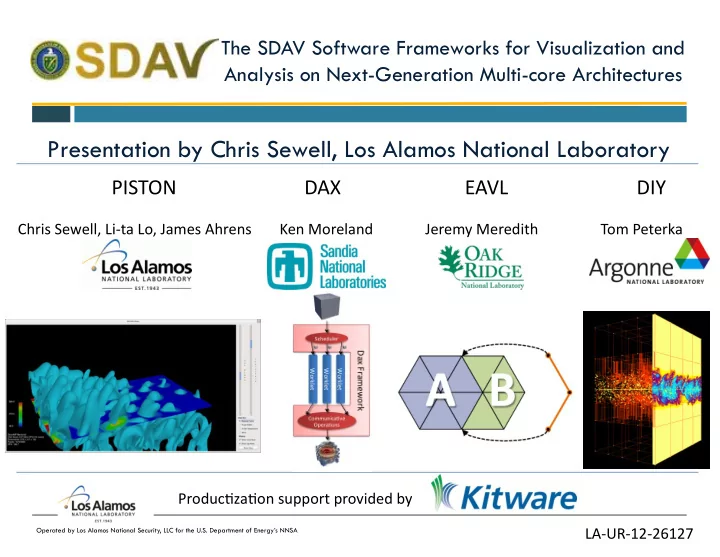
The SDAV Software Frameworks for Visualization and Analysis on Next-Generation Multi-core Architectures Presentation by Chris Sewell, Los Alamos National Laboratory


slide-1
SLIDE 1

Operated by Los Alamos National Security, LLC for the U.S. Department of Energy’s NNSA

LA-UR-11-11980

The SDAV Software Frameworks for Visualization and Analysis on Next-Generation Multi-core Architectures

Presentation by Chris Sewell, Los Alamos National Laboratory

¡ ¡ ¡ ¡ ¡ ¡ ¡ ¡ ¡ ¡ ¡ ¡ ¡ ¡ ¡ ¡ ¡ ¡ ¡PISTON ¡ ¡ ¡ ¡ ¡ ¡ ¡DAX ¡ ¡ ¡ ¡ ¡ ¡ ¡ ¡ ¡ ¡ ¡ ¡ ¡EAVL ¡ ¡ ¡ ¡ ¡ ¡ ¡ ¡ ¡ ¡ ¡ ¡ ¡ ¡ ¡ ¡ ¡ ¡ ¡ ¡ ¡ ¡ ¡ ¡ ¡ ¡DIY ¡

Chris ¡Sewell, ¡Li-­‑ta ¡Lo, ¡James ¡Ahrens ¡Ken ¡Moreland ¡ ¡ ¡ ¡ ¡Jeremy ¡Meredith ¡ ¡ ¡ ¡ ¡ ¡ ¡ ¡ ¡ ¡ ¡ ¡ ¡ ¡ ¡ ¡ ¡Tom ¡Peterka ¡ ProducFzaFon ¡support ¡provided ¡by ¡ ¡ LA-­‑UR-­‑12-­‑26127 ¡

slide-2
SLIDE 2

Operated by Los Alamos National Security, LLC for the U.S. Department of Energy’s NNSA

LA-UR-11-11980

SDAV VTK-m Frameworks

  • Objective: Enhance existing multi/many-core technologies in anticipation of in

situ analysis use cases with LCF codes

  • Benefit to scientists: These frameworks will make it easier for domain scientists’

simulation codes to take advantage of the parallelism available on a wide range of current and next-generation hardware architectures, especially with regards to visualization and analysis tasks

  • Projects
  • EAVL, Oak Ridge National Laboratory
  • DAX, Sandia National Laboratory
  • DIY, Argonne National Laboratory
  • PISTON, Los Alamos National Laboratory
  • Work on integrating these projects with VTK is on-going, in collaboration with

Kitware

LA-­‑UR-­‑12-­‑26127 ¡

slide-3
SLIDE 3

Operated by Los Alamos National Security, LLC for the U.S. Department of Energy’s NNSA

LA-UR-11-11980

EAVL: Extreme-scale Analysis and Visualization Library

  • Targets approaching hardware/software ecosystem:
  • Update traditional data model to handle modern simulation codes

and a wider range of data.

  • Investigate how an updated data and execution model can

achieve the necessary computational, I/O, and memory efficiency.

  • Explore methods for visualization algorithm developers to achieve

these efficiency gains and better support exascale architectures.

http://ft.ornl.gov/eavl https://github.com/jsmeredith/EAVL

LA-­‑UR-­‑12-­‑26127 ¡

slide-4
SLIDE 4

Operated by Los Alamos National Security, LLC for the U.S. Department of Energy’s NNSA

LA-UR-11-11980

An Efficient Data Model in EAVL

  • More efficiently support existing data types with more

flexible mesh structures

  • Better support non-physical and new types of data (high-
  • rder, high-dim)
  • Algorithms execute faster due to fewer data

transformations.

methane ¡ temperature ¡

H C H C H H 3

1 ¡2

LA-­‑UR-­‑12-­‑26127 ¡

slide-5
SLIDE 5

Operated by Los Alamos National Security, LLC for the U.S. Department of Energy’s NNSA

LA-UR-11-11980

ConnecFvity ¡ 3D ¡Point ¡Coordinates ¡ Cell ¡Fields ¡ Point ¡Fields ¡ Dimensions ¡ 3D ¡Point ¡Coordinates ¡ Cell ¡Fields ¡ Point ¡Fields ¡ Dimensions ¡ 3D ¡Axis ¡Coordinates ¡ Cell ¡Fields ¡ Point ¡Fields ¡

A Traditional Data Set Model

Data ¡Set ¡ RecFlinear ¡ Structured ¡ Unstructured ¡

LA-­‑UR-­‑12-­‑26127 ¡

slide-6
SLIDE 6

Operated by Los Alamos National Security, LLC for the U.S. Department of Energy’s NNSA

LA-UR-11-11980

Tree ¡ ConnecFvity ¡ Dimensions ¡ FieldName ¡ Component ¡ Name ¡ AssociaFon ¡ Values ¡ Cells[] ¡ Points[] ¡ Fields[] ¡

The EAVL Data Set Model

Data ¡Set ¡ CellSet ¡ Explicit ¡ Structured ¡ Coords ¡ Field ¡ QuadTree ¡

CellList ¡

Subset ¡

LA-­‑UR-­‑12-­‑26127 ¡

slide-7
SLIDE 7

Operated by Los Alamos National Security, LLC for the U.S. Department of Energy’s NNSA

LA-UR-11-11980

  • No problem-sized data modifications.
  • Interleaved and separated coordinates can be used simultaneously.

EAVL Example: Elevating a Structured Grid

LA-­‑UR-­‑12-­‑26127 ¡

slide-8
SLIDE 8

Operated by Los Alamos National Security, LLC for the U.S. Department of Energy’s NNSA

LA-UR-11-11980

Productive Algorithm Development in EAVL

struct PolyNormalFunctor { void operator()(float *x, float *y, float *z, float *n) { // get two adjacent edge vectors float ax = x[1]-x[0], ay = y[1]-y[0], az = z[1]-z[0]; float bx = x[2]-x[1], ay = y[2]-y[1], az = z[2]-z[1]; // calculate their cross product n[0] = ay*bz - az*by; n[1] = az*bx - ax*bz; n[2] = ax*by - ay*bx; } }; void FaceNormalFilter::Execute(...) { executor->AddOperation(new NodeToCellOp3(xcoord, ycoord, zcoord, outputnormals, inputcells, PolyNormalFunctor())); }

  • Topological iterators encapsulate data-parallel patterns
  • Functors provide optimized execution on CPU and GPU
  • Transparent heterogeneous memory space support

LA-­‑UR-­‑12-­‑26127 ¡

slide-9
SLIDE 9

Operated by Los Alamos National Security, LLC for the U.S. Department of Energy’s NNSA

LA-UR-11-11980

Dax: A Toolkit for Analysis and Visualization at Extreme Scale

  • “Worklets” ¡ease ¡design ¡in ¡serial, ¡scheduled ¡in ¡parallel ¡
  • Basic ¡visualizaFon ¡design ¡objects ¡(think ¡VTK ¡for ¡many-­‑core) ¡
  • CommunicaFve ¡operaFons ¡provide ¡neighborhood-­‑wide ¡
  • peraFons ¡without ¡exposing ¡read/write ¡hazards ¡

The ¡primiFves ¡necessary ¡to ¡design ¡finely-­‑threaded ¡algorithms ¡

Contour ¡with ¡subsequent ¡ vertex ¡welding, ¡coarsening, ¡ subdivision, ¡and ¡curvature ¡ esFmaFon ¡

hcp://daxtoolkit.org ¡

Streamlines ¡(preliminary ¡work) ¡ ¡Extracted ¡cells ¡ ¡of ¡large ¡gradient ¡ and ¡compacted ¡points ¡

LA-­‑UR-­‑12-­‑26127 ¡

slide-10
SLIDE 10

Operated by Los Alamos National Security, LLC for the U.S. Department of Energy’s NNSA

LA-UR-11-11980

Dax Framework

LA-­‑UR-­‑12-­‑26127 ¡

slide-11
SLIDE 11

Operated by Los Alamos National Security, LLC for the U.S. Department of Energy’s NNSA

LA-UR-11-11980

Example Dax Worklet

struct Normal: dax::exec::WorkletMapField

{ typedef void ControlSignature(Field(In),Field(Out)); typedef _2 ExecutionSignature(_1); template<typename T> T operator()(const T& coord) const { dax::Scalar dot = dax::dot(coord,coord); return coord * dax::math::RSqrt(dot); } };

LA-­‑UR-­‑12-­‑26127 ¡

slide-12
SLIDE 12

Operated by Los Alamos National Security, LLC for the U.S. Department of Energy’s NNSA

LA-UR-11-11980

Example Dax Control Code

int main() { using namespace dax::cont; std::vector<dax::Vector3> coords(10); for(int i=0; i < 10; i++) { const dax::Scalar x(1.0f + i); coords[i] = dax::Vector3(dax::math::Sin(x)/i+1, 1/(x*x), 0); } //make a dax array handle to the coordinates ArrayHandle<dax::Vector3> coordHandle = make_ArrayHandle(coords); //make a dax array handle to store the results ArrayHandle<dax::Vector3> normals; Schedule< > scheduler; //note two parameters passed to scheduler like the control // signature requests scheduler(Normal(), coordHandle, normals); std::vector<dax::Vector3> results(normals.GetNumberOfValues()); normals.CopyInto (results.begin()); }

LA-­‑UR-­‑12-­‑26127 ¡

slide-13
SLIDE 13

Operated by Los Alamos National Security, LLC for the U.S. Department of Energy’s NNSA

LA-UR-11-11980

DIY (Do-It-Yourself): Overview

13 ¡

DIY ¡usage ¡and ¡library ¡organizaFon ¡

Main ¡Ideas ¡and ¡ObjecFves ¡ ¡

  • ­‑Large-­‑scale ¡parallel ¡analysis ¡(visual ¡and ¡ ¡

numerical) ¡on ¡HPC ¡machines ¡

  • ­‑For ¡scienFsts, ¡visualizaFon ¡researchers, ¡tool ¡

builders ¡

  • ­‑In ¡situ, ¡coprocessing, ¡postprocessing ¡
  • ­‑Data-­‑parallel ¡problem ¡decomposiFon ¡
  • ­‑MPI ¡+ ¡threads ¡hybrid ¡parallelism ¡
  • ­‑Scalable ¡data ¡movement ¡algorithms ¡
  • ­‑Runs ¡on ¡Unix-­‑like ¡plahorms, ¡from ¡laptop ¡to ¡

supercomputer ¡(including ¡all ¡IBM ¡and ¡Cray ¡HPC ¡ leadership ¡machines) ¡ Benefits ¡

  • ­‑Researchers ¡can ¡focus ¡on ¡their ¡own ¡

work, ¡not ¡on ¡parallel ¡ infrastructure ¡

  • ­‑Analysis ¡applicaFons ¡can ¡be ¡custom ¡
  • ­‑Reuse ¡core ¡components ¡and ¡

algorithms ¡for ¡performance ¡and ¡ producFvity ¡ Features ¡ ¡

  • ­‑Parallel ¡I/O ¡to/from ¡storage ¡
  • ­‑Domain ¡decomposiFon ¡
  • ­‑Network ¡communicaFon ¡
  • ­‑Wricen ¡in ¡C++ ¡
  • ­‑C ¡bindings, ¡can ¡be ¡called ¡from ¡Fortran, ¡C, ¡C++ ¡
  • ­‑Autoconf ¡build ¡system ¡
  • ­‑Lightweight: ¡libdiv.a ¡800KB ¡
  • ­‑Maintainable: ¡~15K ¡lines ¡of ¡code ¡

LA-­‑UR-­‑12-­‑26127 ¡

slide-14
SLIDE 14

Operated by Los Alamos National Security, LLC for the U.S. Department of Energy’s NNSA

LA-UR-11-11980

ParFcle ¡tracing ¡of ¡thermal ¡hydraulics ¡flow ¡ InformaFon ¡entropy ¡analysis ¡of ¡astrophysics ¡ Morse-­‑Smale ¡complex ¡of ¡combusFon ¡ Voronoi ¡tessellaFon ¡of ¡cosmology ¡

DIY: Applications

LA-­‑UR-­‑12-­‑26127 ¡

slide-15
SLIDE 15

Operated by Los Alamos National Security, LLC for the U.S. Department of Energy’s NNSA

LA-UR-11-11980

PISTON: A Portable Data-Parallel Visualization and Analysis Framework

 Goal: Portability and performance for visualization and analysis operators on current and

next-generation supercomputers

 Main idea: Write operators using only data-parallel primitives (scan, reduce, etc.)  Requires architecture-specific optimizations for only for the small set of primitives  PISTON is built on top of NVIDIA’s Thrust Library

LA-­‑UR-­‑12-­‑26127 ¡

slide-16
SLIDE 16

Operated by Los Alamos National Security, LLC for the U.S. Department of Energy’s NNSA

LA-UR-11-11980

Motivation and Background

  • Current production visualization software does not take full advantage of acceleration

hardware and/or multi-core architecture

  • Research on accelerating visualization operations are mostly hardware-specific; few were

integrated in visualization software

  • Standards such as OpenCL may allow program to run cross-platform, but usually still requires

many architecture specific optimizations to run well

  • Data parallelism: independent processors performs the same task on different pieces of data

(see Blelloch, “Vector Models for Data Parallel Computing”)

  • Due to the massive data sizes we expect to be simulating we expect data parallelism to be a

good way to exploit parallelism on current and next generation architectures

  • Thrust is a NVidia C++ template library for CUDA. It can also target other backends such as

OpenMP , and allows you to program using an interface similar the C++ Standard Template Library (STL)

LA-­‑UR-­‑12-­‑26127 ¡

slide-17
SLIDE 17

Operated by Los Alamos National Security, LLC for the U.S. Department of Energy’s NNSA

LA-UR-11-11980

Videos of PISTON in Action

LA-­‑UR-­‑12-­‑26127 ¡

slide-18
SLIDE 18

Operated by Los Alamos National Security, LLC for the U.S. Department of Energy’s NNSA

LA-UR-11-11980

Brief Introduction to Data-Parallel Programming and Thrust

  • Sorts
  • Transforms
  • Reductions
  • Scans
  • Binary searches
  • Stream compactions
  • Scatters / gathers

Challenge: Write operators in terms of these primitives only Reward: Efficient, portable code ¡ What algorithms does Thrust provide? LA-­‑UR-­‑12-­‑26127 ¡

slide-19
SLIDE 19

Operated by Los Alamos National Security, LLC for the U.S. Department of Energy’s NNSA

LA-UR-11-11980

Isosurface with Marching Cube – the Naive Way

  • Classify all cells by transform
  • Use copy_if to compact valid cells.
  • For each valid cell, generate same

number of geometries with flags.

  • Use copy_if to do stream compaction
  • n vertices.
  • This approach is too slow, more than

50% of time was spent moving huge amount of data in global memory.

  • Can we avoid calling copy_if and

eliminate global memory movement?

LA-­‑UR-­‑12-­‑26127 ¡

slide-20
SLIDE 20

Operated by Los Alamos National Security, LLC for the U.S. Department of Energy’s NNSA

LA-UR-11-11980

Isosurface with Marching Cube – Optimization

  • Inspired by HistoPyramid
  • The filter is essentially a mapping

from input cell id to output vertex id

  • Is there a “reverse” mapping?
  • If there is a reverse mapping, the

filter can be very “lazy”

  • Given an output vertex id, we only

apply operations on the cell that would generate the vertex

  • Actually for a range of output vertex

ids

1 2 5 4 3 6

1 2 3 4 5 6 7 8 9

LA-­‑UR-­‑12-­‑26127 ¡

slide-21
SLIDE 21

Operated by Los Alamos National Security, LLC for the U.S. Department of Energy’s NNSA

LA-UR-11-11980

Isosurface with Marching Cubes Algorithm

LA-­‑UR-­‑12-­‑26127 ¡

slide-22
SLIDE 22

Operated by Los Alamos National Security, LLC for the U.S. Department of Energy’s NNSA

LA-UR-11-11980

Variations on Isosurface: Cut Surfaces and Threshold

  • Cut surface
  • Two scalar fields, one for generating

geometry (cut surface) the other for scalar interpolation

  • Less than 10 LOC change, negligible

performance impact to isosurface

  • One 1D interpolation per triangle vertex
  • Threshold
  • Classify cells, this time based on whether

value at each vertex falls within threshold range, then stream compact valid cells and generate geometry for valid cells

  • Additional pass of cell classification and

stream compaction to remove interior cells LA-­‑UR-­‑12-­‑26127 ¡

slide-23
SLIDE 23

Operated by Los Alamos National Security, LLC for the U.S. Department of Energy’s NNSA

LA-UR-11-11980

Additional Operators

Current prototypes

  • Glyphs
  • Halo finder for cosmology

simulations

  • “Boid” simulation (flocking

birds) LA-­‑UR-­‑12-­‑26127 ¡

Data ¡Structures ¡ ¡ ¡ ¡ ¡Graphs: ¡Neighbor ¡reducing, ¡distribuFng ¡excess ¡across ¡edges ¡ ¡ ¡ ¡ ¡Trees: ¡Leaffix ¡and ¡roohix ¡operaFons, ¡tree ¡manipulaFons ¡ ¡ ¡ ¡ ¡MulFdimensional ¡arrays ¡ ComputaFonal ¡Geometry ¡ ¡ ¡ ¡ ¡Generalized ¡binary ¡search ¡ ¡ ¡ ¡ ¡k-­‑D ¡tree ¡ ¡ ¡ ¡ ¡Closest ¡pair ¡ ¡ ¡ ¡ ¡Quickhull ¡ ¡ ¡ ¡ ¡Merge ¡Hull ¡ Graph ¡Algorithms ¡ ¡ ¡ ¡ ¡Minimum ¡spanning ¡tree ¡ ¡ ¡ ¡ ¡Maximum ¡flow ¡ ¡ ¡ ¡ ¡Maximal ¡independent ¡set ¡ Numerical ¡Algorithms ¡ ¡ ¡ ¡ ¡Matrix-­‑vector ¡mulFplicaFon ¡ ¡ ¡ ¡ ¡Linear-­‑systems ¡solver ¡ ¡ ¡ ¡ ¡Simplex ¡ ¡ ¡ ¡ ¡Outer ¡product ¡ ¡ ¡ ¡ ¡Sparse-­‑matrix ¡mulFplicaFon ¡

Blelloch’s “Vector Models for Data-Parallel Computing”

slide-24
SLIDE 24

Operated by Los Alamos National Security, LLC for the U.S. Department of Energy’s NNSA

LA-UR-11-11980

PISTON Performance

LA-­‑UR-­‑12-­‑26127 ¡

slide-25
SLIDE 25

Operated by Los Alamos National Security, LLC for the U.S. Department of Energy’s NNSA

LA-UR-11-11980

Integration with VTK and ParaView

  • Filters that use PISTON data types and algorithms integrated into VTK and ParaView
  • Utility filters interconvert between standard VTK data format and PISTON data format

(thrust device vectors)

  • Supports interop for on-card rendering

LA-­‑UR-­‑12-­‑26127 ¡

slide-26
SLIDE 26

Operated by Los Alamos National Security, LLC for the U.S. Department of Energy’s NNSA

LA-UR-11-11980

Extending PISTON’s Portability: Architectures

  • Prototype OpenCL backend
  • Successfully implemented isosurface and cut plane operators in

OpenCL with code almost identical to that used for the Thrust-based CUDA and OpenMP backends

  • With interop on AMD FirePro V7800, we can run at about 6 fps for

256^3 data set (2 fps without interop)

  • Renderer
  • Allows generation of images on systems without OpenGL
  • Rasterizing and ray-casting versions (using K-D Tree)
  • Inter-node parallelism
  • VTK Integration

Domain partitioned by VTK’s MPI libraries

Each node uses PISTON filters to compute results for its portion

  • f domain

Results combined by VTK’s compositors

  • Distributed implementations of Thrust primitives using MPI (in progress)

LA-­‑UR-­‑12-­‑26127 ¡

slide-27
SLIDE 27

Operated by Los Alamos National Security, LLC for the U.S. Department of Energy’s NNSA

LA-UR-11-11980

Extending PISTON’s Portability: Data Types

  • Curvilinear coordinates
  • Multiple layers of coordinate transformations
  • Due to kernel fusion, very little performance

impact

  • Unstructured / AMR data
  • Tetrahedralize uniform grid or unstructured grid

(e.g., AMR mesh)

  • Generate isosurface geometry based on look-up

table for tetrahedral cells

  • Next step: Develop PISTON operator to

tetrahedralize grids, and/or to compute isosurface directly on AMR grid

LA-­‑UR-­‑12-­‑26127 ¡

slide-28
SLIDE 28

Operated by Los Alamos National Security, LLC for the U.S. Department of Energy’s NNSA

LA-UR-11-11980

PISTON In-Situ

  • VPIC (Vector Particle in Cell) Kinetic Plasma Simulation Code
  • Implemented first version of an in-situ adapter based on

Paraview CoProcessing Library (Catalyst)

  • Three pipelines: vtkDataSetMapper, vtkContourFilter,

vtkPistonContour

  • CoGL
  • Stand-alone meso-scale simulation code developed as part of

the Exascale Co-Design Center for Materials in Extreme Environments

  • Studies pattern formation in ferroelastic materials using the

Ginzburg–Landau approach

  • Models cubic-to-tetragonal transitions under dynamic strain

loading

  • Simulation code and in-situ viz implemented using PISTON

Output ¡of ¡vtkDataSetMapper ¡and ¡vtkPistonContour ¡ filters ¡on ¡Hhydro ¡charge ¡density ¡at ¡one ¡Fmestep ¡of ¡ VPIC ¡simulaFon ¡

LA-­‑UR-­‑12-­‑26127 ¡

Strains ¡in ¡x,y,z ¡(above); ¡PISTON ¡in-­‑situ ¡ visualizaFon ¡(right) ¡

slide-29
SLIDE 29

Operated by Los Alamos National Security, LLC for the U.S. Department of Energy’s NNSA

LA-UR-11-11980

PISTON’s New Companion Project: PINION

  • A portable, data-parallel software framework for physics simulations
  • Data structures that allow scientists to program in a way that maps easily to the problem domain rather than

dealing directly with 1D host/device vectors

  • Operators that provide data-parallel implementations of analysis and computational functions often used in

physics simulations

  • Backends that optimize implementations of data parallel primitives for one or two emerging supercomputer

hardware architectures

slide-30
SLIDE 30

Operated by Los Alamos National Security, LLC for the U.S. Department of Energy’s NNSA

LA-UR-11-11980

PISTON Open-Source Release

  • Open-source release
  • Stable tarball: http://viz.lanl.gov/projects/PISTON.html
  • Current repository: https://github.com/losalamos/PISTON

LA-­‑UR-­‑12-­‑26127 ¡

slide-31
SLIDE 31

Operated by Los Alamos National Security, LLC for the U.S. Department of Energy’s NNSA

LA-UR-11-11980

Acknowledgments and Resources

  • http://sdav-scidac.org/
  • Panel at SC12: “Visualization Frameworks for Multi-Core and Many-Core

Architectures” Hank Childs, Jeremy Meredith, Patrick McCormick, Christopher Sewell, Kenneth Moreland

  • Wednesday, November 14, 3:30 – 5:00, 355-BC
  • The SciDAC Institute of Scalable Data Management, Analysis and

Visualization (SDAV) is funded by the DOE Office of Science through the Office of Advanced Scientific Computing Research.

  • SciDAC Institute Director: Arie Shoshani
  • Visualization Project Chairs: James Ahrens, Wes Bethel
  • Related PISTON projects also funded by ASC Program, ASCR, LANL LDRD

LA-­‑UR-­‑12-­‑26127 ¡