SLIDE 1
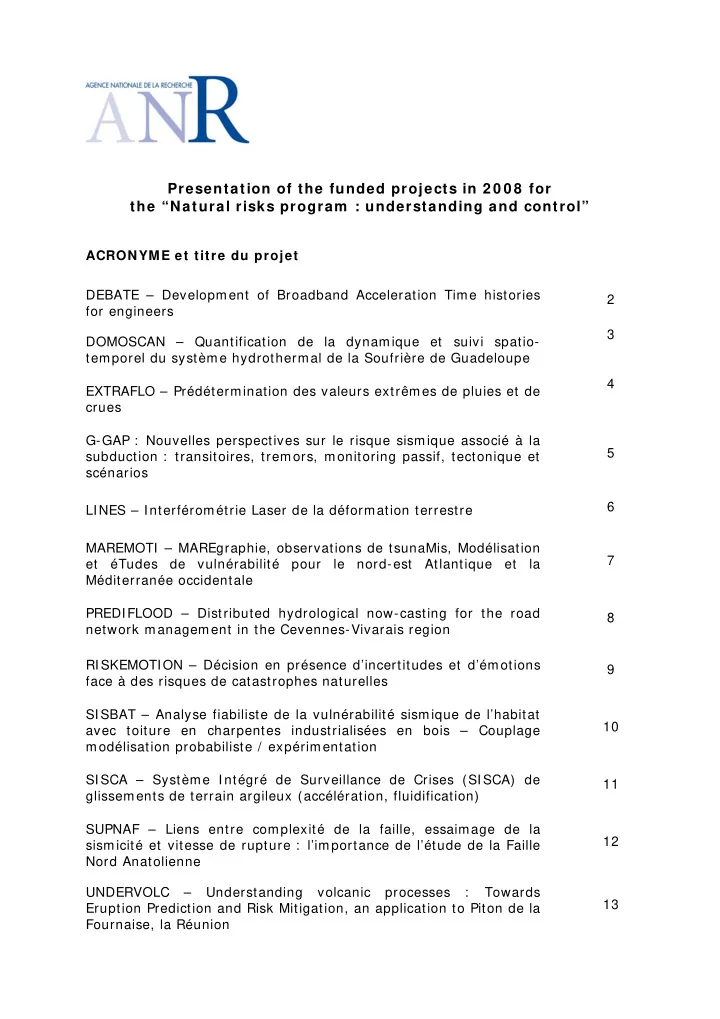
Presentation of the funded projects in 2 0 0 8 for the “Natural risks program : understanding and control”
ACRONYME et titre du projet DEBATE – Development of Broadband Acceleration Time histories for engineers 2 DOMOSCAN – Quantification de la dynamique et suivi spatio- temporel du système hydrothermal de la Soufrière de Guadeloupe 3 EXTRAFLO – Prédétermination des valeurs extrêmes de pluies et de crues 4 G-GAP : Nouvelles perspectives sur le risque sismique associé à la subduction : transitoires, tremors, monitoring passif, tectonique et scénarios 5 LINES – Interférométrie Laser de la déformation terrestre 6 MAREMOTI – MAREgraphie, observations de tsunaMis, Modélisation et éTudes de vulnérabilité pour le nord-est Atlantique et la Méditerranée occidentale 7 PREDIFLOOD – Distributed hydrological now-casting for the road network management in the Cevennes-Vivarais region 8 RISKEMOTION – Décision en présence d’incertitudes et d’émotions face à des risques de catastrophes naturelles 9 SISBAT – Analyse fiabiliste de la vulnérabilité sismique de l’habitat avec toiture en charpentes industrialisées en bois – Couplage modélisation probabiliste / expérimentation 10 SISCA – Système Intégré de Surveillance de Crises (SISCA) de glissements de terrain argileux (accélération, fluidification) 11 SUPNAF – Liens entre complexité de la faille, essaimage de la sismicité et vitesse de rupture : l’importance de l’étude de la Faille Nord Anatolienne 12 UNDERVOLC – Understanding volcanic processes : Towards Eruption Prediction and Risk Mitigation, an application to Piton de la Fournaise, la Réunion 13
SLIDE 2 2
Programme « Risques Naturels : Compréhension et Maîtrise »
Edition 2008 Titre du projet
DEBATE : Developm ent of Broadband Acceleration Tim e histories for engineers Résum é The proper way to reduce seismic risk is to construct earthquake resistant infrastructures. As infrastructure becomes more sophisticated and complex, such a system has become increasingly mechanically complex and non-
- linear. In the project DEBATE we approach this problem
from three perspectives: (1) The development of improved methods for the simulation of deterministic strong ground motion, which will be combined with a stochastic simulation at higher frequencies, (2) the nonlinear soil behaviour on strong ground motion, considering the reliability and variety
- f signals (broadband acceleration time histories) as well as
the consistency with our knowledge from the real data, and (3) the recent large earthquakes with acquired strong motion data in Japan and in Chile. Partenaires BRGM -ARN Laboratoire de Géologie de l’Ecole Normale Supérieure CNRS UMR8538 Géodynamique & Structure Institut de Radioprotection et Sûreté Nucléaire -IRSN - BERSSIN Coordinateur Monsieur Aochi Hideo H.Aochi@brgm.fr Aide de l’ANR 438 967 € Début et durée 01/ 02/ 2009 - 36 mois Référence ANR-08-RISK-001
SLIDE 3 3
Programme « Risques Naturels : Compréhension et Maîtrise »
Edition 2008 Titre du projet
DOMOSCAN : Quantification de la dynam ique et suivi spatio-tem porel du systèm e hydrotherm al de la Soufrière de Guadeloupe Résum é The Domoscan project involves a number of innovative imaging techniques and a set of original measurements on the active areas of the Soufrière Volcano to quantify the time and space evolution of the hydrothermal system. Institutions participating to the project are the LGIT from Grenoble and Chambery, the Institut de Physique du Globe from Paris, Geosciences Rennes and the University of Antilles and Guyane. A first part of the project is devoted to the construction of a structural tomographic model of the dome and of its basement. This involves an experimental task with new imaging methods (seismic imaging by noise correlation, cosmic muon tomography) and the modeling, inversion and integration of all available geophysical data in a common tomographic model. A second part of the project concerns the detailled study
the dynamics the hydrothermal system of La Soufrière. Numerous physical and chemical methods will be used to perform continuous measurements during at least two years on and around the most active areas located on the summit and at the base of the lava dome. Other more difficult measurements will be episodically performed during several days or weeks (e.g. wire mesh tomography, anemometry in acid gas). Partenaires LGIT - CNRS UMR5559 Laboratoire Géosciences Rennes CNRS UMR6118 IPGP CNRS UMR7154 LPAT MESR EA4098 Coordinateur Monsieur Olivier Coutant Olivier.Coutant@lgit.obs.ujf-grenoble.fr Aide de l’ANR 598 387€ Début et durée 01/ 02/ 2009 - 36 mois Référence ANR-08-RISK-002
SLIDE 4
4
Programme « Risques Naturels : Compréhension et Maîtrise »
Edition 2008 Titre du projet
EXTRAFLO : Prédéterm ination des valeurs extrêm es de pluies et de crues Résum é The aim of this project is to compare design methods for extreme rainfall and flood estimation, in order to know which method to use regarding the available data, the hydrological characteristics of the case study, and the target accuracy level (which depends on the flooding stakes). The innovative aspects of such project is to deal with a large range of approaches: extreme value theory, regional analysis, use of historical data, geomorphological and paleo-hydrological studies, rainfall stochastic generator coupled with rainfall-runoff models, and to stress on the need of data sets for validation. Partenaires Cemagref Meteo France Hydrosciences Montpellier EDF Géosciences Montpellier CNRS UMR5243 Coordinateur Monsieur Michel Lang michel.lang@cemagref.fr Aide de l’ANR 650 000 € Début et durée 01/ 02/ 2009 - 48 mois Référence ANR-08-RISK-003
SLIDE 5 5
Programme « Risques Naturels : Compréhension et Maîtrise »
Edition 2008 Titre du projet
G-GAP : Nouvelles perspectives sur le risque sism ique associé à la subduction : transitoires, trem ors, m onitoring passif, tectonique et scénarios. Résum é Our proposal is centred on fundamental changes of perspective for seismology and seismic hazard evaluation. ETS (Episodic Tremors and slip) is certainly the most important discovery of new phenomenon of the last 50 years in seismology. It is a new and rapidly evolving
- subject. We propose to study the implications of ETS to the
seismic hazard evaluation by putting together the most efficient techniques of analysis in seismology, geodesy and tectonics in a comprehensive study. In the same time we developed new approaches to image and monitor the Earth by using continuous recordings of ambient noise. We will apply these methods to the imaging of the basins responsible of huge site effects in Mexico City. We will evaluate the strong ground motion expected from subduction and shallow earthquake both from a numerical and empirical point of view. Partenaires LGIT - CNRS UMR5559 IPGP - CNRS UMR7154 INSTITUT DE PHYSIQUE DU GLOBE DE STRASBOURG CNRS UMR7516 Coordinateur Monsieur Michel Campillo Michel.Campillo@ujf-grenoble.fr Aide de l’ANR 499 935 € Début et durée 01/ 02/ 2009 - 48 mois Référence ANR-08-RISK-004
SLIDE 6 6
Programme « Risques Naturels : Compréhension et Maîtrise »
Edition 2008 Titre du projet
LI NES : I nterférom étrie Laser de la déform ation terrestre Résum é Measurements of strain and vibrations due to seismic and volcanic processes are mandatory for the understanding and the monitoring of the behaviour of these systems. The robustness of strain and motion detection is primary linked to measurement accuracy, but also to the number and repartition of instrument. This implies that instrument cost and maintenance are essential for the development of
- networks. On the basis of existing prototype sensors, we
aim to develop seismometers and tilt meters using an interferometric device. Laser source and fringe analysis are connected to the mechanical sensor with long optic fibber. We will validate prototypes on underground laboratories, industrial sites and also pilot sites on earthquakes prone areas and volcanoes. Partenaires Géosciences Montpellier CNRS UMR5243 Laboratoire d'optoélectronique pour les systèmes embarqués -ENSEEIHT-LOSE IPGP - CNRS UMR7154 GSII-ESEO Observatoire Côte d'Azur -OCA Coordinateur Monsieur Jean Chery jean@gm.univ-montp2.fr Aide de l’ANR 554 307 € Début et durée 01/ 02/ 2009 - 36 mois Référence ANR-08-RISK-012
SLIDE 7 7
Programme « Risques Naturels : Compréhension et Maîtrise »
Edition 2008 Titre du projet
MAREMOTI : MAREgraphie, observations de tsunaMis, m Odélisation et éTudes de vulnérabI lité pour le nord- est Atlantique et la Méditerranée occidentale Résum é The MAREMOTI project gathers 9 French and 1 Portuguese partners involved in the tsunami science. Five main
- bjectives are addressed: (1) the synthesis of tide gauge
- bservations in order to build comprehensive databases,
(2) the field investigation for historical and paleo tsunami
- bservations (especially in the Balearic and the NE Atlantic
coast), (3) the development and use of numerical tools for the hazard assessment and mapping, and towards a future warning system, (4) the study
poorly known tsunamigenic earthquake sources, and (5) the vulnerability
- assessment. The end-users are the communes of Cannes
and Mandelieu where detailed studies will be conducted, as well as the “Centre Polynésien de Prévention des Tsunamis” (CPPT) in Tahiti (Polynesian Tsunami Warning System). Partenaires CEA Département Analyse Surveillance Environnement Service Hydrographique et Océanographique de la Marine Littoral Environnement et Sociétés - CNRS UMR6250 Noveltis Geolab Geodynamique des milieux naturels et anthropises CNRS UMR6042 Laboratoire de Géographie Physique CNRS UMR8591 Geosciences Consultants Gestion des sociétés des territoires et des risques -MESR EA3766 Laboratoire de Géologie de l’Ecole Normale Supérieure CNRS UMR8538 Coordinateur Madame Hélène Hébert helene.hebert@cea.fr Aide de l’ANR 762 754 € Début et durée 01/ 02/ 2009 - 36 mois Référence ANR-08-RISK-005
SLIDE 8
8
Programme « Risques Naturels : Compréhension et Maîtrise »
Edition 2008 Titre du projet
PREDI FLOOD : Distributed hydrological now -casting for the road netw ork m anagem ent in the Cevennes- Vivarais region Résum é PrediFlood aims at developing a pre-operational system for the now-casting of road inundations during intense rainfall events in the Cevennes-Vivarais region (France). These forecasts will consist in maps, updated every 15 minutes, indicating, over the whole considered region, the points of the road system likely to be flooded with a colour code indicating the risk level. Such a monitoring and forecasting tool is necessary for the rescue services to define their intervention priorities, to select the safest access or evacuation routes to or from the most affected areas and to stop the traffic on roads at risk. Partenaires LCPC Laboratoire d'étude des transferts en hydrologie et environnement CNRS UMR5564 Laboratoire GAME CNRS URA1357 Cemagref Laboratoire PACTE - CNRS UMR5194 Coordinateur Monsieur Eric Gaume gaume@lcpc.fr Aide de l’ANR 650 000 € Début et durée 01/ 02/ 2009 - 36 mois Référence ANR-08-RISK-006
SLIDE 9 9
Programme « Risques Naturels : Compréhension et Maîtrise »
Edition 2008 Titre du projet
RI SKEMOTI ON : Décision en présence d’incertitude et d’ém otions face à des risques de catastrophes naturelles Résum é Decision models that rely on the Expected Utility framework cannot properly explain choices involving natural risks, which are characterized by very small probabilities but huge
- losses. We aim to adapt an alternative theory relying on a
different topology to rationalize these choices, and implement experiments to enrich this work in four directions: the variation of the levels of catastrophe, the elicitation of willingness to pay to reduce the exposure / the consequences of catastrophic events, the introduction of actual potentially unpleasant outcomes that generate emotions (disgust or unpleasant feelings, … ) and the study
- f repeated choices among risky outcomes. This project
should favour rational public orientations to reduce the society vulnerability to catastrophic events. Partenaires GREQAM - CNRS UMR6579 Centre d’Economie de la Sorbonne - CNRS UMR8174 Coordinateur Monsieur Olivier Chanel
Aide de l’ANR 88 000€ Début et durée 01/ 02/ 2009 - 36 mois Référence ANR-08-RISK-007
SLIDE 10 10
Programme « Risques Naturels : Compréhension et Maîtrise »
Edition 2008 Titre du projet
SI SBAT: Analyse fiabiliste de la vulnérabilité sism ique de l'habitat avec toiture en charpentes industrialisées en bois
m odélisation probabiliste / expérim entation Résum é In a context where the prevention of the seismic risk becomes a national concern, this project deals with the development of a tool for reliability analysis of the seismic behaviour of residential building with roofs made of prefabricated timber trusses, constructions which represent a significant part of the existing and future French market. The project proposes to couple:
- stochastic finite element method which will make it
possible to quantify the sensitivity of mechanical response
- f the frame to the variability of random parameters such
as the seismic action and the properties of the components,
- with an experimental approach to identify the dynamic
behaviour of several input parameters of the numerical tool such as the connections and wood frames. By improving scientific knowledge of the global behaviour of the houses subjected to seismic actions, the project aims to conceive and design these structures with a target safety level at lower cost. Partenaires Institut Technologique FCBA Centre Scientifique et Technique du Bâtiment -CSTB CEA BRGM/ Service Aménagement et Risques Naturels Sols, Solides, Structures, Risques (3S - R) - CNRS UMR5521 Laboratoire de Mecanique et Ingenieries - MESR-EA3867 Laboratoire de Mecanique et Technologie - CNRS UMR8535 Coordinateur Madame Carole Faye carole.faye@fcba.fr Aide de l’ANR 748 068 € Début et durée 01/ 02/ 2009 - 48 mois Référence ANR-08-RISK-008
SLIDE 11 11
Programme « Risques Naturels : Compréhension et Maîtrise »
Edition 2008 Titre du projet
SI SCA : Systèm e I ntégré de Surveillance de Crises ( SI SCA) de glissem ents de terrain argileux ( accélération, fluidification) Résum é Marly clay landslides are generally 'slow' (a few cm to dm / year), but they may: (1) suffer sudden accelerations under the action of various triggers or (2) all or a part of the marly-clay mass could fluid under some conditions to trigger viscous mud flow or debris flows. Project SISCA will develop a methodology (1) for identification and crisis precursors analysis (acceleration, fluidizing) and hydro- mechanisms understanding, (2) in-situ field monitoring related to precursors testing new ' monitoring and reversal data methods for these precursors survey, and (3) near real-time slope stability numerical modelling to propose a landslide forecast model may include a decision tree or any
- ther decision support tool (ie changing measurements
frequency, system changing, etc.). Partenaires LETG CNRS UMR6554 BRGM INSTITUT DE PHYSIQUE DU GLOBE DE STRASBOURG CNRS UMR7516 LGIT - CNRS UMR5559 Laboratoire d'Hydrogéologie - UMR EMMAH 1114 LCPC Coordinateur Monsieur Olivier Maquaire
- livier.maquaire@unicaen.fr
Aide de l’ANR 528 746 € Début et durée 01/ 02/ 2009 - 36 mois Référence ANR-08-RISK-009
SLIDE 12 12
Programme « Risques Naturels : Compréhension et Maîtrise »
Edition 2008 Titre du projet
SUPNAF : Liens entre com plexité de la faille, essaim age de la sism icité et vitesse de rupture : l’im portance de l’étude de la Faille Nord Anatolienne Résum é Are there two types of faults: one having a simple structure (made up of a few linear segments with small offsets in between), exhibiting little seismicity, except near the zone
- f nucleation (precursory events) and a « fast » (i.e. super-
shear) rupture speed, with possibility of slip partitioning, and the other one having a complex (multi-scale) structure, high seismicity (particularly aftershocks) and a « slow » (i.e. sub-Rayleigh) rupture velocity? This is the problem which we propose to address in this project, taking as
- bject of study the western part of the North Anatolian
Fault (from the Marmara see to the region of Ismit-Duzce, epicenters of the 1999 earthquakes). The subject if of importance because the city of Istanbul is particularly at risk. Partenaires INSTITUT DE PHYSIQUE DU GLOBE DE STRASBOURG CNRS UMR7516 LGIT - CNRS UMR5559 BRGM Coordinateur Monsieur Jean Schmittbuhl Jean.Schmittbuhl@eost.u-strasbg.fr Aide de l’ANR 277 980 € Début et durée 01/ 02/ 2009 - 36 mois Référence ANR-08-RISK-010
SLIDE 13
13
Programme « Risques Naturels : Compréhension et Maîtrise »
Edition 2008 Titre du projet
UNDERVOLC: Understanding volcanic processes : Tow ards Eruption Prediction and Risk Mitigation, an application to Piton de la Fournaise, la Reunion Résum é UnderVolc is a joint project between IPGP (Paris and OVPF), LGIT, BRGM and Parc National de la Réunion. Our goal is to improve our understanding of volcanic processes such as mechanism of volcanic unrest, dike propagation, temporal evolution of eruptions, rock falls linked to volcanic activity. Our goal is also to improve the forecasting of volcanic eruptions and volcanic hazard mitigation. We will focus on the active (1 eruption per year on average) Piton de la Fournaise volcano on La Réunion island. During this 3 year project, we will deploy a broadband seismological network as well as a GPS network, both complementary to the permanent network ran by the Piton de la Fournaise Volcanological Observatory (OVPF). Partenaires IPGP - CNRS UMR7154 LGIT - CNRS UMR5559 BRGM Coordinateur Monsieur Florent Brenguier fbrengui@ipgp.jussieu.fr Aide de l’ANR 685 000 € Début et durée 01/ 02/ 2009 - 48 mois Référence ANR-08-RISK-011