SLIDE 1 1
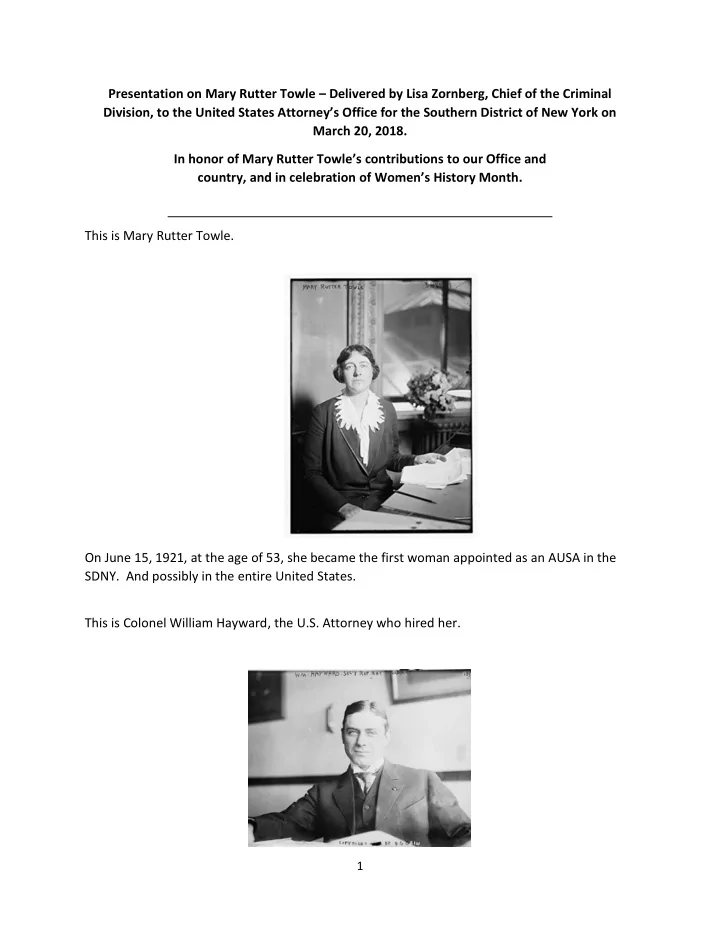
Presentation on Mary Rutter Towle – Delivered by Lisa Zornberg, Chief of the Criminal Division, to the United States Attorney’s Office for the Southern District of New York on March 20, 2018. In honor of Mary Rutter Towle’s contributions to our Office and country, and in celebration of Women’s History Month. This is Mary Rutter Towle. On June 15, 1921, at the age of 53, she became the first woman appointed as an AUSA in the
- SDNY. And possibly in the entire United States.
This is Colonel William Hayward, the U.S. Attorney who hired her.
SLIDE 2
2
He was sworn in as U.S. Attorney on June 4, 1921. For over 100 years before him, this Office had never employed a woman lawyer. Hayward made hiring Mary Rutter Towle one of his very first acts of Office. The press was invited to attend the historic swearing in. Here is the headline that appeared in the New York Times the following day, on June 16, 1921: The article reports the following exchange that took place at the swearing in: How did Mary Rutter Towle and William Hayward both get here? To our Office? Well, not to this building exactly, but to an equally decrepit building, I assure you. Today, I would like to share with you their extraordinary, trailblazing stories. These are our stories and we should celebrate them. Mary Rutter Towle Let’s begin with Mary. Mary Rutter Towle was not a native New Yorker. She was born in Massachusetts in 1867. Her father was a lawyer. And she was damn smart.
SLIDE 3
3
She graduated from Bryn Mawr in 1899 with a degree in political science and philosophy. Mary then proceeded to get a Master’s degree in Physics and Chemistry from Radcliffe in 1901. She spent the next several years teaching high school English and History. Then, in 1908, Mary Rutter Towle arrived in New York City – to attend NYU Law School. Let me pause here. Being an educated, ambitious woman in New York City in 1908 was both an exciting and daunting prospect. There was a community of intelligent women in New York City looking to push boundaries. Educational opportunities were becoming more available to women. NYU Law School – at the forefront – had opened its doors to women in 1890. In contrast, Columbia Law School’s dean, Harlan Stone, promised to admit women only “over his dead body.” Harvard Law School? – fuggedaboutit. It did not admit its first woman student until 1950. Consider also that, in 1908, when Mary Rutter Towle entered NYU Law school, women still did not have the right to vote. And the legal profession – one of the most conservative professions there is – was largely closed off to women. In New York State, to practice law one first needed to complete a year clerkship (an apprenticeship) with a law practice. The problem was that the vast majority of law practices in New York and elsewhere would not hire women. So when Mary entered law school, she could get a law degree, but she couldn’t vote and she might not ever be able to get a clerkship or a job. As one historian has observed, there were a lot of “restless women” in the New York in the early 20th century. And with that restlessness came energy.
SLIDE 4
4
New York City was THE place to be a woman’s rights activist in the early 20th century. The few practicing female lawyers in New York starting hanging up their own shingles – opening their own law practices—to enable women coming out of law school to do clerkships and gain entry to the bar. Women supporting women. A proposition that remains essential today. Mary graduated law school and did her clerkship with Bertha Rembaugh, a New York attorney who was also a leader of the women’s suffragist movement. Mary was admitted to the New York bar in 1912. She and Bertha became law partners, lifelong friends and fellow activists. Both were active in the Republican Party. And in May 1912 – the same year Mary was admitted to the bar – New York City hosted one of the largest suffrage parades of the time. 20,000 women marching down Fifth Avenue. Parades were a new bold tactic in the fight for women’s rights. And here is our Mary in the “Night Parade” of November 1912 – another suffrage march:
SLIDE 5
5
Mary is on the left. She and her fellow suffragists are standing on a building rooftop holding lanterns. Mary Rutter Towle went on to serve as general counsel for the National American Woman Suffrage Association – the national organization that resurrected the lobby for a federal suffrage amendment. You may know the organization by its current name, the League of Women Voters. She was at the very heart of the legal and political fight to get women the right to vote. Then World War I happened.
SLIDE 6
6
The United States entered the War in 1917. Women across the country stepped up to support the War effort, taking on roles previously thought appropriate only for men. It had a transformative effect on the fight for suffrage. When WWI ended in 1919, the possibilities for women felt different. President Woodrow Wilson supported the vote as a “reward to women for their war work.” Here is how Edith Wharton described the transformation of the War on the suffrage movement: “What had seemed unalterable rules of conduct became … as quaintly arbitrary as the domestic rites of the Pharoahs.” -- Edith Wharton On August 18, 1920, the 19th Amendment passed – FINALLY giving women the right to vote.
SLIDE 7
7
Mary Rutter Towle must have been triumphant, elated, gratified …. and ready to find her next mountain to climb. William Hayward Now let’s talk about William Hayward. Another New York transplant.
SLIDE 8 8
Hayward was born in Nebraska, 1877. He was a local football star. He graduated from the University of Nebraska College and the University of Nebraska Law School. He fought in the Spanish-American war, rising to rank of Colonial. And then he entered Republic politics. His various political appointments included Secretary of the Republic National Committee. In 2010, Hayward ran for Congress and lost. Disappointed, he and his wife traveled the world (to Japan, China, Europe), and like all world travelers, he naturally found his way to New York. Hayward arrived in New York City in 1911. In 1913, he became an Assistant District Attorney in the Manhattan DA’s Office. Charles Whitman was the District Attorney for New York County at the time. Within a year, Hayward was Whitman’s first assistant, and in 1914, Hayward went on to serve as legal counsel and campaign manager to Whitman, who ran for the New York governorship and won. And then World War I broke out. What did William Hayward do? He discussed with Governor Whitman forming an all-black regiment of the New York National
- Guard. The armed forces of the United States were strictly segregated at that time.
In 1916, Governor Whitman appointed Hayward – then 39 years old – as colonel of the all- black, all-volunteer New York National Guard regiment.
SLIDE 9 9
Hayward recruited, organized and trained an estimated 3,000 black men – all volunteers – 70%
- f them from Harlem – in his regiment.
The regiment came to be famously known as the Harlem Hellfighters. They departed for France, to go fight the Germans, in December 1917. At the time of their departure, New York City threw a farewell parade for the New York National Guard – but this all-black regiment was excluded because of their race, over Hayward’s
protest.
And when the Harlem Hellfighters got to France, despite Hayward’s personal appeal, the U.S. Commander of the American Armed Forces refused to send the regiment into combat, stern in the belief that black troops should provide only non-combat labor. The Hellfighters wanted to see combat. Undeterred, Colonel Hayward approached the French Marshal – head of the French armed forces during WWI – with a request that the Hellfighters fight with the French. The French gladly agreed and the Harlem Hellfighters fought alongside the French – carrying French guns and wearing American uniforms. The Harlem Hellfighters saw more combat than any other American regiment in the entire war – 191 days. They fought with exceptional valor. The stuff of history. Hayward had also arranged for the regiment to be accompanied by an all-black band of over 40
- musicians. The band toured France, playing for civilian and military audiences, endearing the
French to American Jazz.
SLIDE 10
10
Following the War, the French Government awarded the Harlem Hellfighters and Hayward, their commander, with France’s Medal of the Legion of Honor – the Croix de Guerre. And when the Harlem Hellfighters returned from the War in 1919, they received a much warmer reception. Now, New York City threw a victory parade just for them, attended by millions of New Yorkers of every race.
SLIDE 11 11
Hayward led his regiment from lower Manhattan to Harlem while still recovering from a leg
- wound. They marched in a tight “French phalanx” formation, sixteen-men across. It is said,
however, that once they arrived at Harlem, the formation narrowed its columns so that every
- bserver could see every soldier.
The Office in 1921 Following the War, now back in New York, William Hayward was appointed to be U.S. Attorney
- f our Office in June 1921, by President Warren Harding.
Within two weeks of his own appointment, Hayward appointed Mary Rutter Towle – our suffragist, then 53 years old – as an AUSA. According to Bryn Mawr records, Towle was the first female AUSA in the nation. Then, the following month, on July 6, 1921, Hayward appointed the first African-American AUSA in the Southern District of New York: James C. Thomas, Jr.
SLIDE 12
12
Thomas was graduate of Cornell Law School who had fought in the Harlem Hellfighters. And by the end of 1921 – in December of that year – U.S. Attorney Hayward hired Susan Brandeis as a SAUSA.
SLIDE 13
13
Susan Brandeis, was a graduate of University of Chicago Law School. No one would hire her – even though her father, Louis Brandeis, was then an Associate Justice on the Supreme Court. William Hayward hired her. These three – Towle, Thomas and Brandies – were among the 38 AUSAs and 3 SAUSAs who served our Office at the time. Where did they all work? Here. In the Old Post Office – located at Broadway and Park Row. It was a universally reviled building that housed the federal court, the U.S. Attorney’s Office and the Post Office. Here is how the building was described – “Never was there a dirtier, noisier, uglier, more uncomfortable or more crowded building than this.” Clearly, whoever said this had not imagined 1 Saint Andrew’s Plaza. Our Office continued to work out of the Old Post Office until 1937, when the new federal courthouse at Foley Square opened its doors. Our Office was then located in the Foley Square courthouse until the 1970’s, when our Office to its present cathedral, 1 St. Andrew’s Plaza. So what happened to them all? AUSA James Thomas, Jr., served 6 years in the Office, doing criminal work, and then went into politics, where he was elected New York State Assemblyman from the Bronx. SAUSA Susan Brandeis served in the Office for about three years, handling anti-trust cases, before she left the Office for private practice. She went on to become the first woman ever to argue before the Supreme Court, in 1925. She got her start here, in the SDNY. William Hayward served for four years as our U.S. Attorney, during which time he vigorously prosecuted bootlegger cases – prohibition having been passed just before he took office.
SLIDE 14
14
But, ultimately, Hayward spoke out against prohibition laws. By 1924, he bemoaned “the growing revolt against law enforcement” because, under prohibition, “respectable citizens had become accomplices of a lot of rotten criminals in order to get a drink.” Hayward left the Office in 1925, turning over the reins to Emory Buckner. Hayward went into private practice, remained active in Republican politics, and later led world expeditions for the Museum of Natural History and the Bronx Zoo. Mary Rutter Towle? She stayed. She remained a dedicated SDNY AUSA for 16 years. She handled all manner of civil cases. Customs fraud cases. Admiralty cases. Immigration. And possibly the first environmental case – when she took defendants to trial to stop them from dumping of oil in New York Harbor. Mary Rutter Towle left our Office at the age of 70. I think I know why Mary sought to become an AUSA, and why she stayed with our Office for 16 years. Because she loved the law, she loved making a contribution to her country – to this great American experiment of ours – and because here she found important work to do. As I near the end of this talk, I want to share with you a little of Mary Rutter Towle in her own words. Only 3 days into her new position as an AUSA, a bill was proposed in Congress to ban women from smoking in public places – on the ground that such conduct by women was immoral. A New York Times reporter reached out to Mary Rutter Towle for her views. (Mind you, this predated our Office policy against AUSAs speaking directly to the press!) Here is what Mary said:
SLIDE 15 15
“What possible moral code is involved? The important question is whether any sex legislation is possible now that women are equal citizens. . . Woman has passed the mass stage where she can be lumped as able or not able to do certain kinds of work, and where legislation can define her function. Only experimentation can define now where she belongs. She continued: I myself am being tried out on my present job. I’ve been in office only three days, so the community will hardly be ready to pass judgment. Like every man
- n the job it is a cold-blooded business of making good. When a certain number
- f women have made good in a given profession, then the bars go down to the
rest of women– each to make good or fail as an individual in her turn. Turning back to the subject of smoking: …And truthfully it can be said that woman has made good in the diversion of
- smoking. Maybe she was a bit self-conscious at the start – well, so, too, is each
male fledgling on his first cigarette.” Mary Rutter Towle, for the record, did not smoke—and neither should you. Mary Rutter Towle has no descendants. She never married and had no children. But when I look around this room, I know that her spirit is alive and well, right here, in the Southern District of New York.
SLIDE 16 16
Geoff, I want to thank you for warmly embracing the suggestion that we honor Mary Rutter Towle, today and always, by permanently installing a photograph of her in our building. And I want to end by sharing with you the working draft of the inscription that will appear next to her photograph. Mary Rutter Towle
- Trailblazer. Suffragist. AUSA.
Sworn in June 15, 1921 – The first woman to become an SDNY AUSA. “I expect her to do a regular lawyer’s work,” said U.S. Attorney William Hayward, in appointing her. “That,” Miss Towle responded, “is exactly what I want to do.” Thank you for attending.